Move Twins: How Sui and Aptos Are Challenging the Blockchain Landscape?
TechFlow Selected TechFlow Selected
Move Twins: How Sui and Aptos Are Challenging the Blockchain Landscape?
At a time when modular EVM blockchains flood the market, Move is actually a bold attempt.
 Navigating Web3 tides with focused insights
Author: YBB Capital Researcher Zeke
Preface
Recently, the market has grown increasingly cold, and many industry OGs have begun questioning the very purpose of the sector. Let me share some personal thoughts. I've always believed that many past grand visions were not truly "disproven"—they simply lacked logical consistency from the start. Non-financial DApps often try to mask subpar products by overemphasizing decentralization. The reality is, they ask me to stop trusting Google, Twitter, or YouTube, and instead trust their multisig wallets and single-server setups as secure. Many visions weren't disproven—they were never properly validated in the first place. I still believe that even if most of these visions aren't as grandiose, they carry meaning and may just need sufficient underlying infrastructure to thrive. Ultimately, achieving either full decentralization or Web2-level user experience would be a win. Just as TON and Solana were once dismissed, they are now steadily catching up with established leaders. Innovative Layer 1 blockchains that support applications drive progress in every cycle. Today, we’ll explore a long-overlooked category of blockchain: the Move ecosystem.
1. Move
The Move programming language originated from Meta’s abandoned project Diem (originally called Libra), which aimed to create a more stable, regulated stablecoin as the foundation for its metaverse vision. However, the project faced strong global regulatory opposition and sustained pressure. Regulators feared Diem's scale and Facebook’s massive user base could threaten financial stability, monetary policy, and data privacy. Under pressure led by the Biden administration, Meta ultimately had to abandon the Diem project.
Luckily, Diem’s core wasn’t entirely lost. Various factions spun off from the original team continued developing Move, evolving into today’s “Move twins”: Sui and Aptos. Other projects such as Linera (a Rust-based chain inspired by Move) and Movement, currently gaining momentum, are also emerging.
Why has this remnant of a failed project generated so much interest? As a response from a top Web2 tech giant to blockchain programming languages, Move’s technical depth speaks for itself. Its design reflects deep lessons learned from existing blockchain languages—especially Solidity—with a focus on performance and security. Move was specifically engineered to provide a type system tailored for asset management and access control. In my view, its strengths can be summarized in three key points:
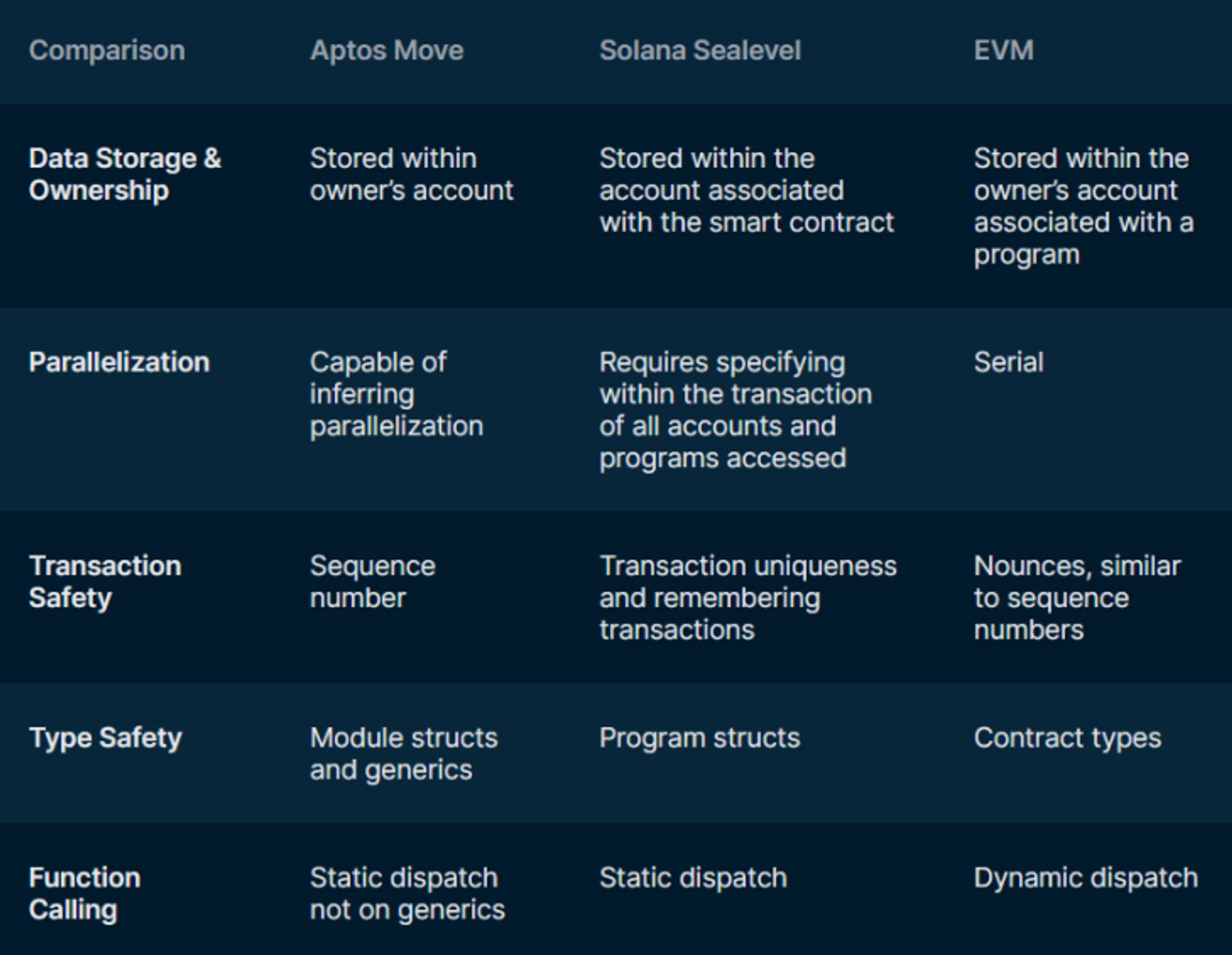
● Security: Security is foundational to Move’s design. It employs static type checking and resource management to prevent common vulnerabilities like overflow errors and reentrancy attacks. Compared to other virtual machines, Move supports multiple advanced security features—refer to the Nansen comparison chart below.
● Composability: Move supports modularity and composability, enabling developers to easily build and combine different smart contracts to create more complex applications.
● Performance: The Move Virtual Machine is optimized—with support for parallel execution, memory management, and compiler optimizations—to efficiently execute smart contracts, improving transaction speed and throughput.
In an era dominated by modular EVM chains, Move represents a bold experiment. While you might have seen similar claims from other blockchain projects, I recommend hands-on experience to truly grasp what these words mean.
2. Sui

2.1 Architecture
One of the twin stars, Sui, has been criticized since launch due to its airdrop mechanics and token release schedule. But setting those aside, the project itself stands out—particularly in performance and user experience, especially for gaming. This success stems from architectural innovations designed for mainstream adoption. Here’s a brief overview of Sui’s key architectural components:
1. Object Storage Model: This is the core innovation of Sui’s adaptation of Move. Data is stored as independent objects, each with a unique identifier. Unlike traditional databases with fixed schemas, this model supports diverse data types—text, images, video, audio—and enables parallel execution and horizontal scaling (adding nodes to increase storage). Sui’s entire architecture revolves around this model.
2. Causal Ordering: Ensures transactions are executed in causal order, preventing data conflicts and inconsistencies. This allows Sui to handle high volumes of concurrent transactions while maintaining data consistency.
3. Narwhal and Bullshark Consensus Engine: Sui uses Narwhal for transaction ordering and validation. Each node maintains a local mempool, orders transactions based on causality, and broadcasts them, ensuring all nodes agree on a consistent transaction sequence. Bullshark then receives this ordered list, votes on it, and applies Byzantine Fault Tolerance (BFT) consensus to achieve final agreement across all nodes.
4. Sui Move: An extension of the Move language, adding new capabilities such as native NFT support, enhanced asset management, and flexible data storage.
5. Sui Framework: A comprehensive suite of tools and libraries—including the Sui Wallet, Sui SDK, and Sui CLI—that help developers quickly build and deploy applications.
Sui’s architecture enables high concurrency, low fees, and strong security. Combined with Sui Move and the Sui Framework, developers gain powerful tools to build secure, scalable, and user-friendly applications.
2.2 Consensus
Sui uses a consensus mechanism called Mysticeti—an optimized BFT protocol designed for low latency and high throughput.
Mysticeti allows multiple validators to propose blocks in parallel, maximizing network bandwidth and enhancing censorship resistance. The protocol achieves finality in just three message rounds—the same as pBFT and matching theoretical minimums. Its commit rule enables parallel voting and leader certification, further reducing median and tail latency. It also tolerates unresponsive leaders without significantly increasing confirmation delays.
Before launching on mainnet, Mysticeti ran on testnet for three months, demonstrating an 80% reduction in latency. Now, Sui can process tens of thousands of transactions per second with end-to-end latency well under one second.
Sui also implements Delegated Proof of Stake (DPoS) as its staking mechanism. For transactions involving shared objects (“complex transactions”), Sui relies on the Narwhal & Bullshark engine for ordering. Compared to other BFT chains, Sui’s advantages and disadvantages can be summarized in six points:
Advantages:
● Low Latency and High Throughput: Mysticeti reduces consensus delay and boosts throughput via parallel block proposals and optimized messaging, supporting tens of thousands of TPS with sub-second end-to-end latency;
● Censorship Resistance: Parallel block proposal by multiple validators increases resilience against censorship;
● Tolerance for Unavailable Leaders: The commit rule handles faulty leaders gracefully, automatically electing replacements without significant delay impact.
Disadvantages:
● Complexity: Mysticeti’s design is relatively complex, requiring deeper technical expertise to fully understand;
● Security: While promising on testnet, its real-world security needs further validation;
● Scalability: Long-term scalability remains to be proven as network size and transaction volume grow.
2.3 Account Abstraction
Sui’s account abstraction model simplifies and secures account and transaction management by abstracting account logic from the underlying blockchain protocol.
In Sui, accounts are no longer simple public-private key pairs but rich objects with unique identifiers (Account IDs) linked to their keys.
Key components include:
1. Account Object: The fundamental unit of an account in Sui, containing attributes and behaviors tied to a unique Account ID;
2. Account Data: Core component including basic info like Account ID and key pairs;
3. Transaction Context: Contains essential details such as Transaction ID, Account ID, and transaction payload;
4. Account Logic: Defines how accounts process transactions and manage state.
Transaction flow works as follows:
1. Transaction Creation: User creates and submits a transaction;
2. Validation: Network verifies transaction integrity;
3. Account Lookup: Network retrieves the corresponding Account Object using the Account ID;
4. Logic Execution: Account logic processes the transaction and updates state;
5. Confirmation: Result is confirmed and written to the blockchain.
In short, Sui’s account abstraction is an innovative mechanism that streamlines account and transaction handling, making dApps feel more like traditional apps.
2.4 Gaming
For a blockchain to break through, it must first accumulate traction. I call Move a “bold attempt” for two reasons: First, in an age where modular architectures dominate, native Move chains (the Move twins) represent one of the last attempts at innovating Layer 1—a counter-trend move. Yet the rise of heterogeneous chains suggests modularity isn’t the only path. Second, rebuilding a blockchain with a new programming language is akin to launching a new mobile OS to challenge iOS and Android—fraught with challenges. Whether Move chains will shine like Solana in coming years depends heavily on strategic direction. Sui’s answer? Gaming.
Gaming is a critical gateway to Web3, yet most blockchains poorly support games—largely because blockchains were originally built for finance and suffer from poor performance due to decentralization. Sui is different. Its architecture suits both DeFi and non-financial applications, especially games. As mentioned earlier, everything in Sui is an object. Complex hierarchical assets—like a hero character owning inventory items—can be accurately modeled in Sui, where objects can own other objects. This allows developers to express application logic freely, unbound by typical blockchain constraints.
Beyond technical strengths, Sui actively partners with Web2 giants. Last year, it partnered with three of South Korea’s four major game companies (Netmarble, NHN, and NCSoft). More recently, it teamed up with TikTok to develop blockchain games and SocialFi projects, bringing traditional tech powerhouses into Web3.
3. Aptos
Aptos, another Move-based Layer 1 blockchain, also aims to build a high-performance, scalable Web3 infrastructure. While sharing similarities with Sui, Aptos has distinct architectural choices.
3.1 Architecture
1. Modular Design: Aptos adopts a modular architecture, allowing independent development and upgrades of components, enhancing flexibility and development speed;
2. Parallel Execution Engine (Block-STM): Unlike blockchains requiring pre-declared data dependencies, Aptos’ engine executes transactions in parallel without prior knowledge of data locations, boosting throughput and reducing latency;
3. Pipelined Transaction Processing: Transaction processing is divided into stages—propagation, metadata ordering, batch storage—and executed in parallel via pipelining to maximize throughput;
4. Move Programming Language: Aptos uses Move, focusing less on radical innovation and more on refinement—standardizing syntax, enhancing function support, and expanding customization;
5. Flexible State Synchronization: Nodes can choose synchronization strategies—full history or latest state only—improving operational flexibility;
6. AptosBFT Consensus: A BFT-based mechanism optimizing validator communication and synchronization for higher throughput and lower latency. Compared to Sui’s Mysticeti, it’s more of an evolution of DiemBFT, with improvements in efficiency and crash recovery—so we’ll keep this explanation brief.
Aptos’ architecture supports high concurrency, low cost, and strong security. Combined with its developer tools, it empowers builders to create secure, scalable, and user-friendly applications.
3.2 Block-STM
Let’s dive deeper into Aptos’ core innovation: the parallel execution engine Block-STM.
Core Principles of Block-STM:
1. Preset Sequential Execution: Transactions must follow a predefined order within a block to ensure consistent final states;
2. Optimistic Concurrency Control: Transactions are executed optimistically in parallel, assuming no conflicts. Based on the assumption that conflicts are rare, modifications proceed without locks and are validated before final commitment;
3. Multiversion Data Structures: Each write creates a new data version; reads access the appropriate version, enabling safe optimistic execution;
4. Validation and Retry: After execution, a transaction’s read set is checked. If versions have changed (indicating conflict), the transaction is marked invalid and retried;
5. Collaborative Scheduling: A scheduler coordinates thread execution and validation to maximize parallelism.
Workflow of Block-STM:
1. Transaction Grouping: Transactions in a block are grouped and assigned to threads for parallel execution;
2. Optimistic Execution: Each thread executes its transactions, recording read/write sets;
3. Validation: Upon completion, the thread checks if read data versions remain valid;
4. Retry: On validation failure (conflict), the transaction is retried;
5. Commit: Once all transactions pass validation, results are committed to the blockchain state.
Advantages of Block-STM:
● High Throughput: Leverages multicore processors via optimistic concurrency and collaborative scheduling;
● Low Latency: Parallel execution drastically reduces confirmation time;
● Security: Preset order and validation ensure state consistency and correctness.
In essence, Block-STM is a highly efficient parallel execution engine combining optimistic concurrency, multiversion data structures, and cooperative scheduling to maximize throughput without compromising safety or correctness.
3.3 Account Abstraction
Unlike Sui’s direct approach, Aptos offers more limited abstraction without standardized definitions. Its account abstraction capabilities manifest in several ways:
1. Modular Account Management: Uses Move modules to define and manage accounts, allowing developers to create custom account types and functions;
2. Flexible Key Management: Supports multiple keys for different operations—e.g., one key for signing transactions, another for account recovery;
3. Programmable Transaction Validation: Developers can embed custom logic in Move modules—such as multisig, spending limits—for diverse use cases.
3.4 Partnership with Microsoft
While Sui focuses on gaming, Aptos doesn’t target a specific vertical, positioning itself as “the most production-ready blockchain.” Notably, Aptos is collaborating with Microsoft to integrate AI into blockchain. Their first joint product, Aptos Assistant—an AI-powered assistant for the Aptos network—is already live. Additional AI-integrated products are expected in the coming months.
4. The Move Ecosystem
Despite Sui’s recent momentum, Move still lags behind EVM chains and heterogeneous networks like Solana and TON. Although Sui and Aptos enjoy star status and genuine technical breakthroughs, the overall Move ecosystem remains smaller in scale and activity. Developer count, app diversity, and user base all require time to mature. Moreover, both projects exhibit strong Web2-style thinking in partnerships and operations, lacking deeper Web3 cultural integration—resulting in lukewarm community reception for many collaborations.
Yet the potential of the Move ecosystem is undeniable and increasingly recognized by developers. As noted earlier, there are already projects integrating Move into Ethereum Layer 2s. In the future, Move-based solutions may thrive within Ethereum’s L2 landscape. For now, the priority is building awareness and driving adoption of the Move ecosystem.
References:
A comparison of Aptos and Sui:https://cryptotvplus.com/2022/08/a-comparison-of-aptos-and-sui/
Nansen: Deep Dive into Aptos’ Technical Features and Ecosystem Status:https://foresightnews.pro/article/detail/16825
Aptos Documentation:https://aptos.dev/en/network/blockchain/move
Sui Official Documentation:https://docs.sui.io/
As a Blockchain Newcomer, How to Understand Sui and Its Operations?:https://medium.com/sui-network-cn/身为区块链新人-如何理解sui及其运行方式-f2aaa5d8848f
Join TechFlow official community to stay tuned
Telegram:https://t.me/TechFlowDaily
X (Twitter):https://x.com/TechFlowPost
X (Twitter) EN:https://x.com/BlockFlow_News
 @YBBCapital