Character.AI team joins Google en masse—why do small AI firms struggle to avoid the fate of being acquired?
TechFlow Selected TechFlow Selected
Character.AI team joins Google en masse—why do small AI firms struggle to avoid the fate of being acquired?
Those who repeatedly reinvent the wheel ultimately boxed themselves into a dead end.
 Navigating Web3 tides with focused insights
Text: Mu Mu
Editor: Wen Dao
Another AI unicorn has been absorbed by a tech giant. On August 2, Noam Shazeer, co-founder and CEO of AI startup Character.AI, joined DeepMind's team under a non-exclusive agreement: Character.AI licensed its models to Google, while Google provided funding in return.
Shazeer has deep roots at Google—he previously led the development of LaMDA. However, on the eve of the AI boom in 2021, he left Google to dive into the AGI startup wave, founding the new natural language large model company Character.AI.
Character.AI’s flagship product is an “AI companion,” which once attracted millions of monthly users and quickly secured around $193 million in funding from top-tier investors including a16z. But good times didn’t last—after March last year, the company failed to raise additional capital, paid user numbers declined, and just over a year later, it ended up being taken over by Google.
In fact, Character.AI isn't alone. Other rising stars in this AI startup wave—including Adept, Humane, and Inflection AI—have similarly fallen into the fate of being absorbed by big tech. The same script that played out during the internet era, where unicorn startups collectively sold out, is now repeating itself on the AI stage—and even faster.
Whether AI has accelerated productivity remains uncertain, but it’s certainly accelerating the lifecycle of AI startups. Behind this trend lies an imbalance between fierce market competition, high startup costs, and insufficient revenue generation. AI companies reinventing the wheel in large models have ultimately driven themselves into a dead end.
Multiple AI Startups Absorbed by Tech Giants
By trading technology and talent for capital, Character.AI gained another chance to stay in the generative AI race. Under its agreement with Google, the tech giant receives a non-exclusive license to Character.AI’s large language model (LLM) technology, while providing further financial support.
Beyond technology, Noam Shazeer and his co-founder Daniel De Freitas are bringing approximately 30 members of their pre-training team to join Google DeepMind. Before starting Character.AI, both Shazeer and Freitas were Google engineers—Shazeer led LaMDA’s development, while Freitas was a senior software engineer at Google.
Notably, aside from the 30 employees following their former leaders to Google, the remaining ~120 staff at Character.AI—including some researchers—will gradually shift focus to open-source models, abandoning further development of proprietary pre-trained foundation and voice models.
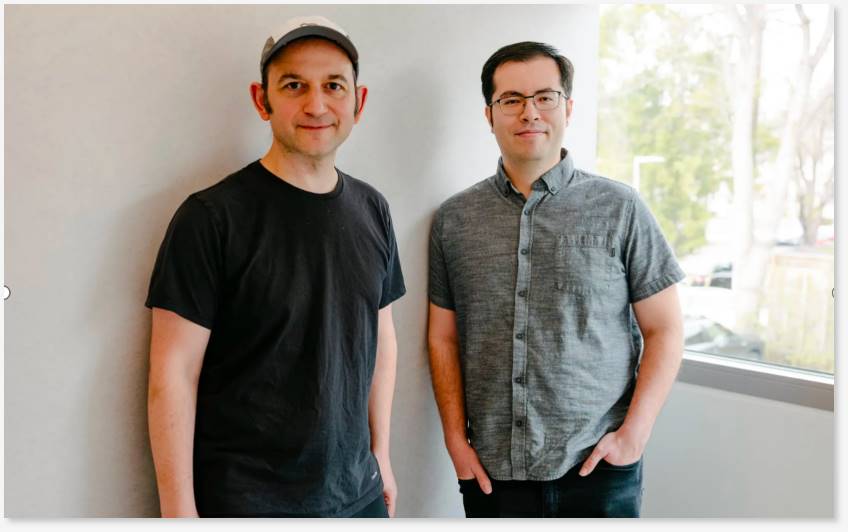
Noam Shazeer (left) and Daniel De Freitas
In essence, Character.AI has been indirectly acquired by Google. This is common in Silicon Valley: big tech acquires core teams and gains technology licenses. While the startup retains its brand and products, it effectively loses the "nuclear arsenal" needed for independent growth—especially when its key team departs.
From 2022 to 2023, Character.AI’s AI companion captured significant attention, with over 200 million monthly visits to its web app and users creating more than 10 million custom AI characters.
These strong user metrics helped the company secure $193 million in funding in March last year from investors including a16z, SV Angel, former GitHub CEO Nat Friedman, and angel investor Elad Gil. Character.AI reached a $1 billion valuation, officially becoming an AI unicorn.
As recently as June this year, Character.AI’s traffic continued growing, reaching 263 million visits—a 19.66% increase from May. By comparison, Perplexity, an AI search app valued at $3 billion, had only 73.2 million visits during the same period.
Yet despite traction, Character.AI fell into the trap of “popular but unprofitable.” Although it launched a $9.99/month subscription plan, only about 100,000 out of 6 million monthly active users in July were paying subscribers. Worse, operating costs remained extremely high—because the company built everything atop self-developed models, ongoing training, inference, upgrades, and maintenance consumed massive computing resources, all translating directly into heavy GPU spending.
With revenues failing to match expenses and no new funding secured, selling out to Google became inevitable.
Character.AI is not alone—many prominent AI startups have faced similar fates. Adept, founded by developers of the Transformer architecture, was acquired by Amazon; Humane, creator of the AI wearable AI Pin, and Inflection AI, a $1.5 billion-funded AI software firm, both shut down original operations and merged into Microsoft by late March this year.
As AI unicorns are absorbed by large tech firms, these giants consolidate both talent and technology. In competitive cases, they even quietly poach talent. Reports suggest Elon Musk’s X.AI had also pursued acquiring Character.AI before Google moved first.
AI startups built on large models face tougher survival challenges than typical internet startups. Large models demand expensive hardware, while homogeneous products trap them in low commercial returns. Once cash flow becomes unsustainable and funding tightens, burning through capital leads quickly to the end.
Reinventing the Wheel Into a Dead End
Not every AI startup can become a star like OpenAI—and even OpenAI is operating at a loss.
According to estimates by FutureSearch researchers, OpenAI’s annual recurring revenue (ARR) reaches $3.4 billion (Ed.: ARR typically extrapolates one month’s revenue by multiplying by 12). However, due to high model-building and operational costs, OpenAI’s total operating cost this year could reach $8.5 billion—resulting in substantial losses. FutureSearch predicts OpenAI may need to raise hundreds of billions more to cover future costs as advanced models continue development.
If even OpenAI struggles, early-stage startups—especially those developing proprietary models alongside products—are in worse shape.
Take Character.AI: estimated monthly inference costs alone amount to ~$3.3 million, totaling nearly $40 million annually. With subscription revenue generating only ~$1 million per month ($11.88 million annually), income doesn’t even cover inference costs, let alone training or personnel expenses.
Inflection AI, acquired earlier, faced the same issue. It developed its own models and a ChatGPT-like chatbot called Pi. In March, it released Inflection-2.5, said to require only 40% of GPT-4’s compute for training. Yet Pi never found a viable business model.
Despite claiming 1 million daily active users and 6 million monthly active users—impressive numbers—Pi remains free. After raising $1.5 billion across two rounds, Inflection AI ultimately joined Microsoft.
In its press release announcing the Google deal, Character.AI revealed a common pain point among AI startups:
Our goal of achieving personalized superintelligence requires a full-stack approach, necessitating both pre-training and post-training of models. However, the technical landscape has evolved over the past two years—with many pre-trained models now available. Given these changes, we believe combining third-party LLMs with our own models offers advantages. This allows us to allocate more resources toward post-training and deliver new product experiences for our growing user base.
Character.AI subtly acknowledged a reality: within two years, the market has become flooded with pre-trained large models.
From the user perspective, too, numerous AI startups and tech giants have crowded into the natural language modeling space, duplicating efforts to build large, medium, and small models with multimodal capabilities covering text, images, and video. At the product level, offerings remain largely limited to chatbots and content generators with minimal differentiation. User fatigue has set in, hallucination issues persist, concerns over data infringement have intensified, and new AI risks continue emerging.
New problems accompany new technologies. As startups vanish or get acquired, generative AI appears to be entering a bottleneck phase, and investors are growing cautious. Some predict the generative AI bubble is about to burst.
AI expert Gary Marcus believes 2023 was the year of AI promises, while 2024 will be the year of AI reality. He forecasts that the generative AI bubble will burst within the next 12 months. Large language models must find new paths—fully solving hallucinations and achieving self-reasoning—before AI can truly advance toward AGI.
Join TechFlow official community to stay tuned
Telegram:https://t.me/TechFlowDaily
X (Twitter):https://x.com/TechFlowPost
X (Twitter) EN:https://x.com/BlockFlow_News