








Top 10 Centralized Exchange Hacks in History
TechFlow Selected TechFlow Selected
Top 10 Centralized Exchange Hacks in History
This article explores the largest vulnerabilities in the history of top centralized exchange hacks.
 Navigating Web3 tides with focused insights
By Beosin
In recent years, centralized exchanges (CEXs) such as Mt. Gox and WazirX have suffered major losses due to external hacking attacks, while others like FTX collapsed due to internal misuse of funds. Even industry giants Binance and Coinbase face existential threats from the world's most powerful financial regulators.
Decentralized exchanges (DEXs) can effectively defend against these three major threats—hacking, fraud, and overregulation—that have long plagued CEXs. Of course, beyond "hacking," other risks exist. For example, FTX’s collapse involved mismanagement and misuse of customer funds by its executives—scenarios that are far less feasible on DEXs, where their inherent structure promotes transparency and user control.
This article explores the largest vulnerabilities in the history of top centralized exchange hacks, from notorious breaches to systemic flaws, as the cryptocurrency world has experienced turbulence. Here, we review the 10 most severe centralized exchange hacking incidents.
10. Bithumb Hack: Repeated Attacks
Founded in 2014, Bithumb quickly became a cornerstone of South Korea’s cryptocurrency market, boasting over 8 million registered users and trading volume exceeding $1 trillion. Despite its prominence, Bithumb has been repeatedly attacked.
Starting in 2017, Bithumb suffered multiple intrusions:
-
February 2017: Hackers stole $7 million.
-
June 2018: Employee personal data was exploited to steal nearly $32 million worth of cryptocurrency.
-
March 2019: Bithumb announced another breach, suspending deposits and withdrawals after losing approximately $20 million in EOS and XRP.
-
June 2019: Bithumb was attacked again, with hackers stealing $30 million worth of digital tokens.
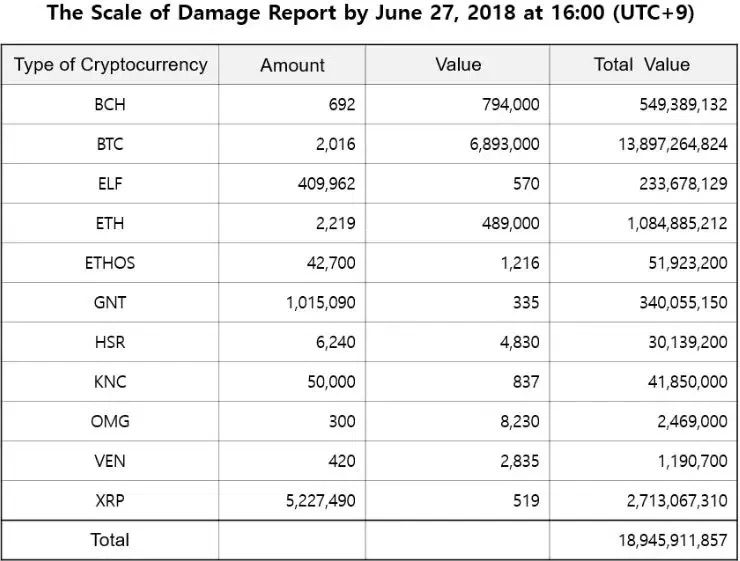
Bithumb-reported stolen assets during the June 2018 hack
In response to repeated breaches, South Korea’s Ministry of Science and ICT (MSIT) conducted a thorough investigation, with key findings including:
-
Inadequate network isolation.
-
Poor monitoring systems unable to distinguish between normal and suspicious activities.
-
Inadequate management of encryption keys and passwords.
9. WazirX Cryptocurrency Hack Incident
Among 108 incidents in 2024, over $473 million worth of cryptocurrency was lost due to hacks and fraud. WazirX alone accounted for 86.4% of all crypto lost to hacks in July.
Indian CEX WazirX announced plans to freeze withdrawals on July 18, 2024, before reversing all transactions. On that day, WazirX suffered a major wallet vulnerability attack, resulting in unauthorized transfers of over $230 million in crypto assets. The attack targeted WazirX’s multi-signature wallet on Ethereum.
Over $100 million in Shiba Inu (SHIB), 20 million MATIC tokens ($11 million), 640 billion PEPE tokens ($7.5 million), 5.7 million USDT, and 135 million GALA tokens ($3.5 million) were stolen.
Despite advanced security measures such as hardware wallets and address whitelisting, WazirX fell victim to a sophisticated attack. This underscores the need for comprehensive security audits and continuous improvements in digital asset protection. The risk of centralized private key control is evident.
8. Binance Hack: A Harsh Reminder of Cryptocurrency Vulnerabilities
In 2019, Binance, the world’s leading cryptocurrency exchange, suffered a major CEX hack. On May 7, malicious attackers used phishing and virus-based attacks to compromise Binance’s security system, stealing users’ two-factor authentication codes and API keys.
This intrusion enabled them to steal 7,074 bitcoins from the exchange’s hot wallet in a single transaction, valued at over $40 million at the time.
Following the incident, Binance CEO Changpeng Zhao announced the creation of the Secure Asset Fund for Users (SAFU) to protect user funds in extreme circumstances. Despite these measures, Binance faced another significant security challenge in October 2022. Hackers illegally generated and stole 2 million BNB tokens via the BSC Token Hub cross-chain bridge, amounting to approximately $570 million.
7. KuCoin: A Hollywood-Style Heist
In September 2020, KuCoin experienced a Hollywood-style heist, ranking among the top CEX hacks. Hackers launched a cunning attack, siphoning Bitcoin and Ethereum into a mysterious wallet. The plot grew more complex as digital thieves accessed the vault by stealing KuCoin’s hot wallet private keys.
The next day, as KuCoin CEO Johnny Lyu addressed the world live, the crypto community was already on edge. The KuCoin team responded swiftly, moving remaining funds to new hot wallets, disabling compromised wallets, and temporarily freezing all customer transactions to mitigate further risk.
Further investigation revealed the stolen funds included various cryptocurrencies such as BTC, ETH, LTC, and XRP, totaling approximately $281 million. Despite the heavy loss, proactive measures by KuCoin allowed recovery of about $204 million in stolen assets within weeks.
Notably, KuCoin collaborated with international law enforcement agencies, attributing the cyberattack to a suspected North Korean hacking group.
6. BitGrail: Internal Failures
Italian cryptocurrency exchange BitGrail became embroiled in controversy after 120 million euros ($146.55 million) went missing from its platform. Italian police accused Firano (also known as "FF") of either participating in the hack or failing to strengthen security after initially discovering the vulnerability.
This series of events led to losses for approximately 230,000 users. Firano faces charges including computer fraud, fraudulent bankruptcy, and money laundering—one of Italy’s largest financial misconduct cases.
Afterward, the Italian bankruptcy court took decisive action, declaring both Firano and BitGrail bankrupt. The court also ordered Firano to return as much of the stolen assets to customers as possible.
Additionally, the court approved seizure of Firano’s assets, including over $1 million in personal property and millions of dollars in cryptocurrency from BitGrail accounts. The court found software defects in the BitGrail platform caused repeated improper withdrawal requests.
In CEXs like BitGrail, centralized control over all assets and security makes them attractive targets for hackers.
5. Poloniex: A Tale of Two Hacks
Poloniex suffered two serious security breaches.
In March 2014, hackers exploited a software vulnerability to steal 97 bitcoins—12.3% of the exchange’s Bitcoin holdings at the time. Despite the setback, Poloniex successfully rebounded and fully compensated affected users.
Fast forward to November 2023, the exchange was attacked again, this time more severely. The attackers, suspected to be the Lazarus Group linked to North Korea, stole private keys and extracted approximately $126 million from Poloniex’s hot wallet.
The attack involved social engineering and malware to obtain critical private keys. After the breach, hackers employed complex strategies, including sending different tokens to specific addresses and using decentralized exchanges to launder funds, making tracking and recovery difficult.
4. Bitstamp Theft
Cybercriminals targeted Bitstamp’s system administrator Luka Kodric, who unknowingly downloaded a malicious file, compromising the exchange’s security. The malware, hidden within an innocuous document, activated a script that infected Bitstamp’s servers, allowing hackers access to the critical wallet.dat file and passwords.
Upon detecting the breach, Bitstamp acted swiftly, forming an emergency response team and issuing company-wide alerts. Despite these actions, hackers successfully stole 18,866 bitcoins from the hot wallet, causing losses of about $5 million at the time of the hack.
Afterward, Bitstamp undertook a massive overhaul of its trading platform, opting for a complete rebuild rather than patchwork fixes. They migrated infrastructure to secure Amazon cloud servers in Europe, implemented multi-signature wallet access, and hired Xapo for cold wallet management.
3. Bitfinex Theft
In August 2016, Bitfinex suffered a cyberattack. Hackers exploited a vulnerability in the exchange’s multi-signature security system supported by BitGo. They manipulated the security protocol to illegally withdraw 120,000 bitcoins from Bitfinex’s hot wallet.
After the hack, Bitfinex maintained transparency regarding financial losses. Losses were distributed across user accounts, with each account suffering a 36% reduction. To mitigate the impact, Bitfinex issued BFX tokens to affected users, redeemable for USD or shares in iFinex Inc., facilitating gradual recovery.
2. Coincheck Theft
At the end of January 2018, Japan’s prominent cryptocurrency exchange Coincheck suffered one of the worst CEX hacks in history. Hackers breached the exchange’s hot wallet and stole 523 million NEM tokens, valued at around $534 million at the time.
Despite prior lessons from other hacks, Coincheck kept large amounts of assets in hot wallets without adequate multi-signature protection. Immediately after the attack, the exchange halted all deposits and withdrawals to prevent movement of stolen funds.
The cryptocurrency community quickly rallied to stop liquidation of the stolen assets. Exchanges like ShapeShift banned trading of stolen NEM coins and flagged related addresses to block further transactions. Despite these efforts, full recovery of the funds remained unfeasible.
1. Mt. Gox: The Unforgettable Hack
The Mt. Gox hack remains arguably the most infamous and widely discussed cryptocurrency theft, primarily due to its scale and timing. This major event stands as a classic case among top CEX hacks.
In 2011, when Mt. Gox was the world’s largest Bitcoin exchange, it first encountered a major security breach, resulting in the loss of 25,000 bitcoins. By 2014, the situation worsened dramatically, culminating in a catastrophic theft of approximately 850,000 bitcoins.
The impact of this hack was enormous, affecting Bitcoin’s price and eroding trust across the global cryptocurrency community. “I almost lost everything. It permanently changed my view on digital currency security,” shared one forum user, highlighting the profound personal and financial consequences of the breach.
Exchange Security Prevention Measures
Exchange security has become a focal point for the entire cryptocurrency industry in recent years, especially after major security incidents and internal issues led to exchange collapses or fund losses. To enhance security, exchanges can adopt multiple measures.
For instance, storing the majority of assets in offline cold wallets, with only small amounts in online hot wallets for daily trading needs, significantly reduces the risk of hackers successfully stealing large sums. Multi-signature technology, which requires multiple key holders to sign off on transactions, prevents fund loss due to a single compromised key.
Hiring professional blockchain security firms enables comprehensive security audits of exchange systems, identifying and patching potential vulnerabilities. Smart contract audits, for example, can prevent fund losses due to coding flaws.
Real-time monitoring and threat detection: Implementing real-time network monitoring allows rapid identification of abnormal activity and timely countermeasures against attacks. Strict KYC and KYT procedures help exchanges prevent illicit funds from entering the platform, reducing money laundering risks. Collaborating with specialized security companies for regular system assessments and penetration testing helps exchanges proactively prevent and respond to potential cyber threats.
Join TechFlow official community to stay tuned
Telegram:https://t.me/TechFlowDaily
X (Twitter):https://x.com/TechFlowPost
X (Twitter) EN:https://x.com/BlockFlow_News
 @Beosin_com











