








Can DeFi Make a Comeback? The Breakthrough Point for Copycat Bulls
TechFlow Selected TechFlow Selected
Can DeFi Make a Comeback? The Breakthrough Point for Copycat Bulls
The DeFi narrative is beginning to show some new developments worth noting.
 Navigating Web3 tides with focused insights
By: Terry
Who are the liquidity backbone and innovation incubators of on-chain crypto markets?
Most people would probably say DeFi. Indeed, as the cornerstone of on-chain liquidity markets, DeFi not only provides an environment for existing capital to engage in low-friction trading and earn genuine native yields, but also serves as a primary channel for attracting incremental capital and high-quality underlying assets such as RWA. For the overall crypto market’s funding landscape, it remains an indispensable positive force. However, since 2023, amid the rotating hype around other narratives, the collective voice of DeFi as a macro narrative has gradually faded. It often leads the downturn during broad market sell-offs, making it increasingly overlooked—an abandoned storyline in the cyclical rotation of crypto sectors.
That said, three years on, there are now some noteworthy shifts emerging within the DeFi narrative. Whether it's new moves from established giants like Aave and Compound, or developments in emerging DeFi ecosystems like Solana, several interesting variables are beginning to appear.
The Fading DeFi Narrative
While the "DeFi Summer" of 2020 holds a profound place in the memories of crypto participants, a strict timeline review reveals that the entire DeFi market boom lasted only about a year and a half, with metrics like TVL providing the clearest illustration.
According to DefiLlama data, in November 2021, total value locked (TVL) across the crypto market's DeFi sector peaked at approximately $180 billion. After that, it entered a prolonged period of volatility and decline, enduring successive crises involving Terra/Luna, Three Arrows Capital, and FTX/Alameda throughout 2022. Liquidity was continuously drained, eventually hitting a cyclical low in October 2023.
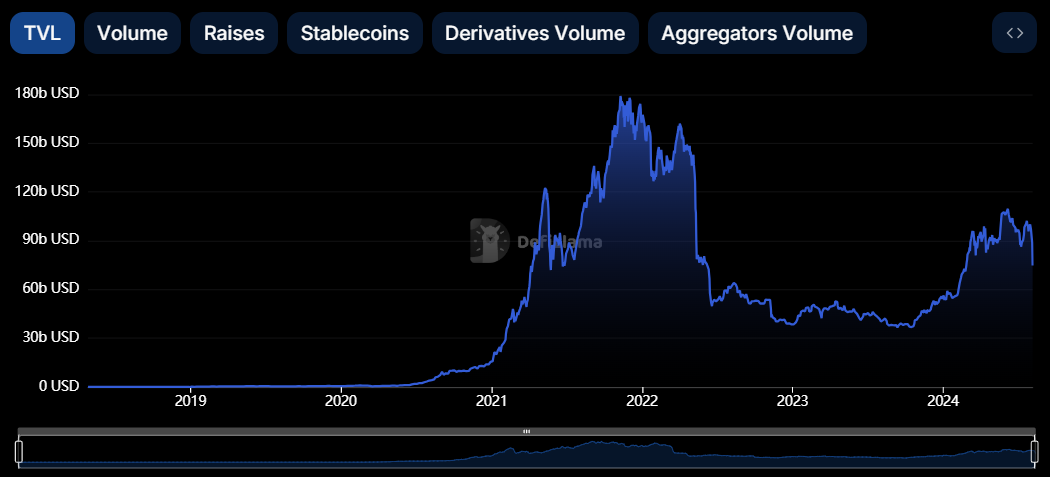
At the time of writing, the total TVL across the DeFi sector has recovered slightly to around $85 billion (as of August 13), merely 47% of its all-time high at the end of 2021. This massive gap is not just reflected numerically—it also manifests in ecosystem development and user confidence within DeFi projects.
For instance, many once-prominent DeFi projects, due to capital outflows and eroded market confidence, have been forced to downsize operations or even shut down entirely:
-
September 20, 2023: DeFi yield aggregator Gro Protocol announced it would cease operations and dissolve Gro DAO;
-
September 21, 2023: Cross-chain lending aggregator Fuji Finance announced closure of its protocol and operations;
-
December 15, 2023: DeFi protocol SafeMoon officially filed for Chapter 7 bankruptcy under U.S. law;
-
January 30, 2024: Fixed-rate lending protocol Yield Protocol advised users to close their positions; official support ended January 31;
-
July 20, 2024: Decentralized derivatives exchange Rollup.Finance announced it would cease operations, with infrastructure fully shutting down after September 21, 2024. Users were given one month to close positions and withdraw funds;
It should be noted that the above list includes only relatively well-known DeFi protocols that made headlines. In reality, according to incomplete statistics, the pace of project shutdowns across the crypto industry accelerated sharply starting in the second half of 2023—sparking what amounted to a “shutdown wave.” Numerous projects appeared to collapse overnight, unable to sustain normal operations.
Even among those DeFi protocols still holding on, token price performance in secondary markets has been extremely weak. Paradoxically, during this same period, Bitcoin and Ethereum—traditionally seen as “beta” assets—have significantly outperformed the so-called “alpha” DeFi tokens:
If we take November 2021 (BTC: $68,999) as a key reference point, we can clearly see that Bitcoin currently trades around $60,000—approximately 86% of its previous peak. Ethereum trades around $2,670, roughly 55% of its all-time high ($4,800 at the time).
But DeFi’s performance is nearly catastrophic—effectively reduced to ankle-level valuations. According to Binance’s DeFi Token Index, the current quote stands at around 630, less than 20% of its November 2021 peak of 3,400!
While this comparison may not be perfectly precise, it indirectly underscores an undeniable truth: despite broader market recovery and even Bitcoin reaching new highs, the DeFi sector has failed to keep pace. It has struggled to attract fresh capital inflows, and investor enthusiasm for DeFi has clearly cooled, no longer matching the fervor previously seen in participation and investment.
This serves as a wake-up call for DeFi’s future development.
Self-Rescue and Expansion by OG DeFi Projects
Yet, looking inward at the DeFi space, some intriguing changes are underway—most notably among blue-chip leaders like Aave and Compound.
1) MakerDAO: Pushing Forward on RWA and Stablecoins
MKR has been among the most resilient of legacy DeFi projects. Maker and MakerDAO have consistently evolved, with initiatives like “Maker Endgame” representing one of the boldest strategic overhauls in DeFi history—especially in the RWA arena.
As of August 2024, Makerburn data shows MakerDAO’s RWA portfolio has reached approximately $2.1 billion in total assets.
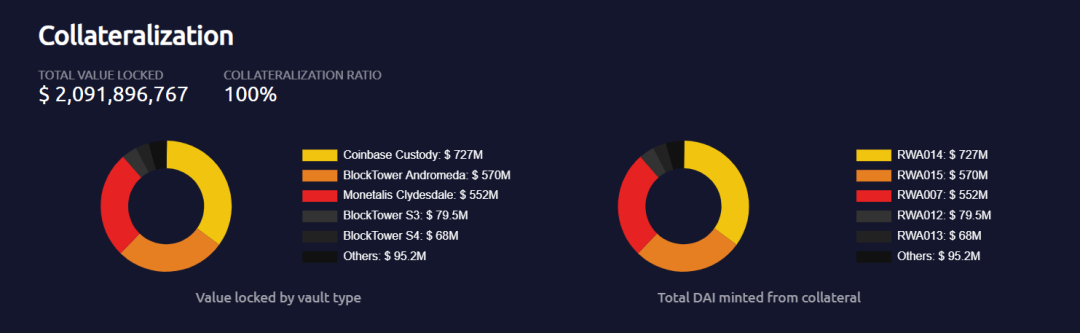
Source: Makerburn.com
Meanwhile, DAI’s total supply has once again crossed the $5 billion threshold since November last year. In May, MakerDAO also proposed plans to launch new tokens to replace DAI and MKR—issuing a new stablecoin and governance token under different symbols.
NewStable (NST) will serve as an upgraded version of DAI, maintaining a stable peg to the U.S. dollar and backed by RWA reserves. Dai holders will have the option to upgrade to NST.
PureDai aims to realize an idealized form of DAI—using highly decentralized oracles and accepting only deeply decentralized, battle-tested collateral (such as ETH and stETH). Additionally, PureDai will introduce a lending platform to maximize PureDai issuance.
2) Aave: Upgrading Security Module and Token Buybacks
On July 25, ACI, the governance representative of the Aave core team, proposed a new economic model for Aave, suggesting the launch of a “Buy and Distribute” program. Under this plan, protocol revenues would be used to purchase AAVE tokens on secondary markets, with the acquired tokens allocated to ecosystem reserves to reward key users.
Simultaneously, a new security module would activate Atokens' safety mechanisms, eliminate GHO borrowing rate discounts, and introduce anti-GHO minting and burning mechanisms—aligning incentives between AAVE stakers and GHO borrowers. The proposal also recommends upgrading the current AAVE security module into a new “staking module.”
In essence, the previous Aave security module had recurring issues in handling bad debt—such as the 2.7 million CRV treasury loss during the CRV “hunt,” which led to temporary AAVE token mints and auctions to cover deficits.
The biggest change in the new module is converting it into a “staking module,” thereby closing the supply-side inflation loophole. Meanwhile, using protocol revenue to buy back AAVE tokens from secondary markets creates a consistent long-term demand source, jointly enhancing AAVE’s appreciation potential from both supply and demand perspectives.
3) Compound: Whale Takeover, Blessing or Curse?
On July 29, Compound underwent a fierce governance vote, narrowly passing Proposal 289 by 682,191 votes to 633,636. The decision allocates 5% of Compound’s protocol reserve funds (approximately $24 million worth of 499,000 COMP tokens) to the “Golden Boys” yield protocol to generate returns over the next year.
At first glance, this seems like a solid move—effectively adding yield functionality to COMP, which was previously a pure governance token. But digging deeper into “Golden Boys” reveals complications: its driving force is Humpy, the whale who previously seized control of Balancer through similar governance attacks.
Humpy’s past exploits need no rehashing, but essentially, he once again amassed large quantities of tokens and leveraged voting power to redirect $24 million from Compound’s treasury directly into goldCOMP—a wallet he controls. While procedurally legal, this action undeniably undermines the principles of decentralized governance.
Nonetheless, Compound recently released a new proposal introducing the concept of “Proposal Guardians”—a multi-sig mechanism designed to block malicious proposals. Initially composed of a 4-of-8 multi-signature from trusted members of the Compound DAO community, these guardians can veto proposals that have passed majority voting but not yet executed, especially when governance risks emerge.
In contrast, Uniswap and Curve have appeared relatively sluggish. Curve recently faced another crisis involving founder-led token dumping. Moreover, the long-dreaded 140 million CRV “dam” hanging over its head finally burst during this turmoil, triggering major market shock and unease.
Summary
In fact, the fate of most DeFi projects—prosperous in 2020, struggling from 2021 onward—was sealed from the start: generous liquidity incentives are inherently unsustainable. Thus, the current efforts by DeFi blue chips to launch new products or enhance token utility represent various forms of self-rescue.
Notably, despite recent market turbulence causing widespread liquidations across DeFi—Ethereum-based DeFi protocols set a year-to-date liquidation record exceeding $350 million on August 5—no panic-driven stampede occurred. This indirectly demonstrates that DeFi’s resilience continues to strengthen, reflecting an ongoing phase of adjustment and exploration.
Regardless, as the liquidity foundation and innovation hub of the crypto market, after the froth clears, those surviving DeFi projects that continue innovating stand a strong chance of standing out, reattracting capital and user attention, spawning new narratives, and ultimately achieving their breakthrough moment.
Join TechFlow official community to stay tuned
Telegram:https://t.me/TechFlowDaily
X (Twitter):https://x.com/TechFlowPost
X (Twitter) EN:https://x.com/BlockFlow_News
 白话区块链
白话区块链






