








Unisat openly supports Fractal, a Bitcoin scaling solution: A brief overview
TechFlow Selected TechFlow Selected
Unisat openly supports Fractal, a Bitcoin scaling solution: A brief overview
How does Fractal improve processing efficiency in multiple aspects while maintaining mainnet integrity?
 Navigating Web3 tides with focused insights
Scaling has long been a key focus in the development of the BTC ecosystem. However, as overall market enthusiasm cools down, many creative projects—including various scaling solutions—have gradually faded from public attention. Behind the volatile market sentiment, however, "still working" remains an accurate description of the current status for many project teams.
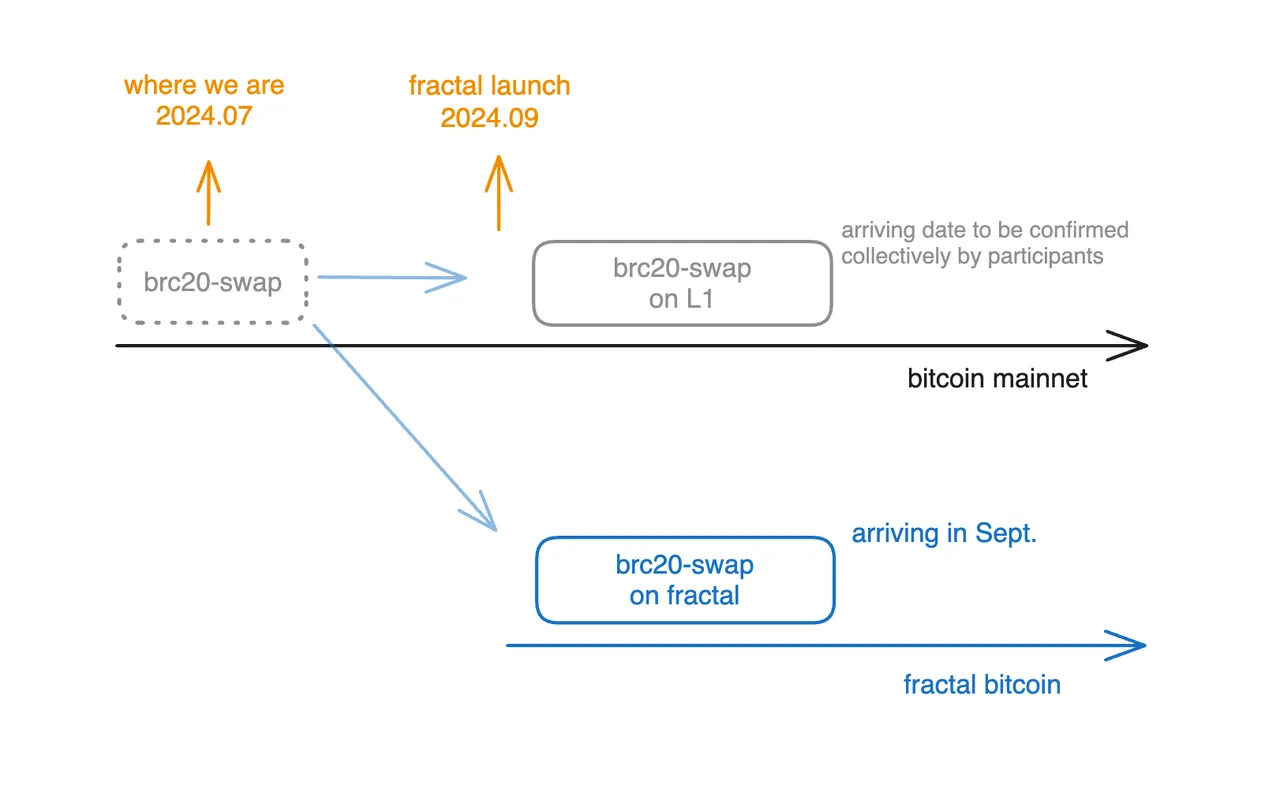
Yesterday, Fractal, a native BTC scaling solution built on Bitcoin’s core code and supported by UniSat, opened its official faucet. Combined with previous news that Unisat will launch Fractal Bitcoin in September (link), this caught our interest. We visited the Fractal official website to better understand what makes this project unique.
Authentic and Native: A "Legitimate" Enhancement Based on the BTC Mainnet?
According to its official description, Fractal Bitcoin improves transaction throughput and speed by recursively creating infinite scaling layers directly on the BTC main chain using Bitcoin's core code, while maintaining full compatibility with the existing Bitcoin ecosystem.
In short, Fractal extends functionality based on Bitcoin’s core code, featuring the following characteristics:
-
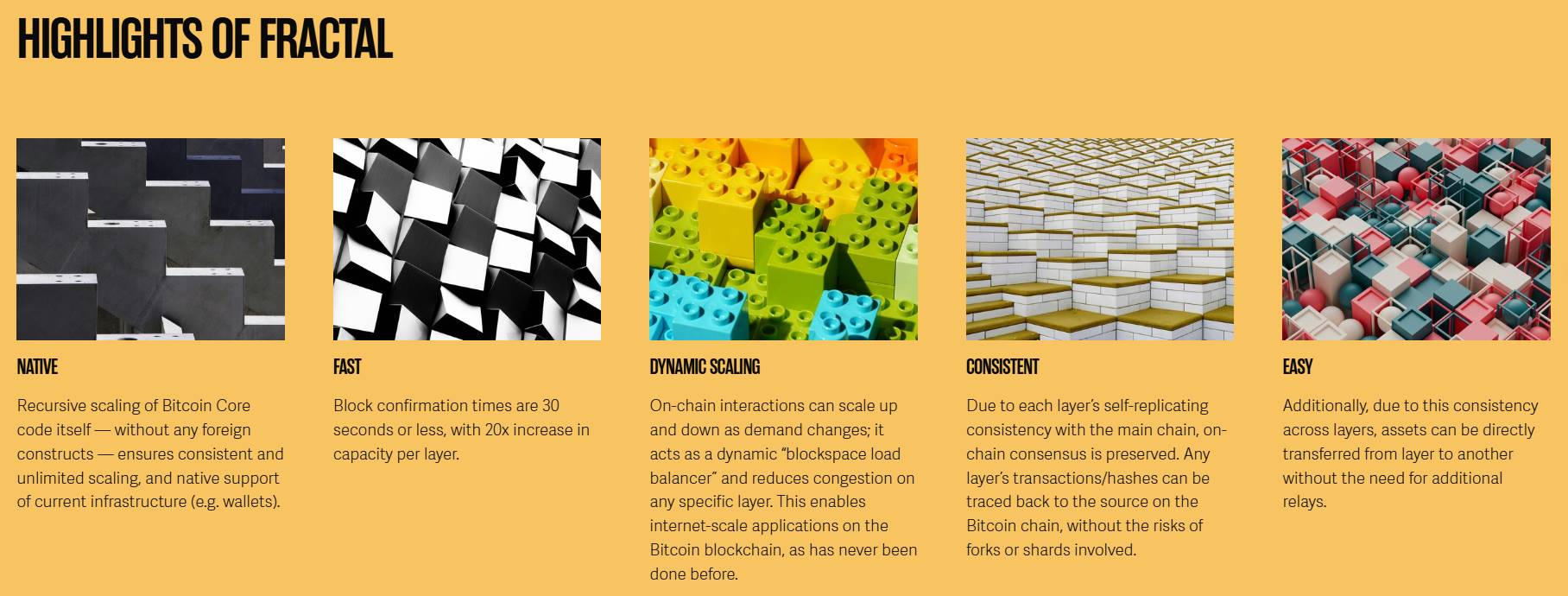
Fast transactions: The Fractal network achieves block confirmation times of approximately 30 seconds, with transaction processing capacity 20 times that of the BTC main chain.
-
Native compatibility: Built on Bitcoin’s core code, Fractal Bitcoin is fully compatible with existing Bitcoin wallets, tools, and mining hardware.
-
Dynamic adjustment: The recursive system based on the BTC main chain can automatically adjust the number of scaling layers according to network congestion.
-
Secure and traceable: All transactions on the Fractal network are ultimately anchored back to the Bitcoin main chain.
How exactly does Fractal achieve improved efficiency while preserving the authenticity and integrity of the mainnet?
Multi-Layer Scaling Architecture
Fractal employs a clever recursive layer design to increase Bitcoin’s transaction throughput. It builds multiple tiers of scaling layers atop the BTC main chain, forming a tree-like recursive structure. This allows each layer to further branch out—a "forking model"—enhancing the network’s parallel processing capability.
When transaction volume increases on the main chain, Fractal automatically offloads some transactions to upper layers. Each layer processes transactions independently and can dynamically scale the number of layers up or down based on network demand. During peak periods, new layers can be rapidly created to handle surges in traffic, giving the network flexible adaptability to varying loads.
Cadence Mining
Fractal uses the same Proof-of-Work (PoW) consensus mechanism as Bitcoin, allowing BTC miners to seamlessly transition their existing ASICs, GPUs, and other hardware to mine Fractal blocks.
To broaden miner participation, Fractal introduces a hybrid mining mechanism called Cadence Mining, combining Permissionless Mining and Merge Mining in a cyclical pattern: every three blocks, two are mined via "permissionless mining," and one via "merge mining."
For clarity: "Permissionless mining" allows anyone with suitable tools and hardware to mine Fractal blocks—similar to how Bitcoin mining works. "Merge mining" is specifically designed for BTC miners, enabling them to simultaneously mine both BTC and Fractal blocks without requiring additional computational power.
Reviving OP_CAT
Fractal Bitcoin revives OP_CAT, an opcode that existed in early versions of Bitcoin but was later disabled due to security concerns. OP_CAT allows concatenation of two strings, and scripts using it could expand a 1-byte value into over 1 TB of data. This capability made it vulnerable to DoS attacks, potentially crashing nodes or congesting the network. Since no effective mitigation existed at the time, OP_CAT remained disabled until Tapscript introduced a limit of 520 bytes per stack element, effectively resolving the issue.
Now, the "sanitized" OP_CAT serves as a powerful tool for developers, enabling easier handling of large integers and enhancing Bitcoin’s scripting capabilities.
More broadly, reintroducing OP_CAT opens new possibilities for the Bitcoin ecosystem, paving the way for more diverse on-chain applications and smart contract use cases to take root directly on the Bitcoin main chain.
Summary
Currently, Fractal has launched its faucet and test interface. However, due to overwhelming demand—likely from faucet farmers—the faucet page has crashed and remains inaccessible. Additionally, test tokens will be reset at 16:00 Beijing Time on August 13. The official testnet will follow shortly after, so interested users don’t need to rush.
Returning to the project itself, whether judged by vision or technical implementation, Fractal genuinely delivers innovative mechanisms for native Bitcoin scaling, staying true to the principle of "authentic expansion" on the BTC main chain. Widespread adoption, long-term security validation, and seamless integration with the broader Bitcoin ecosystem will require continuous iteration and time. We hope Fractal remains committed and keeps moving forward in the often-hype-driven world of crypto.
Join TechFlow official community to stay tuned
Telegram:https://t.me/TechFlowDaily
X (Twitter):https://x.com/TechFlowPost
X (Twitter) EN:https://x.com/BlockFlow_News
 深潮TechFlow


