








Double-digit rebound underway—Is a Bitcoin-led reversal rally about to ignite?
TechFlow Selected TechFlow Selected
Double-digit rebound underway—Is a Bitcoin-led reversal rally about to ignite?
Stimulated by a slight recovery in risk appetite in financial markets, market sentiment has improved, leading to a strong rebound in the crypto market.
 Navigating Web3 tides with focused insights
By Nancy, PANews
Japan's stock market, one of the key drivers behind the recent global equity sell-off, triggered its circuit breaker mechanism twice. On August 7, Shinichi Uchida, Deputy Governor of the Bank of Japan (BOJ), spoke out for the first time following this historic market turmoil, assuring investors that the BOJ would not raise policy rates if financial markets remain unstable. Meanwhile, improved U.S. economic indicators have eased recession fears, allowing bullish sentiment to recover and stabilizing Wall Street. As risk appetite across financial markets gradually improves, investor confidence has been lifted, fueling a strong rebound in the crypto market.
Rebound Momentum Drives Record Trading Volumes and Bottom-Fishing Capital Inflows
The improving risk sentiment has somewhat alleviated investor anxiety. According to Alternative.me data, the Fear & Greed Index stood at 29 on August 7, indicating reduced panic compared to the previous day, though concerns still linger.
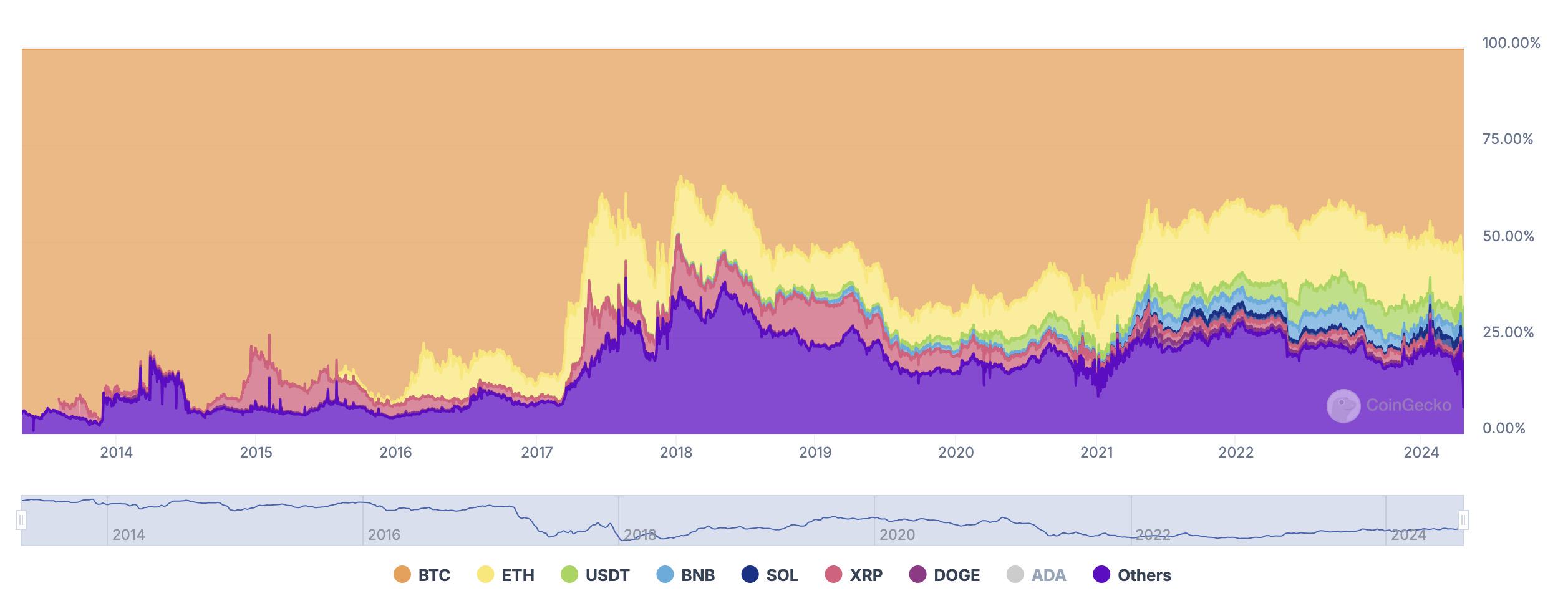
The crypto market has made significant gains during the rebound, reclaiming a total market capitalization above $2 trillion. Data from CoinGecko shows the total crypto market cap now stands at $2.1 trillion, with Bitcoin’s dominance reaching 52.4%—a new high since April 2021—and Ethereum’s share at 14.2%.
Binance data shows Bitcoin surged above $57,000 at one point, representing a peak recovery of 16.9% from its recent lows; Ethereum climbed 21.1% from its bottom, briefly surpassing $2,500. Solana also staged a powerful rebound, rising 37.9% from its low. Notably, according to TradingView, the SOL/ETH ratio reached an all-time high of 0.0599 as of writing.
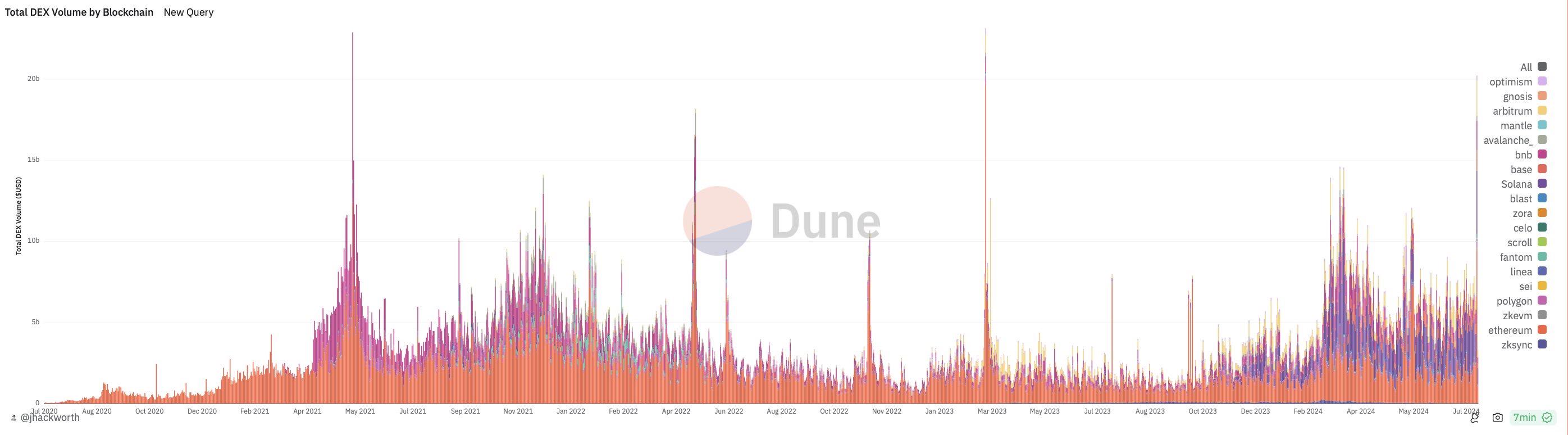
Trading volumes across the crypto market have also hit new highs. Dune Analytics reports that decentralized exchange (DEX) daily trading volume exceeded $20.2 billion on August 5—the third-highest level in history, behind only the Silicon Valley Bank run ($23.1 billion) and the May 2021 flash crash ($22.8 billion). Blockchain.com data further reveals that Bitcoin’s transaction volume on August 6 reached a post-halving record high of over $1.14 billion.
Behind these surging volumes, institutional players and large whales have taken advantage to accumulate assets. Crypto analyst Ali noted on X that over the past 48 hours, Bitcoin whales acquired more than 30,000 BTC worth approximately $1.62 billion, evidenced by spikes in exchange outflows and declining BTC supply held on exchanges. Lookonchain data revealed that the entity "7 Siblings," holding $1.57 billion in assets, quietly bought 56,093 ETH (worth $129 million) at an average price of $2,305 during the market panic. Additionally, five whale addresses collectively purchased 144,071 ETH (~$330 million). Monitoring by @ai_9684xtpa showed James Fickel, founder of Amaranth Foundation, bought 4,336 ETH (~$10.94 million) on-chain at an average price of $2,523. IntoTheBlock reported that wallets holding between 1,000 and 10,000 BTC demonstrated confidence during the recent price drop, continuing to increase their holdings.
FalconX, a digital asset brokerage firm, also tweeted that institutions are buying the dip amid the selloff. Their observations on August 7 indicated nearly all investor categories were net buyers: proprietary trading desks (57% of buy-side flow), hedge funds (63%), venture funds (61%), and retail aggregators (72%). “Last week’s buy/sell ratio below 50% is now above 50% today.” Bitcoin remains the dominant crypto asset, with trading volume 2.8 times that of ETH, while combined BTC and ETH volumes exceed those of altcoins by more than double.
Rebound or Reversal? Market Fears Overblown but Caution Warranted in Short Term
The recent global equity sell-off is widely seen as a panic-driven overreaction. With financial markets beginning to stabilize, is the current crypto rally merely a technical bounce—or the start of a broader market reversal?
Rob Halfack, Partner at Dragonfly, believes short-term pain may persist, but the medium- to long-term outlook remains bullish. He explained that the major deleveraging event caused by unwinding yen carry trades is unlikely to extend beyond this week, although some contagion risks remain. The likelihood of Japanese financial intervention has increased, which could help mitigate certain risks. Concerns around certain U.S. economic data have been exaggerated, and most informed capital views the selloff as overdone. Equities are expected to stage a strong rebound when risk appetite returns. However, emergency rate cuts are unlikely, contributing to pre-Jackson Hole symposium jitters. Iran appears to be retracting its most aggressive rhetoric, reducing the risk of large-scale conflict. Over the coming months (within a year), markets could see renewed quantitative easing, widespread rate cuts, and eventually, a resumption of accelerated business cycle growth.
He added that non-native crypto investors may stay away for a prolonged period due to excessive leverage in long-tail assets. Liquidity is likely to return primarily to major cryptocurrencies, while most altcoins may never (or barely) reach prior all-time highs—especially those lacking strong product-market fit (PMF) or long-term fundamentals.
Crypto investment firm QCP Capital echoed this view, stating that talk of emergency rate cuts is “highly unlikely,” as such moves would severely damage the Federal Reserve’s credibility and amplify market panic and recession fears. The firm believes asset prices may continue to fluctuate until monetary policies from both the Fed and the BOJ become clearer, with market volatility likely to persist. With prices down sharply, now may be an opportune time to begin accumulating spot Bitcoin and Ethereum positions.
Raoul Pal, founder of Real Vision, described the situation as a severe shakeout and reset of risk leverage, asserting that strong upward momentum will define 2024–2025. He emphasized that the next week could represent the final chance to enter or fully position for the next bull cycle. However, liquidity and policy responses take time. Governments and central banks generally prefer a weaker dollar and lower interest rates, so they might allow current conditions to persist before stepping in. The Fed’s eventual rate cuts will usher in a period of dollar weakness, potentially setting the stage for a macro summer/fall rally. “Markets are in extreme fear territory now. Hold on. Make a plan suited to your risk tolerance and time horizon. Stay safe. Those who wait will be rewarded. Markets are never easy—bull markets exist to disappoint you. This too shall pass.”
“Since the unwind of yen carry trades began, Bitcoin has experienced notable price volatility. Declining open interest and negative funding rates suggest a higher probability of Bitcoin entering a consolidation phase. However, anticipated swift central bank interventions could make Bitcoin appear attractively priced at current levels,” said Jamie Coutts, Bloomberg’s crypto analyst.
David Duong, researcher at Coinbase, noted that Tuesday’s market dynamics indicate potential short squeezes, especially given increased trading activity on centralized exchanges. While he expects continued near-term volatility, shorts may be squeezed here, possibly triggering a rebound in the coming days. The recent downturn does not signal a new long-term trend or the start of a new market cycle. Instead, it aligns with their defensive strategy for Q3 2024 and a more constructive outlook for Q4 2024.
Additionally, Ki Young Ju, founder and CEO of CryptoQuant, posted on X that as long as Bitcoin holds above $45,000, it could break its all-time high again within a year. While some indicators currently show bearish signals, a rebound is still possible—what matters now is whether price can stabilize at this level for one to two weeks. A longer consolidation increases bearish risks; if it extends beyond a month, recovery could become significantly more difficult.
Join TechFlow official community to stay tuned
Telegram:https://t.me/TechFlowDaily
X (Twitter):https://x.com/TechFlowPost
X (Twitter) EN:https://x.com/BlockFlow_News
 PANews











