Demystifying the AI Training and Inference Technology Stack: From Silicon to Intelligence
TechFlow Selected TechFlow Selected
Demystifying the AI Training and Inference Technology Stack: From Silicon to Intelligence
The AI technology stack is a layered architecture composed of hardware and software, serving as the foundation of the current AI revolution.
 Navigating Web3 tides with focused insights
By IOSG Ventures
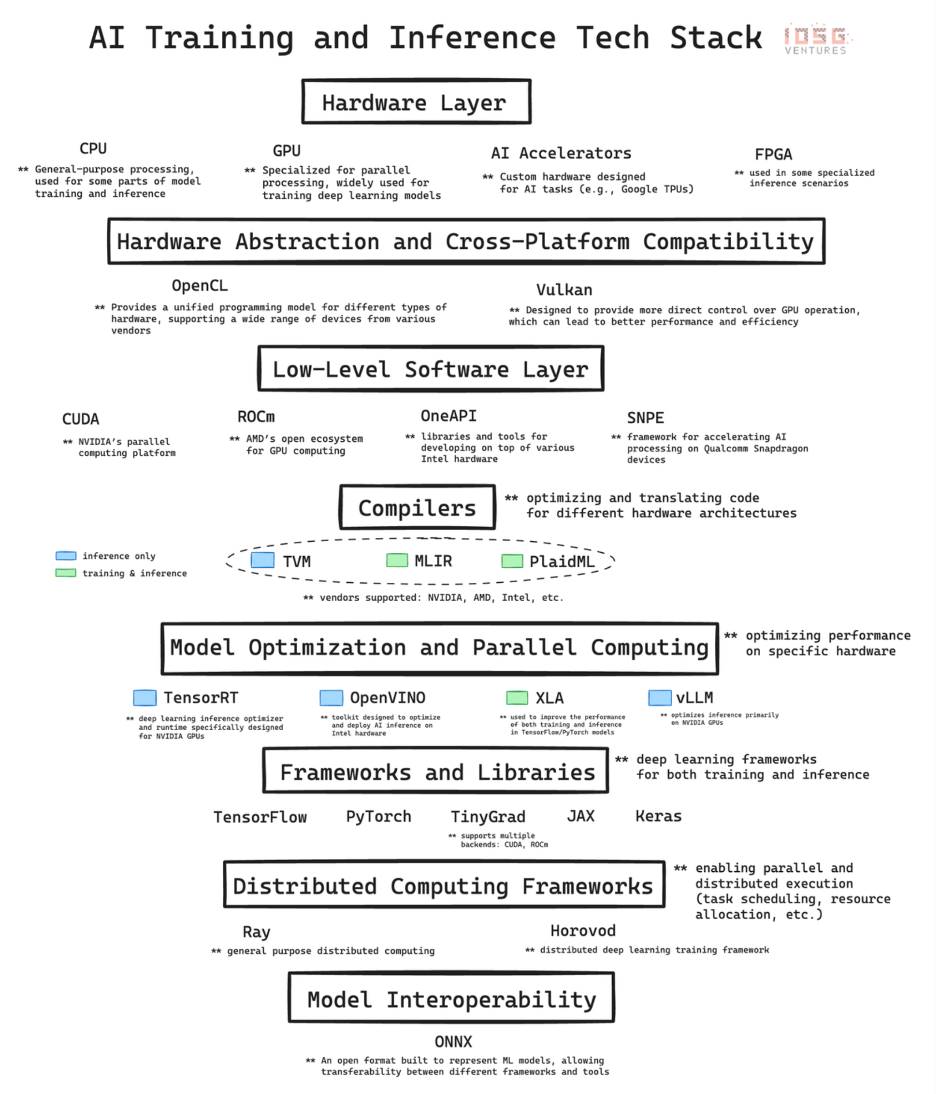
The rapid advancement of artificial intelligence is built upon a complex infrastructure. The AI tech stack is a layered architecture composed of hardware and software, serving as the backbone of today’s AI revolution. Here, we will analyze the key layers of this stack and explain how each contributes to AI development and deployment. Finally, we reflect on the importance of mastering these fundamentals—especially when evaluating opportunities at the intersection of cryptocurrency and AI, such as DePIN (decentralized physical infrastructure) projects like GPU networks.
1. Hardware Layer: The Silicon Foundation
At the base lies hardware—the physical source of computational power for AI.
-
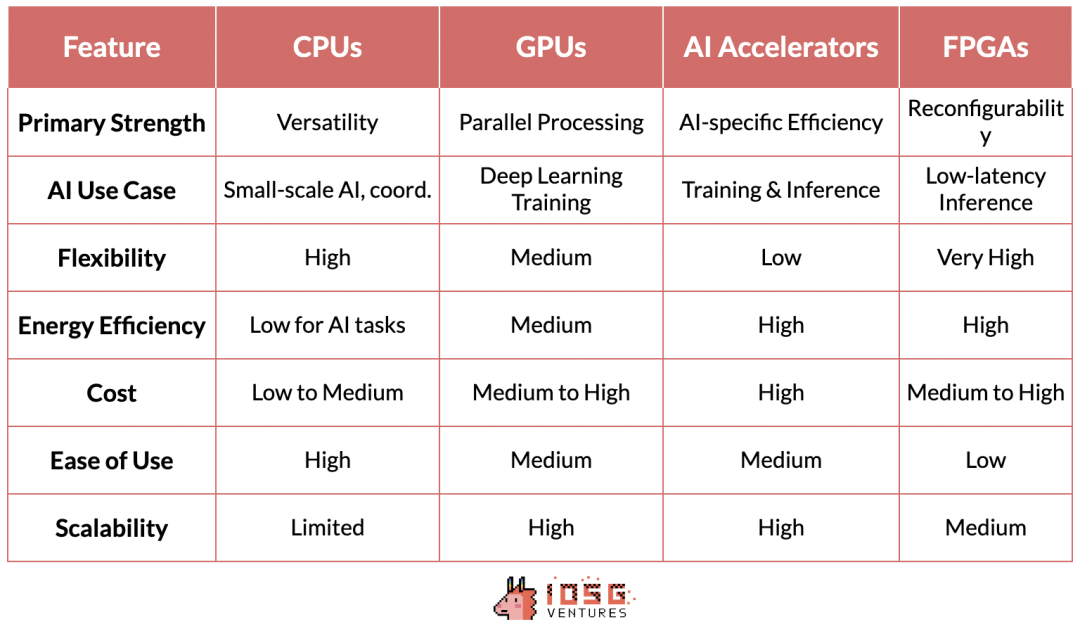
CPU (Central Processing Unit): The foundational processor for computing. CPUs excel at sequential tasks and are essential for general-purpose computing, including data preprocessing, small-scale AI workloads, and coordinating other components.
-
GPU (Graphics Processing Unit): Originally designed for graphics rendering, GPUs have become central to AI due to their ability to perform massive parallel computations. This parallel processing capability makes GPUs ideal for training deep learning models. Without GPU advancements, modern GPT models would not be feasible.
-
AI Accelerators: Chips specifically designed for AI workloads. These are optimized for common AI operations, delivering high performance and energy efficiency for both training and inference.
-
FPGA (Field-Programmable Gate Array): Offers flexibility through reprogrammability. FPGAs can be optimized for specific AI tasks, particularly in low-latency inference scenarios.
2. Lower-Level Software: Middleware
This layer in the AI tech stack is critical—it bridges high-level AI frameworks with underlying hardware. Technologies like CUDA, ROCm, OneAPI, and SNPE strengthen the connection between advanced frameworks and specific hardware architectures, enabling performance optimization.
CUDA, NVIDIA’s proprietary software layer, has been foundational to the company's rise in the AI hardware market. NVIDIA’s leadership stems not only from its hardware superiority but also from powerful network effects created by tight software and ecosystem integration.
CUDA’s influence comes from its deep integration into the AI tech stack and its comprehensive suite of optimized libraries, which have become de facto standards in the field. This software ecosystem creates strong network effects: AI researchers and developers proficient in CUDA propagate its use throughout academia and industry during model training.
This virtuous cycle reinforces NVIDIA’s market dominance, making the ecosystem of CUDA-based tools and libraries increasingly indispensable to AI practitioners.
This hardware-software symbiosis not only cements NVIDIA’s position at the forefront of AI computing but also grants the company significant pricing power—a rarity in typically commoditized hardware markets.
CUDA’s dominance—and the relative obscurity of its competitors—stems from a series of factors that create substantial entry barriers. NVIDIA’s first-mover advantage in GPU-accelerated computing allowed CUDA to build a robust ecosystem before competitors could gain traction. Despite having capable hardware, rivals like AMD and Intel lack the necessary software libraries and tools, and fail to integrate seamlessly with existing tech stacks—this explains the wide gap between NVIDIA/CUDA and others.
3. Compilers: The Translators
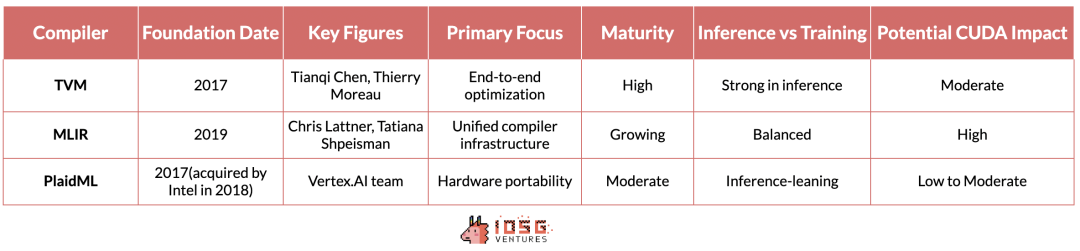
TVM (Tensor Virtual Machine), MLIR (Multi-Level Intermediate Representation), and PlaidML offer different solutions to the challenge of optimizing AI workloads across diverse hardware architectures.
Originating from research at the University of Washington, TVM quickly gained attention for its ability to optimize deep learning models across various devices—from high-performance GPUs to resource-constrained edge devices. Its strength lies in end-to-end optimization, particularly effective in inference scenarios. TVM abstracts away differences between hardware vendors and underlying architectures, enabling inference workloads to run seamlessly across different platforms, whether NVIDIA, AMD, or Intel.
However, beyond inference, the situation becomes more complex. The ultimate goal of hardware-agnostic computation for AI training remains unresolved. Still, several initiatives are worth noting.
MLIR, a Google project, takes a more foundational approach. By providing a unified intermediate representation across multiple abstraction levels, it aims to streamline the entire compiler infrastructure for both inference and training use cases.
PlaidML, now led by Intel, positions itself as a dark horse in this race. It emphasizes portability across a broad range of hardware architectures—including those beyond traditional AI accelerators—envisioning a future where AI workloads run seamlessly across all computing platforms.
If any of these compilers could integrate smoothly into the tech stack without sacrificing model performance or requiring developer modifications, they could significantly threaten CUDA’s moat. However, currently, MLIR and PlaidML are not yet mature or well-integrated enough into the AI stack to pose a clear threat to CUDA’s leadership.
4. Distributed Computing: The Coordinators
Ray and Horovod represent two distinct approaches to distributed computing in AI, each addressing the critical need for scalable processing in large-scale AI applications.
Developed by UC Berkeley’s RISELab, Ray is a general-purpose distributed computing framework. It excels in flexibility, enabling the distribution of various workloads beyond machine learning. Ray’s actor-based model greatly simplifies the parallelization of Python code, making it especially suitable for reinforcement learning and other AI tasks requiring complex, heterogeneous workflows.
Horovod, originally developed by Uber, focuses on distributed implementations of deep learning. It offers a clean and efficient solution for scaling deep learning training across multiple GPUs and server nodes. Horovod stands out for its user-friendliness and optimization for data-parallel neural network training, integrating seamlessly with mainstream frameworks like TensorFlow and PyTorch. This allows developers to scale their existing training code with minimal modifications.
5. Conclusion: A Crypto Perspective
Integration with the existing AI stack is crucial for DePIN projects aiming to build distributed computing systems. Such integration ensures compatibility with current AI workflows and tools, lowering adoption barriers.
In the crypto space, current GPU networks are essentially decentralized GPU rental platforms—representing an initial step toward more sophisticated distributed AI infrastructure. These platforms function more like Airbnb-style marketplaces than true distributed clouds. While useful for certain applications, they are insufficient for supporting real distributed training, a key requirement for advancing large-scale AI development.
Current distributed computing standards like Ray and Horovod were not designed for globally distributed networks. For truly functional decentralized networks, we need a new framework at this layer. Some skeptics even argue that Transformer models—due to their need for intensive communication and global function optimization during training—are incompatible with distributed training methods. On the other hand, optimists are working on new distributed computing frameworks designed to work effectively with globally dispersed hardware. Yotta is one startup attempting to solve this problem.
NeuroMesh goes further, innovatively re-engineering the machine learning process. By using Predictive Coding Networks (PCN) to seek convergence through local error minimization instead of directly optimizing a global loss function, NeuroMesh addresses a fundamental bottleneck in distributed AI training.
This approach enables unprecedented parallelization and makes model training possible on consumer-grade GPU hardware (such as the RTX 4090), democratizing AI training. Specifically, while the computational power of a 4090 GPU is comparable to that of an H100, bandwidth limitations have historically underutilized it in training. Because PCN reduces reliance on bandwidth, leveraging these lower-end GPUs becomes viable—potentially leading to significant cost savings and efficiency gains.
GenSyn, another ambitious crypto-AI startup, aims to build a compiler suite. GenSyn’s compiler enables any type of compute hardware to be used seamlessly for AI workloads. Analogous to how TVM functions for inference, GenSyn seeks to build similar tooling for model training.
If successful, it could dramatically expand the capabilities of decentralized AI computing networks by efficiently utilizing diverse hardware to handle more complex and varied AI tasks. This ambitious vision, though challenging due to the complexity of cross-architecture optimization and high technical risk, could—if executed successfully and obstacles like maintaining performance across heterogeneous systems are overcome—undermine the moats of CUDA and NVIDIA.
Regarding inference: Hyperbolic adopts a relatively pragmatic strategy by combining verifiable inference with a decentralized network of heterogeneous computing resources. By leveraging compiler standards like TVM, Hyperbolic can utilize a wide range of hardware configurations while maintaining performance and reliability. It aggregates chips from multiple vendors—from NVIDIA to AMD and Intel—including both consumer-grade and high-performance hardware.
These developments at the intersection of crypto and AI point toward a future where AI computing could become more distributed, efficient, and accessible. The success of these projects depends not only on their technical merits but also on their ability to integrate seamlessly with existing AI workflows and address the practical concerns of AI practitioners and enterprises.
Join TechFlow official community to stay tuned
Telegram:https://t.me/TechFlowDaily
X (Twitter):https://x.com/TechFlowPost
X (Twitter) EN:https://x.com/BlockFlow_News
 IOSG Ventures