After the Meme craze, will Solana be the fragile house of cards?
TechFlow Selected TechFlow Selected
After the Meme craze, will Solana be the fragile house of cards?
As always, it's the people selling shovels who profit, while speculators often suffer losses without realizing it.
 Navigating Web3 tides with focused insights
Author: Flip Research
Translation: TechFlow
Recently, my social media timelines have been flooded with bullish arguments about $SOL, mixed in with promotions for meme coins. I started believing that the meme coin supercycle is real and that Solana will surpass Ethereum as the dominant Layer 1 blockchain. But then I began digging into the data—and the findings are concerning, to say the least... In this article, I’ll present my discoveries and explain why Solana might be a house of cards.
First, let’s look at the bullish case, succinctly summarized by @alphawifhat:
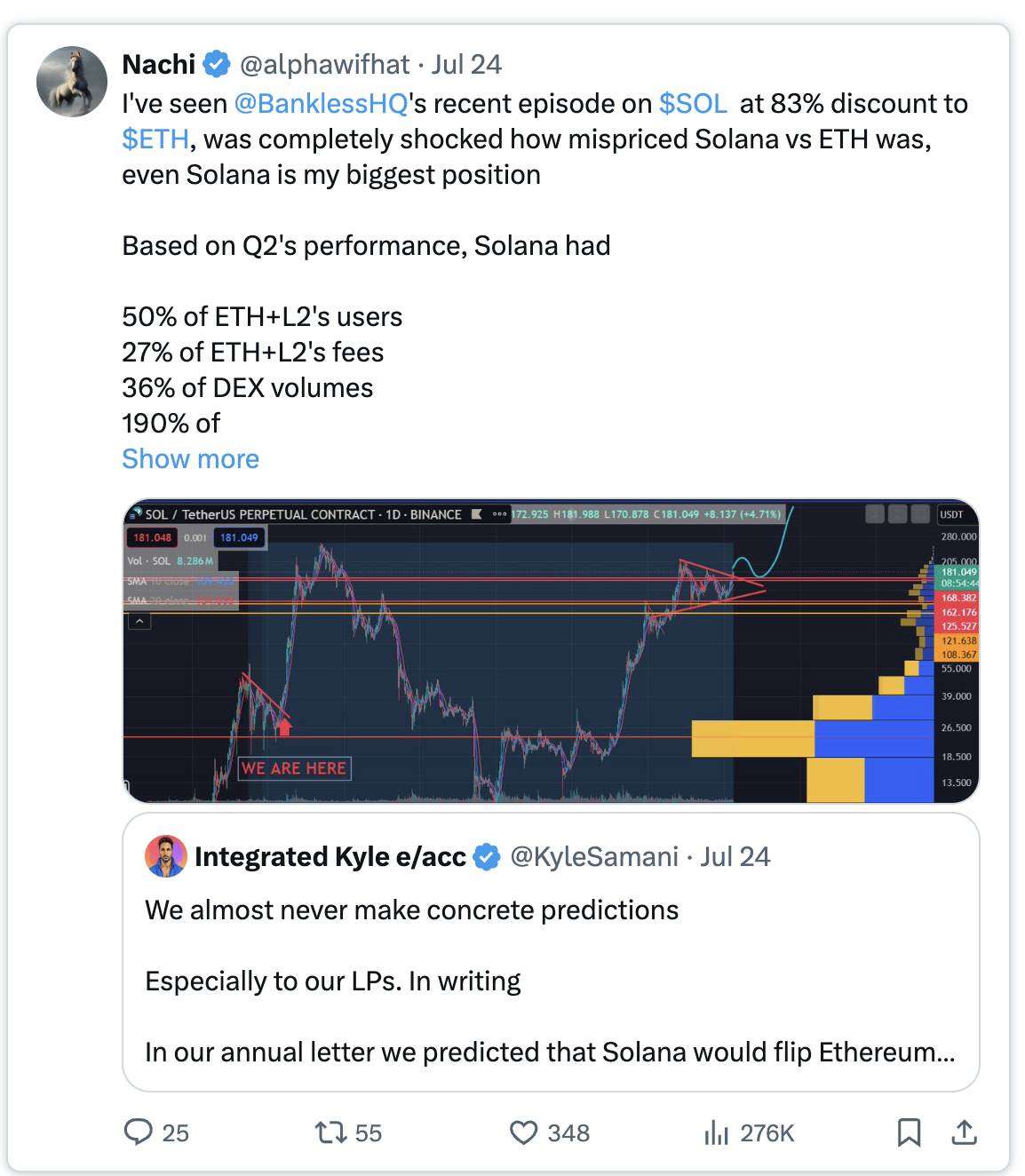
Explanation of the image above:
Nachi: “I watched @BanklessHQ’s recent show on $SOL mentioning it's priced 83% lower than $ETH—I was completely shocked by Solana’s mispricing relative to ETH despite Solana being my largest position.”
Based on Q2 performance, Solana’s metrics were:
-
50% of ETH+L2 users
-
27% of ETH+L2 fees
-
36% of DEX volume
-
190% of ETH+L2 stablecoin trading”
Integrated Kyle e/acc: “We almost never make specific predictions, especially to our LPs.
In our annual letter, we predicted Solana would overtake Ethereum across most major chain metrics by year-end. We specifically pointed out volume as the key metric.”
There are four clear claims regarding metrics compared to ETH and L2s:
-
Higher user base ratio
-
Relatively higher fees
-
High DEX trading volume
-
Significantly higher proportion of stablecoin trading volume
User Base Comparison
Below is a comparison between Ethereum mainnet and SOL (mainnets only, since the vast majority of fees come from here; source: @tokenterminal):

ETH user base + transaction count

SOL user base + transaction count
At first glance, these numbers look great for SOL—over 1.3 million daily active users (DAUs), versus just 376,300 DAUs for ETH. However, when factoring in transaction counts, I noticed something odd.
For example, on Friday, July 26, ETH had 1.1 million transactions with 376,300 DAUs—around 2.92 transactions per user per day. Meanwhile, SOL had 282.2 million transactions and 1.3 million DAUs—an average of 217 transactions per user per day.
I assumed this could be due to lower transaction fees enabling more trades, frequent position compounding, increased arbitrage bot activity, etc. So I compared it to another popular chain, Arbitrum. Yet Arbitrum averaged only 4.46 transactions per user on the same day. Looking at other chains yielded similar results.
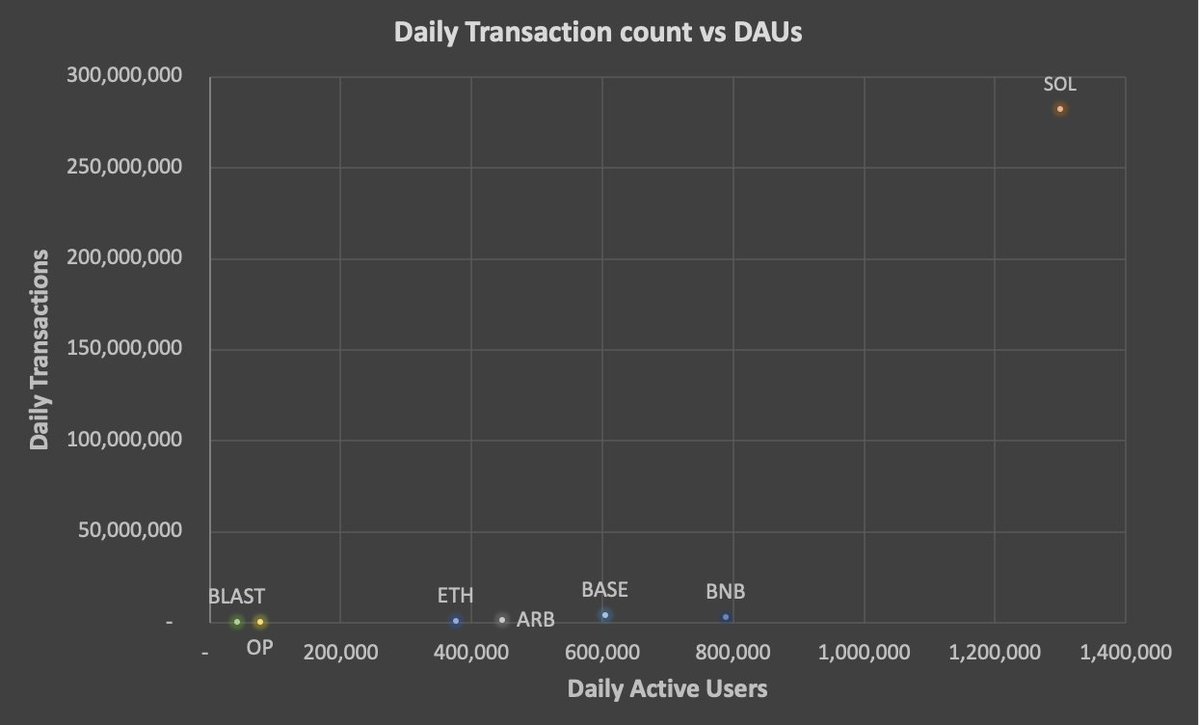
Given its higher user count than ETH, I checked Google Trends, which should offer a relatively unbiased view of user interest:
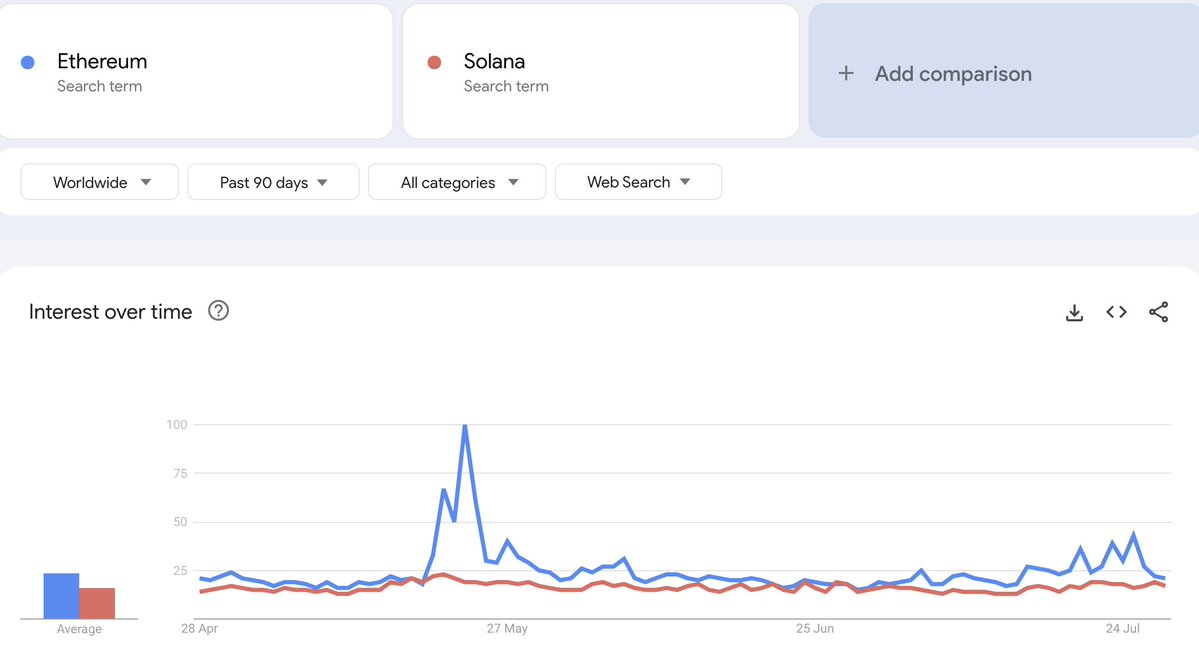
ETH trends either match or lead SOL. Given the DAU gap and all the hype around SOL meme coins, I did not expect this result. So what’s going on?

DEX Volume Analysis
To understand the transaction discrepancy, examining Raydium’s liquidity providers (LPs) offers insight. Even at a glance, something clearly seems off:
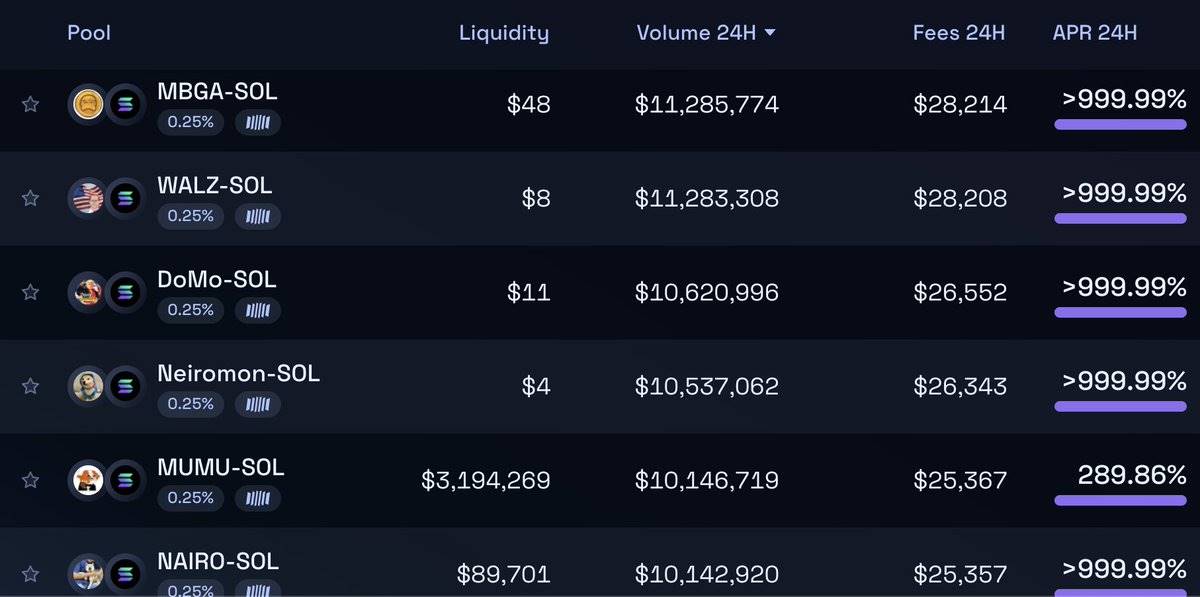
Initially, I thought this was just wash trading on low-liquidity honeypot LPs to attract casual meme coin speculators. But the chart reveals something far worse:
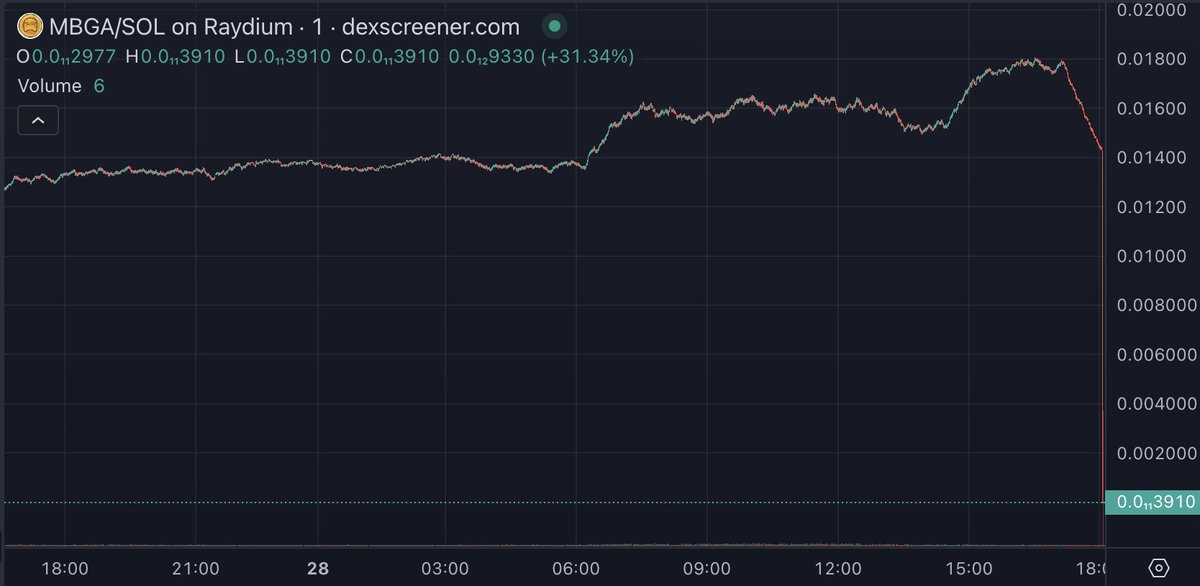
Every low-liquidity pool corresponds to a project that was recently "pumped" within the past 24 hours. Take MBGA, for instance—in the last 24 hours, there were 46,000 transactions, $10.8M in volume, 2,845 unique wallets trading, and over $28,000 in fees generated on Raydium. (Note: A similarly sized legitimate LP, $MEW, generated only 11,200 trades.)
Looking at participating wallets, most appear to be bots within the same network executing tens of thousands of trades. They independently generate fake volume with random SOL amounts and trade frequencies, moving from one project to the next after a pump.
On Raydium’s standard liquidity pools alone, there were over 50 pumps in the past 24 hours, each exceeding $2.5M in volume, totaling over $200M in volume and over $500K in fees. Orca and Meteora saw significantly fewer pumps, while I could find almost no substantial pump-and-dump activity with meaningful volume on Uniswap (ETH).
Clearly, Solana has a severe pump-and-dump problem, leading to several implications:
-
Given the abnormally high transaction-to-user ratio and the volume of on-chain wash trading and pumps, the vast majority of transactions appear artificial. Among major ETH L2s, the highest daily transaction-to-user ratio is 15.0x on Blast (where fees are also low and users are farming Blast S2). As a rough estimate, assuming SOL’s real transaction-to-user ratio is similar to Blast’s implies over 93% of Solana’s transactions (and corresponding fees) are artificial.
-
These scams exist because they’re profitable. Therefore, users lose at least an amount equivalent to the fees and trading costs generated—millions of dollars daily.
-
Once deploying these scams becomes unprofitable (i.e., when real users grow tired of losing money), you’d expect most trading volume and fee revenue to collapse.
Thus, user counts, organic fees, and DEX trading volumes are all severely inflated.
I’m not the only one reaching these conclusions—@gphummer recently posted similar analysis:
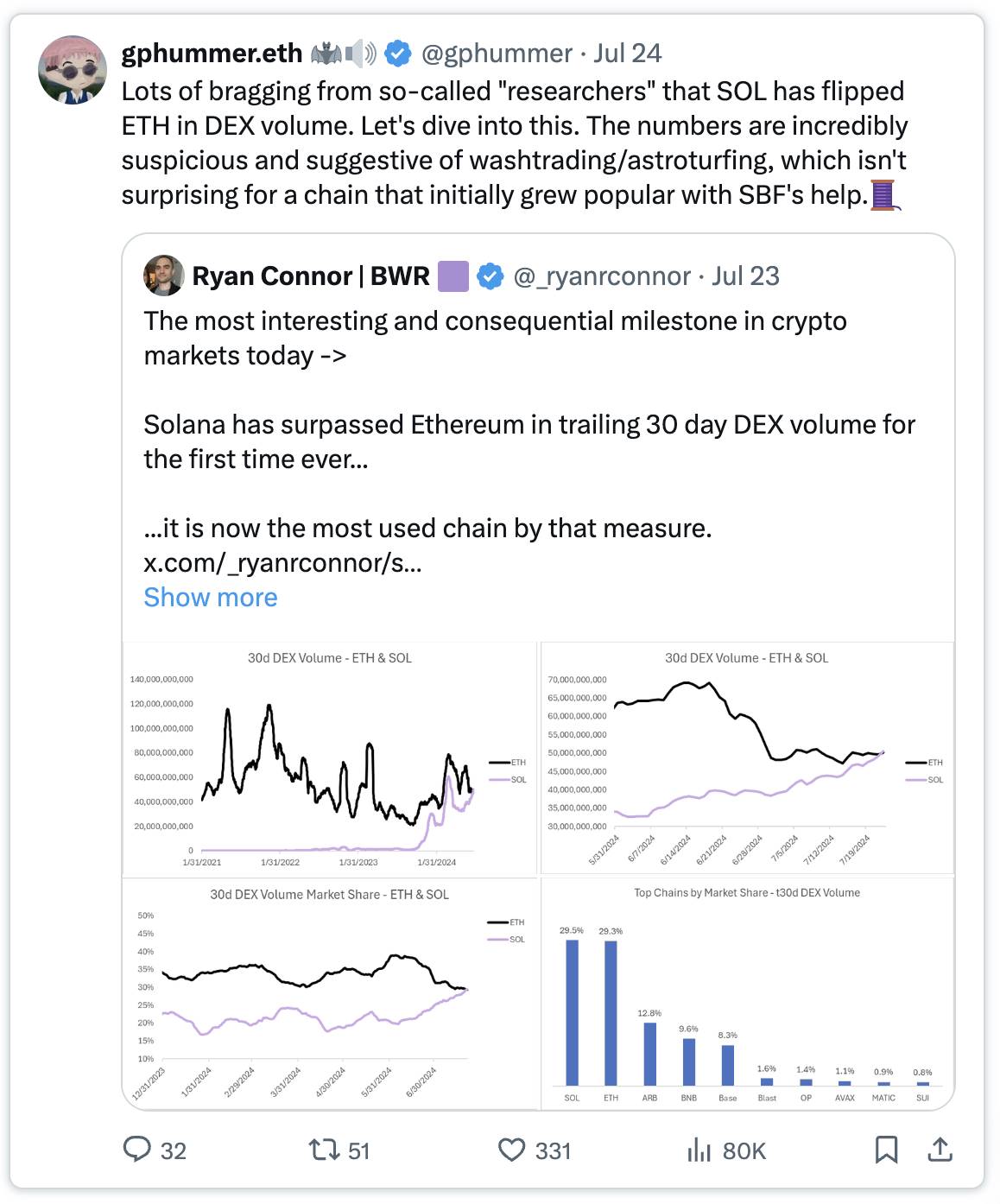
gphummer.eth: “Some self-proclaimed ‘researchers’ are loudly claiming SOL has surpassed ETH in DEX volume. Let’s dig deeper. This number is highly suspicious and suggests wash trading and manipulation—which isn’t surprising for a chain that initially gained popularity with SBF’s help.”
Ryan Connor | BWR: “The most interesting and important milestone in crypto today → Solana has officially surpassed Ethereum in 30-day DEX volume. By this measure, it’s now the most used chain.”
MEV on Solana
MEV on Solana has unique characteristics. Unlike Ethereum, Solana lacks a built-in mempool. Instead, participants like @jito_sol created (now deprecated) off-protocol infrastructure to simulate a mempool, enabling MEV opportunities such as frontrunning and sandwich attacks. Helius Labs published an in-depth article detailing MEV on Solana.
The issue on Solana is that the vast majority of traded tokens are hyper-volatile, low-liquidity meme coins, where traders often set slippage above 10% to ensure execution. This creates a rich attack surface for MEV:
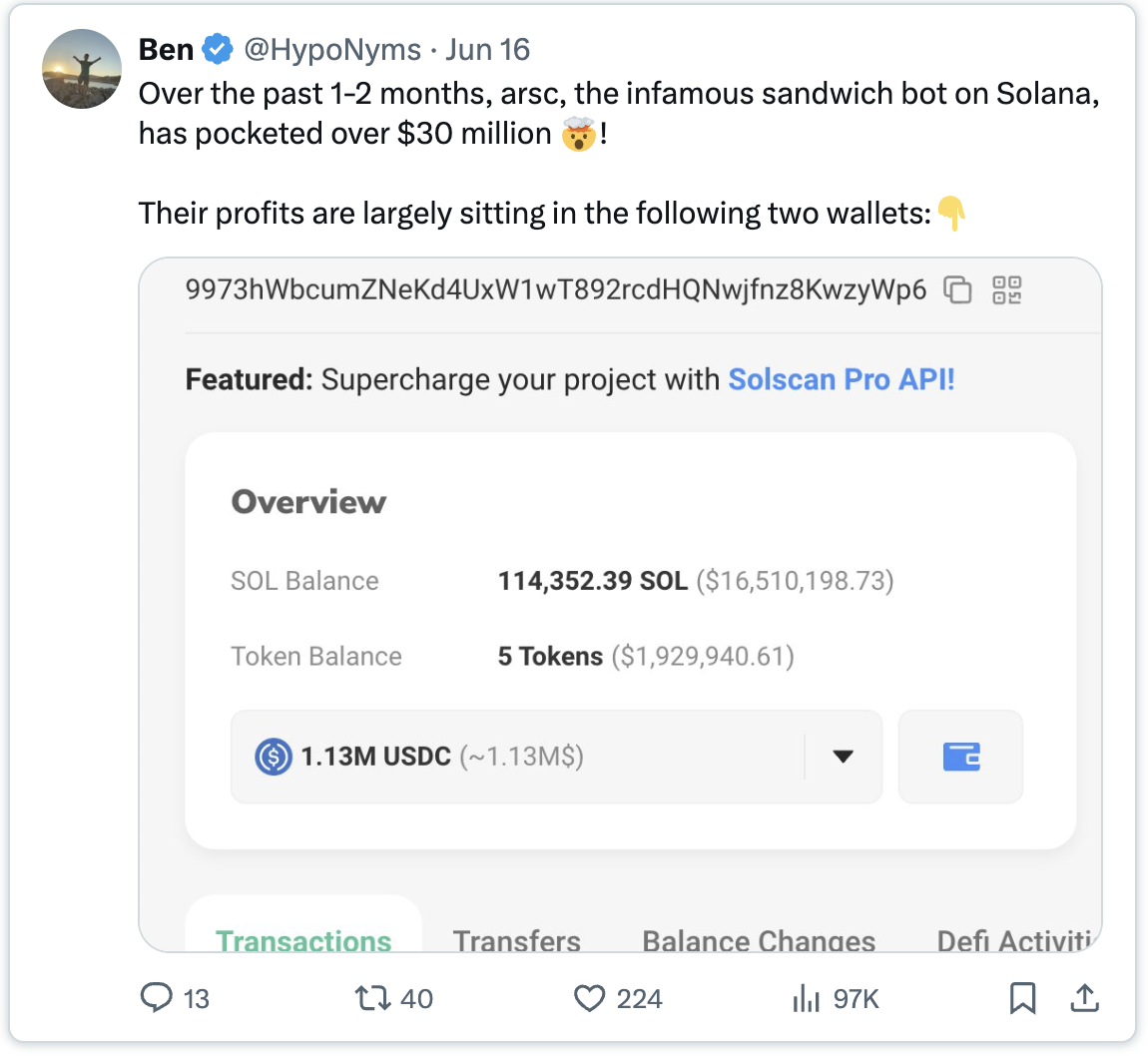
Ben: “Over the past 1–2 months, the notorious sandwich bot arsc has made over $30M in profit on Solana! Their profits are mainly stored in the following two wallets.”
Looking at blockspace profitability, it’s clear that most value now comes from MEV tips:
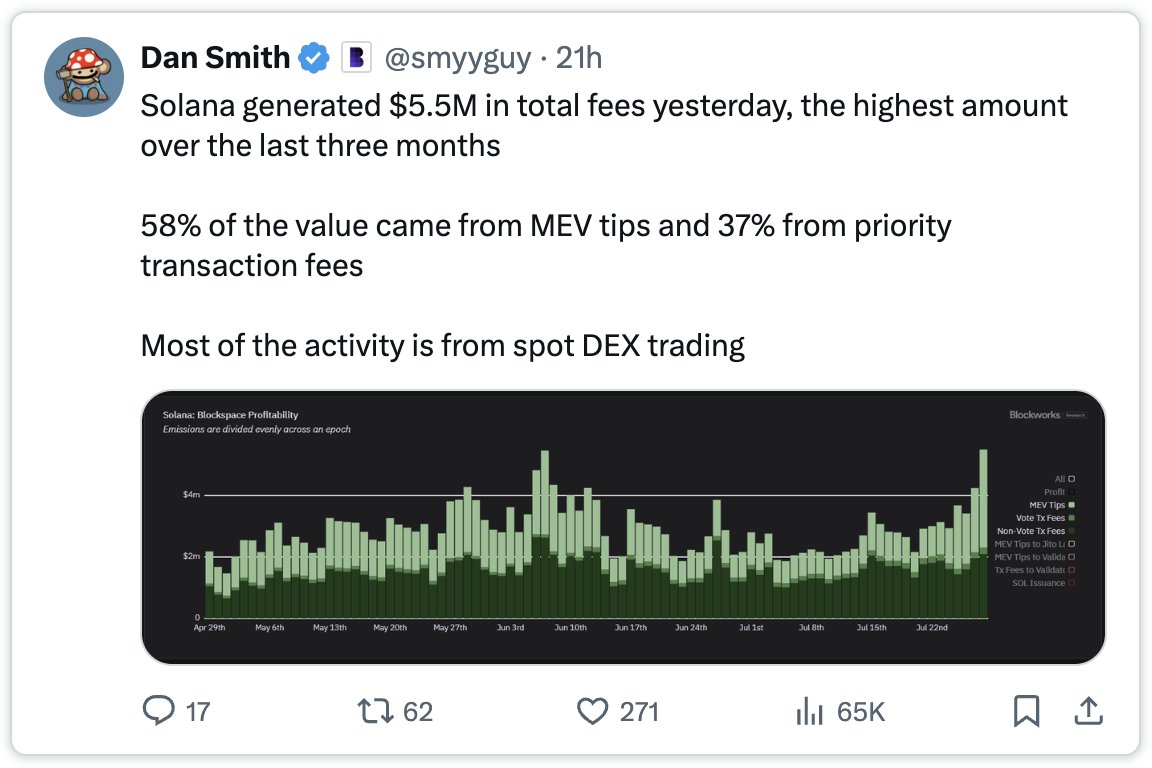
Dan Smith: “Solana generated $5.5M in total fees yesterday—the highest in the past three months. 58% of value came from MEV tips, 37% from priority fees. Most activity came from spot DEX trading.”
While technically real value, MEV only occurs when profitable—that is, as long as retail keeps participating and losing money on memes. Once meme activity cools down, MEV revenue will collapse too.
I’ve seen many arguments suggesting eventual migration toward infrastructure projects like $JUP and $JTO. That’s possible, but notably, these have lower volatility and higher liquidity, offering fundamentally different MEV opportunities.
Sophisticated players are incentivized to build optimal infrastructure to exploit this. During my research, some sources mentioned rumors of these players investing to control transaction pool space and selling access to third parties. However, I couldn’t verify these claims.
Nevertheless, clear distorted incentives are at play—by shifting as much meme coin activity as possible to SOL, sophisticated actors can continuously profit from MEV, insider trading on said memes, and rising $SOL prices.
Stablecoins
Another oddity appears in stablecoin trading volume and total value locked (TVL). Trading volume is clearly higher than ETH, yet when checking @DefiLlama’s stablecoin data, ETH’s stable TVL is $80B, while SOL’s is only $3.2B.
I believe stablecoin (and broader) TVL is a less manipulatable metric than volume and fees on low-cost platforms, reflecting actual capital commitment.
Stablecoin volume dynamics highlight this—@WazzCrypto noted that once the CFTC announced its investigation into Jump, trading volume suddenly dropped:
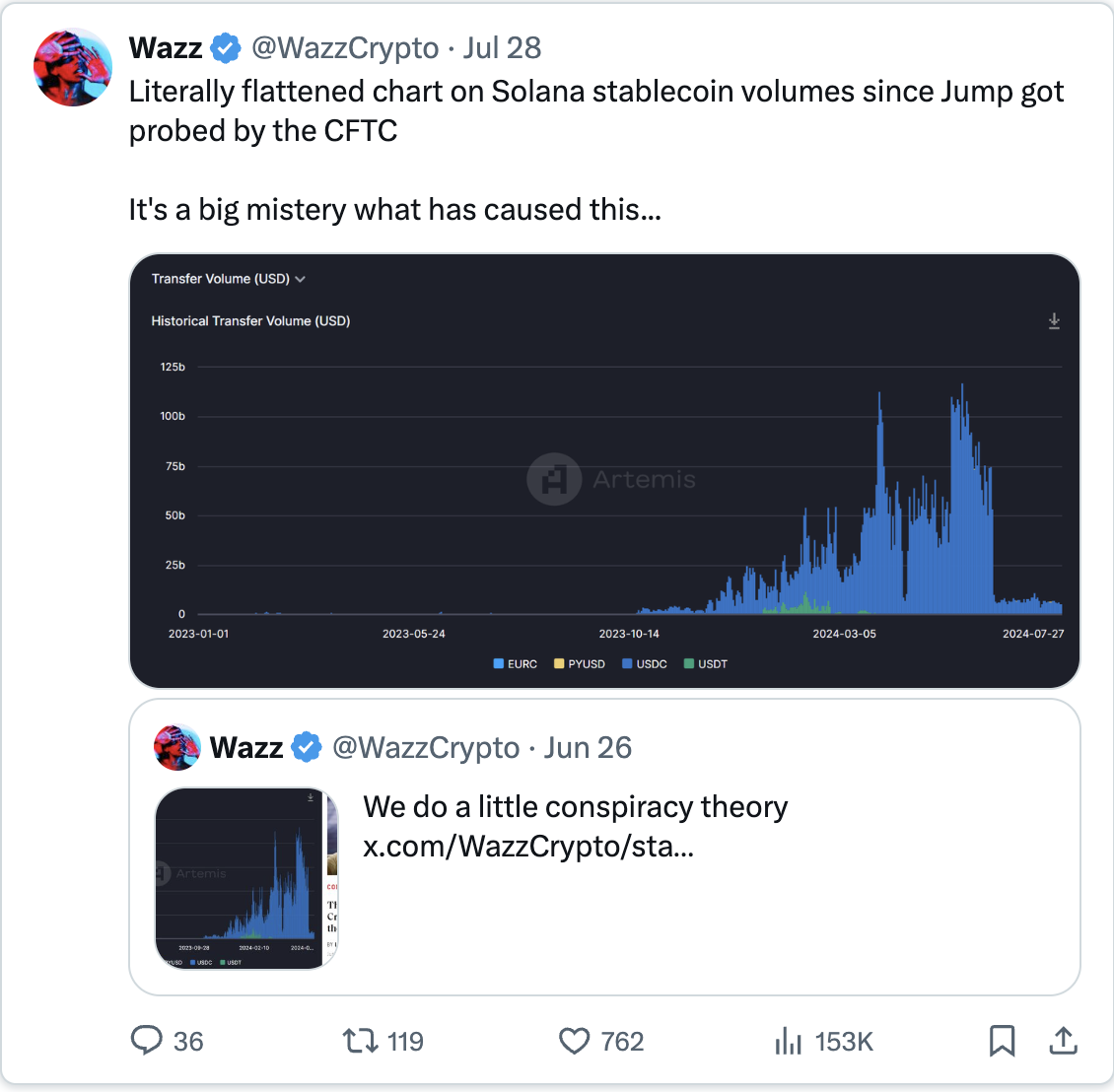
Wazz: “Since the CFTC probe into Jump, the Solana stablecoin volume chart has actually flattened. It’s a big puzzle what caused this.”
General Value Extraction
Beyond scams and MEV, the outlook for regular markets remains bleak. Celebrities have chosen Solana as their preferred blockchain, but the results haven’t been great:
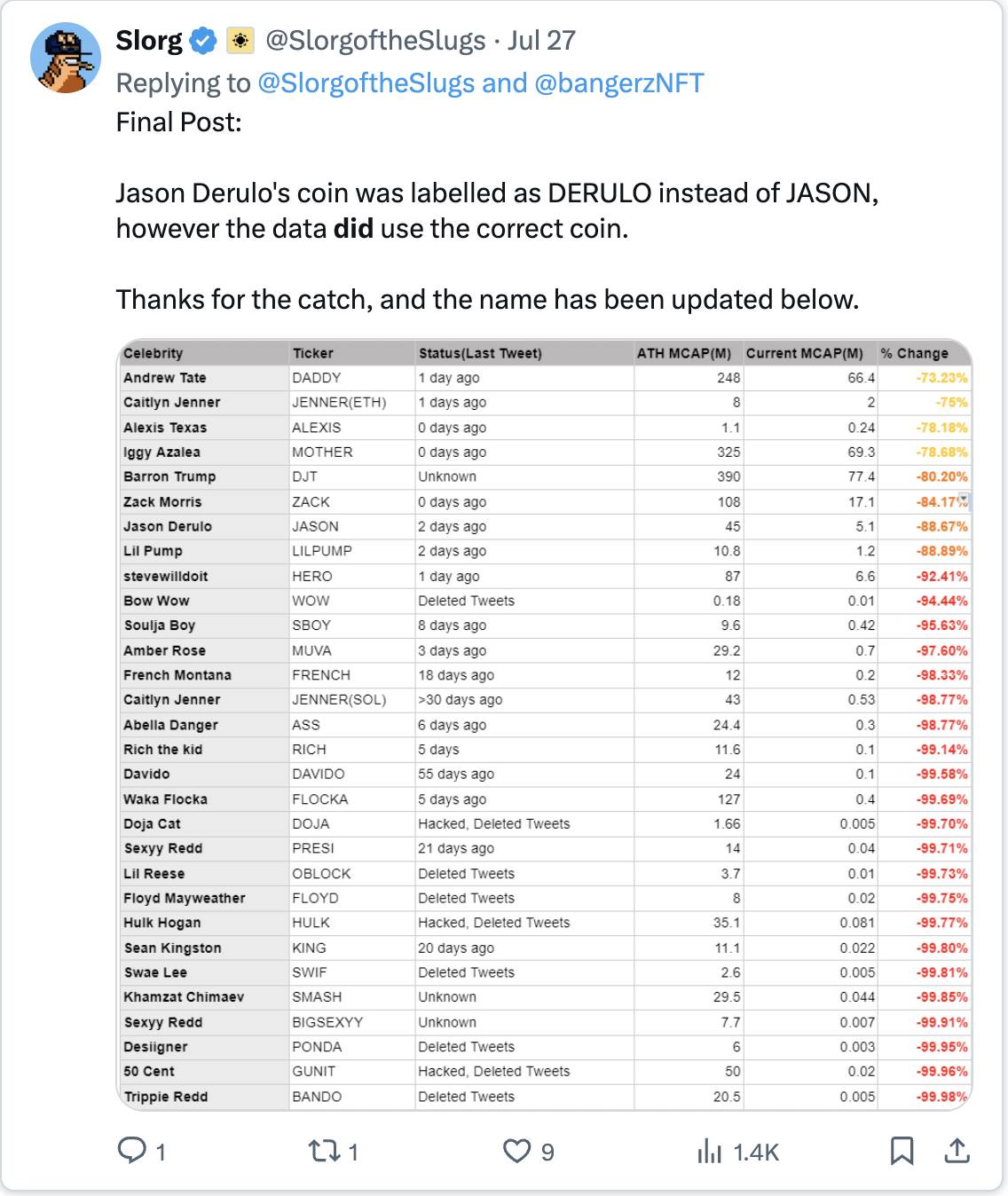
Slorg: “Jason Derulo’s token was labeled DERULO instead of JASON, but the data does use the correct token.” Andrew Tate’s DADDY is the top-performing celebrity token, yet still down 73%. On the flip side, things aren’t better:
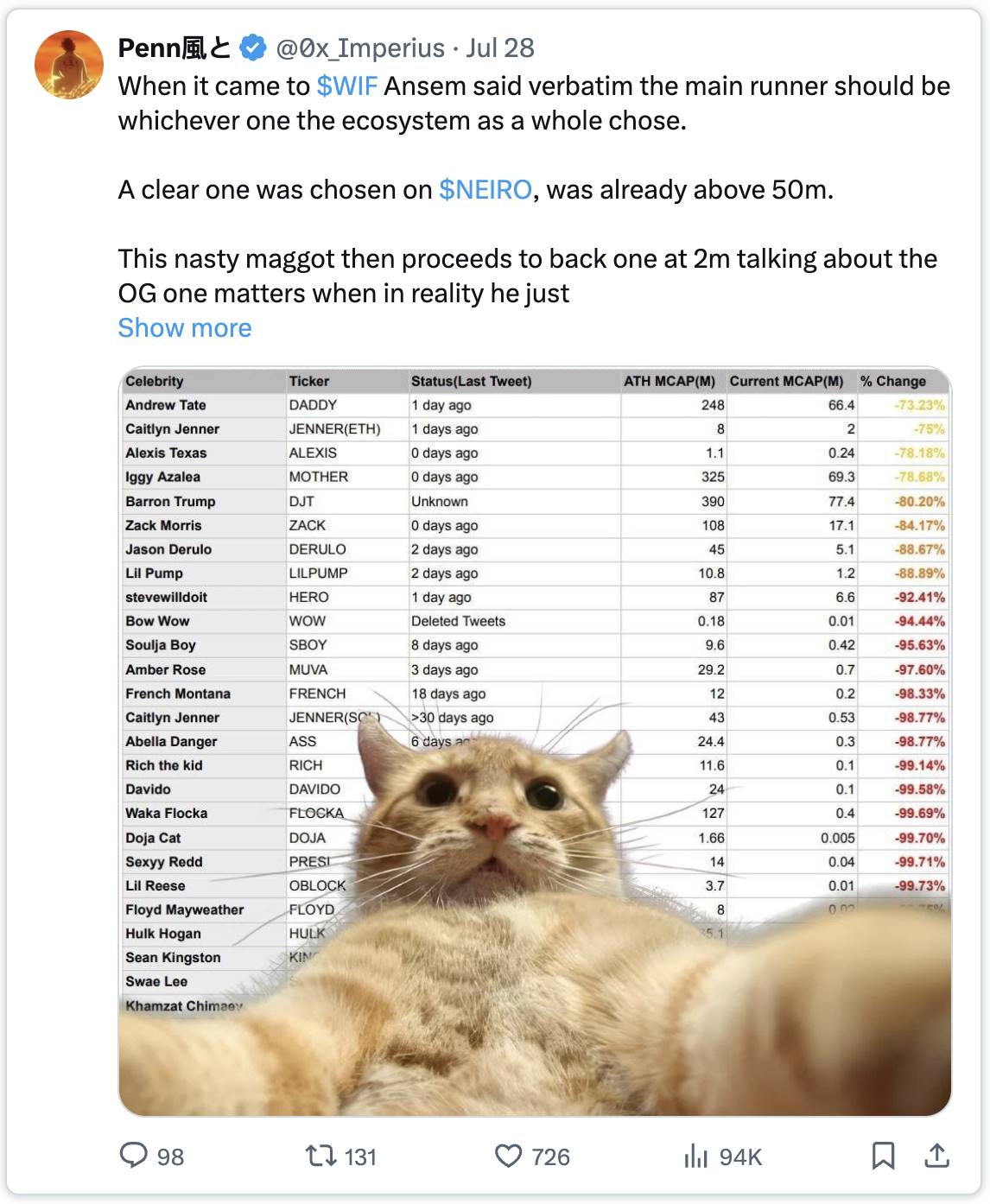
Penn風と: “Regarding $WIF, Ansem literally said the major player should be the one the ecosystem chooses. On $NEIRO, one has clearly been chosen, with volume already exceeding $50M. This guy later supports one based on 2M, talks about old projects mattering, when in reality he just missed the main opportunity. This is his outcome post-WIF—you guys need to stop worshipping this celebrity idol.”
A quick search on X also shows rampant insider trading and developer dumps on buyers:

Lookonchain: “$Neiro’s developer turned 3 $SOL ($552) into 15,508 $SOL ($2.85M)—a 5,169x return! 😱
He spent 3 $SOL ($552) to buy 97.5M $Neiro when deploying $Neiro.
Then he swapped across multiple wallets for 15,511 $SOL ($2.85M), selling 68M $Neiro, realizing a profit of 15,508 $SOL ($2.85M).
He also sent 10M $Neiro to a burn wallet, leaving 19.5M $Neiro ($1.8M) unrealized profit!
$Neiro is a #MEMEcoin on #Solana named after $DOGE (Kabosu)’s owner’s newly adopted dog.”
But Flip, my timeline is full of people making millions trading memes on Solana. How does that fit your narrative?
I don’t believe KOL posts on X represent the broader user base. In the current mania, it’s easy for them to establish positions, promote their tokens, profit from followers, and repeat. There’s clear survivorship bias—winners’ voices drown out losers’, distorting perception of reality.
Objectively, the average market participant loses millions daily—from scammers, developers, insiders, MEV, and KOLs—not to mention that most tokens traded on Solana are unsupported memes. It’s hard to argue against the fact that most memes will eventually meet the same fate as $boden.
Additional Considerations
Markets are fickle. When sentiment shifts, factors previously ignored become apparent:
-
Blockchain instability, frequent outages
-
High transaction failure rate
-
Difficult-to-use block explorers
-
High development barrier—Rust is far less user-friendly than Solidity
-
Poor interoperability with EVM. I believe competition among multiple interoperable chains for our attention is healthier than being trapped in a single (relatively centralized) chain.
-
Lower likelihood of ETF approval, both regulatorily and in terms of demand. This article highlights reasons for low institutional demand under Solana’s current state. @malekanoms also emphasized points I consider relevant to traditional finance (along with @0xmert’s rebuttal):
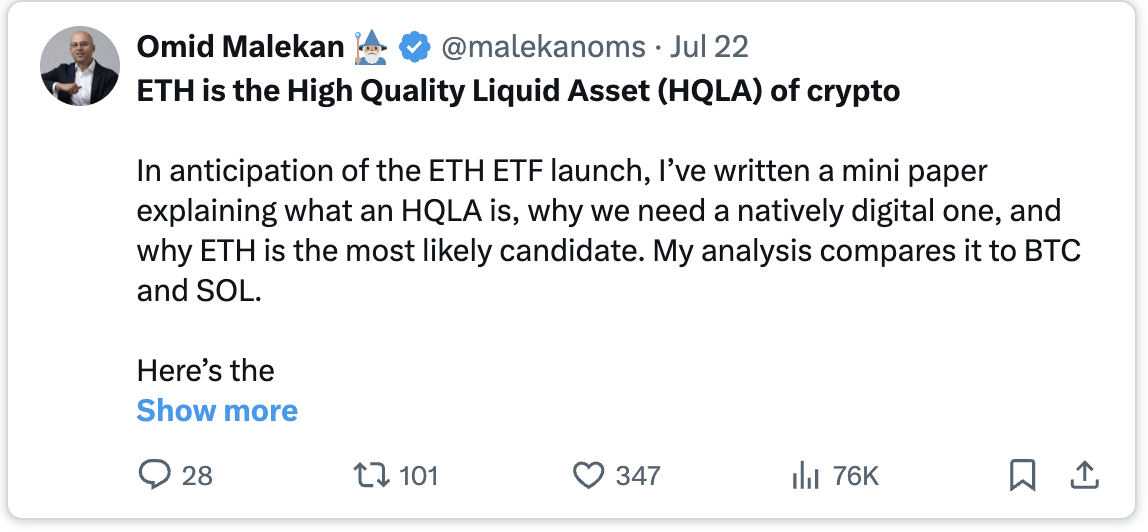
Omid Malekan: “ETH is high-quality liquid collateral (HQLA) in crypto. In preparation for the ETH ETF launch, I wrote a short paper explaining what HQLA is, why we need a native digital asset, and why ETH is the most likely candidate. My analysis contrasts it with BTC and SOL.”
-
Up to 67,000 new SOL (worth $12.4M) minted daily
-
41M SOL ($7.6B) still locked in FTX asset sales. 7.5M ($1.4B) unlock in March 2025, followed by 609,000 ($113M) monthly unlocks through 2028. Most tokens were purchased at ~$64 each.
Conclusion
As always, those who sell shovels profit, while speculators often suffer losses unknowingly.
I believe commonly cited SOL metrics are severely inflated. Moreover, the vast majority of organic users are rapidly losing money to malicious actors. We’re currently in a mania phase where net inflows still exceed outflows, creating a positive illusion. Once users grow weary from continuous losses, these metrics will collapse quickly.
As outlined, SOL also faces numerous fundamental headwinds that will surface once sentiment turns. Any price increase will exacerbate inflationary pressure and unlock schedules.
Ultimately, I believe SOL is overvalued on fundamentals. While prevailing sentiment and momentum may drive prices higher in the short term, the long-term outlook is far more uncertain.
Disclaimer: While I’ve held SOL at various times in the past, I currently do not hold any meaningful $SOL position. Many views expressed above are my personal speculation, not facts. I may be wrong in my assumptions and conclusions. Please do your own research—this is not investment advice.
Join TechFlow official community to stay tuned
Telegram:https://t.me/TechFlowDaily
X (Twitter):https://x.com/TechFlowPost
X (Twitter) EN:https://x.com/BlockFlow_News
 Flip Research