Podcast Notes | Vitalik Interview at EthCC: My Reflections on Cryptographic Protocols, Ecosystems, and Tokens
TechFlow Selected TechFlow Selected
Podcast Notes | Vitalik Interview at EthCC: My Reflections on Cryptographic Protocols, Ecosystems, and Tokens
In this episode, Vitalik shares his reflections on the journey of cryptocurrency so far, as well as his insights into the birth of Ethereum, the splitting of blockchain components, and competing with centralized protocols.
 Navigating Web3 tides with focused insights
Compiled & Translated by TechFlow

Guests: Vitalik Buterin, Founder of Ethereum; Christopher Goes, Co-founder of Anoma
Host: Michael Ippolito
Podcast Source: Bell Curve
Original Title: EthCC Campside Chat: Protocols, Ecosystems, Community & Tokens | Vitalik Buterin & Christopher Goes
Air Date: July 17, 2024
Key Takeaways
In this special episode, Vitalik Buterin and Christopher Goes joined our live session during the intent discussion meeting at EthCC 2024! Highlights from this campfire chat include Vitalik’s reflections on crypto’s journey so far, his insights into Ethereum’s origins, the splitting of blockchain components, and competing with centralized protocols. The conversation concludes with thoughts on social consensus and the importance of learning from past failures to better navigate future development.
Reflections on 15 Years of Cryptocurrency
Vitalik Buterin's Perspective as Ethereum's Founder
Michael asked about 15 years of cryptocurrency experimentation—Bitcoin has been around for over a decade, and Ethereum is already 10 years old. He invited Vitalik to reflect on Ethereum’s design philosophy and share which developments aligned with expectations and which were surprising.
-
Initial Design Philosophy: Vitalik recalled Ethereum’s origins, explaining that while working on early "Bitcoin 2.0" projects like Colored Coins and Mastercoin, he proposed adding a general-purpose programming language to enhance functionality. However, progress was slow, prompting him to launch Ethereum himself.
-
Core Design Principles: Ethereum’s key innovation was introducing a general-purpose programming language, distinguishing it from other protocols. Other major decisions included linearly increasing monetary supply, ASIC-resistant proof-of-work algorithms, and allowing miners to vote on gas limits.
-
Whitepaper and Use Cases: Vitalik noted that the whitepaper outlined multiple use cases—token issuance, stable assets, financial derivatives, decentralized file storage markets, and parametric insurance. Most have been attempted, but decentralized storage markets have underperformed.
-
Surprises and Lessons: NFTs were an unexpected success, while technical missteps like the 256-bit virtual machine required fixes. Vitalik also reflected on underestimating development timelines—had they anticipated this better, they might have simplified the roadmap and focused earlier on simpler proof-of-stake and scalability solutions.
Christopher’s Perspective
Michael asked Christopher about his experience developing IBC (Inter-Blockchain Communication) and what lessons he learned from Signal founder Moxie Marlinspike regarding decentralized protocol design.
-
Moxie Marlinspike’s View: Moxie once explained in a talk why he chose not to federate Signal—because doing so would slow down iteration. He believed Signal needed rapid updates to compete with WhatsApp and other centralized messaging services while preserving privacy and user sovereignty.
-
Challenges of Decentralized Protocols: Christopher noted that changing decentralized protocols involves complex social consensus requiring coordination among many stakeholders, significantly slowing development.
-
Balancing Speed and Decentralization: In blockchain, there must be a balance between fast iteration and decentralization—enabling competition with Web2 and traditional finance without sacrificing core values.
How Can We Compete With Centralized Protocols?
Michael posed the question: As designers and contributors to decentralized protocols, how can we successfully compete with centralized ones? Centralized systems benefit from speed and efficiency, while decentralized protocols face complex decision-making and slower execution. How can decentralization become a “superpower”?
Vitalik’s Perspective
Upgrading Decentralized Protocols
-
Vitalik believes that despite challenges in upgrading, Ethereum has proven it's feasible. Through multi-client architecture and consensus mechanisms, Ethereum has successfully completed numerous protocol upgrades.
-
Advantages of Multi-Client Architecture: This avoids centralization risks from a single development team and increases diversity of expertise, enhancing development efficiency and innovation.
Benefits of Decentralization
-
Political Resilience: Multi-client architecture prevents monopoly by any single team, offering users more choice and flexibility.
-
Diversity of Expertise: Multiple teams expand the knowledge base, accelerating development and fostering innovation.
Christopher’s Perspective
Diversity and Innovation
-
Christopher emphasized that decentralization’s greatest strength lies in diverse perspectives, ideas, and organizational structures. This enables innovation from multiple angles.
-
Ethereum’s Success: He praised Ethereum’s successful “Merge”—one of the most complex distributed system upgrades in human history—as proof that decentralized protocols can execute highly complex tasks.
Diversity Across Projects
-
Christopher believes different decentralized projects should offer unique perspectives and solutions rather than simply copying existing protocols. For example, Anoma aims to provide alternative research directions and solutions to complement and enrich the ecosystem.
Challenges with Financial Assets
-
Slow Changes in Decentralized Protocols: Once blockchains involve financial assets, changes become extremely difficult—users don’t want their asset security compromised. Thus, upgrades must be approached with extreme caution.
-
Exceptions Requiring Fast Response: Rapid action is only justified in cases of attacks or system failures—the few scenarios demanding urgency.
-
Exploring Capital Structures
-
Christopher suggested exploring new capital structures to avoid the post-launch rigidity caused by fast deployment. Many projects slow down drastically after launch due to real assets and decentralized operations—this needs to be considered upfront in design.
Ethereum’s Roadmap: What Comes Next?
Michael asked Vitalik about Ethereum’s future. A few months ago, Vitalik published a blog post stating Ethereum had shifted from solving “0 to 1” problems to “1 to N” problems. Michael wanted Vitalik to elaborate on that article and discuss Ethereum’s next steps.
Vitalik’s Perspective
Complex Upgrade Process
-
Vitalik stressed that Ethereum’s “Merge” was incredibly complex—not just technically, but also in terms of specification and ecosystem adaptation. Future upgrades will be relatively simpler since much foundational work is now complete.
Maturity of the L2 Ecosystem
-
Ethereum’s roadmap now focuses more on Layer 2 (L2) solutions. Users and developers are increasingly adapting to L2 environments, with many applications already running on L2s.
-
Blob Data Structure: EIP-4844 introduced blob data, enabling L2s to handle data more efficiently. This reduces the impact of future upgrades on L2s, allowing them to operate without major modifications.
Future Work
-
Vitalik said future efforts will shift behind the scenes, becoming less disruptive. Over time, upgrades will become more incremental and less impactful to applications.
From L1 to Application-Layer Focus
-
Vitalik believes the focus will gradually move from Layer 1 (L1) issues to application-layer concerns. Developers now have sufficient tools to build user-friendly yet cypherpunk-aligned applications.
Role of Ethereum L1
-
Vitalik explained L1’s role in improving user experience. He outlined two possible roadmaps:
-
Minimalist L1 Roadmap: L1 acts as a settlement layer, prioritizing security and censorship resistance, leaving fast confirmations to L2s.
-
More Complex L1 Roadmap: L1 provides faster confirmation times, reducing L2 burden and allowing some apps to remain on L1.
-
-
Vitalik mentioned that if he could change one thing, he’d opt for a simpler version of proof-of-stake, saving significant development time.
-
He also highlighted Ethereum’s unique approach to 51% attacks—not relying solely on social consensus, but actively designing protocol-level recovery mechanisms to automatically restore integrity if attacked.
Censorship Resistance
-
Vitalik emphasized the importance of censorship resistance. If an L2 chooses to censor users, the user experience could degrade sharply. Therefore, having L1 provide faster confirmations is valuable—it ensures user experience remains intact even if L2s censor transactions.
The Role of Standards
Michael asked: As blockchains move toward a modular world, what role do standards play?
He referenced the “tragedy of the commons,” where pure reliance on free markets may lead to resource overuse. How can standards help in such situations within blockchain?
Christopher’s Perspective
Distinguishing Modularity
-
Christopher first distinguished modularity within a protocol versus across networks. Protocol modularity usually refers to building abstraction layers, while network modularity often means adding many intermediary nodes across chains.
-
Impact of Capital Structure: He argued that network-level modularity is often driven more by capital structure than design philosophy.
Modularity in Protocol Design
-
Modularity is crucial in protocol design—clearly defining roles of different entities. For example, in rollup-based architectures, L1 provides data availability and ordering, whereas in Plasma, L1 only handles ordering.
-
Decoupling vs. Coupling: Protocol designers should aim to decouple roles, though economic incentives may naturally cause certain roles to re-couple in practice.
Market Structure and Protocols
-
Free market competition benefits protocols by enabling free flow and evolution of ideas, driving research and progress. However, decentralized development ecosystems may create complexity that users find hard to understand and use.
-
Advantage of Centralization: Successful consumer software companies are typically large hierarchical organizations capable of coordinating development and interface design to deliver user-centric products. Hence, he recommended exploring hybrid capital structures between free markets and centralized models to improve UX in crypto.
Vitalik’s Perspective
Maintaining a Unified Ethereum Experience
-
Vitalik stressed that entering the L2 era, it’s vital that the entire Ethereum ecosystem still feels like Ethereum. Users shouldn’t feel confused switching between apps—no manual network switching required.
-
ERC-3737 Standard: Users should be able to enter an address in a browser wallet and click send without worrying about which chain the recipient is on.
Value of Standards
-
Vitalik believes standards’ greatest value lies in simplifying user experience, enabling seamless interaction across apps and networks. He also noted that certain entities need strong incentives to drive standard adoption.
-
Role of the Ethereum Foundation: He believes the Ethereum Foundation can play a larger role in promoting standards, such as coordinating cross-L2 infrastructure.
Incentive Mechanisms
-
Vitalik discussed ideas around modifying ETH issuance rules to incentivize rollups. He cautioned such mechanisms must be designed carefully to avoid politicization.
-
Indirect Selection Mechanisms: He emphasized that the best systems are indirect—avoiding direct allocation of funds, thus reducing bias and increasing fairness.
Splitting Blockchains
Michael raised the topic of blockchain splitting. While we often discuss it through data availability, execution, and settlement, he argued that we’re actually splitting core blockchain components: assets, security models, and communities.
Christopher’s Perspective
Bitcoin’s Bundling
-
Christopher began by reviewing Bitcoin’s history. Initially, Bitcoin tightly bundled assets, protocol, and community. Early adopters saw these as inseparable, with little effort to split them.
-
Ethereum’s Decoupling: Over time, projects like Ethereum began separating these elements. For instance, the Ethereum community is related to ETH, but not identical—many active participants hold little ETH.
Relationship Between Community and Assets
-
Christopher believes Ethereum’s value stems more from its community than the asset alone. Even users purely interested in dollar value must consider how many others are willing to buy ETH with dollars—driven more by community trust and support than protocol usage.
Asset Capital Structures
-
He suggested that decoupling allows exploration of novel capital structures. For example, Asset A could annually distribute 50% of its supply to holders of Asset B, and vice versa. Such mutual distribution could foster collaboration and reduce duplicated efforts.
-
Governance Challenges: However, such mechanisms face governance hurdles. Deciding how assets are distributed is hard to resolve abstractly—ultimately requiring subjective human judgment.
Vitalik’s Perspective
Uniqueness of the Ethereum Community
-
Vitalik emphasized the Ethereum community’s uniqueness—its diversity and inclusivity. People may use different tools, but they share common values and goals.
-
Importance of Standards: He believes standards are crucial for maintaining consistency. For example, ERC-3737 simplifies cross-app and cross-network interactions, reinforcing ecosystem unity.
Incentive Mechanism Design
-
Vitalik revisited the idea of adjusting ETH issuance to incentivize rollups, stressing careful design to prevent politicization.
-
Indirect Selection Mechanisms: Again, he advocated for indirect mechanisms over direct funding allocations to maintain fairness and reduce bias.
Success and Failure in Cryptocurrency
Michael posed a final question: Looking back 15 or 20 years from now, what will determine whether cryptocurrency experiments succeeded? What would make us feel this time was well spent and worth being proud of? Conversely, what would disappoint us—and how can we avoid that outcome?
Vitalik’s Perspective
Real-World Adoption
-
Vitalik believes ultimate success depends on real-world use. If crypto becomes mainstream—or at least a credible alternative like Linux—that’s success. Examples: Ethereum accounts replacing social logins, crypto integrated into financial systems, DAOs replacing corporations or nonprofits, or decentralized social media and prediction markets gaining traction.
Signs of Failure
-
Conversely, failure would mean crypto is remembered as a shrinking group of idealists shouting into the void—or merely a playground for trading digital monkeys and celebrity photos.
High-Leverage Work
-
Vitalik believes current work is high-leverage. While trivial applications (like monkey/NFT trading) aren’t sensitive to fees or UX, truly valuable applications depend heavily on low costs and good user experience. Improving these aspects directly enables broader adoption of useful apps.
Improving User Experience
-
He gave examples: Trading on Augur five years ago was terrible, but Polymarket today offers a vastly improved experience. Similarly, UX in decentralized social media has greatly improved—such progress drives wider adoption.
Christopher’s Perspective
Autonomy vs. Interoperability
-
Christopher believes crypto’s promise lies in balancing autonomy and interoperability. Today, systems force trade-offs—e.g., to interoperate with U.S. finance, you must use SWIFT. Crypto can offer standardized protocols allowing communities to clearly define dependencies and autonomous zones.
Low Switching Costs
-
If protocols enable easy interoperability, switching costs drop. Communities can freely adjust topology and dependencies when needed.
Social Impact
-
Christopher hopes to be completely irrelevant in 15 years. Blockchain tech should become as mundane as databases—boring infrastructure, no longer headline news. Success means it’s so widespread and normalized that only specialists care.
Audience Q&A
-
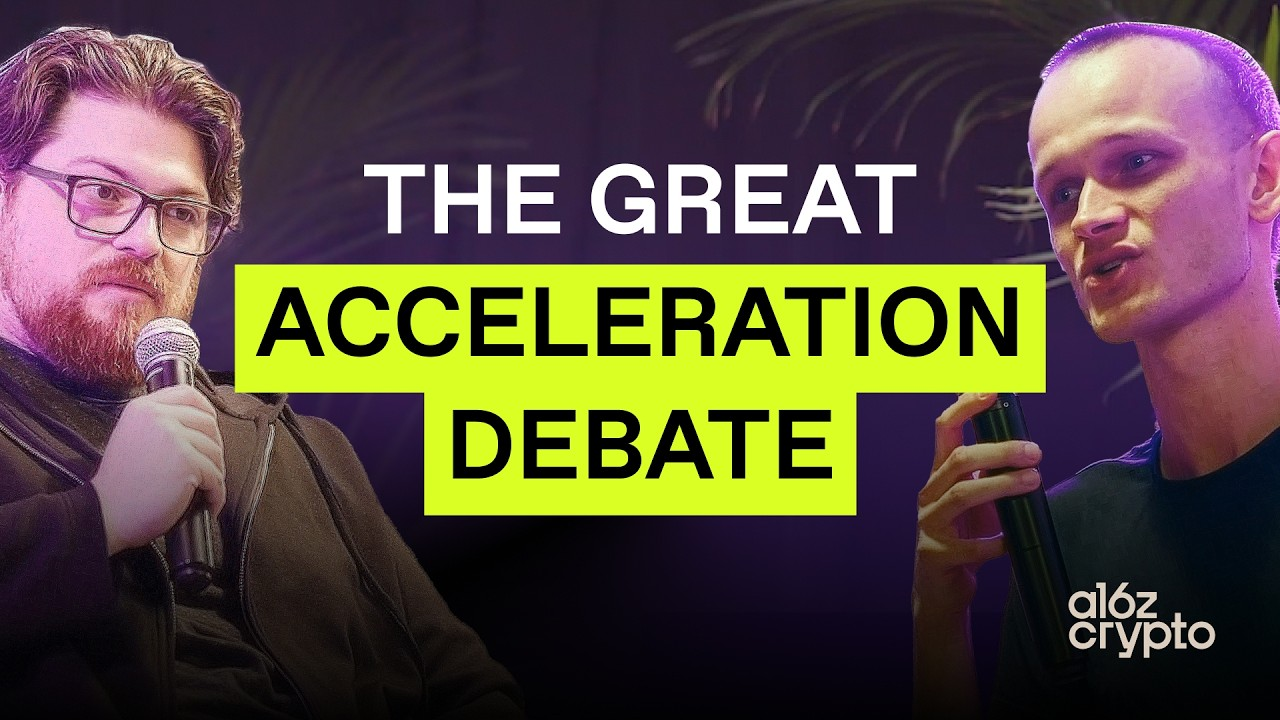
Nathan referenced Vitalik’s past comments on the dangers of social consensus and asked whether an accelerationist approach—rapidly experiencing all failure modes early—could help fix systemic issues before the space grows too large and uncoordinated.
-
Vitalik responded that it’s an interesting view. He noted that if Mt. Gox hadn’t collapsed early, people might not have seen the importance of decentralized exchanges, remaining overly reliant on centralized ones—potentially making later disasters like FTX even worse.
-
He added that threat-driven responses are chaotic systems—this perspective could be valid, but it’s also easily exploited by bad actors to justify harmful behavior.
-
Vitalik personally prefers such experiments happen at smaller scales than Ethereum. He advocates for intermediate-sized test environments—e.g., L2s with TVL and DeFi activity in the tens to hundreds of millions, not billions like Ethereum.
-
He described L2s as “crypto-anarchist economic free zones,” encouraging wild experimentation and seeking regulatory tolerance. Those who wish can participate; others can stay in the conventional world.
-
Vitalik believes using Ethereum itself as a sandbox is now too risky, but L2s feel like the right scale.
Join TechFlow official community to stay tuned
Telegram:https://t.me/TechFlowDaily
X (Twitter):https://x.com/TechFlowPost
X (Twitter) EN:https://x.com/BlockFlow_News
 深潮TechFlow