








Spot Ethereum ETF First-Day Data Analysis and Market Outlook: Clinging to the Past or Jumping the Gun?
TechFlow Selected TechFlow Selected
Spot Ethereum ETF First-Day Data Analysis and Market Outlook: Clinging to the Past or Jumping the Gun?
Strong selling pressure from Grayscale, but BlackRock and Bitwise join forces to reverse the capital flow; however, the market remains under short-term pressure.
 Navigating Web3 tides with focused insights
Author: Nanzhi, Odaily Planet Daily
Last night marked the first trading day for spot Ethereum ETFs. The nine ETFs collectively recorded over $1 billion in trading volume on their debut—approximately 23% of the $4.6 billion traded on the first day of spot Bitcoin ETFs in January—and achieved a net inflow of $106 million.
How do the specific figures for spot Ethereum ETFs compare to those of Bitcoin? Can we draw direct parallels? In this article, Odaily compiles data and market insights to analyze the situation.
Spot Ethereum ETF Data
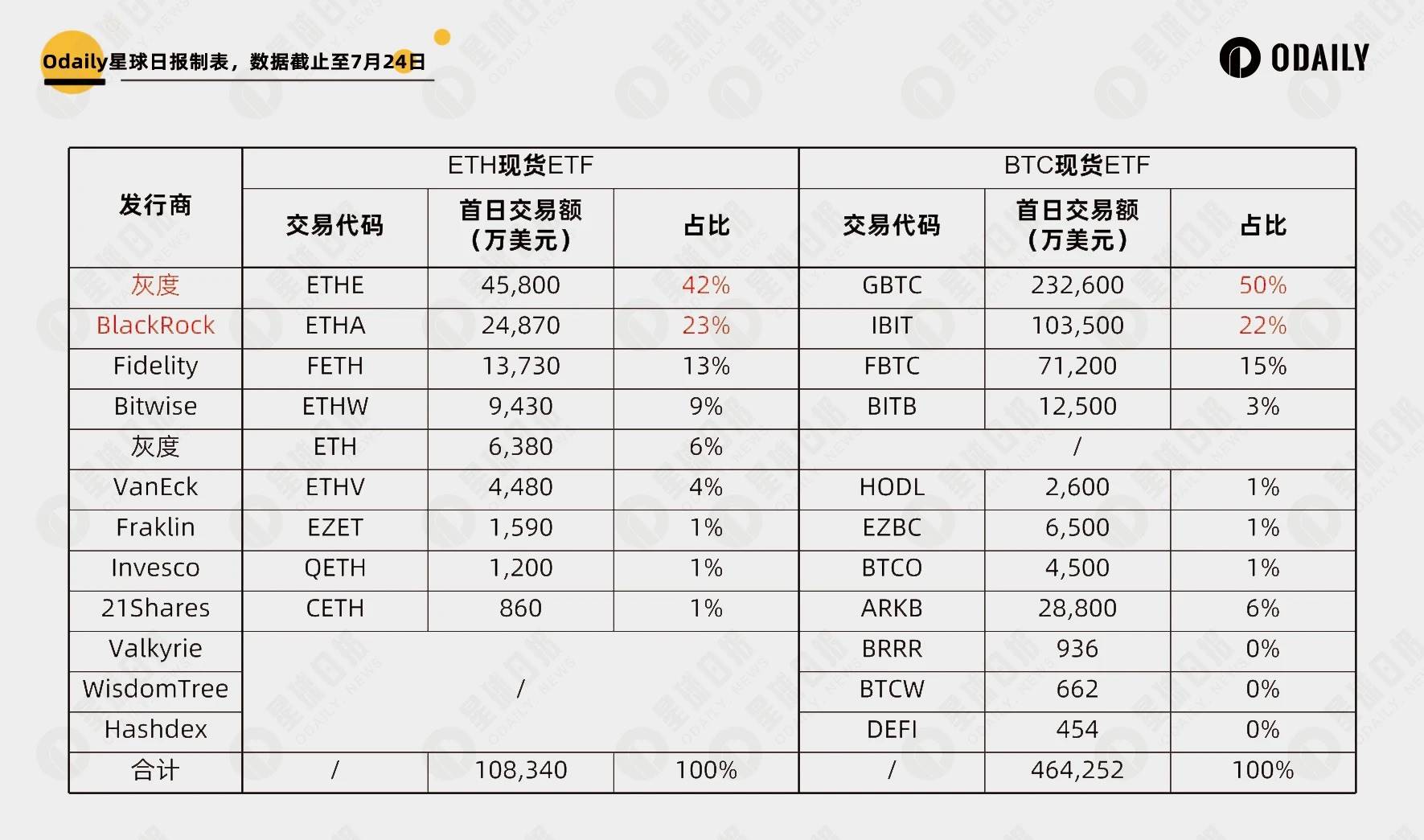
According to data released by Bloomberg ETF analyst Eric Balchunas, the nine ETFs saw $1.083 billion in trading volume on their first day (The Block reported $1.019 billion), with:
Grayscale’s ETHE leading at $458 million, accounting for 42% of total volume. By comparison, Grayscale’s spot Bitcoin ETF GBTC had $2.3 billion in volume on its January debut, representing 50% of that day’s total.
BlackRock’s ETHA ranked second with $248 million, or 22.9% of total volume. For reference, BlackRock’s IBIT recorded $1.03 billion on its first day in January, capturing 22.7% of total volume—a very close proportion.
In terms of net flows, spot Ethereum ETFs recorded a net inflow of $106 million on day one—about 17% of the $620 million net inflow seen by Bitcoin ETFs on their debut. Specifically:
Grayscale’s ETHE experienced a net outflow of $484 million, while the primary inflows came from BlackRock’s ETHA ($266 million) and Bitwise’s ETHW ($204 million). As shown in the chart below, the balance is less even than in the Bitcoin ETF case, and Grayscale’s outflows are more pronounced.
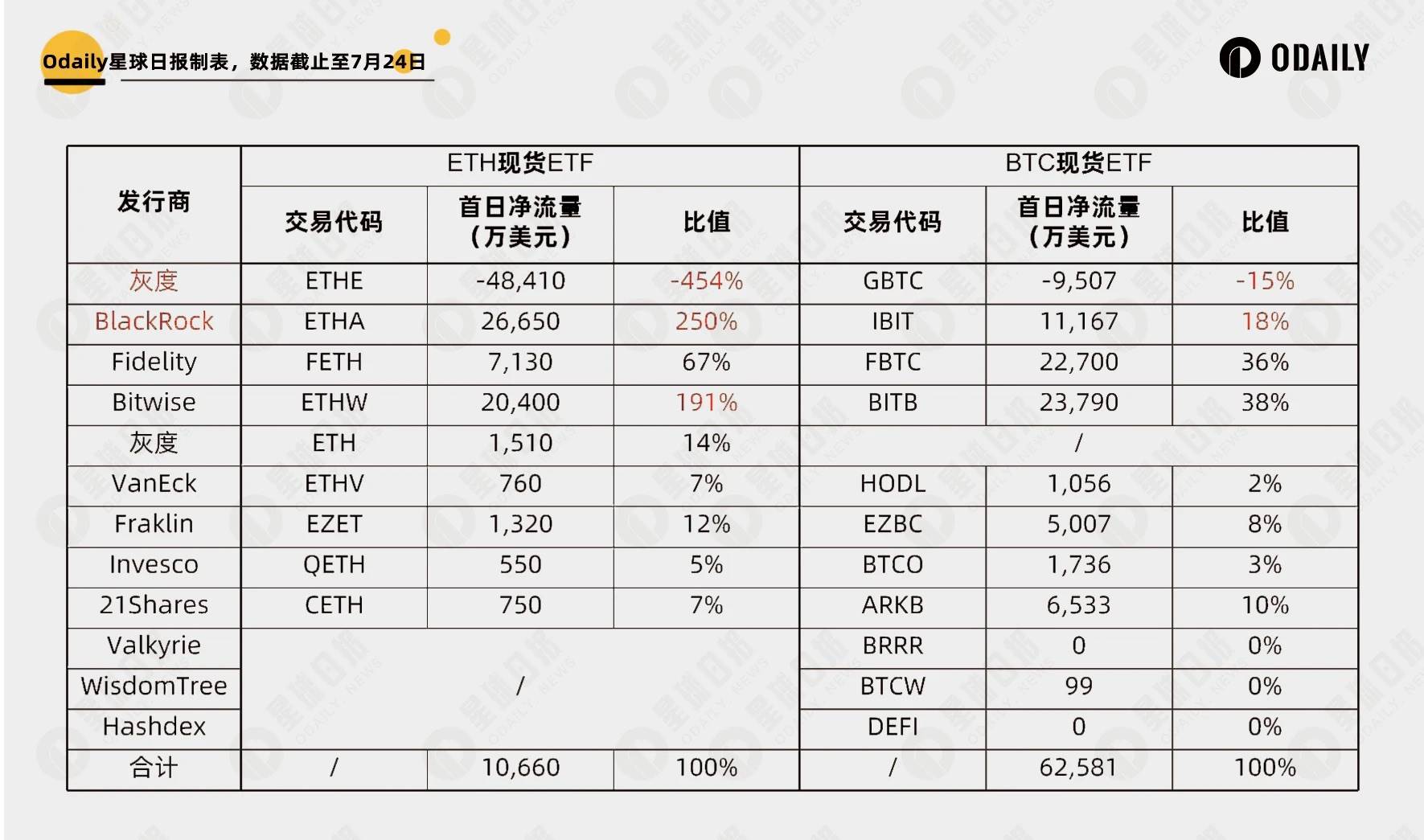
Over the months since Bitcoin ETFs launched, IBIT’s strong inflows have been the key force countering GBTC’s sustained selling pressure. From day-one data, both trading volume and net flow ratios between major players appear similar. However, Grayscale may still dominate early stages, potentially mirroring the earlier trend.
Looking Back at Bitcoin's January Trajectory
What was the price movement around the approval of spot Bitcoin ETFs?
-
On January 1, Bitcoin opened at approximately 42,280 USDT;
-
On January 11, following ETF approval, Bitcoin briefly peaked at 48,960 USDT—an increase of 15.7%. It then began to decline under GBTC selling pressure, falling 7.6% the next day;
-
On January 23, Bitcoin hit a short-term low of 38,550 USDT, down 21.2% over 12 days, before embarking on a rally that eventually reached a new high of 73,777 USDT.
The recent peak occurred just two days ago (July 22). Measured from the highest price to the price 12 hours after Ethereum ETF trading commenced, BTC has dropped 4.2%, while ETH has declined 3.7%.
How is the market interpreting the post-approval trajectory for ETH spot ETFs—is it a repeat of past patterns, or has the rally already been priced in?
Market Perspectives
Short-Term Pressure
Most institutions expect the market to trade sideways or downward in the early phase following ETF approval due to selling pressure from Grayscale’s ETHE:
-
Haseeb Qureshi, Managing Partner at Dragonfly, commented that the opening trading volume for spot Ethereum ETFs was strong, but ETH prices haven’t moved significantly yet—likely because Grayscale’s ETHE is primarily selling, which offsets much of the day-one inflows.
-
Jupiter Zheng, Partner at Hashkey Capital Liquid Fund, noted that fund outflows from Grayscale’s Ethereum Trust could pressure ETH prices following today’s ETF launch and may dampen market sentiment in the short term. However, as with Bitcoin ETFs, investors might shift capital into lower-fee alternatives.
-
QCP Capital’s latest report stated that the market reaction to the spot Ethereum ETF launch has been muted, with investors watching for a “buy the rumor, sell the news” pattern. Influenced by U.S. government actions and Mt Gox developments, options markets suggest further downside in the near term. With spot Ethereum ETFs unlikely to immediately impact prices, and potential selling pressure from U.S. authorities and Mt Gox, spot prices may remain subdued until momentum builds ahead of the elections.
Options Data: High IV, Slight Bullish Bias
Adam, macro researcher at Greeks.live, noted that ETH’s expiry-day implied volatility (IV) has surged above 80%, significantly higher than the recent average of 60%. In terms of trading activity, aggressive call buying accounted for nearly half of daily volume, with skew slightly favoring bulls. Overall, the options market today is dominated by bullish positioning. However, he also pointed out that during BTC ETF launches, heavy selling caused price drops—so today’s bullish momentum is weaker than during the BTC ETF debut.
Interestingly, large block trades today were mostly concentrated in BTC, with over 5,000 deep out-of-the-money long-dated call options traded, whereas ETH activity remained centered at the order book. Market makers are actively rebalancing amid heightened market activity.
BRN: Target Price $2,800–$3,100
Valentin Fournier, analyst at digital asset research firm BRN, said in an email: "We recommend maintaining exposure to the positive momentum in crypto markets, but with a preference for Bitcoin over Ethereum, as we believe the hype and ETF inflows for Ethereum have already been priced in. We expect Ethereum to fall to a level between $2,800 and $3,100 before rebounding to $4,000 by September."
Markus Thielen, founder of 10x Research, echoed this view in Tuesday’s newsletter, stating, "Once the spot Ethereum ETFs launch, investors will likely take profits."
Ethereum ETFs Lack Appeal Due to Absence of Staking Rewards
Investor sentiment ahead of the U.S. Ethereum ETF launch has been more cautious and divided, in stark contrast to the widespread enthusiasm preceding Bitcoin ETFs. A key concern for some investors is the SEC’s exclusion of staking—a core feature of the Ethereum blockchain. Staking allows users to earn rewards by locking up their ETH to help secure the network. These rewards come in the form of newly minted ETH and a share of transaction fees. Under the current framework, the SEC will only permit ETFs to hold standard, non-staked ETH.
"Institutional investors focused on Ethereum know that staking generates yield," said Mel McGurk, analyst at CoinShares. "It’s like a bond manager saying, 'I want to buy bonds, but I don’t want the interest'—it completely contradicts the purpose of buying bonds." McGurk believes investors will continue staking ETH directly outside of ETFs to earn yield, rather than pay fees to hold unstaked ETH through an ETF.
Join TechFlow official community to stay tuned
Telegram:https://t.me/TechFlowDaily
X (Twitter):https://x.com/TechFlowPost
X (Twitter) EN:https://x.com/BlockFlow_News
 Odaily






