








Vitalik's new article: Don't let your political stance be determined by someone being "pro-crypto"
TechFlow Selected TechFlow Selected
Vitalik's new article: Don't let your political stance be determined by someone being "pro-crypto"
Don't just support cryptocurrencies themselves, but support the deeper goals they aim for and the policy implications they bring.
 Navigating Web3 tides with focused insights
Author: Vitalik Buterin
Compiled by: TechFlow
Over the past few years, "crypto" has gained increasing importance in political policy, with various jurisdictions considering different bills to regulate participants in blockchain activities. For example, the EU's Markets in Crypto-Assets Regulation (MiCA), the UK’s regulatory efforts on stablecoins, and the complex legislative and enforcement attempts by the U.S. Securities and Exchange Commission (SEC). In my view, most of these proposals are reasonable, although there are concerns about extreme measures such as treating nearly all tokens as securities or banning self-custody wallets. Due to these concerns, an increasing number of crypto practitioners have become politically engaged, often supporting political parties or candidates almost entirely based on their stance toward "crypto."
In this article, I argue against this trend, particularly because I believe such decision-making is highly risky and may contradict the original motivations and values that brought you into the crypto space.

(A photo of me with Vladimir Putin in 2018. At the time, many Russian government officials expressed openness toward "crypto.")
"Crypto" Is More Than Just Cryptocurrencies and Blockchains
Within the crypto community, there's often a strong tendency to overemphasize the importance of "money," and the freedom to hold and use money (or "tokens"), treating it as the paramount political issue. I agree this is indeed a crucial battle: in modern society, anything significant requires money, so if someone can cut off another person’s funding, they can suppress political opponents at will. The right to spend privately, passionately advocated by Zooko, is equally important. The ability to issue tokens significantly enhances people's capacity to create digitally organized communities with collective economic power. However, focusing almost exclusively on cryptocurrencies and blockchains is hard to justify, and more importantly, it does not reflect the original ideals that gave rise to crypto.
Cryptocurrencies were originally created by the cypherpunk movement, a broader technolibertarian ethos advocating for the general protection and enhancement of individual freedom through free and open technologies. In the 2000s, a major focus was resisting restrictive copyright legislation pushed by corporate lobbying groups like the RIAA and MPAA, which the internet dubbed "MAFIAA." A notorious legal case that sparked widespread outrage was Capitol Records, Inc. v. Thomas-Rasset, where the defendant was forced to pay $222,000 in damages for illegally downloading 24 songs via file-sharing networks. The main tools of resistance were peer-to-peer sharing networks, encryption, and online anonymity. An early lesson learned was the importance of decentralization. As Satoshi Nakamoto explained in one of his rare public political statements:
Omitted is any detailed explanation of the system's vulnerability to monopolies using force.
You won't find solutions to political problems in cryptography.
Yes, but we can win an important battle in the arms race and gain a new territory of freedom for several years.
Governments are good at decapitating centralized networks like Napster, but pure P2P networks like Gnutella and Tor seem capable of standing on their own.
Bitcoin was seen as an extension of this spirit into the domain of internet payments. There were even early equivalents of "regenerative culture": Bitcoin, being an extremely simple online payment method, could be used to organize compensation for artists without relying on restrictive copyright laws. I myself participated in such efforts: in 2011, while writing for Bitcoin Weekly, I developed a mechanism where we would publish the first paragraphs of two new articles I wrote, holding the rest "hostage," releasing the full content only when donations to a public address reached a specified BTC amount.
All of this illustrates the mindset behind the original creation of blockchains and cryptocurrencies: freedom is crucial, decentralized networks excel at protecting freedom, and money is an important area where these networks can be applied—but only one among many important areas. Indeed, several other critical domains don’t even require decentralized networks—you just need proper cryptography and one-to-one communication. The idea that financial freedom is central to all other freedoms emerged later—cynics might say it was a retroactive ideology formed to justify "digital price increases."
I can think of at least several other technological freedoms that are as fundamentally important as the freedom to use cryptographic tokens:
-
Freedom and privacy of communication: This includes encrypted messaging and pseudonymity. Zero-knowledge proofs can protect pseudonymity while ensuring key authenticity claims (e.g., messages genuinely sent by real humans), making applications supporting ZKPs critically important.
-
Freedom of privacy-friendly digital identity: While there are some blockchain applications here, especially around revocation and decentralized "proof of negation," hash functions, signatures, and zero-knowledge proofs are actually used much more frequently.
-
Freedom and privacy of thought: This will become increasingly important over the coming decades as our interactions with AI deepen. Without significant changes, our thoughts will be increasingly mediated and read directly by servers controlled by centralized AI companies.
-
Access to high-quality information: Social technologies can help people form high-quality opinions in adversarial environments. Personally, I’m optimistic about prediction markets and community notes; you might prefer different solutions, but the key point is that this issue matters.
The above covers only technical aspects of freedom. The goals driving people to build and participate in blockchain applications often extend beyond technology: if you care about freedom, you may want governments to respect your freedom to choose your family structure. If you care about building a more efficient and fair economy, you might consider its implications for housing policy. And so on.
My core point is: if you’re willing to read this far, you got into crypto not just because it’s crypto, but because of deeper goals. Don’t support crypto alone—support those deeper goals and the policy implications they entail.
Current "pro-crypto" initiatives, at least as of today, do not think this way:
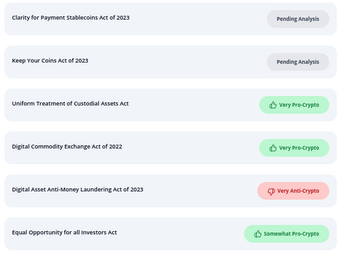
(Key bills tracked by StandWithCrypto. No attempt is made to evaluate cryptographic or tech-related freedoms beyond crypto.)
If a politician supports your freedom to trade tokens but says nothing about the above issues, then the reasoning behind their support likely differs greatly from yours (and mine). This means there’s a high risk they’ll reach different conclusions on issues you may care about in the future.
Crypto and Internationalism

(Map of Ethereum nodes, source: ethernodes.org)
Internationalism has always been a deeply valued social and political cause for me and many cypherpunks. National-level egalitarian politics has a critical blind spot here: they implement various restrictive economic policies to try to "protect domestic workers," yet often ignore that two-thirds of global inequality actually occurs between countries, not within them. A recent popular strategy for protecting domestic workers is imposing tariffs; but even if tariffs achieve that goal, unfortunately, it often comes at the expense of workers in other countries. One of the internet’s great liberating features is that, in theory, it makes no distinction between the richest and poorest nations. Once basic internet access becomes widely available, we can build a more equal and globalized digital society. Cryptocurrency extends these ideals into the realms of money and economic interaction, potentially promoting balanced global economic development—something I’ve personally witnessed in many cases.
But if I care about "crypto" because of its benefits for internationalism, then I should also judge politicians and their policies based on how much they care about the outside world. I won’t name names, but clearly many fail this standard.
Sometimes, this even directly affects the "crypto industry." During a recent EthCC, I received messages from multiple friends saying they couldn’t attend due to harder-to-obtain Schengen visas. Visa accessibility is a key consideration in choosing locations for events like Devcon; on this front, the United States also performs poorly. The crypto industry is uniquely international, so immigration law is, in a sense, crypto law. Which politicians and countries recognize this?
Being Pro-Crypto Today Doesn’t Mean Being Pro-Crypto in Five Years
If you see a politician who is friendly toward crypto, look up what they thought about crypto five years ago. Likewise, check their views five years ago on related topics like encrypted messaging. Especially, try to find issues where "pro-freedom" and "pro-corporate" positions diverge; the copyright wars of the 2000s are a perfect example. This can help you predict how their views might shift over the next five years.
Decentralization vs. Acceleration: Diverging Goals
One potential source of divergence arises when the goals of decentralization and accelerated development conflict. Last year, I conducted a series of polls asking people, primarily in the context of AI, which they value more. The results clearly favored the former:
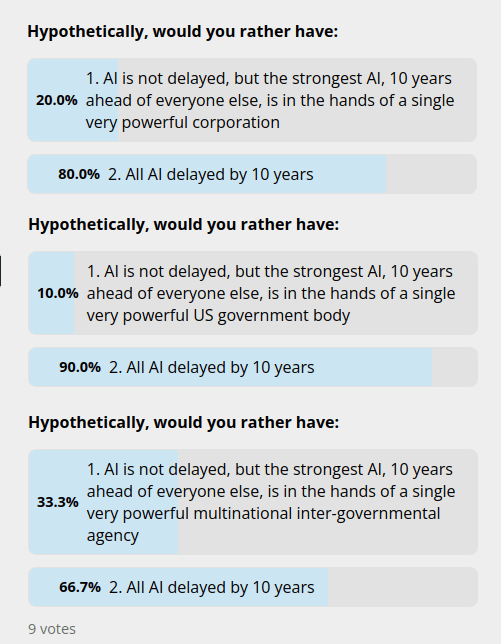
Typically, regulation harms both decentralization and acceleration: it centralizes industries and slows progress. Many of the most harmful crypto regulations (e.g., "mandatory KYC for all transactions") clearly go in this direction. However, these goals sometimes diverge. In AI, this may already be happening. A decentralization-focused AI strategy emphasizes small models running on consumer hardware, avoiding dystopias of privacy loss and centralized control where all AI depends on central servers that see all our behavior, and whose operators’ biases influence AI outputs with no escape. A benefit of the small-model approach is that it favors AI safety, as smaller models are inherently less capable and more tool-like rather than autonomous agents. In contrast, an acceleration-focused AI strategy enthusiastically embraces everything from tiny-chip micro-models to Sam Altman’s dream of a $7 trillion compute cluster.
To my knowledge, we haven’t seen such a large split in crypto yet, but it could happen in the future. If you encounter a "pro-crypto" politician today, it’s worth probing their core values to see which side they’d prioritize when conflicts arise.
What "Crypto-Friendly" Means to Authoritarians
There is a type of authoritarian "crypto-friendly" stance worth watching out for. The best example is modern Russia.
Recent Russian government policies on crypto are very simple and have two sides:
-
When we use crypto, it helps us evade others’ restrictions—so this is good.
-
When you use crypto, it makes it harder for us to restrict or surveil you, or imprison you for nine years for donating $30 to Ukraine—so this is bad.
Here are examples of each type of action by the Russian government:
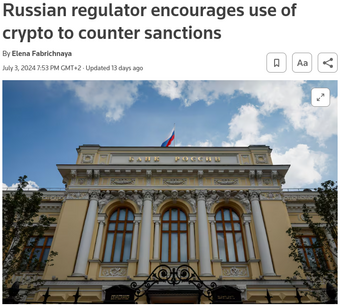
An important takeaway is this: if a politician supports crypto today but is deeply power-seeking or willing to appease power-seekers, their advocacy for crypto is likely to evolve in this direction over the next decade. If they or those they appease consolidate power, this outcome is almost inevitable. Moreover, it's worth noting that strategies attempting to get close to dangerous figures to "help them improve" often backfire.
But I Like a Politician Because of Their Overall Platform, Not Just Their Crypto Stance! So Why Shouldn’t I Be Enthusiastic About Their Crypto Position?
Politics is far more complex than simply "who wins the next election," and your words and actions affect many dimensions. In particular, when you publicly express support for a "pro-crypto" candidate solely because they support crypto, you're helping create an incentive for politicians to believe that supporting crypto alone is enough to earn your backing. Even if they support banning encrypted messaging, even if they are power-hungry narcissists, or push legislation making it harder for your friends in China or India to attend the next crypto conference—these politicians need only ensure you can easily trade crypto.

("A man tossing coins in a jail cell," generated using locally-run StableDiffusion 3)
Whether you're someone ready to donate millions, someone able to influence millions of Twitter followers, or just an ordinary person, you can help create more honorable incentives.
If a politician supports crypto, the key question is: are their motives correct? Do they have a coherent 21st-century vision for technology, politics, and economic development that aligns with yours? Do they have a positive vision that goes beyond short-term interests (like "defeating the opposing faction")? If so, great: you should support them, and explicitly state that this is why. If not, then either stay completely neutral or seek better allies.
Join TechFlow official community to stay tuned
Telegram:https://t.me/TechFlowDaily
X (Twitter):https://x.com/TechFlowPost
X (Twitter) EN:https://x.com/BlockFlow_News
 @VitalikButerin











