








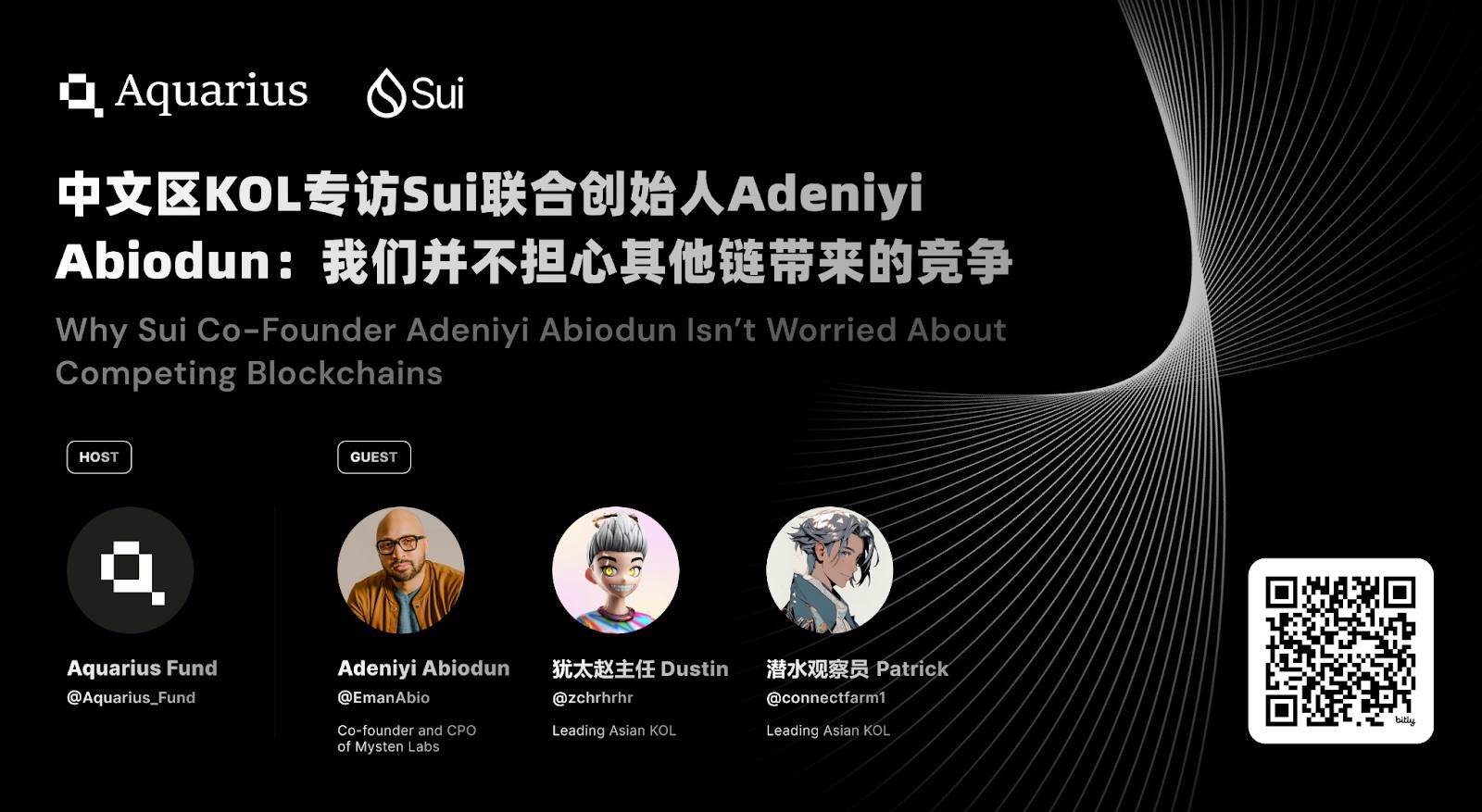
Exclusive Interview by Chinese-region KOL with Sui Co-founder Adeniyi Abiodun: We're Not Worried About Competition from Other Chains
TechFlow Selected TechFlow Selected
Exclusive Interview by Chinese-region KOL with Sui Co-founder Adeniyi Abiodun: We're Not Worried About Competition from Other Chains
Adeniyi Abiodun shared comprehensive insights into the Sui blockchain and the broader crypto ecosystem alongside two Asian KOLs.
 Navigating Web3 tides with focused insights
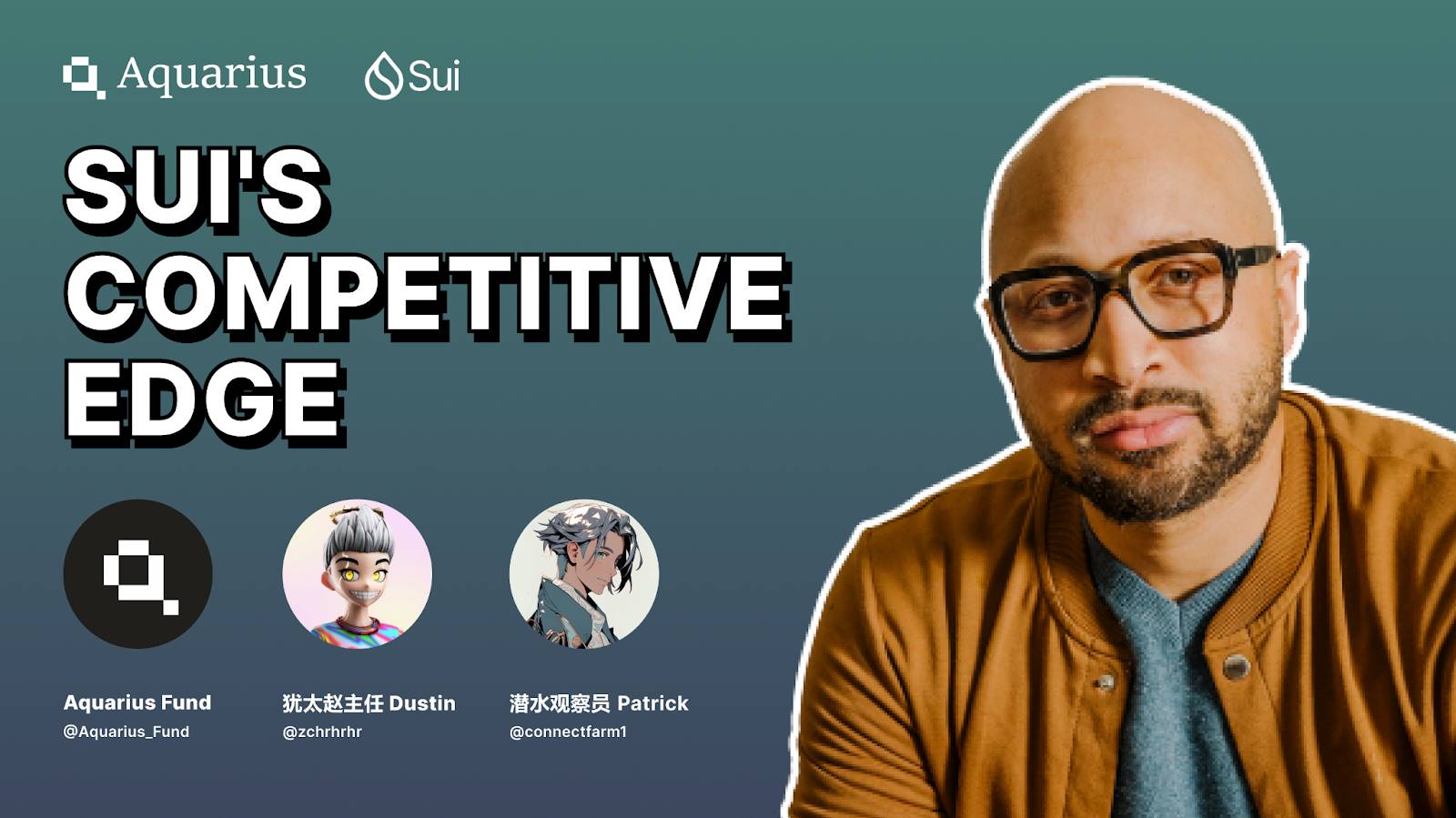
Full video: https://www.youtube.com/watch?v=ufo8BJ4ITCU
Host: Aquarius Fund
Guests:
-
Adeniyi Abiodun, Co-founder and CPO of Mysten Labs
-
Dustin Zhao (Jewish Director), Leading Asian KOL
-
Observer Patrick, Leading Asian KOL
Highlights
In a recent podcast hosted by Aquarius Fund, Adeniyi Abiodun, co-founder and Chief Product Officer of Mysten Labs, joined two leading Asian KOLs—Dustin (@zchrhrhr) and Patrick (@connectfarm1)—to share comprehensive insights into the Sui blockchain and the broader crypto ecosystem.
-
Adeniyi highlighted several upcoming iterations within the Sui ecosystem, demonstrating his commitment to advancing technological progress. Most notably, the upgrade of Sui’s consensus mechanism to its second version will reduce latency from 500 milliseconds to an impressive 300 milliseconds, positioning Sui as one of the fastest blockchain platforms on the market. Additionally, Adeniyi introduced SuiPlay0X1—a high-performance handheld PC gaming console equipped with an OLED screen—supporting both web2 and web3 games. Designed to build a robust gaming economy around Sui, this device allows users to earn NFTs and own in-game assets while playing.
-
Adeniyi addressed major challenges facing the blockchain space, particularly liquidity issues related to staking and restaking across layer 1 and layer 2 networks. He emphasized the necessity of adopting practical, utility-driven applications in everyday user experiences. Criticizing the current overemphasis on token acquisition and staking, he advocated for a shift toward utility-based tokens and user-friendly applications. By integrating DeFi elements into gaming and other daily-use apps, he believes interaction with blockchain technology can be simplified, paving the way for mass adoption.
-
Adeniyi expressed strong confidence in Sui’s competitive position among layer 1 blockchains. With high transaction volume, growing user adoption, programmable transaction blocks, and low gas fees, Sui is positioned as an ideal platform for DeFi and other applications. Sui aims to meet increasing demand through scalable infrastructure that enables efficient processing, attracting traditional web2 companies to build on its network.
-
The discussion also covered strategies for achieving mass adoption. Both Patrick and Adeniyi stressed the importance of balancing high performance with decentralization. Adeniyi acknowledged the initially high cost of running validator nodes on Sui due to the network being in its early stages but noted ongoing upgrade plans to lower these barriers, making validation more accessible and distributed. Future updates will include lightweight clients capable of operating on low-power devices, further enhancing accessibility and decentralization.
-
Adeniyi shared examples of thriving projects within the Sui ecosystem. Innovative initiatives like Karrier One, which is building global decentralized telecom infrastructure; Playtron, developing a gaming-focused Android OS on Sui; and Walrus, aiming to create a global storage layer surpassing AWS and Google in power—all focus on real-world applications and mass-market reach, aligning closely with Sui’s long-term vision.
-
Looking ahead, Adeniyi outlined Sui’s roadmap, including the launch of key stablecoins and the release of the second version of its consensus mechanism. He emphasized Sui’s commitment to supporting engaging, user-attracting applications and providing developers with essential tools to innovate. Adeniyi remains optimistic about the potential of meme coins on Sui, citing early successes such as Hopper and Double Up.
-
Finally, Adeniyi discussed the importance of broader user adoption and the development of creator tokens and assets with real utility. He believes these factors will drive future growth, solidifying Sui’s position as a leading platform in the web3 space.
Introduction
Hazel: Welcome everyone to today’s podcast episode. I’m thrilled to have you all here. I’m Hazel from Aquarius Fund, and I’ll be moderating today’s discussion. Founded in 2018, Aquarius manages venture and liquid capital, focusing on seed and early-stage investments. We offer comprehensive support including on-chain liquidity management and global KOL marketing. Recently, we launched a $600 million liquidity fund to institutionalize functional liquidity management. Today, we’re honored to welcome several highly anticipated guests: Adeniyi, co-founder and Chief Product Officer of Mysten Labs, along with two of my favorite Chinese KOLs—Patrick and Dustin. Let’s begin with introductions. Please share a bit about yourselves and your journeys in web3. Adeniyi, please go first, followed by Patrick and Dustin.
-
Adeniyi: Hello everyone. I’m Adeniyi, co-founder and CPO at Mysten Labs. I’ve been in crypto since 2011. Back then, I was working at a well-known investment bank when a colleague introduced me to cryptocurrencies. I became deeply interested and read the Bitcoin whitepaper. At first, I thought it was a scam, but after studying the code, I started mining Bitcoin myself—and soon it turned into a business. Friends began asking for help with mining, so I built one of Europe’s largest Bitcoin mining operations, later acquired by a company in Silicon Valley. After that, I worked at Oracle and VMware, launching their blockchain initiatives, and then led product development for Facebook’s (Meta) Libra project. The engineers and developers I met there are now building Sui at Mysten.
-
Patrick: I entered the space about seven years ago, focusing on building a significant KOL matrix across the Asia-Pacific region, managing influencers and boosting community engagement.
-
Dustin: I got into crypto at the end of 2016 and beginning of 2017 when I first bought Bitcoin. While doing venture capital in Silicon Valley, close friends introduced me to the space. In 2017, ICOs were booming, and everyone in tech was talking about them. I clearly remember an app called HQ Trivia where comments kept popping up encouraging people to buy Bitcoin, Litecoin, and other ICO-related assets. That environment pulled me into crypto. Since then, I’ve been deeply involved in crypto venture investing, participating in numerous risk and angel investments—some of which have already listed on major exchanges. In 2019, I started incubating my own projects, several of which performed quite well during DeFi summer. Currently, I focus on incubating, supporting, and investing in new DeFi projects. I’m actively exploring new opportunities in the space. Thank you for having me!
Technical Upgrades
Hazel: That’s amazing! Thanks for those great intros—it’s fascinating to hear how each of you entered crypto through different paths. Let’s talk about some exciting upgrades. Adeniyi, are there any upcoming developments or partnerships in the Sui ecosystem that excite you?
-
Adeniyi: There’s a lot to look forward to. We recently announced that Sui’s consensus mechanism will be upgraded to version two. Some may not know that Sui already has one of the fastest consensus algorithms in the industry, with latency around 500 milliseconds—soon to be reduced to approximately 300 milliseconds. Not only does Sui feature horizontally scalable block units, but it also has no maximum throughput limit, making it a leader in speed and latency.
We’re also excited about the pre-orders for SuiPlay0X1, our upcoming gaming console—a high-performance handheld PC device with an OLED screen and top-tier specs. It supports both web2 and web3 games. We partnered with a team that previously developed the Android operating system to build this device, and we’re thrilled about the number of games coming to Sui. These games will be fully integrated, allowing users to play both Sui-native and traditional web2 games, earn NFTs, own their assets, and help grow a vibrant gaming economy around Sui.
So, game partnerships and upcoming technical upgrades on the network are particularly exciting.
Market
Hazel: That sounds very promising. Let’s zoom out and discuss the broader market. Adeniyi, Patrick, and Dustin—what do you see as the biggest challenges currently facing the blockchain space? And what are the most effective ways to address them?
-
Dustin: Great question, especially amid market volatility. From a financial standpoint, the biggest challenge today is liquidity. Everyone is involved in staking or venture capital, particularly on layer 1 and layer 2 chains—including Ethereum’s L2s. This cycle’s innovation centers on locking up tokens and restricting access for ordinary users. This creates a contradiction: on one hand, we talk about mass adoption and permissionless systems, yet we build products that restrict token access. Our goal is to increase token value and create deflationary models, turning them into strong brands. For example, Binance buys back and burns tokens; Ethereum’s shift to PoS created deflation. Yet we also want more people entering the market—this creates a paradox. How does the industry resolve this? Right now, we’re building on one side while contradicting ourselves on the other.
-
Adeniyi: I’d add that crypto has essentially played the same game over the past three to four years—acquiring tokens, staking them, and controlling supply. Markets experience cyclical swings, followed by new trends. What web3 truly needs is real adoption driven by applications that add tangible value to daily life. Most people don’t engage with DeFi or staking because it’s too complex. We need to break free from these cycles and create services people actually use and find valuable. For instance, at Facebook, we explored ways to let people use Web3 subtly. While we enjoy deep crypto discussions, the reality is that 99.9% of the market won’t understand them. To achieve massive growth, we must bring in mainstream users—and gaming is one powerful way. Games can seamlessly integrate DeFi features, letting users buy, sell, or liquidate tokens within gameplay without realizing they’re using Web3. These issues are usually solved via complex in-game mechanics, but Web3 interoperability bridges the gap. Tokens should be seen as utilities, not commodities—with clear reasons for use. Every network is grappling with this, but we need to reach a stage where millions of regular users adopt these networks at scale.
-
Patrick: I agree with both of you. The biggest challenge now is rewarding actual application usage. We have plenty of DeFi, staking, and lending, but it's mostly internal circular activity with little substance. Many projects claim to be value chains but just repeat the same DEX and lending activities without real-world use cases. That’s why I like Sui—I see Sui trying to bridge gaming and payments with real-world applications. The solution lies in attracting average users who unknowingly use web3—that’s the key to overcoming current challenges.
Hazel: You’ve all touched on token incentives and new applications. Adeniyi, how do you view Sui’s positioning among today’s many layer 1 blockchains? How does Sui plan to maintain its competitive edge?
-
Adeniyi: This might sound controversial or even radical, but I’m not particularly worried about other chains. Frankly, when we were at Facebook, we saw that technology hadn’t advanced significantly since 2017. That realization led us to start a new company focused on layer 1—we observed that despite all the hype around new innovations, there hadn’t been any real breakthroughs.
For example, Sui ranks in the top two in terms of transaction volume, exceeding Solana on certain metrics. We can participate in web3 gaming and benefit significantly, but what truly matters is real user engagement. Sui already has over 100,000 daily active users, making it one of the most engaged blockchains. Our programmable transaction blocks allow users to chain transactions across 20–30 DeFi protocols at once, making Sui the best trading chain. Industry-low gas fees give Sui superior infrastructure for DeFi and degenerate activity. Even more exciting, traditional web2 companies can leverage Sui as well.
Compared to long-standing blockchains, Sui has processed more transactions faster than Bitcoin ever did, setting historical records. From a usability perspective, Sui offers infrastructure that makes user interaction extremely simple. For instance, users can log in to any website using just their Google account, enjoying a self-custodial experience without remembering passwords. Sui widely applies zk technology for user onboarding—not scalability, because Sui doesn’t face scalability issues. This greatly simplifies user entry. We also have sponsored transactions, where users don’t need to worry about gas fees. On Sui, users don’t need to think about wallets or gas—the backend handles it, possibly funded by ads. Users might interact with Sui without even knowing it—just like when visiting a website today, you don’t think about whether it’s hosted on Google or Amazon; you just appreciate the content.
A key measure of infrastructure is its ability to scale with user adoption. At Google and Facebook, we built platforms like Search, Facebook infrastructure, WhatsApp, and Instagram to scale horizontally. We never worried about maximum capacity—if we needed more, we added more machines. Similarly, Sui scales horizontally. Every blockchain talks about TPS (transactions per second), but for Sui, we simply add more machines to increase capacity. In its current configuration, Sui processes 300,000 transactions per second—already 30 times faster than the next quickest chain. By adding more machines, TPS can grow exponentially. We’ve already solved scalability and performance challenges. Now, the key is user adoption. We’re excited about developments expected in September that will differentiate Sui from other chains—these are the areas we’re most passionate about.
Hazel: Thank you for those insights—they’re incredibly valuable. From your perspective, what’s the key to achieving mass adoption?
-
Patrick: Currently, I don’t see any real mass adoption of crypto in the real world. I’m not criticizing, but I have a concern about Sui. You mentioned doubling or tripling TPS by adding more machines. But this seems highly centralized, requiring large stakes and expensive hardware on Sui. Does this align with the decentralization principles crypto should follow?
-
Adeniyi: That’s an excellent question. Currently, running a validator node on Sui costs about 25 million SUI, which is indeed high. This is because the network has only been live for just over a year, and the first-year goal was stability—ensuring high-value validators for a robust network. We plan updates to significantly lower the barrier to entry, reducing required SUI to roughly 1–3 million. Our hardware requirements are already lower than most chains—Sui performs 100x faster at the lowest computational cost in the industry. Imagine a world with 400, 500, or even 1,000 validators. If we need to double TPS, we simply double the machines per validator. However, expecting a network processing 50 million transactions per second to run on a laptop isn’t realistic.
Sui also supports light clients and lightweight validators, enabling verification with minimal hardware. This model allows a core group of high-performance validators to handle fast transactions, while an unlimited number of light validators ensure network integrity. This combination of high-performance validators and light clients delivers scalability without sacrificing decentralization. The team is actively researching light clients, but priorities matter. This month, we’re focused on reducing latency by 80%. Next, we’ll improve fast-path transaction finality, then move on to light clients. Over the past year, we’ve released major innovations like ZK login, on-chain randomness, and the fastest consensus protocol. Sui aims to be the easiest platform for developers—applications can go live in as little as 12 hours.
-
Dustin: Building blockchain, Web3, or even the metaverse involves creating a virtual society. For any economy, you need two things: capital returns and labor returns. Sui’s approach of introducing people to crypto through gaming is smart because standalone DeFi only involves trader-to-trader transactions. Capital costs in this space are well known, but labor returns aren’t. Activities like airdrops offer some rewards for interacting with protocols, but these are often poorly calculated. Gaming, however, can measure contributions and reward users accordingly, making it a powerful tool for driving usage. By promoting crypto gaming, we can attract more people into the space. Additionally, decentralized physical infrastructure (DePIN) is another promising area. Some projects are combining gaming with DePIN, using consumer electronics as entry points. These devices measure user engagement in games, merging physical and digital worlds to drive mass adoption. Therefore, combining gaming with DePIN could be the key to achieving mass adoption in crypto.
Ecosystem
Hazel: That’s a very interesting perspective. Since you mentioned various verticals like gaming and DePIN, which projects in the Sui ecosystem are you most excited about? What types of projects would you like to see more of?
-
Adeniyi: There are quite a few notable ones. Regarding DeFi, two high-quality projects are joining Sui. One is Carrier One, a Canadian telecom company launching a global, decentralized enterprise-grade telecom infrastructure.
What makes Carrier One unique is that it allows you to run your own wireless signals and base stations and get paid for it. This is enterprise-grade telecom hardware, unlike anything in other ecosystems. Top telecom providers can pay you directly by connecting to your hardware. This is unprecedented at the enterprise level and has massive adoption potential. Additionally, Carrier One offers SIM protection via two-factor authentication against SIM swapping, which is highly valuable. While applicable across many ecosystems, it runs on Sui due to its unique capabilities.
On the gaming front, we’re focusing on studios with millions of followers and players because we believe gaming can significantly boost DeFi growth. Currently, DeFi involves trades among many users, but combining it with gaming brings in millions of passive users, increasing the value of DeFi protocols. Playtron is one example—it’s building a future gaming-oriented Android OS on Sui.
We’ve also announced Walrus, a global storage layer—the first proof-of-stake storage network rivaling AWS and Google in power. It can host websites, data availability layers, and people are already building Layer 2s on it. Sui builders are using Walrus as core infrastructure for dApps.
Additionally, we have some remarkable DeFi protocols. For example, Navi Scallop is already among the top 20 DeFi protocols in Web3, indicating where future developers will choose to build their next applications.
Patrick: I have some thoughts on these projects—they seem great. But I have a small concern: what happens when incentives stop? Right now, we see many accounts in these projects cycling loans just to capture incentives. A friend of mine manages a liquidity pool and uses this strategy. They’re not really using the products—they’re just chasing incentives. I’m a bit concerned about what happens post-incentives.
-
Adeniyi: Yes, that’s a good question. One way to think about liquidity is ensuring it’s good, sticky, and genuinely useful. One metric I track is trading volume—just yesterday, intra-Sui ecosystem trading volume exceeded $100 million. Over 80% of rewards given to users came from trading fees, not incentives. So Sui has already reached a point of valuable, usable liquidity. The difference is that if you consider settling positions between Sui and other protocols, Sui is more valuable. This is because we have programmable transaction blocks allowing efficient chained transactions across multiple DEXs simultaneously. We have proper aggregation, consequence aggregation, and fluid aggregation to find optimal cross-chain routes for any asset you want to trade. This means Sui offers better liquidity utility than any other protocol. I’m not worried about incentives in the Sui ecosystem. We’ve already seen organic growth in trading volume—yesterday alone, Sui’s volume surpassed $60 million, with most user rewards coming from trading fees, not incentives. So I believe our DeFi system is healthier than some longer-established modern EVM chains.
-
Dustin: I’d like to briefly comment on this too. Since 2023, I’ve invested in various projects and protocols. The issue you raised is less severe for layer 1s than for Ethereum layer 2s. Currently, all these Ethereum L2s subsidize their DeFi protocols to attract and retain users. For example, Arbitrum is directing all grants and rewards to GMX and GNS, the top projects on its platform. If you trade on Gains Network now and rank high on the leaderboard, the rewards are huge. None of these Ethereum L2s use their native token as gas—gas is still ETH. But for layer 1s, it’s different—all TVL is denominated in their native token. Take Sui, for example. People lock up Sui in DeFi protocols. But on Ethereum L2s, people lock USDT and WETH as TVL. These L2s must subsidize to attract good dApps and product developers to acquire and retain customers. Meanwhile, their tokens like ARB or OP aren’t counted in TVL, so they must distribute tokens in exchange for real money like WETH and USDT. But for layer 1s like Sui, it’s different—we don’t need to do that. We just need to let Sui flow naturally.
Hazel: How do you see the evolving roles of layer 1 and layer 2 solutions in the blockchain space? Will layer 1s surpass layer 2s, or vice versa?
-
Dustin: Due to Ethereum’s scale and multi-billion dollar valuation, layer 2 solutions primarily revolve around Ethereum. Unlike platforms like Sui, which have founders and core contributors who can provide clear direction, Ethereum’s decentralized nature makes this impossible. Ethereum’s vast ecosystem requires resources and development efforts to be spread across various L2s, each backed by strong supporters and driving innovation in specific niches. For example, each L2 has its niche: Base supported by Coinbase, famous for meme coins; Mantle by Bybit; Linea by ConsenSys. These L2s push innovation forward, advancing the Ethereum ecosystem. In contrast, L1s like Sui focus on specific goals or roadmaps—like achieving mass adoption through gaming (GameFi). Ethereum allows these L2s to build niches and compete with specialized L1s. This competition between L1s and L2s is crucial for ecosystem growth. Ethereum benefits from this competitive dynamic as a decentralized platform. In short, L2s are vital for advancing the Ethereum ecosystem and competing with more agile, goal-oriented L1s.
-
Patrick: I think L2s are very useful. After EIP-4844, rollups and L2s have developed well. Vitalik and Celestia’s founder have proposed more modular blockchain architectures. Rollups are essential for those seeking decentralization, efficiency, and capacity. We can make TPS very fast via solutions like Solana, but Ethereum provides the original blockchain approach. Rollups are critical for achieving mass adoption in blockchain.
-
Adeniyi: I agree. Ethereum has chosen its architecture and it’s hard to deviate. Ethereum’s scaling roadmap has been long-standing. Different organizations should collaborate to build better-scaling variants of Ethereum. It’s less a technical issue and more a coordination challenge. We’ve already seen projects building Ethereum L2s on Sui. Because Sui is horizontally scalable, it doesn’t need L2s for performance. However, some L2s use Sui as a better coordination layer, leveraging Sui’s consensus and gas to scale Ethereum. This approach is promising but complex. Ultimately, I think only early Web3 adopters will use these technologies at scale—mainstream users won’t due to fragility. This is opposite to how we built web infrastructure. Still, this tech has a niche market—we need to serve it.
Outlook
Hazel: Looking ahead, Adeniyi, can you share Sui’s roadmap and near-term priorities?
-
Adeniyi: There’s a lot in the works. Sui will soon see native stablecoins launch. We’ll also release SuiPlay0X1, which will be prominently showcased during Korea Blockchain Week. Additionally, we’ll launch version two of our consensus algorithm this month, followed by on-chain randomness next month.
Our belief is that to advance web3 to the next level, we need truly engaging user applications. Developers are quickly realizing they can build things on Sui that aren’t possible on Solana, Ethereum, or anywhere else. We’re targeting 12 million JavaScript developers, not just 20,000 web3 devs. Our team has decades of experience building developer platforms—we know how to create tools developers love. That’s why the developer experience on Sui is often described as ten times better than other platforms. This passion is key to why Sui has become one of the top two blockchains in transaction volume and adoption.
Our main goal this year is bringing more decentralized applications (dApps). Many games are finally launching, and we’re starting to see real users interact with web3 subconsciously. We recently introduced subdomains for naming services, replacing dots with @ symbols (e.g., yourname@dapp), making it easier for users to interact with services and receive airdrops.
We believe bringing web2-like services directly onto web3 chains will unlock entirely new forms of user interaction previously impossible. We’ll keep innovating and building tools easy for average users to adopt. You’ll see top developers behind Navi, Scallop, Cetus, Aftermath, and Hop integrating these tools, drawing in more mainstream users beyond early adopters.
Hazel: That’s fantastic. Our community has an interesting question: When do you think we’ll see a meme coin season on Sui?
-
Adeniyi: People do love memes—it’s part of community building. Meme season is hot right now on Solana and Base, and I believe it will eventually come to Sui. We’ve already seen Hop.fun launch their own meme launcher, soon to debut on Sui. Double Up built one of the best online gambling sites I’ve seen and also created a fun meme launcher on their site.
We’re already seeing early signs of meme culture taking off on Sui, and I’m excited to see how it evolves. Memes on Sui will be different—not just launching a token, but building interactive tools around your community, making them more engaging and sticky than tokens alone. That’s what will set Sui memes apart. We’re eager to see what developers come up with, as we focus on providing infrastructure to empower maximum creativity. What they build will be astonishing—we can’t wait to see it.
Hazel: Finally, what’s your vision for this cycle and the next? Which verticals interest you most?
-
Patrick: This cycle, I’ve observed many developments—not just in crypto but also regulation. We’ve seen approvals like ETFs, meaning crypto is becoming more mainstream globally. I don’t think the crypto world will grow as explosively as before, but it will continue expanding alongside dollar inflation. Also, I’ve noticed many interesting projects this time, like the Bitcoin inscriptions ecosystem exploring new asset types. For the next cycle, I hope to see more technological innovations and projects—like Sui introducing on-chain randomness. These innovations, along with regulatory progress, are fascinating.
-
Dustin: Especially after yesterday’s market volatility, we have a better understanding of cycles. Adeniyi entered crypto in the early 2010s, around 2013, and I came in 2017. I think Patrick joined around then too. From my view, I don’t believe in the traditional Bitcoin halving cycle. Instead, I have my own credit expansion cycle theory. Each bull market starts with an asset creation event—like ICOs in 2017, and DeFi/NFTs in 2021–2022. These events rapidly create massive new assets, kicking off an asset creation cycle, followed by two credit expansion cycles. In early 2018, after the ICO boom, the market crashed hard. People started leveraging their assets to get more funds, pushing prices from ~$3,800 to ~$14,000 by mid-2019. After peaking, the market corrected to ~$6,000 by late 2019. During this period, centralized exchanges introduced perpetual trading, increasing leverage opportunities. This pattern continued until the global liquidity event in March 2020, wiping out many early investors. But that completed one cycle. A new one began mid-2020 with projects like YAM and SushiSwap. In 2023, we saw more on-chain leverage via platforms like Compound, Aave, and MakerDAO. By 2024, perpetual trading expanded on-chain. This shows on-chain leverage is shifting from being exclusive to CEXs. After a high-leverage phase, we can expect a liquidation event to reset the market. I predict this will happen in early 2025, marking the start of a new cycle.
-
Adeniyi: It’s a cycle of asset creation, participant disappearance, then resurgence. We need broader user adoption and lower-risk use cases. As we’ve seen with credit default swaps in traditional finance, leverage is extremely dangerous. Crypto needs frictionless, accessible use cases for mainstream users. I don’t think meme coins are the best way to onboard users—they often lead to bad experiences. Instead, I believe creator tokens and assets with real utility are the way forward. These should offer value and stickiness beyond pure speculation. This approach will help build a stronger, more sustainable ecosystem. We strongly believe in this—that’s why we’re building a layer 1 blockchain.
Hazel: Thank you all for sharing your insights and taking the time to join us. Your perspectives have been incredibly enlightening. Adeniyi, Patrick, and Dustin—this was a fantastic discussion.
-
Adeniyi, Patrick, Dustin: Thank you for having us.
Join TechFlow official community to stay tuned
Telegram:https://t.me/TechFlowDaily
X (Twitter):https://x.com/TechFlowPost
X (Twitter) EN:https://x.com/BlockFlow_News
 Sui Network






