








Why You Should Pay Attention to DePIN: Top Projects Command High Valuations, Yet Capital Keeps Flowing In
TechFlow Selected TechFlow Selected
Why You Should Pay Attention to DePIN: Top Projects Command High Valuations, Yet Capital Keeps Flowing In
This article will explore the current state of DePIN, the challenges faced by DePIN projects, and the future development direction of the industry.
 Navigating Web3 tides with focused insights
Authors: JOMO, NOTDEGENAMY & DEREK
Translation: TechFlow

Introduction
One key theme highlighted in our recent article "Outlook on Web3 in 2024" is the rise of Decentralized Physical Infrastructure Networks (DePIN). DePIN refers to leveraging tokenization to coordinate and scale the early-stage deployment of capital-intensive infrastructure projects. This approach offers blockchain-based solutions to problems where digital infrastructure such as wireless networks, computing, and energy is either too expensive or underdeveloped.
DePIN operates on the principle of distributing control, decision-making, and resources across network nodes rather than relying on a centralized authority. This model transforms traditional innovation paradigms by promoting community-driven innovation over corporate or government-led initiatives. Each DePIN network consists of an ecosystem of nodes—these can be sensors, devices, or even entire systems! Unlike traditional centralized networks, DePIN not only encourages local community participation in governance and management but also delivers additional advantages: enhanced network security and resilience, decentralized control, capital efficiency, and community empowerment.
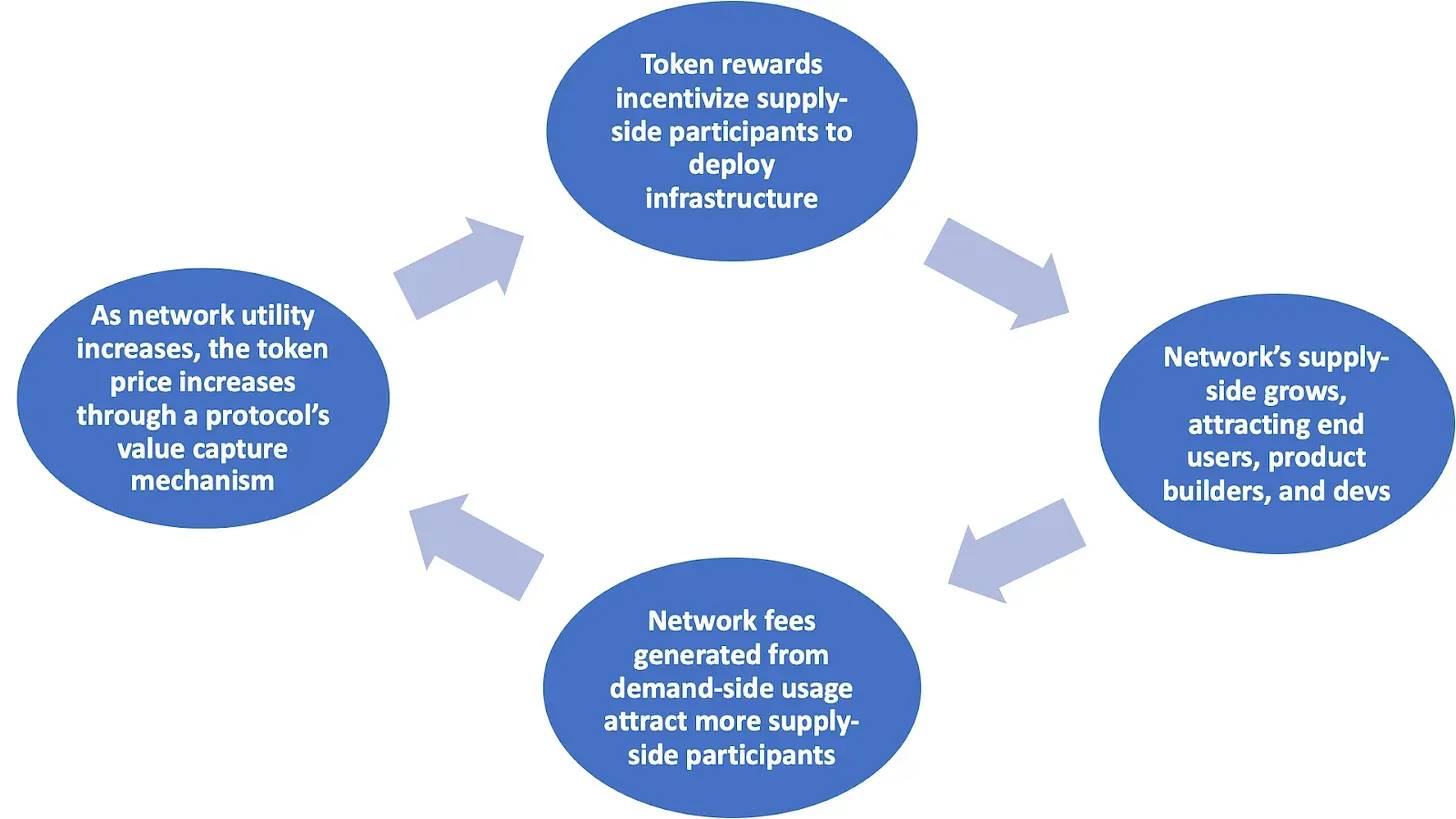
The DePIN flywheel, source: @OcularVC
Compared to traditional centralized infrastructure providers, DePIN demonstrates several clear advantages. First, by utilizing crypto incentives, DePIN provides a capital-efficient way to launch infrastructure that is traditionally capital-intensive and costly to maintain. This may also lead to lower costs for consumers. Second, because DePIN networks are distributed across multiple nodes, they create redundancy, ensuring that even if one node fails, the rest of the system continues operating. Finally, the community-centric nature of DePIN networks empowers local communities to manage their own networks and improve efficiency. When decisions about resource allocation and maintenance are made at the grassroots level, infrastructure is viewed as a long-term collective good rather than merely a profit center.
Over the past few months, we’ve seen the launch of DePIN networks demonstrating early product-market fit reminiscent of the “sharing economy.” These projects span various domains within DePIN, each with distinct use cases. In this article, we will explore the current state of DePIN, the challenges facing DePIN projects, and the future trajectory of the industry.
Current State
Summary
Venture capital funding for all crypto projects has rebounded this year, reaching $4 billion globally by April 2024. DePIN is gaining momentum, with 70 DePIN projects collectively raising $192 million during the same period. Notable deals include io.net, a Solana-based distributed GPU project, which raised $20 million in its Series A round at a $1 billion token valuation, and Aethir, a decentralized GPU compute node provider, which raised $65 million within the first hour of its node sale. Currently, the total market cap of DePIN projects exceeds $54 billion, with leading projects like Filecoin, Flux, Braintrust, and Helium generating over $18 million in annual on-chain revenue across various sectors. While valuations remain extremely high—with FDV/revenue ratios reaching 3,000x—capital continues to flow in, driven by expectations of stronger product-market fit. The entire ecosystem has grown to over 1,220 projects, supported by more than 600,000 active nodes.
The DePIN ecosystem can be further divided into six main categories: computing, wireless, energy, artificial intelligence, services, and sensors.
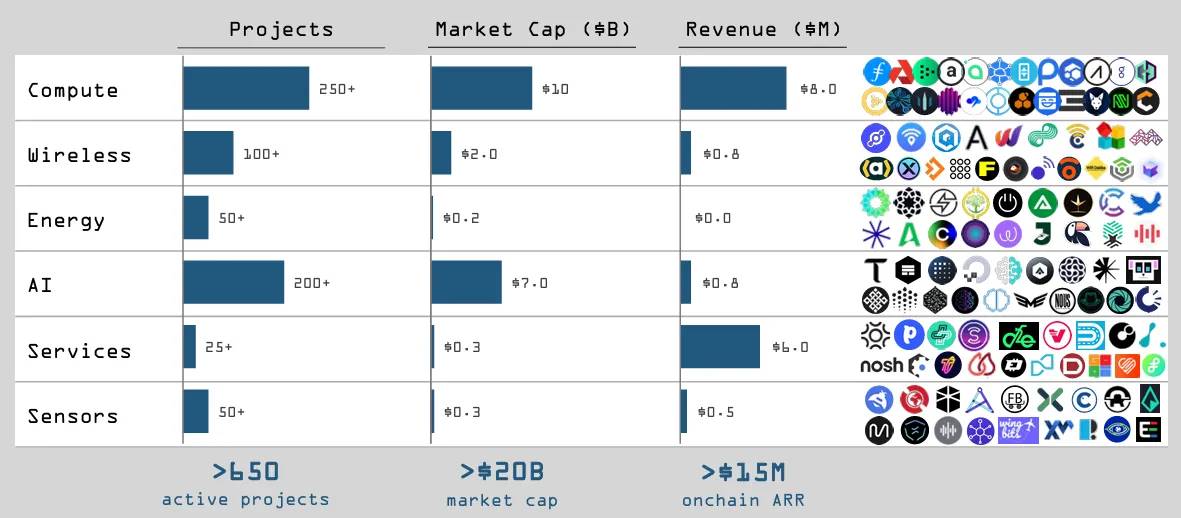
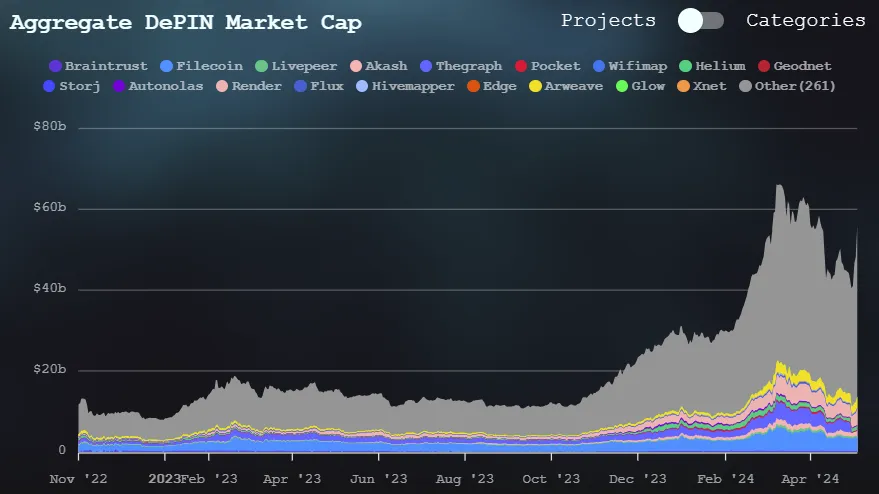
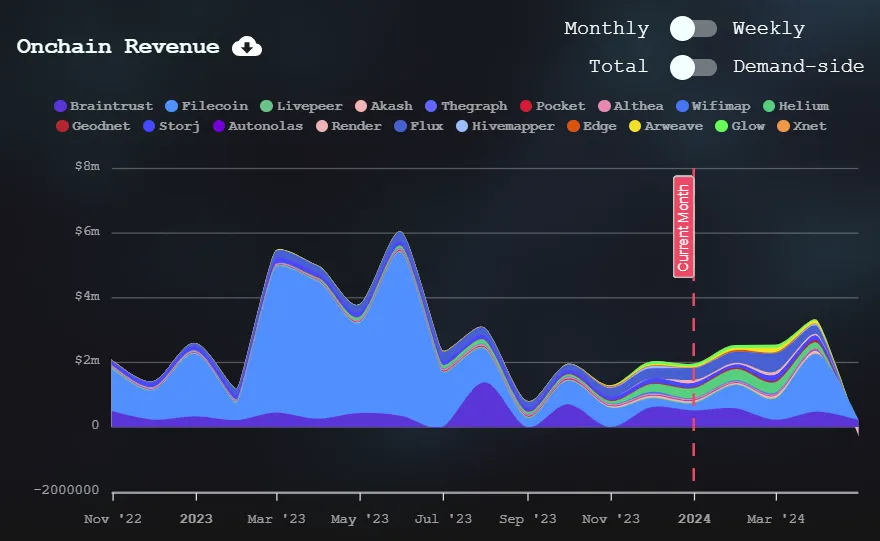
Source: EV3, Messari, Depin Ninja
Computing
This category includes the full computing lifecycle involving storage, actual computation, and data retrieval infrastructure—we’ll briefly discuss their differences.
Storage
Decentralized storage infrastructure allows data to be stored across potentially thousands of different nodes instead of being housed in Web2 data centers/cloud options like Amazon, Microsoft, and Google. Storage providers offer their excess space in exchange for fees, similar to traditional data storage business models. Projects like Storj, Arweave, and Sia participate in this space, but Filecoin continues to lead the industry.
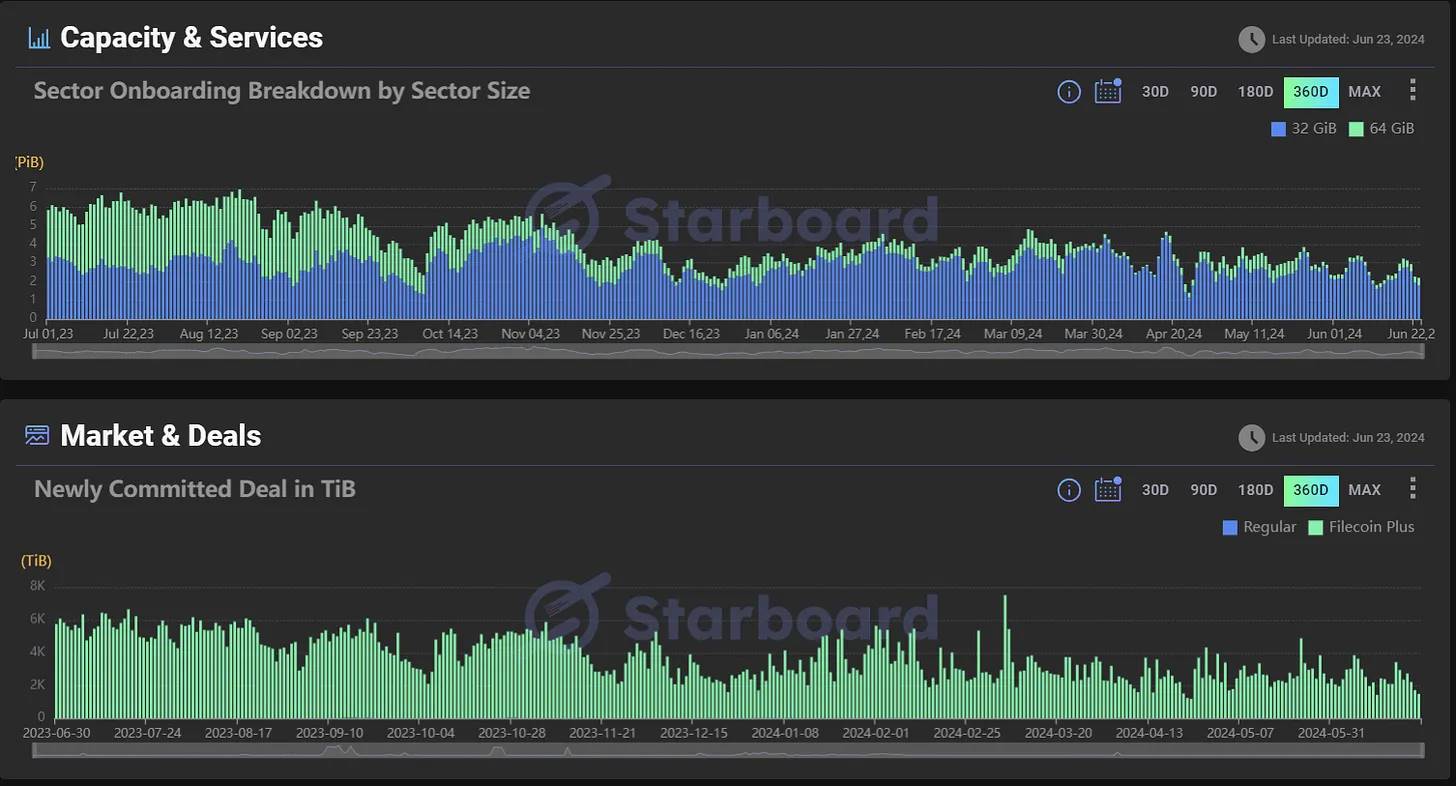
Filecoin capacity, source: Starboard Ventures
Actual Computation
Decentralized compute infrastructure works similarly to data storage, except it sells computational power instead of storage space. This sector has rapidly expanded in recent months due to increased computational demand from AI projects. Unlike storage, the decentralized compute space is constrained by supply shortages. Aethir, a decentralized GPU compute node provider, recently concluded its node sale, raising $65 million in the first hour alone. These nodes aim to provide computational power for both Web2 and Web3 gaming and AI applications.
Data Retrieval
Data retrieval involves extracting stored data for usability. Data stored in a decentralized manner requires robust content delivery networks (CDNs) for easy access, yet the challenge lies in decentralizing CDNs themselves. Projects like Filecoin Saturn and Fleek are tackling this issue and showing early progress, though the retrieval problem remains unsolved.
Complex sentence structure: Some sentences are overly complex and disrupt readability. For example: "The rapid rise of AI companies across all levels of society—DePIN provides infrastructure supporting AI growth while also offering AI companies a way to monetize their models."
Insufficient term explanation: Certain terms and concepts lack clarity, potentially causing confusion. For instance, "fully diluted market cap" and "peer-to-peer energy trading."
High information density without hierarchy: The original text contains abundant information but lacks structural clarity, making it overwhelming for readers.
Awkward phrasing: Some translated sentences feel unnatural. For example: "By leveraging self-funded blockchain networks, restaurant owners can band together to create decentralized delivery systems, avoiding 15% to 25% fees paid to food delivery aggregators."
Artificial Intelligence
AI companies are rapidly expanding across all societal levels. DePIN not only provides infrastructure support for AI development but also enables AI firms to monetize their models. Datasets used for private computations can be sold on decentralized markets. SingularityNET aims to decentralize research and model monetization—its fully diluted market cap currently stands at $1.2 billion.
Energy
In energy distribution, DePIN enables peer-to-peer (P2P) energy trading. Beyond traditional utility companies, individuals and households can sell surplus energy securely over decentralized networks. These household-level networks can form decentralized energy grids, bypassing reliance on centralized grid providers.
An obvious application is deploying such decentralized grids in archipelagic regions like the Philippines or Indonesia, where islands are widely dispersed. Southeast Asia holds significant potential for carbon credit generation due to rich biodiversity and vast opportunities in renewable energy projects such as hydro, solar, and geothermal. Indonesia, Malaysia, and the Philippines are among the world’s 17 megadiverse countries. Southeast Asia accounts for nearly 25% of global natural climate solution potential, with an estimated 58% of the region’s threatened forests (approximately 114 million hectares) considered financially viable for carbon credit projects. We’re seeing DePIN projects like AllInfra or Open Forest Protocol addressing carbon credit market inefficiencies through decentralized carbon credit tokens, unlocking new supply channels.
Wireless
DePIN holds immense potential in supplying data for mobile, fixed, and WiFi networks. Global data consumption by networks and devices will grow rapidly in the coming years, demanding differentiated solutions to meet rising demand.
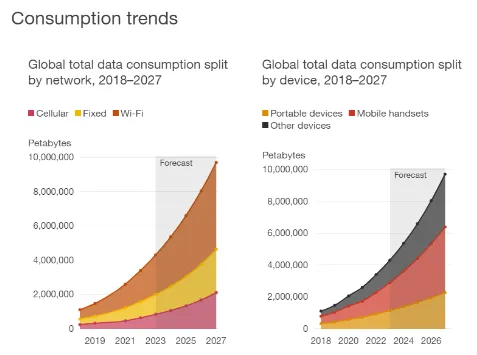
Source: PwC, Omdia
DePIN projects like Helium have launched community-driven, decentralized wireless networks to address connectivity gaps. Helium is a pioneer in the DePIN ecosystem—founded in 2013 to build a peer-to-peer wireless network for IoT devices. In 2021, Helium raised $111 million through a token sale led by a16z, with participation from Ribbit Capital, Multicoin Capital, and the now-defunct Alameda Research. In February 2022, the project raised $200 million in its Series D round at a $1.2 billion valuation. Helium Mobile now offers outdoor Helium mobile hotspots for $499 and indoor hotspots for $249—currently, there are 371,000 active hotspots on the Helium network. Behind the scenes, the network incentivizes hotspot providers via HNT tokens. Despite potentially high valuations relative to traction, Helium has demonstrated early product-market fit. Other projects like WiFi Map are launching similar efforts—the app helps users find public hotspots, access eSIMs globally, and use offline maps. The project boasts 175 million downloads, 15 million active WiFi hotspots, and 5 million monthly active users.
Services
Blockchain also aims to disrupt everyday services such as ride-sharing and food delivery. By leveraging self-funded blockchain networks, restaurant owners can collaborate to build decentralized delivery systems, avoiding the 15% to 25% fees typically paid to food delivery aggregators. Similarly, ride-sharing networks are characterized by app-based duopolies with little room for local or grassroots coordination. DePIN projects like Nosh and Teleport aim to return ownership—and power—to local communities.

Sensors
To drive the DePIN revolution, independent mobile devices need to “sense” their surroundings. The Internet of Things (IoT) will enable DePIN networks to add value as sensing machines. Current projects address issues ranging from noise pollution and lack of navigation/maps in certain areas to even tracking how many steps a person takes daily. Although smartphones are powerful, they still face challenges including needing to be “always on,” requiring user “opt-in,” and managing data privacy concerns.
Projects like Frodobots are crowdsourcing real-world datasets through robotic gameplay. Frodobots allows users to “play” and operate real robots collecting location-based data on city streets. Meanwhile, user actions help label data to train the AI models behind the robots and qualify users for token rewards.
Current Challenges Facing DePIN
Despite significant hype and capital backing, the DePIN industry is not without challenges. We’ll discuss several critical issues DePIN must resolve to become fully viable.
Technical Capability
DePIN will heavily depend on integrating IoT devices and other technologies to build reliable decentralized networks. Currently, even centralized solutions face connectivity issues, especially in emerging markets. Therefore, it's unsurprising that decentralized alternatives also require existing infrastructure and encounter scalability difficulties. DePIN attempts to solve reliability, data synchronization, and integration challenges through its community-centric decentralized model, adopting an “all-hands-on-deck” approach.
Lack of Demand/Attraction and Consumer Trust
Regardless of location, consumers and enterprises always require clear incentives to switch data infrastructure providers. Establishing a reliable, cost-effective, and legally sound business model is crucial for building consumer confidence. If any of these elements fail, consumers are unlikely to adopt decentralized providers and will stick with incumbents. Lack of demand is evident in DePIN projects generating only around $18 million in annual revenue. Enterprises have stricter switching processes—they require consistent and secure suppliers. Although Filecoin’s network is becoming increasingly secure, we see growing numbers of consumers and businesses turning to this cheaper alternative: Filecoin costs $0.19/TB/month versus Amazon S3’s ~$23/month.
Economics
Due to insufficient demand for DePIN projects, the incentive flywheel has failed to take off as expected. DePIN requires substantial capital to bootstrap its network and provide initial infrastructure supply. The current market issue is that even after establishing supply, lack of demand leads to the collapse of the flywheel. The inherent volatility of cryptocurrency makes it difficult to determine the long-term economic viability of self-funded DePIN projects, although teams are working to stabilize their networks against volatility. This is expected to improve as the ecosystem matures and usage increases. When projects generate real revenue, fundamentals will support more stable returns for network participants.
Regulatory Issues
Telecom infrastructure is largely regulated across markets—both developed and emerging—with evolving government regulations. Digital infrastructure providers must remain flexible to navigate these regulatory challenges while maintaining open communication with government officials. Decentralized projects may struggle with current government communication frameworks and foreign ownership concerns surrounding digital infrastructure. Global storage projects like Filecoin should take the lead in negotiating with governments to resolve these issues.
Looking Ahead – New Cryptographic Primitives in DePIN
Despite the aforementioned challenges, DePIN made significant progress in 2023. According to Messari, the industry added over 600,000 nodes in just the past year. Underpinning this growth is strong token holder support: the percentage of locked tokens among successful projects has increased, giving teams more time to incentivize supply or expand into new markets.
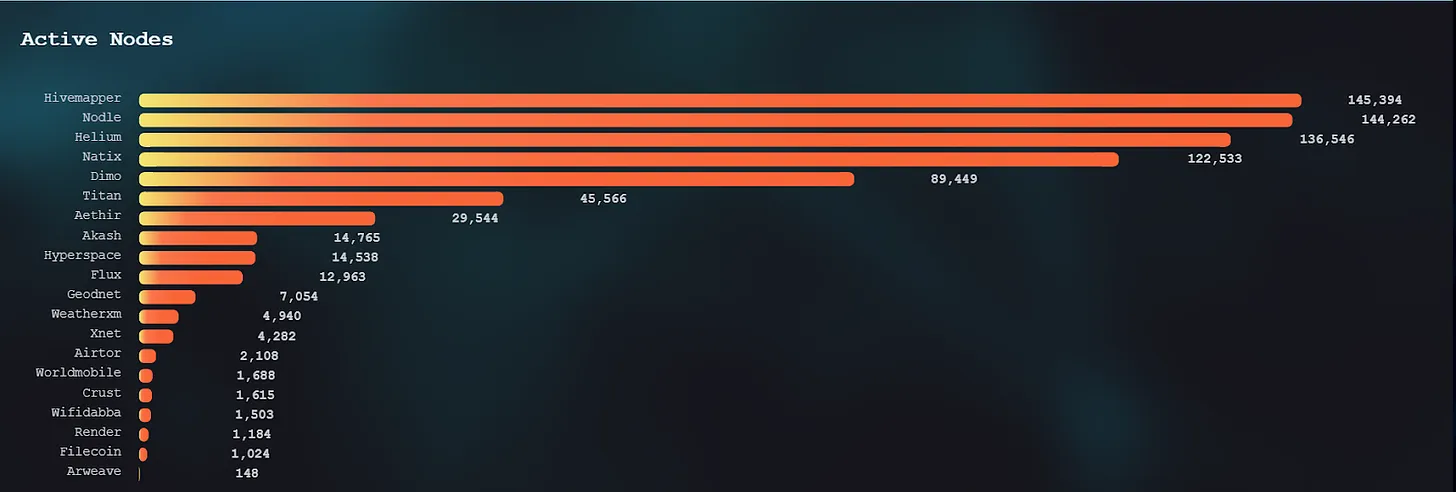
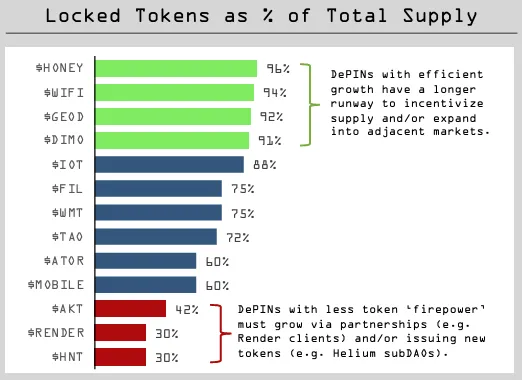
Source: DePIN Ninja, EV3
While traditional DePIN projects continue searching for sustainable incentive models, we believe newer DePIN projects tackling less complex and non-critical infrastructure will rise quickly. Projects like Hivemapper have already created a decentralized way to map the world and achieved promising early results. Users worldwide use their own cameras to map roads. This represents a new model where decentralized solutions (people using phones/cameras) outperform centralized ones (like satellite imagery or government mapping) by producing better maps faster.
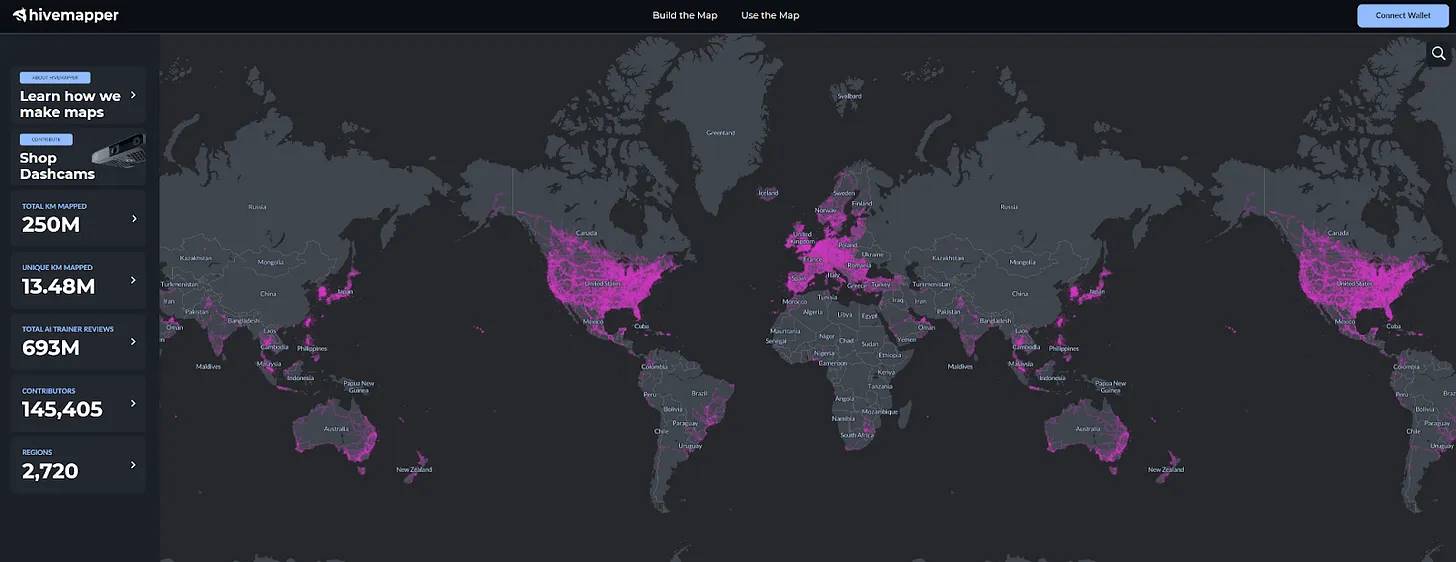
Source: Hivemapper
Underdeveloped markets or conflict zones lacking digital infrastructure—such as Africa and Southeast Asia—stand to benefit significantly from improved digital infrastructure. Internet prices in Africa are among the highest globally, with Nigeria ranking third in cost per Mbps at $4.89. Centralized service providers struggle to achieve ROI without charging high fees, whereas decentralized models have the opportunity to offer more competitive pricing. Southeast Asia includes two major archipelago nations—the Philippines and Indonesia. Unsurprisingly, the Philippines and Indonesia rank 35th and 21st respectively in global internet cost rankings. With young, tech-savvy populations, these markets will benefit greatly from the advanced technological and economic solutions offered by DePIN.
Looking ahead, we anticipate greater experimentation within DePIN projects, incorporating zero-knowledge proofs, memecoins, and increasingly AI. Latest reports from EV3 and Messari also predict that Asia will produce the next top-10 DePIN project between 2024 and 2025.
Conclusion
The Ocular team will certainly continue monitoring DePIN trends and exploring them in future posts—so stay tuned! We’re excited to see how Web3 continues to evolve and improve infrastructure for both enterprises and consumers.
Join TechFlow official community to stay tuned
Telegram:https://t.me/TechFlowDaily
X (Twitter):https://x.com/TechFlowPost
X (Twitter) EN:https://x.com/BlockFlow_News
 @ocularvc






