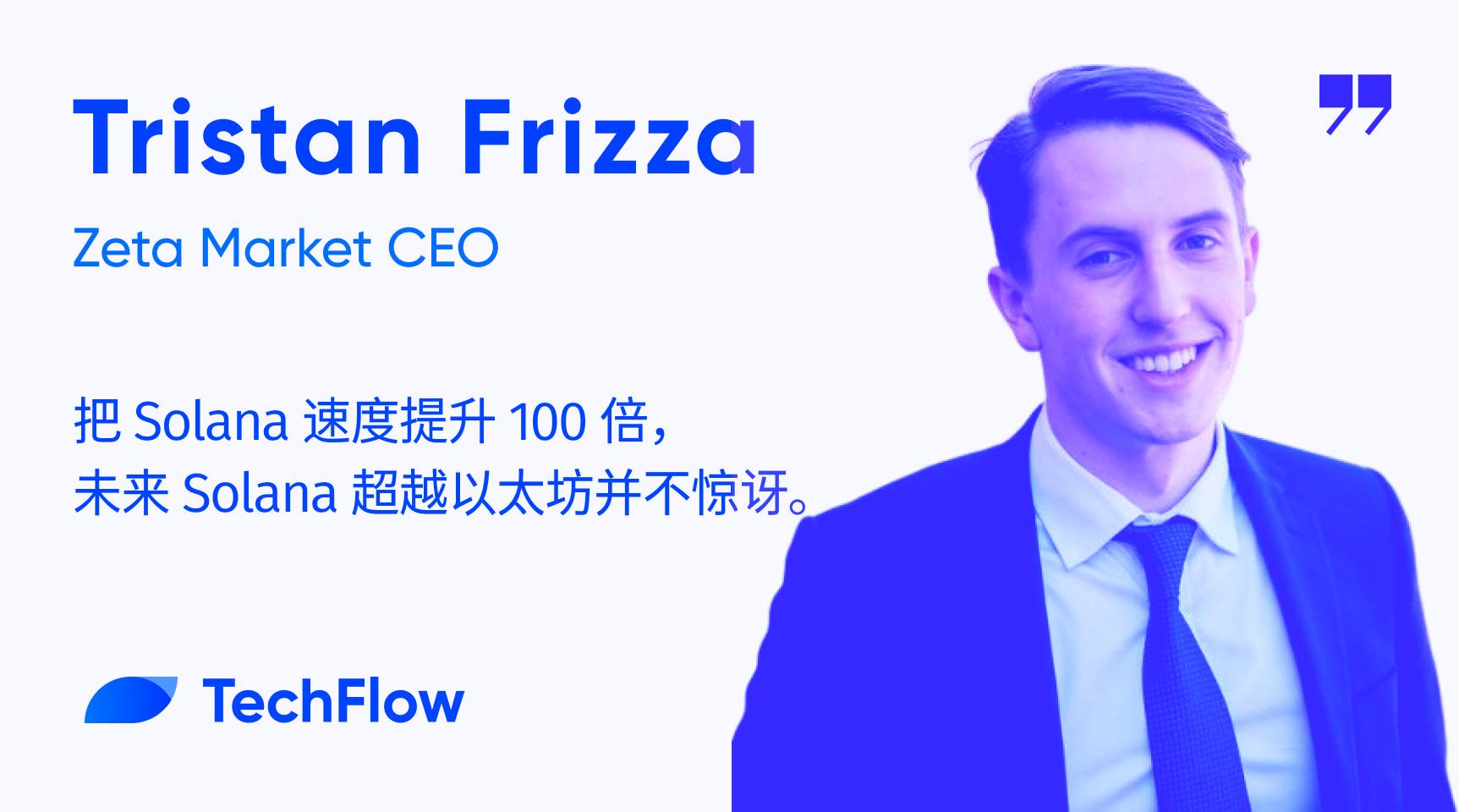
Interview with Zeta Market CEO: Boosting Solana's Speed by 100x, It's No Surprise That Solana Could Surpass Ethereum in the Future
TechFlow Selected TechFlow Selected
Interview with Zeta Market CEO: Boosting Solana's Speed by 100x, It's No Surprise That Solana Could Surpass Ethereum in the Future
Zeta X aims to integrate cutting-edge technology to deliver a non-custodial, fully verifiable perpetual contracts exchange with the speed and ease of use comparable to centralized platforms.
 Navigating Web3 tides with focused insights
By TechFlow
The DEX battlefield is filled with smoke and fire, especially in the high-frequency perpetual DEX arena, where optimization of cost and speed has become the key for players to break through.
Two years ago, despite Ethereum's larger and more mature financial ecosystem, high fees, slow transaction speeds, and scalability limitations led many DeFi projects to consider migrating to Solana. Zeta Markets was one such project. As a decentralized derivatives trading platform, Zeta Markets aimed to leverage Solana’s superior performance to deliver lower-cost, more efficient, and flexible trading experiences for users.
Today, two years later, Zeta Markets has grown into a leading perpetual contract trading platform within the Solana ecosystem, boasting 100,000 active traders and over $10 billion in trading volume. Yet Zeta Markets hasn’t stopped innovating on cost and speed. The vision of building Zeta X—a Layer2 solution on Solana—is now taking shape: by implementing a rollup on Solana, Zeta aims to go even faster on an already fast base layer. Zeta X targets up to 10,000 TPS and 5-millisecond latency, striving to deliver a trading experience comparable to CeFi platforms.
With the $ZEX (Zeta X’s native token) airdrop now live, we sat down with Zeta Markets CEO Tristan Frizza to discuss the design philosophy behind Zeta X, the utility of $ZEX, and the future evolution of perpetual DEXs. During our conversation, Tristan shared:
“Ultimately, we want to become a universal exchange—something like a Robinhood on-chain—that enables users to access various products at low cost and high efficiency, while offering a smooth onboarding experience even for those outside the crypto-native world.”
Below are the highlights from our interview.
Key Takeaways
-
Not every application in the Solana ecosystem needs an L2 or app chain—most likely, most apps don’t, because Solana’s L1 already offers extremely high scalability. However, for applications like Zeta that are highly performance-sensitive, require isolated blockspace, and demand significant customization, an L2 is a natural fit.
-
There’s currently no need to develop a Layer 3, as it would introduce additional bridging complexity, while L1 or L2 performance should already be sufficient.
-
We’re not building an L2 to chase higher valuations. Our development is driven by real product and user needs—we need to create an extremely flexible infrastructure layer to meet trading demands.
-
Currently, Solana’s block time is 400 milliseconds. Zeta aims to accelerate this by 100x, achieving 5-millisecond latency and matching the TPS of top centralized exchanges like Binance.
-
In my view, future improvements in DeFi will come more from faster execution layers, cheaper blockspace, and more user-friendly wallet interfaces.
-
We spent considerable effort designing fair airdrop rules, including prioritizing genuine activity and usage patterns, rewarding based on proportional scoring, filtering out low-quality and low-value users, and thoroughly screening Sybil accounts.
-
It’s hard to predict whether Solana will surpass Ethereum in the future, but I can say this—I wouldn’t be surprised at all if it did.
Solana’s Performance Suffices for Most Apps, But We Still Need an L2
TechFlow: Thank you, Tristan, for joining us. Could you briefly introduce your background and what Zeta Markets is working on?
Tristan:
Hi everyone, I’m Tristan Frizza, CEO of Zeta Markets.
Before entering crypto, I worked primarily in AI research related to computer vision and generative deep learning. I started getting involved in cryptocurrency in 2017 and went full-time into crypto in 2021.
In 2021, I co-founded Zeta with another founder to explore blockchain-based financial markets. Since then, Zeta has evolved into a leading perpetual futures trading platform, with 100,000 active traders and over $10 billion in trading volume.
Since inception, the Zeta team has been pushing the boundaries of DeFi in terms of product UX and performance. Today, users on Zeta can execute trades in under one second while maintaining full self-custody and transparency—an impressive technical achievement.
TechFlow: Zeta Markets was already active in early 2022, near the end of the bull market. After more than two years of development, what progress and major changes have you seen at Zeta Markets?
Tristan:
Our contributors have continued building throughout the bear market.
Since our mainnet launch in early 2022, we completely rewrote the exchange as part of Zeta V2. These efforts significantly improved app usability—completely redesigning the UI, optimizing the order book to be fast and real-time, enhancing tools for market makers to ensure better liquidity, and launching mobile trading, referral, and points systems.
We’re now approaching the launch of our native token, $ZEX, which will allow users to gain governance rights via staking and benefit from trading incentives.
TechFlow: For Zeta Markets, the two hottest topics recently are $ZEX and Solana Layer2. In fact, there’s ongoing debate about whether Solana even needs Layer2. What improvements or changes do you think an L2 brings to Solana? Is there potential for Layer3 in the future—and why or why not?
Tristan:
Frankly, I don’t believe every Solana-based app needs an L2 or app chain—most probably don’t, since Solana’s L1 already offers exceptional scalability. However, for performance-intensive applications like Zeta that require isolated blockspace and extensive customization, an L2 is a natural choice. Building a dedicated rollup on Solana gives us tremendous flexibility in exchange design, as the current Solana runtime may impose some constraints on design space.
Lastly, I don’t think there’s a compelling need to build Layer3 today, as it would add unnecessary bridging complexity, while L1 or L2 performance should already be satisfactory.
TechFlow: Launching an L2 sounds more exciting than just being another perpetual DEX, and could lead to higher valuation. Did you consider this? If you were to value Zeta Markets, you probably wouldn’t want to benchmark it purely against other perpetual DEXs. So how should investors assess Zeta Markets’ potential?
Tristan:
While that may be true in the market, we didn’t choose to build an L2 to chase higher valuations. Our development is rooted in real product and user needs—we need to create a highly flexible infrastructure layer to meet trading demands, and for that, owning the tech stack rather than relying solely on a general-purpose blockchain is essential.
We’ve seen other leading perpetual exchanges take similar paths—like dYdX (now on Cosmos) and Hyperliquid (building its own L1). Given Zeta’s team background in high-frequency trading (HFT), we’re confident in maintaining strong competitiveness in this vertical.
Additionally, we believe value will flow more easily to chains like ours built on Solana, rather than isolated app chains, meaning bridging will be seamless and we inherit Solana’s security guarantees.
TechFlow: Why is Zeta Markets building an L2? Can you walk us through the core features of Zeta X?
Tristan:
The primary goal of Zeta Markets’ Layer2 solution is to move the execution layer off-chain to dramatically improve trading speed and throughput. Currently, Solana’s block time is 400 milliseconds; Zeta aims to accelerate this 100-fold, achieving 5-millisecond latency and matching the TPS of top centralized exchanges like Binance. This upgrade will make perpetual contract liquidity deeper and more efficient, ultimately delivering the best liquidity in the market.
Zeta X will feature a fully Rust-written orderbook executed within a zkVM. This allows cryptographic verification of each trade via zero-knowledge proofs, enabling ultra-fast, pre-confirmed transactions that match the responsiveness of centralized exchanges, while preserving DeFi’s security and transparency.
Moreover, Zeta X will significantly reduce trading costs and enhance UX by eliminating the need for individual transaction signatures and lowering gas fees. Overall, Zeta X aims to integrate cutting-edge technologies—Rust zkVM and Solana’s high-performance base layer—to offer a non-custodial, fully verifiable perpetual exchange with speed and ease of use rivaling centralized platforms.
TechFlow: When announcing your L2 on Solana, did you face any resistance or controversy? How did you handle it?
Tristan:
Initially, there were indeed skeptics who saw this as a rejection of Solana. But I think those criticisms were immature. In reality, Solana is incredibly fast and offers abundant blockspace, making it an excellent choice for data availability and consensus.
Fortunately, over the past few months, building L2s on Solana has become far less controversial. People now recognize that Solana as an ecosystem is here to stay, and many new teams are launching their own L2s or app chains on Solana. Given the Solana developer community’s relentless focus on improving product UX, both developers and users have widely embraced this direction.
Significant Effort Put Into Designing ZEX: Fair Airdrops, Useful Tokens
TechFlow: Let’s shift to the topic users care about most—tokens. You recently tweeted that poorly designed airdrops can do more harm than good. What were the core principles or metrics guiding the design of the $ZEX airdrop?
Tristan:
We invested substantial effort into designing the $ZEX airdrop. The allocation follows these key principles:
Prioritize genuine activity and real usage patterns: We spent significant time identifying core behaviors of authentic users, continuously refining rules to reward those who truly add value to the exchange. Long-term traders, high-volume users, and those broadly active in the Solana ecosystem received larger allocations.
Reward proportionally based on points: We adopted a linear distribution model, meaning airdrop amounts scale roughly with earned points. This is fair—more trading equals more rewards—and prevents users from gaming the system by creating thousands of wallets. While linear models risk giving large allocations to whales, we implemented reasonable caps to maintain overall fairness.
Filter out low-quality, low-value users: We recognized that many users at the tail end were either outright Sybils or unlikely to use the platform long-term. We set a minimum $500 trading volume threshold per wallet, filtering out ~25% of wallets. This ensures fewer tokens go to low-value users and more to genuine traders.
Thoroughly screen fake account activity: We collaborated closely with Allium to analyze behavioral patterns and identified thousands of wallets clearly controlled by single actors or running automated, bot-like operations. These were excluded as well.
TechFlow: We conducted a quick survey among users, and some feel token utility for perpetual DEXs is limited—basically just staking and fee discounts. We know $ZEX will also serve as the Gas token for the Layer2. How should token utility be designed for a Perp DEX? And could you share your complete vision for $ZEX’s utility?
Tristan:
Indeed, there’s a vast and underexplored design space in perpetual protocols and broader tokenomics. I’m particularly impressed by protocols like GMX and their two-token GMX/GLP model, which allows LPs to earn yield in a point-to-pool setup—a unique and valuable approach.
Zeta’s token design includes several notable features. First, users can stake tokens to receive gZEX, Zeta’s governance voting token. This follows a vote-escrow model (we were among the first on Solana to adopt this), where longer lock-up periods result in exponentially more gZEX, incentivizing long-term holding. gZEX grants governance rights and entitles holders to up to 30% of trading incentives, further boosting returns.
Once the L2 launches, we envision $ZEX playing a role in our Rollup infrastructure. For example, operating zk Rollup validator networks is costly, so native rollup tokens could reward validators. We’re still in the conceptual phase, but we’re committed to deeply integrating the token into our new Rollup—stay tuned!
If Solana Surpasses Ethereum, I Wouldn’t Be Surprised
TechFlow: Back to the product—this year, many DEXs are exploring new directions: Uniswap improving AMM mechanisms, Jupiter focusing on UX, dYdX launching its own chain, Bluefin aiming to become financial infrastructure. From a sector perspective, where do you see room for innovation in DEXs, especially Perp DEXs?
Tristan:
I’m thrilled to see such vibrant innovation across DeFi. I believe DeFi still has a long way to go, especially given that DeFi’s current scale is far smaller than CeFi, which itself is dwarfed by traditional finance. In my view, future improvements in DeFi will come more from faster execution layers, cheaper blockspace, and more user-friendly wallet interfaces.
We’re already seeing rapid advancements. Zeta is building an ultra-fast execution layer for perpetual trading, and Solana continues to drive down costs and boost efficiency. We’re also seeing exciting innovations around decentralized entry points that let users directly access DeFi. Integrations like DeBridge, a fast cross-chain bridge we recently added, enable us to attract users from other blockchains to deposit and trade on Zeta.
TechFlow: Where do you see Zeta Markets fitting into the Solana ecosystem in the future? And expanding across the entire blockchain landscape, what kind of Zeta Markets do you envision?
Tristan:
Short-term, we’ve already proven Zeta’s position as the leading perpetual exchange on Solana in terms of speed, liquidity, and volume. As we advance toward our Rollup vision, our ambitions grow—we aim to compete with all on-chain perpetual exchanges, become leaders in the space, and eventually challenge centralized exchanges.
Ultimately, we want to become a universal exchange—like a Robinhood on-chain. We aim to offer users a variety of products (e.g., spot and lending), all under a unified margin system, accessible from any base chain, and providing a seamless onboarding experience for non-crypto-native users.
TechFlow: Final question: Do you think Solana will surpass Ethereum?
Tristan:
Predicting the future is difficult—crypto seems to evolve every few months. But I can say this: if it happens, I wouldn’t be surprised at all.
As an early builder, I’ve been developing on Solana for over three years. I chose Solana because I believe the team excels technically and has cultivated a highly focused ecosystem. Ethereum was a great attempt at a general-purpose smart contract blockchain, but it faces clear scalability bottlenecks—this is precisely why emerging chains like Solana have risen so quickly. With exciting developments like Firedancer, I believe Solana will pull ahead in blockchain scalability.
Furthermore, Solana’s ecosystem hosts a wealth of talented developers—an advantage competitors will struggle to replicate for years. That said, Solana still lags behind Ethereum in metrics like TVL. However, Solana is gaining stronger institutional adoption (e.g., Visa, Stripe, Shopify Pay, PayPal), and this gap could close rapidly in the future.
Join TechFlow’s Official Community
Telegram Subscription Group:
Twitter Official Account:
Twitter English Account:
Join TechFlow official community to stay tuned
Telegram:https://t.me/TechFlowDaily
X (Twitter):https://x.com/TechFlowPost
X (Twitter) EN:https://x.com/BlockFlow_News
 深潮TechFlow