









How can Web3 projects use token incentives to drive market supply?
TechFlow Selected TechFlow Selected
How can Web3 projects use token incentives to drive market supply?
Active supply markets tend to be defensive, while passive supply markets are easier to scale.
 Navigating Web3 tides with focused insights
Author: Mason Nystrom, Investment Partner at Variant Fund
Translation: Luffy, Foresight News
Token incentives can attract supply-side participants to markets, helping overcome cold start problems. But not all supply is created equal.
Active supply requires continuous participation in market activities, whereas passive supply involves an initial setup with minimal ongoing maintenance.
Tokenized markets with active supply tend to be stickier and, once they reach a certain scale, often have stronger defensibility because the compounding nature of demand provides better economics for suppliers. The winner is the one who captures the greatest demand liquidity first.
In contrast, markets with passive supply can rapidly scale up supply without needing equivalent demand growth, but their stickiness is harder to guarantee. Builders can leverage these traits when bootstrapping tokenized markets, provided they understand how to balance them appropriately.
Active Markets vs. Passive Markets
Active supply markets lean toward defensibility, while passive ones are easier to scale. To understand this distinction, we must examine their general characteristics—each falling along a spectrum.
Human Labor vs. Resources
Active supply resembles human labor. For now, people cannot passively rent out their cognitive effort the way they might rent storage space. For example, Braintrust, a decentralized talent network, requires a constant flow of talent to meet real-time employer demands.
In contrast, resources such as hardware, NFTs, and capital represent typical examples of passive supply. For instance, DIMO, a vehicle data-sharing network, requires users to purchase and connect DIMO hardware. After a one-time cost, the device continuously transmits vehicle data to the DIMO network with little need for further user input.
Opportunity Cost vs. Sunk Cost
In active markets, supply-side participants choose the market offering the best combination of income/returns and token appreciation potential. Axie Infinity popularized the play-to-earn model, competing with other platforms where users can earn tokens through labor. Without strong organic demand, active markets must constantly compete against every other way users could spend their time earning tokens.
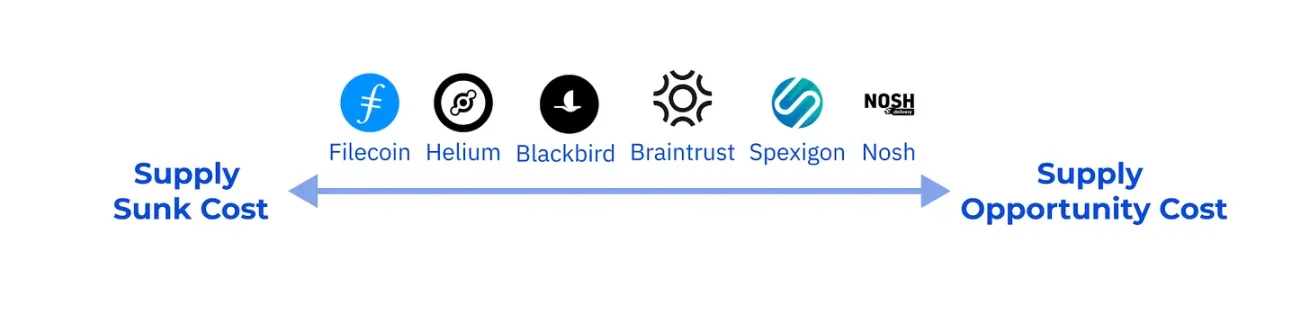
However, in passive markets, suppliers incur upfront asset investments, creating sunk costs. As long as operations remain profitable, supplier operators will passively provide physical assets to the market. For example, GPU owners have incentives to contribute computing power to GPU markets. Even amid supply-demand imbalances, passive markets can use token incentives to support large-scale supply.
Quality-Dependent vs. Quality-Independent Supply
Scaling becomes much easier when supply quality is clearly defined. Passive supply markets, which rely on physical assets, are better suited for this than active supply markets. Their supplies often come with quantitative specifications, making quality improvements more straightforward. For example, GPUs have quantifiable classifications (e.g., A100 vs. RTX 4090), closely tied to supply quality.

This scenario is rare in active supply markets, where participant capabilities vary widely. Platforms like Braintrust or Nosh depend heavily on worker quality, yet demand-side users hold differing standards for what constitutes high-quality labor.
Implications for Token Design
So how should builders bootstrap tokenized markets and scale them effectively? How do supply characteristics influence token design?
Markets with Active Supply
For markets relying on active supply, token design should focus on several key principles:
-
Scale token incentives alongside demand growth
-
Incentivize supplier loyalty, quality, or reliability
-
Implement dynamic incentive mechanisms
In passive markets, supply can wait for demand to catch up (e.g., Filecoin). But this isn’t true for active markets, where individuals face high opportunity costs. Therefore, builders must prioritize demand-side growth to stay competitive. Still, tokens can help bootstrap initial demand to attract supply-side participants.
One strategy for scaling active markets is dynamically expanding supply-side incentives so that token distribution aligns closely with growth. One related mechanism is permissioned supply onboarding, allowing consistent and stable yields for suppliers, maintaining workforce engagement and reliability.
Ultimately, the very constraints of active supply make such markets more sticky as they grow: increasing demand enables more stable returns. From an incentive design perspective, these tokenized markets should focus on delivering sustained rewards to maintain platform activity. Moreover, they should dynamically adjust these rewards to favor users providing reliable supply over those prone to churn.
While token incentives are valuable for bootstrapping supply and demand, innovation at the service, verification, and reputation layers may also be needed to improve supply quality—an essential trait in active supply markets.
Here, tokenized markets should learn from traditional custodial platforms. For example, RealReal and StockX offer authentication services to ensure product legitimacy. Similarly, Braintrust acts as an intermediary, incorporating a quality assurance layer into its marketplace while using tokens to help onboard supply.
Active supply markets that successfully harness token-driven effects can perform even better. By leveraging equity-based intermediary networks or token-incentivized validation and management layers, they can enhance quality assurance and create more efficient markets.
What about tokenized markets where supply and demand originate from the same users—such as NFT marketplaces or play-to-earn games like Axie or Stepn?
Markets where roles can shift require more flexible token incentive designs, as they’re most susceptible to speculative flywheels that obscure organic demand. Such markets can mitigate reflexive growth by incorporating lockups into token rewards, encouraging long-term participation. Active supply markets should incentivize supply diversity, attracting professional consumers and specialized suppliers rather than volatile retail contributors.
Markets with Passive Supply
For builders of passive supply markets, token design also offers critical insights:
-
Actively scale supply-side numbers to achieve commercially viable scale
-
Build stronger defensibility via demand-side products (e.g., SDKs, APIs) or proprietary hardware that locks in suppliers
-
Incentivize supplier loyalty, quality, or reliability
Passive supply markets typically require reaching a minimum supply threshold before becoming commercially viable (i.e., generating strong demand), so builders should initially focus on growing the supply side. Additionally, this supply is usually measured in quantity rather than quality. For example, data collection networks like DIMO, Hivemapper, and Wynd need massive amounts of data before aggregated datasets or derived services become valuable.
Since all passive supply markets are easier to scale, new entrants cannot secure demand merely by aggregating sufficient liquidity. Instead, competition usually occurs at the product level—often through building SaaS components like SDKs and APIs—to help demand-side users access the market. GPU markets like IO.net offer aggregation services that make it easier for end users to access computing power. Likewise, DIMO has built a marketplace enabling DIMO token holders to purchase automotive services.
Another way to strengthen defensibility in passive supply markets is transitioning from commoditized to proprietary supply. Wireless network markets like Helium and XNET are building telecom infrastructure using proprietary hardware.
Finally, given the high sunk costs in passive supply markets, suppliers typically continue serving the network as long as returns exceed operating costs. When sunk costs are high and opportunity costs low (e.g., Blackbird restaurant accepting FLY tokens), suppliers are more likely to stay due to intrinsic motivation. Conversely, when both sunk and opportunity costs are high (e.g., GPU owners supplying compute markets), demand levels or token rewards may become decisive factors in how suppliers allocate their resources.
Join TechFlow official community to stay tuned
Telegram:https://t.me/TechFlowDaily
X (Twitter):https://x.com/TechFlowPost
X (Twitter) EN:https://x.com/BlockFlow_News
 Variant











