Apple Vision Pro China Mainland Edition Is Finally Here—Should You Grab It Now or Wait?
TechFlow Selected TechFlow Selected
Apple Vision Pro China Mainland Edition Is Finally Here—Should You Grab It Now or Wait?
Starting at 29,999 yuan, it's a test for your wallet.
 Navigating Web3 tides with focused insights
Text: Mu Mu
Editor: Wen Dao
One year after its global debut, Apple's Vision Pro headset is finally launching in mainland China on June 28.
To better penetrate the Chinese market, the China model of Vision Pro has made significant efforts in localizing applications, supporting a wide range of locally popular apps adapted for the visionOS operating system—including Taobao, Tencent, Weibo, DingTalk, Amap (Gaode Map), and China Merchants Bank.
However, the starting price of 30,000 RMB has cooled enthusiasm among Chinese consumers. Beyond die-hard fans, many potential users are deterred by the high cost, giving rise to so-called "touch-and-go" users who just want to try it out, and the "wait-and-see" crowd who are holding off for price drops or the next-generation model.
For Apple loyalists, Vision Pro remains appealing due to its spatial multitasking capabilities, seamless human-computer interaction, and cross-device integration within the Apple ecosystem.
Yet judging from pre-order figures, Vision Pro’s technological strengths are severely tested by its pricing. Unlike the sold-out scenario in the U.S., the China model is readily available, with ample inventory still on hand at the time of publication.
Analysts suggest that while the high price may deter average consumers, it could still attract professional B2B users.
Popular Apps Like Taobao Actively Adapted for Vision Pro
On June 14, pre-orders opened for the China model of Apple Vision Pro, priced at 29,999 RMB for the 256GB version, 31,499 RMB for 512GB, and 32,999 RMB for the 1TB variant. The spatial computing device will officially begin shipping on June 28.
Alongside the China launch, Apple updated Vision Pro’s operating system to visionOS 2. A key new feature allows 2D photos to be rendered in 3D directly on the device, enabling users to relive memories in immersive depth. However, the China model ships with visionOS 1.2, while visionOS 2 will roll out to all users this fall.
In addition to system updates, the China model supports many widely used domestic apps.
For example, when opening a product page on Taobao within Vision Pro, items appear not as flat images but as floating 3D models. Users can manipulate them in space—zooming in and out, rotating, or placing them anywhere in their environment.
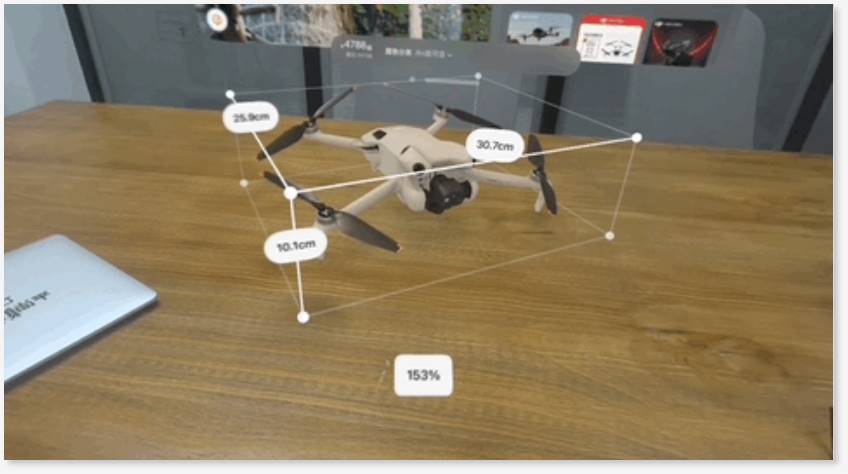
Products displayed as 3D models in virtual space on Vision Pro (image from internet)
Size visualization is particularly useful for large household items such as refrigerators, sofas, or mattresses. By rendering objects at a 1:1 scale and displaying exact dimensions, users can preview how they would look in their homes, reducing errors before purchase.
Tencent Video has also optimized its content for spatial viewing. Watching videos on Vision Pro goes beyond simply projecting a large virtual screen—the integration of 3D content enhances immersion. For instance, during esports broadcasts, 3D sand tables and real-time match data can be viewed from multiple angles, offering a literal “god’s-eye view” of the action.
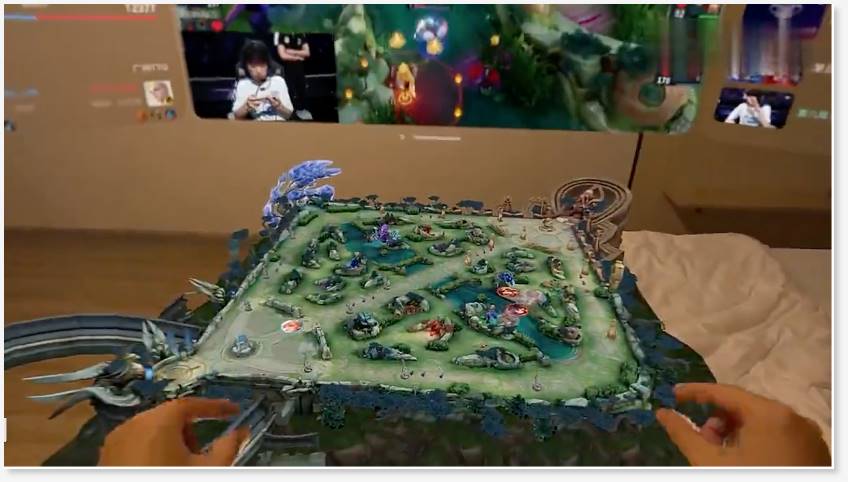
The 3D King's Chessboard in Vision Pro
Tencent Video plans to offer over 600 titles on visionOS, including "Joy of Life Season 2," "The Three-Body Problem," and "Douluo Continent." Immersive 3D environments such as the悬空temple from "Joy of Life" or the Red Coast Base from "The Three-Body Problem" will appear within the headset during viewing.
To win over the Chinese market, Apple is actively encouraging popular local multi-platform apps to join Vision Pro, including Weibo, DingTalk, Douyin, DeWu, China Merchants Bank, Amap, Trip.com (Trip Vision), Migu Video, and others.
Still, compared to the U.S. version, the China model lags in app availability. The overseas Vision Pro App Store currently hosts around 2,000 apps, half of which are games. VR hardware experts predict only about 10% of these may pass review and become available in China.
Under these circumstances, how attractive can this so-called "spatial computer" really be to Chinese users?
Ample Pre-Order Supply, But Consumer Enthusiasm Is Low
Pre-order data shows that unlike the scarcity seen in the U.S., supply for the China model is abundant. As of publication, customers can still place orders and expect delivery after June 28.
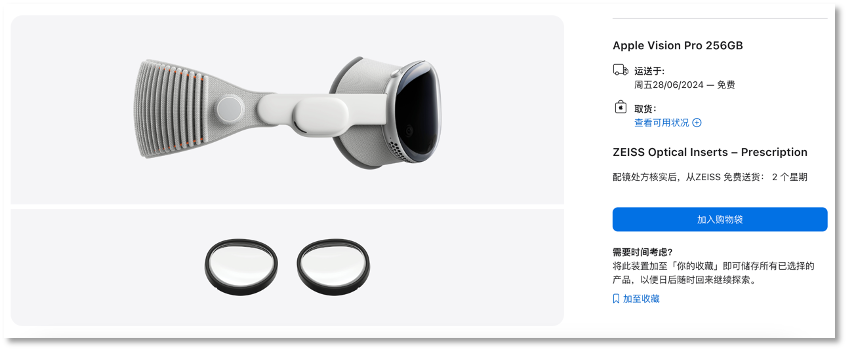
Vision Pro remains available for order in China
For those who can afford it, the main draw lies in its revolutionary experience. Spatial multitasking, fluid user interface, and unmatched immersion remain Vision Pro’s key selling points.
Take spatial multitasking alone—it sets Vision Pro apart from other devices. Imagine having your draft document front and center, reference web pages to the left, project timelines above you, and a video call with a friend open to your right—all visible simultaneously in virtual space.
This ability to expand interfaces beyond what’s possible on PCs or smartphones defines the “killer scenario” of spatial computing.
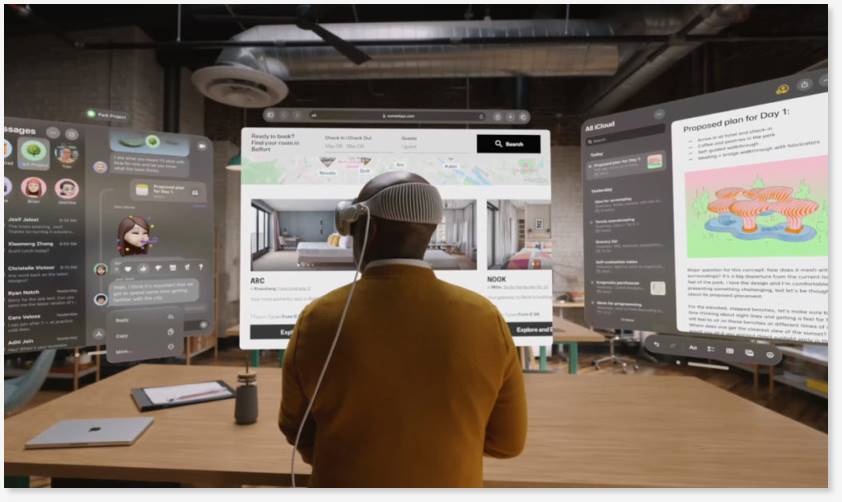
Multi-window spatial interface
Of course, these impressive features were already showcased by early adopters abroad. So too were the drawbacks: high cost, heavy weight unsuitable for prolonged use, reduced clarity in low-light outdoor conditions causing dizziness, and an inefficient virtual keyboard that limits typing to two fingers—the infamous “two-finger typing” returns.
These usability issues may be magnified by the premium price, prompting buyers to carefully weigh whether it’s worth it. As a result, two types of potential buyers have emerged: the “touch-and-go” group, eager to try but not buy immediately, and the “wait-and-see” group, waiting for price cuts or newer models.
Many have booked trial sessions through Apple’s official website and visited flagship stores. Although trials are only available until July 4, slots in major cities like Beijing and Shanghai are already fully booked.
As one “wait-and-see” buyer put it: “I’m afraid I won’t finish paying my installment plan before a new model comes out.” This reflects the broader hope that, like other Apple products, Vision Pro will eventually see a price drop or a significantly upgraded successor.
Industry analysts believe the high price blocks average consumers but may appeal to professional users. IDC China analyst Ye Qingqing stated, “Vision Pro’s primary focus in China this year will be the mid-to-high-end B2B market. After initial excitement, C2C sales will quickly settle at a low level.”
Tech YouTuber @Mengya Myra from Bilibili predicts that first-wave Vision Pro buyers will include 30–40% B2B users—such as internet application developers, software or game studios, hospitals, universities, and advertising agencies.
For internet companies, the goal is adapting existing apps for Vision Pro; for developers, it’s creating native applications; institutions like hospitals and universities aim to boost productivity in specialized fields; and ad agencies will explore new forms of marketing content in immersive environments.
Apple has been strategically targeting B2B markets early on. At its May spring event, CEO Tim Cook highlighted Vision Pro’s early B2B achievements since its February launch, noting it has become a key part of Porsche showroom experiences, allowing potential buyers to explore car color options in virtual space.
In China, B2B use cases are already emerging. In healthcare, for example, on May 13, academician Wang Jun’s thoracic surgery team at Peking University People’s Hospital completed China’s first lung cancer radical surgery assisted by Vision Pro.
Undeniably, as Apple’s first spatial computing device, Vision Pro still has significant flaws. Yet it remains a groundbreaking, even epoch-defining product.
Rooted in the Apple ecosystem, Vision Pro transforms flat 2D displays into dynamic 3D spatial interfaces, seamlessly integrating across devices—an experience no other smartphone or PC brand has yet perfected. With strong existing user loyalty and growing B2B adoption, Vision Pro may outperform other XR headsets in long-term sales potential.
Join TechFlow official community to stay tuned
Telegram:https://t.me/TechFlowDaily
X (Twitter):https://x.com/TechFlowPost
X (Twitter) EN:https://x.com/BlockFlow_News