








Opinion: Vitalik Is Wrong — Crypto Really Does Need "Stupid" Memecoins
TechFlow Selected TechFlow Selected
Opinion: Vitalik Is Wrong — Crypto Really Does Need "Stupid" Memecoins
Celebrities embracing memecoins could provide crypto with the right momentum, potentially improving infrastructure in the long run.
 Navigating Web3 tides with focused insights
By David Canellis, Blockworks
Translation: Felix, PANews
If you're a celebrity, getting involved with Bored Ape Yacht Club (BAYC) is now passé—memecoins are where it's at.
BAYC may have been the most successful project in terms of mainstream popularity. But judging by its floor price, BAYC has clearly fallen out of fashion.
Meanwhile, celebrity memecoins have developed cross-cultural appeal—a trait most cryptocurrencies lack.
The idea that memecoins serve no purpose is short-sighted. Memecoins are key components of blockchain ecosystems—placeholders for "real" economic activity that could eventually shift people from traditional financial gateways to blockchain-based ones. To achieve this, these systems must be capable of handling hundreds of thousands of users simultaneously trading silly-named tokens.
At this point, even as some in crypto remain sensitive to absurd and seemingly meaningless projects, their opposition to memecoins may misrepresent one of the most active segments in the space today.
Celebrities are encountering crypto: fast DEXs, low-cost blockchains, gambling apps, Twitter, Telegram, and Discord.
It’s hard to find fault here without sounding overly conservative or judgmental.
So Iggy Azalea or Caitlyn Jenner launching their own memecoin isn’t particularly scandalous—at least not compared to Katy Perry’s CrYpTo ClAwS, Kim Kardashian’s Instagram promotion of EthereumMAX (a SafeMoon clone), or Randi Zuckerberg’s WAGMI music video.
Those stunts felt more like “Hey kids, are you paying attention?” than anything else.
Countless memecoins have surged, crashed, and flatlined—the classic “rug pull” trajectory—but Caitlyn Jenner’s Ethereum-based memecoin has continued to gain momentum.
Jenner launched on Ethereum just days after her Solana token debuted. The Solana-based JENNER had already surged over 1,000%, briefly reaching a market cap above $30 million.
However, reports indicate Jenner’s team was deceived by an alleged serial memecoin manipulator, and the Solana version should never have been recognized. This renders the Solana token—an asset rapidly losing value—an unofficial and essentially worthless entity.
To boost interest in the new token, Jenner pledged that if the new Ethereum-based Jenner reaches a $50 million market cap (currently valued at $5.8 million, versus the original token’s $3.6 million), she will impose a 3% transaction tax benefiting Donald Trump’s campaign.
Tens of thousands of addresses now hold celebrity memecoins. But make no mistake: none of these are high-market-cap cryptocurrencies. Collectively, memecoins—including Dogecoin and Floki—are worth over $52 billion, yet they still account for less than 5% of the broader crypto market (excluding Bitcoin).
Jenner’s two tokens, along with Iggy Azalea’s MOTHER and Andrew Tate’s DADDY, represent less than 1% of the entire memecoin market.
Memecoins are widely criticized within the crypto community—even Vitalik has voiced concerns about celebrities entering crypto. Or rather, memecoins make crypto appear immature and speculative, potentially diverting attention and capital away from more legitimate, technically robust projects backed by venture capital.
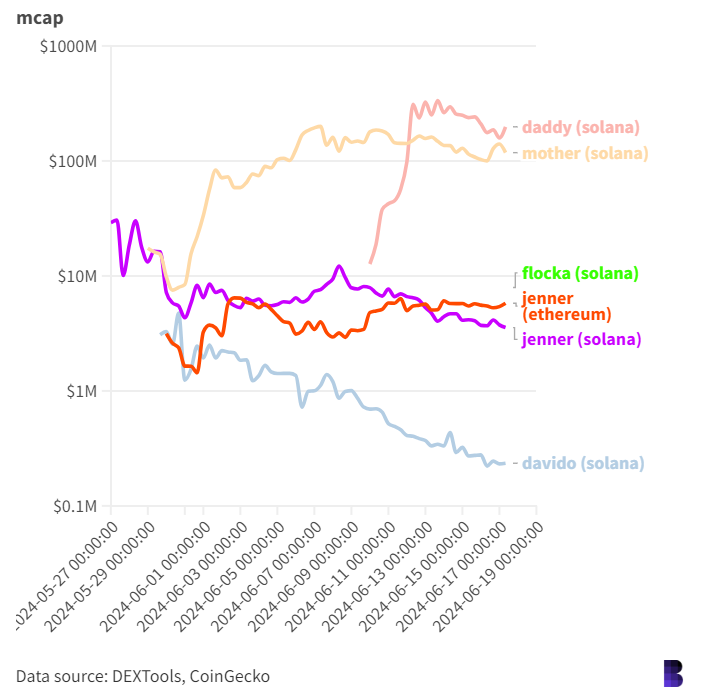
Status of Celebrity Memecoins
For true believers, crypto means everything—from the largest wealth transfer in history to a solarpunk revolution and anarchist capitalist uprising.
But crypto also means nothing. It’s unknowable, chaotic—and technology gives it meaning.
While the warm, fuzzy sense of community derived from trading memecoins with internet strangers may seem irrational, memecoins do possess technical utility: they stress-test blockchains in ways few other token categories ever have.
Past phenomena like the NFT game CryptoKitties revealed Ethereum’s need for Layer 2 scaling; Ordinals showed how nearly any EVM chain could crash under sudden demand; and memecoin mania proved Solana’s transaction routing urgently needed improvement.
Welcome to the celebrity crypto metaverse. These celebrities may not realize it, but by embracing the fun of launching memecoins, they might actually be providing the right push for crypto—potentially improving infrastructure in the long run.
Join TechFlow official community to stay tuned
Telegram:https://t.me/TechFlowDaily
X (Twitter):https://x.com/TechFlowPost
X (Twitter) EN:https://x.com/BlockFlow_News
 Blockworks











