








Is the Layer2 ecosystem developing rapidly? A comprehensive overview of current mainstream Layer2 projects
TechFlow Selected TechFlow Selected
Is the Layer2 ecosystem developing rapidly? A comprehensive overview of current mainstream Layer2 projects
With the rapid development of L2 ecosystems, what are the main L2 technologies and prominent projects? What challenges do they face and what improvements are being made?
 Navigating Web3 tides with focused insights
Author: Starknet
Translation: Baihua Blockchain
Blockchain technology continues to evolve, with Ethereum achieving a record 2 million daily transactions in January 2024. However, scalability issues among first-layer (L1) blockchains like Bitcoin and Ethereum still limit their widespread adoption.
This is where second-layer (L2) solutions come into play: a range of technologies designed to accelerate transactions and reduce costs without compromising the security and decentralization of leading L1 networks. According to data from L2Beat, L2 scaling solutions have transformed Ethereum by processing 11–12 times more transactions than Ethereum itself.
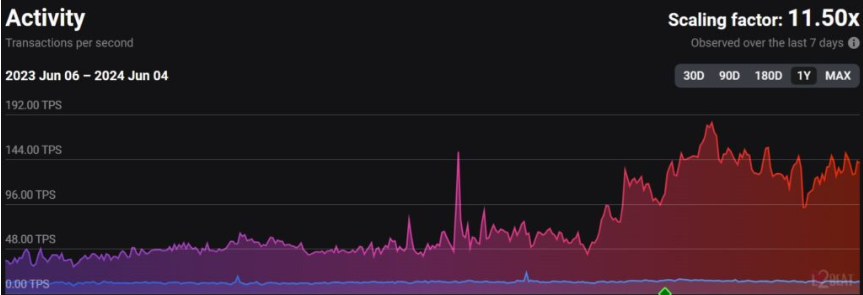
Source: L2beat.com
This article explores the L2 ecosystem, including its key innovations, challenges, and future directions.
1. The Origins of L2
As more users conduct transactions on L1s, these networks become slower and more expensive. Solving scalability issues on L1 typically involves trade-offs between security and decentralization—two core features that all blockchains aim to preserve. The compromise of being able to achieve only two out of the three desired blockchain properties—scalability, decentralization, and security—is known as the "blockchain trilemma."
Resolving the blockchain trilemma is particularly crucial for Ethereum, which has become the preferred L1 for building decentralized applications (dApps). Among the three desired properties, Ethereum prioritizes security and decentralization at the expense of scalability.
To expand both the number and complexity of use cases on Ethereum, building sophisticated dApps must be economically viable.
L2 solutions emerged as a way to address these issues by offloading most of the heavy computational work associated with transaction processing from the base layer to a secondary layer, thereby increasing throughput, reducing costs, and improving user experience—all while leveraging the security and decentralization of the underlying L1 blockchain.
2. Core Technologies and Frameworks
With total value locked (TVL) in the L2 ecosystem now exceeding $46 billion, it encompasses a variety of technologies and frameworks, each with unique characteristics. Let’s take a closer look at some of the most important ones:
Rollups – There are two types of rollups: Optimistic Rollups and Validity (or Zero-Knowledge) Rollups. Optimistic Rollups assume transactions are valid by default and rely on fraud prevention mechanisms, allowing network participants to challenge potentially fraudulent transactions using "fraud proofs" to demonstrate invalidity. In contrast, Validity Rollups use "validity proofs" to verify the correctness of every transaction before it is submitted to the base layer. Both types offer higher throughput and lower fees compared to L1.
State Channels – State channels allow participants to transact off-chain by locking a portion of the blockchain state into a multi-signature contract. Participants can freely exchange transactions off-chain, with final states settled on-chain. State channels provide near-instant transactions and low fees but come with limitations in functionality and participant count.
Plasma – Plasma is a framework for creating hierarchical sidechains anchored to the main chain. Plasma chains process transactions off-chain and periodically submit updates to the main chain, thus reducing load on the L1 network. Similar to Optimistic Rollups, Plasma chains use fraud proofs to challenge suspicious transactions.
3. Examining the L2 Ecosystem
The L2 ecosystem is rapidly evolving, with numerous projects and initiatives working to scale major L1 blockchains. While some solutions focus on bringing scalability to Bitcoin—such as the well-known Lightning Network, which leverages state channels to enable faster and cheaper transactions—there is currently no general-purpose computing L2 solution available on Bitcoin.
In contrast, Ethereum has fostered a thriving ecosystem of L2 solutions. We will highlight the key players and briefly describe them.
1) Validity Rollups (also known as Zero-Knowledge Rollups)
Starknet: A validity rollup with one of the fastest-growing developer communities, featuring native account abstraction and its own programming language (Cairo), optimized for leveraging validity proofs.
zkSync: Another leading validity rollup with native account abstraction, operating on the Ethereum Virtual Machine (EVM).
Scroll: An EVM-compatible validity rollup focused on native-level compatibility with existing Ethereum dApps and tools.
Polygon zkEVM: Developed by Polygon, a veteran in L2 scaling, zkEVM is an EVM-compatible validity rollup.
Linea: Supported by Consensys, the company behind MetaMask, Linea is a validity rollup that can be used directly through MetaMask.
2) Optimistic Rollups
Arbitrum: The largest optimistic rollup by total value locked (TVL), EVM-compatible.
Optimism: The second-largest optimistic rollup by TVL, EVM-compatible.
Base: The third-largest optimistic rollup by TVL, EVM-compatible.
Many of these projects are still in early stages, often involving a period of centralized control known as the "training wheels" phase, which allows for controlled system upgrades and bug fixes. While initially necessary, these training wheels should eventually be removed to achieve the intended decentralized and trustless operation.
Adoption of L2 solutions is steadily growing across various domains, including decentralized finance (DeFi), non-fungible tokens (NFTs), and on-chain gaming. The most commonly used L2 types tend to be optimistic rollups and validity rollups. However, integrating L2 solutions is not without challenges.
4. Challenges and Solutions
Despite their immense potential, L2 solutions must overcome several challenges to fully realize their promise. From a user perspective, interacting with L2 networks can be slightly more complex, requiring additional steps such as bridging assets and managing multiple wallets. Improving user experience through better wallet integration, simplified onboarding processes, and more intuitive interfaces will be critical to driving mainstream adoption.
This is why Starknet offers built-in account abstraction, enabling smoother user experiences—such as signing transactions via facial recognition or fingerprint scanning (for example, the Braavos wallet supports both). On Starknet, scaling Ethereum means delivering Web2-style user experience alongside cheaper and faster transactions.
5. The Future of L2
As the L2 ecosystem matures, we can expect a wave of innovation, such as native account abstraction on Starknet. Hybrid solutions that combine the strengths of different L2 technologies are already emerging, offering dual benefits of both optimistic and validity rollups. Advances in validity proofs (such as STARKs) further enhance the scalability and privacy of L2 networks.
Looking ahead, the future of L2 solutions is closely tied to the overall evolution of blockchain technology. As L1 networks continue to evolve and new consensus mechanisms like proof-of-stake gain wider adoption, L2 solutions will need to adapt and integrate seamlessly with these changes.
In the coming years, we will see a proliferation of L2 solutions tailored to specific use cases and application domains. Some predict that L2 networks will eventually become the primary layer for user interaction, while L1 serves as a secure settlement layer. Others envision a multi-layered blockchain architecture, where L2 solutions develop in parallel—and sometimes even support third-layer (L3) chains—creating a scalable and interoperable ecosystem.
6. Conclusion
As the L2 ecosystem continues to grow, collaboration and contributions from developers, researchers, and users are essential to developing robust and user-friendly L2 solutions.
By embracing the potential of L2 technology, the blockchain community can overcome the limitations of L1 networks and unlock new possibilities for decentralized applications. The road ahead is filled with both challenges and opportunities, but with the right approach and shared vision, we can build a scalable and inclusive blockchain ecosystem that empowers individuals and transforms industries.
Join TechFlow official community to stay tuned
Telegram:https://t.me/TechFlowDaily
X (Twitter):https://x.com/TechFlowPost
X (Twitter) EN:https://x.com/BlockFlow_News


