









Piercing the fog, recharging faith, and embarking on the crypto journey for the second half of 2024
TechFlow Selected TechFlow Selected
Piercing the fog, recharging faith, and embarking on the crypto journey for the second half of 2024
In 2024, the digital asset market outlook is positive, but regulation and liquidity remain key challenges.
 Navigating Web3 tides with focused insights
Author: FELIX HARTMANN
Translation: Kate, Mars Finance
Today, we will take a bird's-eye view of the digital asset landscape for the remainder of 2024, including a close examination of two major catalysts at the current juncture—regulation and liquidity. Portfolio-level insights from Q2 will be shared with limited partners in a separate email.
Six Years of Cryptocurrency Rising from Obscurity
Six years ago, the Hartmann Digital Assets Fund completed its first closing. We (or more precisely, "me" back then—a 23-year-old one-man show) entered a very nascent scene where no more than 100 crypto funds existed. It was easy to know everyone and everything. Only a handful of OTC desks like Circle and Cumberland, one or two custodians such as Kingdom Trust, and a single bank willing to support the space (Silvergate) were around. Honestly, apart from sending and receiving Bitcoin, there were practically no real products or users. The industry was almost entirely built on vision and ideals. This was an era before DeFi, DePin, Web3 Gaming, and all the innovations that emerged in recent years. In fact, most of today’s taken-for-granted “basic” financial primitives—on-chain exchanges, lending, and borrowing—simply didn’t exist. So much so that that year, global DeFi banking totaled about $300,000. For context, that figure has since risen to over $100 billion.
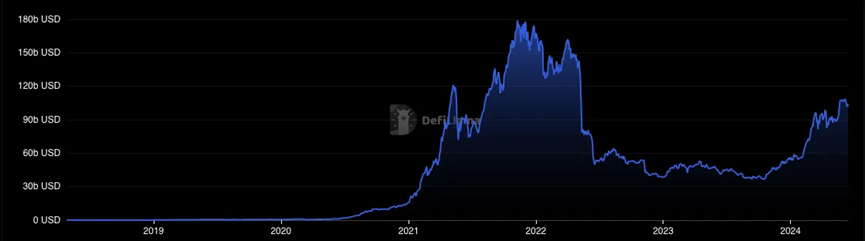
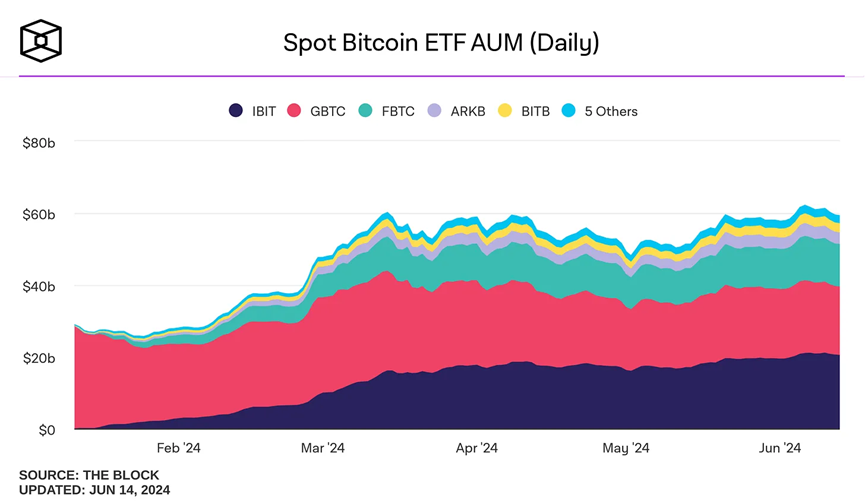
In 2018, BlackRock’s Larry Fink said he couldn’t think of a single global client asking for or wanting exposure to cryptocurrency. Today, BlackRock’s Bitcoin ETF set the record for the most successful ETF launch in history, raising $20 billion in less than five months.
If we compressed the entire trading history of Bitcoin and ETH into just 10 days, I have traded and witnessed 5 days of Bitcoin and 8 days of ETH. Each candle and wick tells a story I miss. Likewise, as a young CIO and general partner, I now carry six years of experience in digital assets—an odyssey that has already consumed 25% of my life and 64% of my adult life. Having spent this long in an emerging industry, I can say that growing up within it—or alongside it—has profoundly shaped my worldview.
The industry has gone through many phases on its path to maturity. A fairly homogeneous, idealism-driven libertarian community has splintered into numerous subcultures—from suit-wearing digital asset professionals pushing institutional adoption, to Twitter-living millennial meme coin gamblers, and finally the original missionary cohort advocating privacy and decentralization while frequently becoming targets of government agencies. The first became my job, the second made me question my job, and the third is why I can overcome the stench of the second and remember what originally brought me here.
Regulatory Bottleneck Heating Up—and About to Break
While the industry continues to evolve, especially in scale, innovation and adoption in the U.S. have been stifled on the regulatory battlefield. It’s nearly a full year since I wrote that letter about the regulatory bottleneck. Although Ripple and Grayscale won their respective cases and the Bitcoin ETF was ultimately approved, as expected, the regulatory war remains far from won. As recently as April this year, the SEC continued targeting the industry’s most prominent players, issuing a Wells notice to Uniswap Labs—the U.S.-based unicorn with millions of users that has never stolen a single dollar from anyone. Instead of going after the countless scams and frauds rampant in finance and crypto, they chose to wage war against pillars of the industry like Coinbase, Kraken, and Uniswap. This isn’t a war to “protect investors”—it’s a war on technology.
This war on technology has had real consequences. When considering how today’s toxic regulatory environment erodes fundamental industry health, several challenges come to mind:
1. Unless builders are willing to go to jail for their mission, many avoid crypto altogether. Running a startup is hard enough—you don’t need the Fed threatening your freedom on top of that.
2. Regulatory pressure is unevenly applied, disproportionately affecting legitimate products. In other words, if you scam someone directly with a pump-and-dump meme coin, you likely won’t hear from the SEC. But God forbid you build new technology that could genuinely transform finance. As a result, we see more worthless junk launched instead of truly valuable tokens designed to capture value and return it to holders.
3. DeFi hasn’t meaningfully grown in three years. While we’ve seen impressive $100 billion in assets on decentralized rails (down from $180 billion in 2021), significant growth requires institutional capital—which won’t come on-chain until regulation is clarified.
Digital asset adoption doesn’t require regulatory support to move from innovators to early adopters. However, the next phase—from early adopters to the early majority—absolutely requires either regulatory backing or the collapse of the old system.
In other words, tokenization and blockchain adoption are technologically inevitable. But whether we start using this technology today or wait until after authoritarianism and monetary debasement leave behind their ashes—that power lies with regulators (and voters).
Disregarding time horizons, there’s only one correct trade: long decentralization, short fiat systems, institutional inertia, and any nation suffocating under bureaucracy.
However, managing a liquid fund means time horizons matter. For example, while AI clearly broke adoption records, the industry experienced two winters—in the 1970s and 1990s. Over recent months, as Bitcoin struggled to defend its all-time highs, I’ve spent considerable time pondering whether the West will win this regulatory battle or remain stalled until a friendlier (or what the media calls “radical”) administration takes over.
But over the past three weeks, things began to shift… As former President Donald Trump publicly voiced support for the digital asset industry, we started seeing a sudden change in tone from Washington:
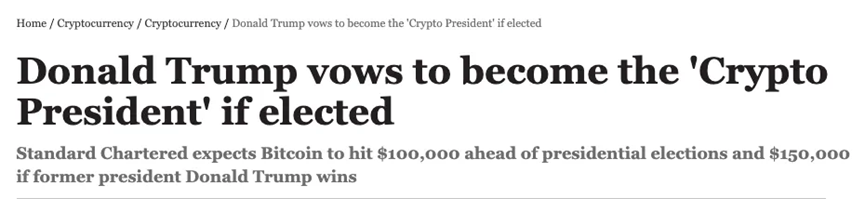
1. Contrary to everyone’s expectations, the SEC rushed approval of Ethereum ETFs
2. Congress opposed the SEC’s strict crypto custody rules under SAB 121, with countless previously hostile Democrats voting in favor
3. The Financial Innovation and Technology Act (FIT21), widely welcomed by the digital asset community for providing greater regulatory clarity and limiting SEC jurisdiction over the asset class, passed the House and moved to the Senate
4. Noticing a sudden surge of support from the digital asset community for Trump’s campaign, the Biden campaign quickly launched its own outreach—but days later, Biden vetoed Congress’s attempt to repeal SAB 121, losing all community goodwill.
Ending Gensler’s Reign
For better context, two weeks ago at CoinCenter’s annual gala in Austin, Texas, I found myself in a room with most of the industry’s policy and leadership teams. The mood was notably upbeat, with speakers acknowledging that “we’re finally starting to win,” given recent victories in Washington. House Majority Whip Tom Emmer addressed the audience, warning SEC Chair Gary Gensler: “Hear me, Gary—your days are numbered.” Sitting there, I asked myself: “Is it really time?”
The presidential election may be the hammer that breaks the regulatory bottleneck. If Trump wins, the worst-case scenario for Gensler is resignation; the best case is prison. Beyond his autocratic abuse of power during his SEC tenure (a point courts are now highlighting more frequently), Gensler also served as CFO for Hillary Clinton’s campaign, branding him as an enemy of a potential Trump administration.
If Biden wants to win, taking down Gensler might be his most direct path to winning crypto votes and distancing himself from the radical left—especially Elizabeth Warren, whose mission is to “build an anti-crypto army.” Warren has effectively been the Democratic Party’s spokesperson on all crypto matters, and her dissent was evident in the FIT21 vote, where even former Speaker Nancy Pelosi voted yes alongside Republicans.

I now estimate a 70% to 80% chance that the Gensler era ends within the next six months. On that day, I expect the global digital asset market cap to rise by more than 30%—in other words, roughly $1 trillion.
If the dice roll into the remaining 20–30% (or my estimate is completely off), and we face four more Biden years plus another two years of Gensler, I’d bet on the continued erosion of what Capo Gensler likes to call “crypto asset securities.” Good actors will lose, and the only winners will be law firms cashing checks from crypto companies and U.S. taxpayers as they clash head-on for the next four years.
Yet, two categories of assets have largely escaped this crackdown: Bitcoin, officially recognized as a crypto commodity, and meme coins, which never attempted to create value but were born as literal imitations yet evolved into proxies for cultural zeitgeist trading. Driven by central banks’ fiscal irresponsibility and financial nihilism among Gen Z and millennials, these two asset classes will continue to grow. Monographs exploring these markets are being written—but for another time.
A New Era for Digital Assets
Beyond Bitcoin’s digital gold thesis, the most meaningful shift for the broader digital asset space—from speculative asset to investable asset—occurs the moment tokens can accumulate value without clashing with regulators. While part of the debate centers on whether digital assets are commodities or securities, another meaningful discussion is how crypto assets can comply without betraying the underlying technology. For instance, KYC for every holder is impossible when core principles are privacy and permissionless access.
With regulatory clarity, the digital asset market could transform, ushering in the largest bull run yet. Here are some key predictions:
1. Shift from Narrative to Product-Market Fit
Because there’s currently no compliant way for crypto assets to accrue value, most issuers don’t even bother building products capable of capturing value. Ironically, the ability to capture value is a great litmus test for whether a product truly meets sufficient demand for consumers to part with their hard-earned money. Instead, crypto founders often build things consumers don’t care about and end up paying users in tokens to use them. Something changed. Build quality improved, and…
2. Projects Will Have Clearer Success Metrics
Currently, valuations of many digital assets appear to be freely floating numbers set purely based on sentiment and competition. While most markets are certainly not efficient—equity trades often diverge significantly from earnings—the stock market does excel at elevating the best performers. Thus, tokens with genuine product-market fit and revenue may begin dominating discourse and portfolios more frequently. This, in turn, leads to…
3. More Favorable Digital Asset Financing Environment
Digital asset funding has heavily favored private markets, and the ability to raise capital post-token launch often becomes a roll of the dice depending on the founder’s market mechanism. This results in cyclical booms and busts in “alternative investments,” where each new cycle brings a fresh batch of projects that raised brilliantly in private rounds but often burn through capital or fail to capitalize in the next bear market—even if they actually built a solid product. Then, private markets rotate to the next queue. Considerable duplication costs and value loss occur in this cycle. Stronger foundations would make it easier for protocols to raise capital, while enabling…
4. M&A Market Flourishes
During 2022–23, we saw many DeFi projects stranded—projects that could have become prime acquisition targets for better-funded DeFi platforms. For example, well-capitalized Uniswap or AAVE could expand into super-apps by acquiring small but well-functioning on-chain derivatives and options platforms. Or, they could enter real-world assets (RWA) more substantially by facilitating token swaps with leading RWA protocols (whose market caps might be just 1% of Uniswap’s). Greater maturity among crypto participants and the market as a whole could open doors for savvy dealmakers and operators to create value in ways unseen before in digital assets, dramatically accelerating product development and innovation—bringing us closer to mass adoption. For instance, some Layer 1 blockchains might use M&A to acquire urgently needed products and convert them into public goods. This would lower user costs while increasing usage and gas fees on the chain itself, thereby boosting the network token’s value.
From the day we entered digital assets at Hartmann Capital, we’ve traded on catalysts and fundamentals—this may be the most promising era yet for this market. Such structural changes could also bring the largest capital inflows ever, as institutional allocators apply familiar models to find real value, just as they’ve done across other asset classes for over a century.
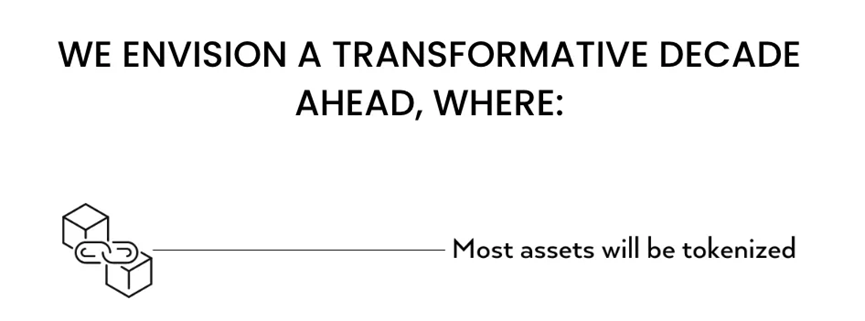
At Hartmann Capital, our core digital asset thesis is that “most assets will be tokenized in the next decade.” Though contrarian, this view finds allies—even Larry Fink and Jamie Dimon (who famously dislikes Bitcoin) are strong proponents of tokenization. While most leaders focus on assets wrapped in tokens and the opportunities and savings they unlock, we aim to focus on the infrastructure powering the entire process, owning stakes in it, and potentially capturing fees across all markets—from finance to physical assets, intellectual property, and personal data.
Lighting the Fuse
The timing of the U.S. presidential election and the regulatory fate of digital assets coincides perfectly with an impending central bank pivot. While the ECB took the first step toward rate cuts, the Fed has yet to deliver its first cut. Now, it’s expected to cut once in 2024, with rates projected to fall to around 4% by 2025 according to June’s economic projections.
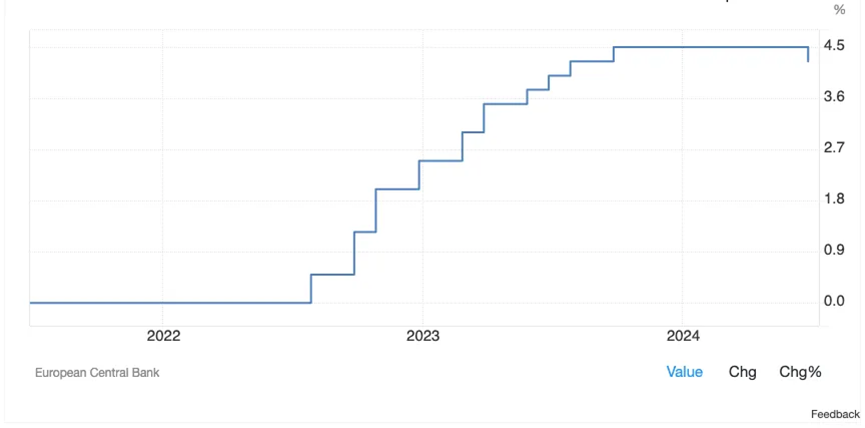
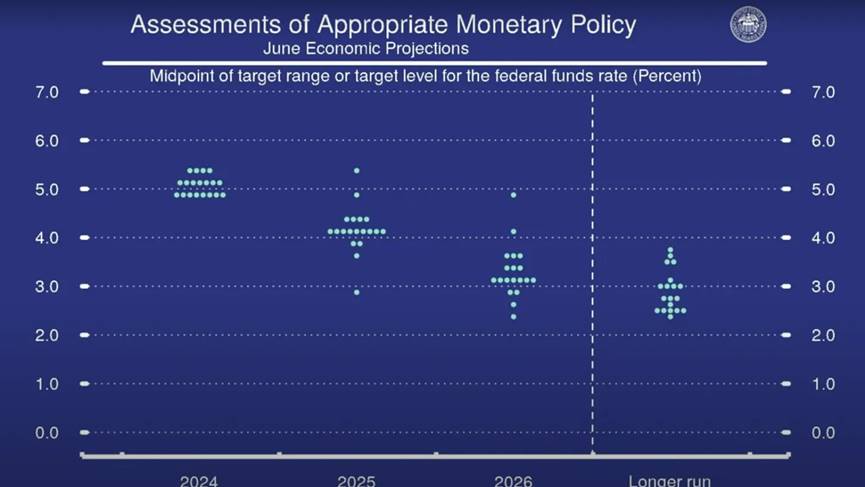
Although the Fed has successfully reduced its balance sheet by about $1.7 trillion since tightening began, M2 money supply remains near all-time highs.
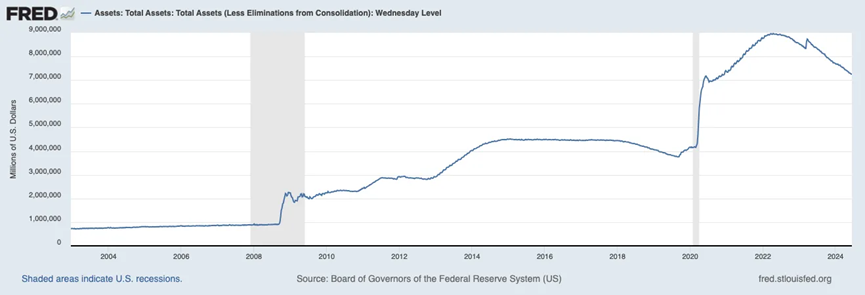
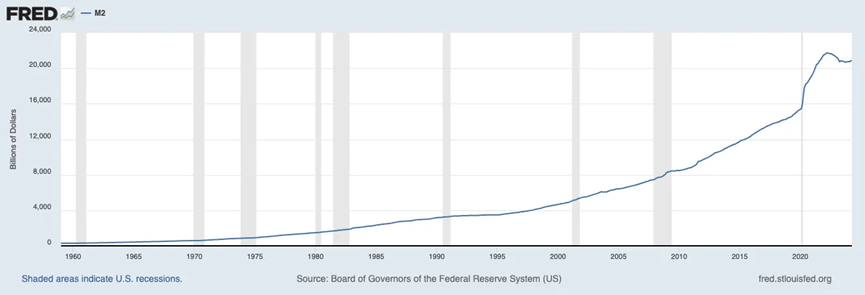
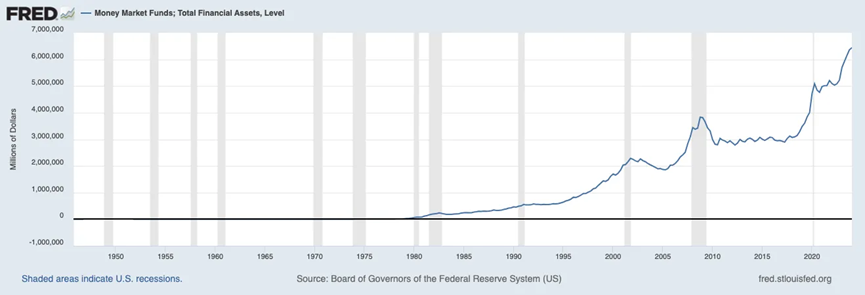
So far, $6.44 trillion of this money supply has flowed into money market funds yielding around 5% annually. As rates decline, not only do risk assets become more attractive due to cheaper capital, but risk-free alternatives also become less appealing. When $2–3 trillion in idle capital re-enters the market, we may see sharp increases in digital asset prices—both in the early stages of easing and throughout a low-rate environment.
Conclusion
Regardless of political outcomes, rate cuts are imminent. And with them, capital will flow. Where this capital flows depends heavily on whether the SEC’s leadership or authority over digital assets changes—or is stripped via courts and Congress. Yet the outcome remains binary: under the current regime, Bitcoin and memes thrive; under a constructive regulatory framework, true digital asset innovation can begin serving trillions in financial value and capturing hundreds of billions in worth.
The trade remains dual—hold tight to the key, choose the right regime. Regardless of outcome, both camps offer a trading arena with immense potential over the next four years.
Finally, I’ll excerpt a keynote speech by digital asset pioneer Erik Voorhees at the annual CoinCenter gala, on the promise of crypto and why the battle for digital sovereignty must be won in America—a country founded on principles most closely mirrored by this industry.
Join TechFlow official community to stay tuned
Telegram:https://t.me/TechFlowDaily
X (Twitter):https://x.com/TechFlowPost
X (Twitter) EN:https://x.com/BlockFlow_News
 @hartmanncap











