
Reviewing the Recent Performance of Hong Kong Virtual Asset ETFs: Banks Have Not Yet Distributed, Multiple Processes Require Alignment
TechFlow Selected TechFlow Selected
Reviewing the Recent Performance of Hong Kong Virtual Asset ETFs: Banks Have Not Yet Distributed, Multiple Processes Require Alignment
Hong Kong's six virtual asset ETFs have been listed since April 30, and after a month and a half, the market is still in a period of adjustment.
 Navigating Web3 tides with focused insights
Author: Weilin, PANews

Since their launch on April 30, Hong Kong's six virtual asset ETFs have been trading for over a month and a half, with the market still in a period of adjustment. On one hand, traditional banks have yet to begin distributing these virtual asset ETFs; on the other, some brokers are actively expanding their offerings—for instance, Victory Securities’ VictoryX trading app now allows professional investors to deposit and withdraw USDT and USDC.
In terms of trading volume performance, data from SoSo Value shows that during this period, the average daily total trading value of Hong Kong’s BTC spot ETFs was $4.3215 million, peaking at $11.4984 million on June 11; the average daily total trading value of Hong Kong’s ETH spot ETFs was $1.4354 million, with the highest level reached on May 27 at $4.4042 million.
Industry experts note that trading volumes for Hong Kong’s virtual asset ETFs have diverged from their scale trends. Stakeholders are essentially “catching up” due to the earlier-than-expected approval of ETFs, undergoing institutional coordination and resolving bottlenecks. The key inflection point for volume growth may arrive in about two months.
How Have the Six Virtual Asset ETFs Performed Since Launch?
According to public data, Hong Kong’s three Bitcoin spot ETFs raised $248 million on their debut day (April 30), while Ethereum spot ETFs raised $45 million—significantly surpassing the approximately $125 million debut size of U.S. Bitcoin spot ETFs on January 10 (excluding Grayscale). This indicates strong market expectations for Hong Kong’s crypto ETFs.
Judging by initial trading volumes, criticism has centered on the relatively "lackluster" performance of Hong Kong’s six crypto ETFs compared to their U.S. counterparts: on their first trading day, the combined turnover of Hong Kong’s six crypto ETFs was HK$875.8 million (approximately $112 million), with the three Bitcoin ETFs accounting for HK$675 million—less than 1% of the U.S. Bitcoin spot ETFs’ first-day trading volume of $4.6 billion.
As of June 13, according to SoSoValue data, Hong Kong ETFs collectively hold 4,070 bitcoins, with total net assets reaching $275 million. For Ethereum spot ETFs, Hong Kong ETFs hold a total of 14,030 ETH.
Over the past month, Hong Kong’s BTC spot ETFs achieved a record single-day trading volume of $11.4984 million on June 11, though volumes quickly declined afterward. Since launch, the average daily trading volume has been $4.3215 million—far below the U.S. Bitcoin ETFs’ average daily volume of $1.965 billion during the same period.
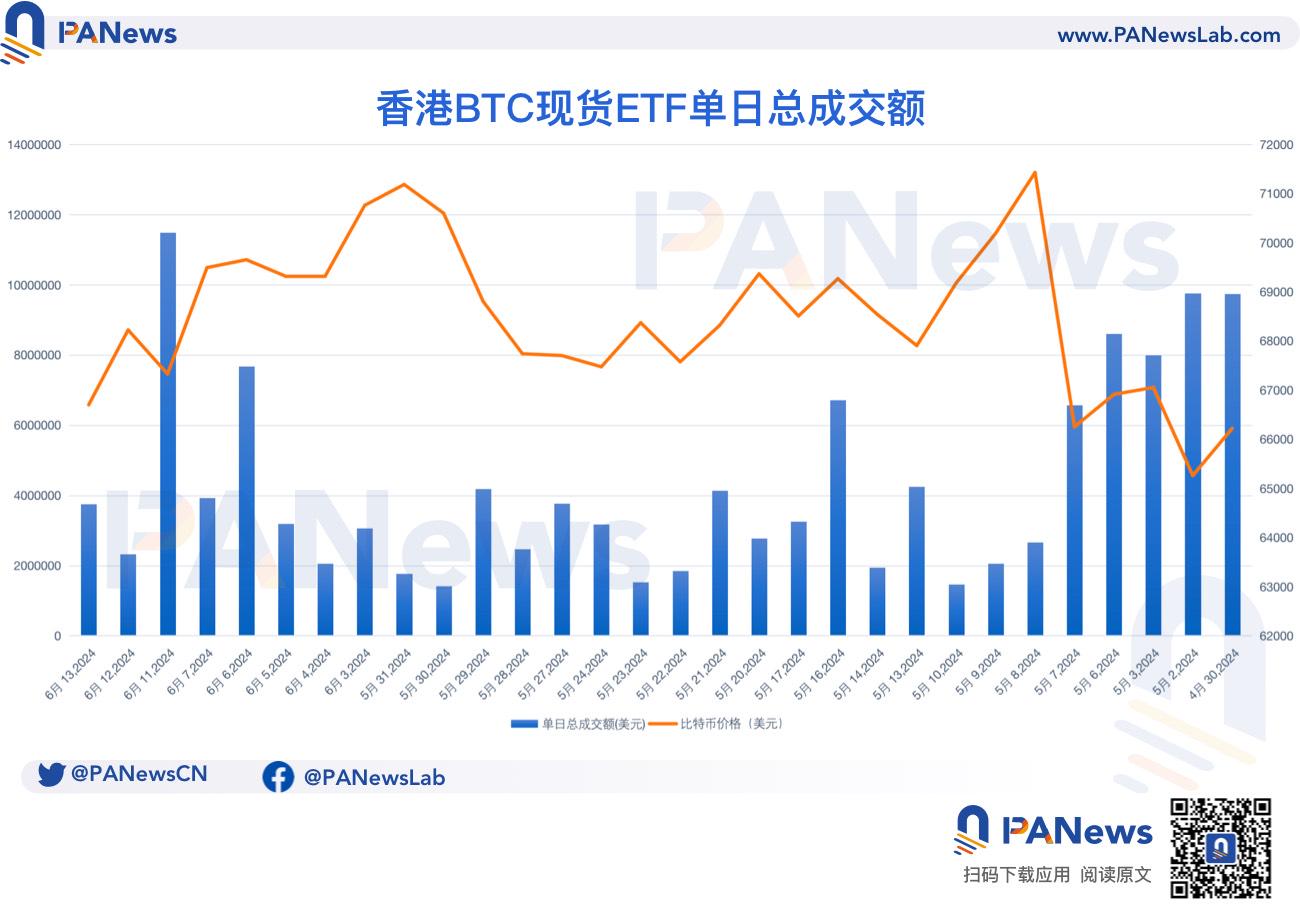
Data: SoSo Value, CoinGecko
For Hong Kong’s ETH spot ETFs, the peak single-day trading volume occurred on May 27 at $4.4042 million. Since launch, the average daily trading volume has been $1.4354 million.
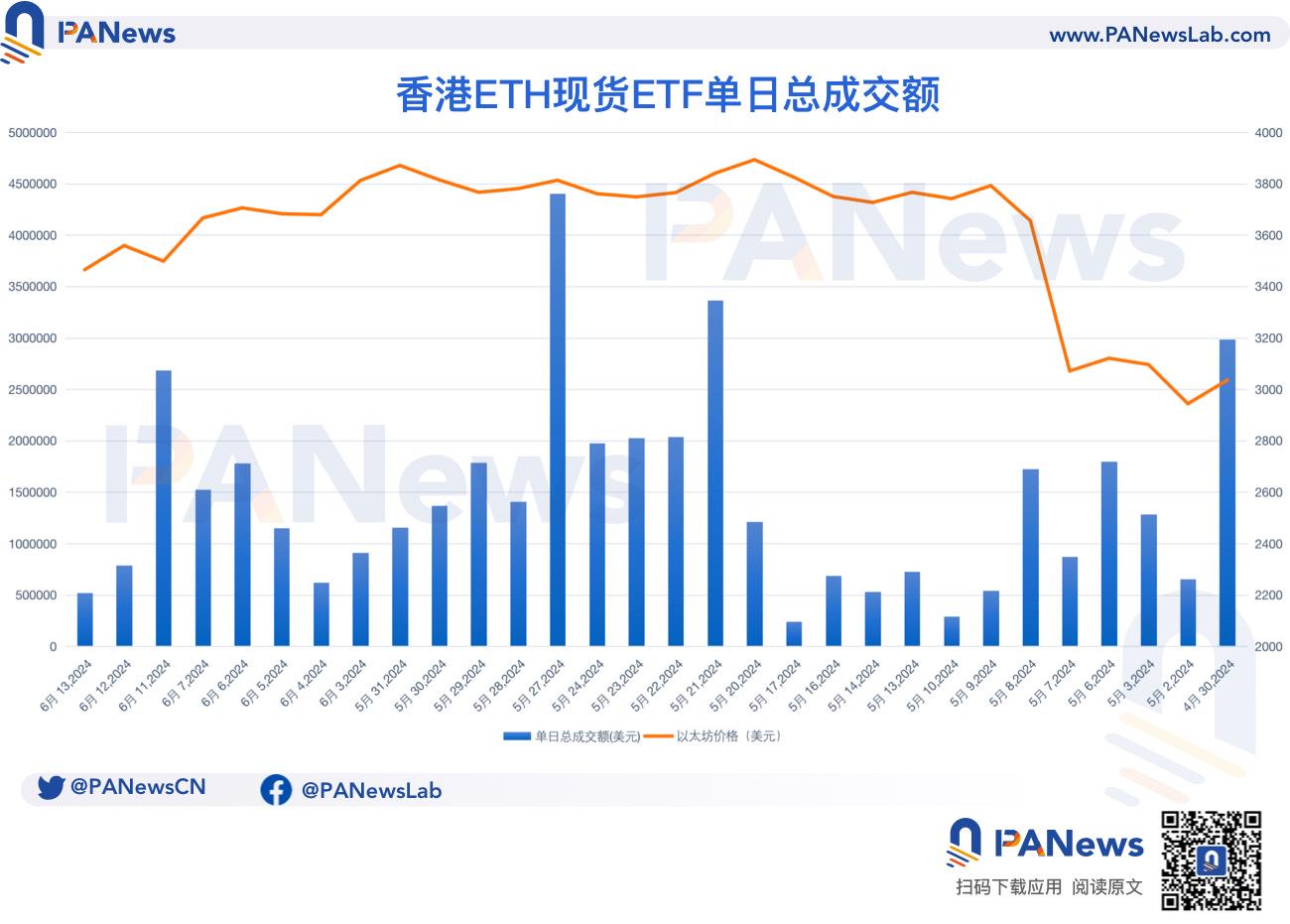
Data: SoSo Value, CoinGecko
Traditional Banks Not Yet Distributing—Growth Inflection Point May Come in Two Months
Despite being listed for over a month, Hong Kong’s virtual asset spot ETFs have not yet been offered by any traditional banks. Chris Barford, Head of Financial Services Consulting Data & Analytics at EY Hong Kong, told the *Hong Kong Economic Journal* that traditional banks remain cautious about product distribution due to concerns over anti-money laundering (AML) and Know Your Customer (KYC) regulatory risks.
An issuer admitted that since banks and brokers are regulated by different authorities, bank distribution awaits corresponding regulatory approvals, and internal assessments may take time. Barford explained that talent shortage is a major challenge—global markets face a lack of professionals who combine expertise in distributed ledger technology and virtual assets with financial services and regulatory knowledge. Only when technical solutions meet the risk control standards of traditional banks or financial institutions can such products be more widely adopted.
Meanwhile, as traditional financial institutions, several Hong Kong brokers are moving forward with offering Bitcoin and other virtual asset trading services.
For example, Hong Kong-based Victory Securities, Tiger Brokers, and Interactive Brokers have all launched relevant services, allowing investors to trade Bitcoin and other virtual assets directly through broker apps. According to *Securities Times*, some brokers estimate that revenue related to virtual assets could account for around a quarter of their total income. As PANews understands, although many brokers support purchasing these ETF products, some larger brokers, due to regulatory considerations, do not actively promote virtual asset ETFs to clients.
On May 6, Tiger Brokers (Hong Kong) officially launched its virtual asset trading service, supporting 18 cryptocurrencies including Bitcoin and Ethereum, becoming one of the first online brokers in Hong Kong to offer both securities and virtual asset trading on a single platform. On June 17, Tiger Brokers (Hong Kong) announced it had received SFC approval to upgrade its license, officially extending the service to retail investors in Hong Kong. Currently, all Hong Kong retail investors can use Tiger Brokers’ flagship platform Tiger Trade to seamlessly trade Bitcoin, Ether, stocks, options, futures, U.S. Treasuries, funds, and other global assets at competitive costs, enabling integrated management of virtual and traditional financial assets.
Additionally, on November 24 last year, Victory Securities became the first licensed corporation in Hong Kong approved by the SFC to provide virtual asset trading and advisory services to retail investors. Also on November 24 last year, Interactive Brokers Hong Kong obtained permission to serve Hong Kong retail clients in virtual asset trading, allowing trades in Bitcoin and Ethereum.
To trade Bitcoin and other virtual assets via broker apps, investors must open a virtual asset account. Brokers have set low entry barriers, with minimum transactions starting at $100.
Jupiter Zheng, Partner at Hashkey Capital’s secondary fund, recently wrote that the disconnect between trading volume and asset scale in Hong Kong’s virtual asset ETFs reflects an underlying “structural” trend—stakeholders are refining processes and clearing bottlenecks. Particularly regarding in-kind creation and redemption, coordination among market makers (PDs), brokers, custodians/exchanges, and liquidity providers is required. In about two months, we may reach the critical juncture for volume growth.
Moreover, institutional investors will be a key driver of future Hong Kong virtual asset ETF growth. An EY survey found that many institutional investors plan to increase their allocation to virtual assets over the next two to three years. For those managing over $50 billion in assets, most allocate about 1% to some form of cryptocurrency, and many family offices are also involved. Large investors believe virtual assets may outperform the broader market over the coming period, despite volatility. If risks can be managed, virtual assets represent an attractive asset class.
Looking ahead, although current performance of Hong Kong’s virtual asset ETFs still needs improvement, with more brokers rolling out related services, potential expansion into bank distribution channels, and rising institutional interest in virtual assets, the market potential for Hong Kong’s virtual asset ETFs remains promising.
Join TechFlow official community to stay tuned
Telegram:https://t.me/TechFlowDaily
X (Twitter):https://x.com/TechFlowPost
X (Twitter) EN:https://x.com/BlockFlow_News
 PANews