









Pantera Research: Crypto Users Lack Patience, Instant Gratification Over Future Gains
TechFlow Selected TechFlow Selected
Pantera Research: Crypto Users Lack Patience, Instant Gratification Over Future Gains
The study reveals that cryptocurrency users tend to be impatient and prefer immediate rewards over future gains.
 Navigating Web3 tides with focused insights
Author: PAUL VERADITTAKIT
Compiled by: TechFlow
Do Crypto Users Need Intervention?
-
A study from Pantera Research Lab found that cryptocurrency users exhibit high present bias and low discount factors, indicating a strong preference for immediate gratification.
-
The quasi-hyperbolic discounting model, characterized by parameters such as present bias (ꞵ) and discount factor (𝛿), helps understand individuals' tendencies to favor immediate rewards over future benefits—a behavior particularly evident in the volatile and speculative cryptocurrency market.
-
This research can inform optimized token distributions, such as rewarding early adopters, decentralizing governance, and marketing new products through airdrops.
Introduction
In Silicon Valley startup lore, there's a classic case of PayPal deciding to pay users $10 to use its product. The logic was simple: if you could pay people to join, eventually the network value would become so high that new users would join for free, allowing you to stop paying. This seemed to work—PayPal was able to cease payments and continue growing, thus harnessing network effects.
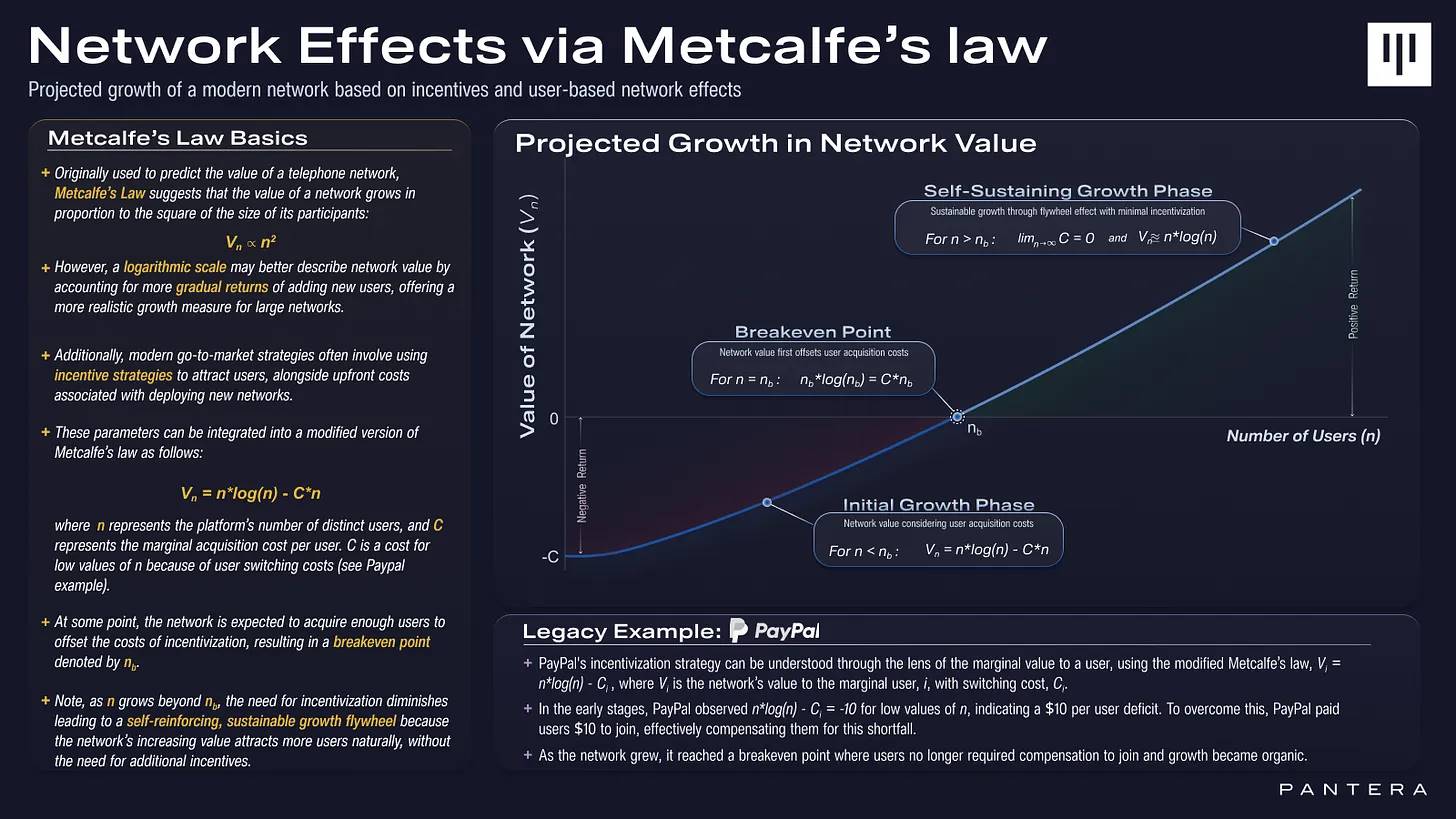
In crypto, we've adopted and extended this approach by using airdrops—not only to pay people to join but often requiring them to use our product for a period of time.
Quasi-Hyperbolic Discounting Model
Airdrops have evolved into multifaceted tools used to reward early users, decentralize protocol governance, and promote new products. Establishing criteria for who should receive rewards and how much their efforts are worth has become an art form. In this context, both the quantity and timing of token distribution (often implemented via mechanisms like vesting periods or gradual releases) play crucial roles. These decisions should be based on systematic analysis rather than guesswork, sentiment, or precedent. Employing more quantitative frameworks ensures fairness and strategic alignment with long-term goals.
The quasi-hyperbolic discounting model offers a mathematical framework for analyzing choices individuals make when trading off rewards across different time points. Its applications are especially relevant in domains where impulsivity and time inconsistency significantly influence decision-making, such as financial decisions and health-related behaviors.
The model is driven by two specific parameters: present bias (ꞵ) and discount factor (𝛿).
Present Bias (ꞵ):
This parameter measures an individual’s tendency to prioritize immediate rewards over delayed ones. It ranges between 0 and 1, where 1 indicates no present bias, reflecting a balanced, time-consistent evaluation of future rewards. Values closer to 0 indicate stronger present bias, signaling a heightened preference for immediate gratification.
For example, when choosing between receiving $50 today or $100 one year from now, someone with high present bias (close to 0) would prefer taking the $50 immediately rather than waiting for the larger amount.
Discount Factor (𝛿):
This parameter describes the rate at which the value of a future reward declines as the delay increases, accounting for its naturally diminishing perceived value over time. The discount factor more accurately quantifies preferences over longer, multi-year intervals. When evaluating two options in the short term (less than one year apart), this factor shows considerable variability, as immediate circumstances may disproportionately affect perception.
For the general population, studies suggest a discount rate of approximately 0.9. However, in groups with higher gambling tendencies, this value is typically significantly lower. Research shows habitual gamblers have an average discount factor slightly below 0.8, while problem gamblers’ discount factor approaches 0.5.
Using the above terminology, we can express the utility U of receiving a reward x at time t with the following formula:
U(t) = βδᵗU(x)
This model captures how the value of rewards changes over time: immediate rewards are evaluated at full utility, while future rewards are adjusted according to present bias and exponential decay.
Experiment
Last year, Pantera Research Lab conducted a study to quantify behavioral tendencies among cryptocurrency users. We surveyed participants with two simple questions, designed to measure their preference for immediate payouts versus future value.
This method helped us identify representative values for ꞵ and 𝛿. Our findings revealed that a representative sample of cryptocurrency users exhibited a present bias slightly above 0.4 and a notably low discount factor.
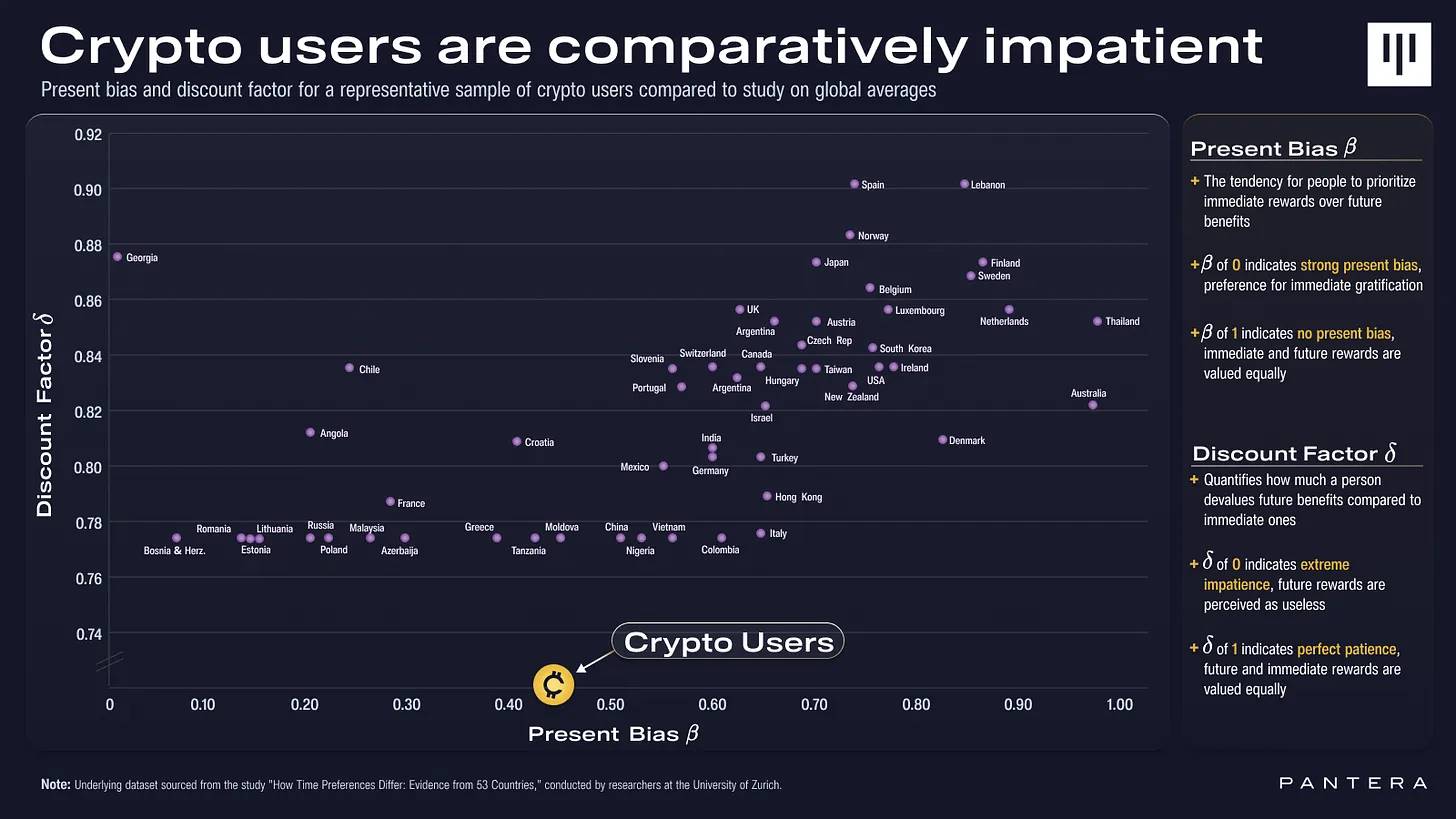
The study revealed that cryptocurrency users have higher-than-average present bias and lower discount factors, indicating impatience and a preference for immediate satisfaction over future gains.
This can be attributed to several interrelated factors within the cryptocurrency environment:
-
Cyclical Market Behavior: Cryptocurrency markets are known for their volatility and cyclical nature, with tokens frequently experiencing rapid value fluctuations. This cyclicality influences user behavior, as many become accustomed to navigating these cycles rather than adopting the longer-term investment strategies common in traditional finance. Frequent ups and downs may lead users to steeply discount future value, fearing potential downturns could erase profits.
-
Stigma Around Tokens: The survey specifically asked about tokens and their perceived future value, which may highlight the entrenched stigma associated with token trading. The stigma tied to valuations linked to cyclicality and speculation reinforces caution toward long-term investments. Moreover, if the survey had measured fiat currency or other forms of rewards, results might align more closely with global averages, suggesting the nature of the reward may significantly influence observed discounting behavior.
-
Speculative Nature of Crypto Applications: Today’s cryptocurrency ecosystem is deeply rooted in speculation and trading, characteristics prevalent among its most successful applications. This inclination suggests that current users overwhelmingly favor speculative platforms, a preference reflected in the survey results showing a strong inclination toward immediate financial gain.
While the study's findings may diverge from typical norms of human behavior, they reflect the characteristics and tendencies of the current cryptocurrency user base. This distinction is particularly important for projects designing airdrops and token distributions, as understanding these unique behaviors enables more strategic planning and structuring of reward systems.
For instance, Drift, a perpetual contracts DEX on Solana, recently launched its native token DRIFT. The Drift team included a time-delay mechanism in its token distribution strategy, offering double rewards to users who waited six hours after the token launch to claim their airdrop. The time delay aims to alleviate congestion typically caused by bots during initial airdrop claims and help stabilize token performance by reducing an initial surge of sellers.
Indeed, only 7.5k, or 15% (at the time of writing), of eligible recipients chose not to wait six hours to claim double rewards. Based on our research findings, Drift could have delayed the claim window by months and statistically still satisfied the majority of end users.
Join TechFlow official community to stay tuned
Telegram:https://t.me/TechFlowDaily
X (Twitter):https://x.com/TechFlowPost
X (Twitter) EN:https://x.com/BlockFlow_News
 Pantera Capital











