Will you pay for Apple Intelligence with AI tied to hardware?
TechFlow Selected TechFlow Selected
Will you pay for Apple Intelligence with AI tied to hardware?
Apple-style AI: plenty of innovation, but lacking in novelty.
 Navigating Web3 tides with focused insights
Author: Mu Mu
At Apple's 2024 Worldwide Developers Conference (WWDC), AI was clearly the star of the show—out of a 1 hour and 44 minute presentation, over 40 minutes were dedicated to AI.
In the hour before WWDC kicked off on June 11 Beijing time, Apple updated its operating systems including iOS, iPadOS, and macOS, and for the first time introduced updates to visionOS. The remaining time was reserved for Apple’s “AI package”—Apple Intelligence.
The core highlight of Apple Intelligence is a major upgrade to Siri, transforming it into an AI assistant within Apple devices. With this upgrade, users can leverage generative AI capabilities directly on their iPhones—for tasks such as searching and editing photos, summarizing information, and more.
Overall, Apple’s approach to AI represents innovation compared to its own past, but when measured against other AI-powered smartphones, it lacks novelty. After all, many of these AI features are already available on OPPO, vivo, or Samsung phones, or can be achieved through third-party apps. Apple’s sense of “revolution” is fading.
For consumers, Apple’s AI requires upgrading to newer device models, meaning that accessing Apple Intelligence will come with a hefty price tag. So, can Apple’s somewhat underwhelming AI still spark consumer desire to buy?
Apple’s “AI Package” Lacks Freshness
After a year-long wait, Apple finally unveiled its long-anticipated artificial intelligence system, redefining its AI strategy under the name Apple Intelligence. By then, nearly every other smartphone manufacturer had already jumped on the AI bandwagon—Apple’s move came noticeably late.
The mystery was solved at WWDC: AI generation models will be embedded into mainstream Apple hardware like iPhone, iPad, and Mac via system and hardware upgrades, enabling native apps to enhance functionality through AI.
For Apple users, the most appealing aspect is AI’s ability to enable cross-app operations. With Apple Intelligence, Siri moves beyond its reputation as a “glorified chatbot” and becomes a capable AI assistant. For example, you can now use voice commands to ask Siri to find specific photos and edit them according to your needs, or request summaries of text messages.
Rumors about Apple’s collaboration with OpenAI have also materialized—though ChatGPT only gets a small entry point, activated by user choice. Users can selectively call upon ChatGPT’s generative AI functions as needed. Apple added: “We plan to support additional AI models in the future,” prompting speculation over which large language model Chinese users might eventually gain access to.
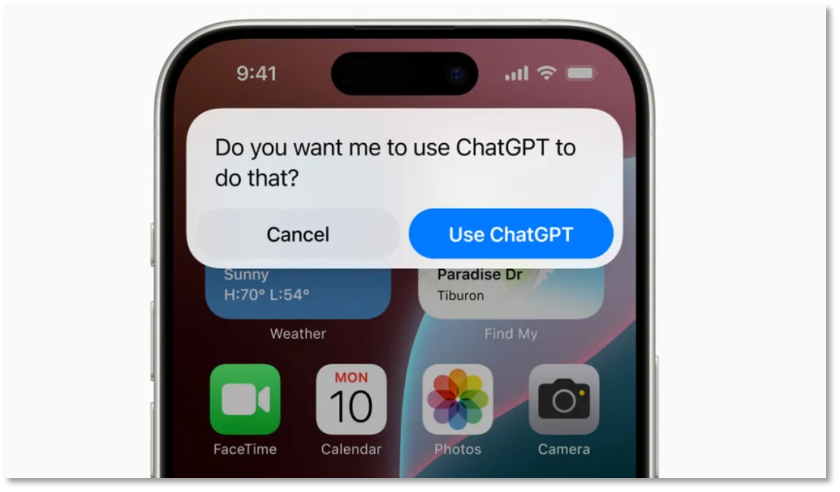
Users can choose whether to use ChatGPT
Apple Intelligence brings new, previously unavailable functionalities to hardware via software integration. For instance, Apple has introduced a calculator to iPadOS 18 for the first time. Powered by AI, this calculator gains a “math notes” feature—it’s no longer just a button-based tool. Users can write calculations by hand using the Apple Pencil, and the calculator not only provides answers but displays them in their own handwriting and even generates corresponding graphs.
For example, users can handwrite a formula and get the result instantly. If they change variables, the results update dynamically, and function graphs can be generated in real time.
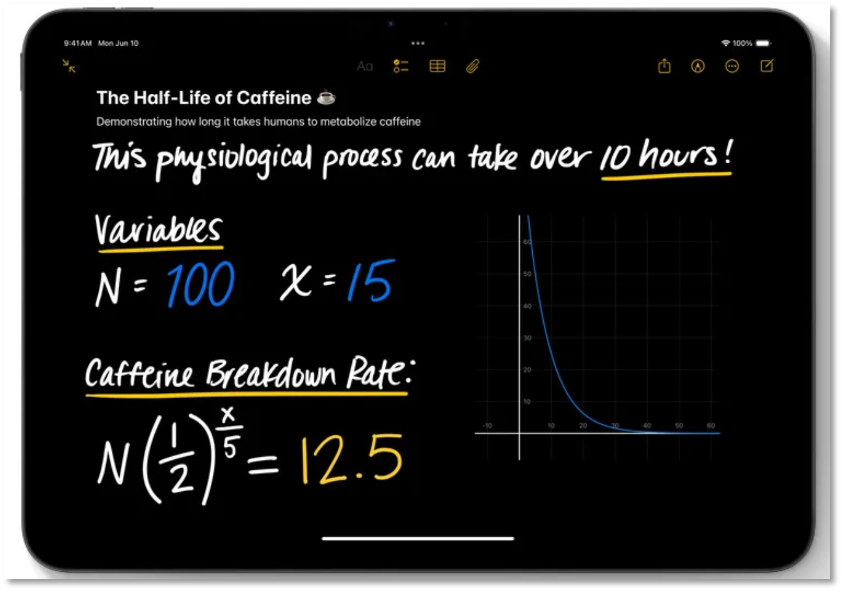
iPad Calculator Can Automatically Generate Function Graphs
Notably, these AI-powered features won’t be supported across all devices.
Currently, only the iPhone 15 Pro and iPhone 15 Pro Max can access Apple Intelligence. Even if older models upgrade to iOS 18, they still won’t be able to use Apple’s AI. For iPad and Mac users, devices must be equipped with M1 chips or higher.
However, while legacy device users can’t experience Apple Intelligence, AI applications aren’t exclusive to Apple. Whether it’s conversational bots or AI-powered image creation/editing, such tools are already widely available as various apps in the Apple App Store.
This is precisely what makes Apple’s WWDC feel underwhelming: innovative internally, but lacking freshness externally. These AI features have already been seen and used on other smartphones.
Since the beginning of this year, both domestic brands like Huawei, Xiaomi, OPPO, and vivo, as well as Apple’s fiercest competitor Samsung, have branded their Android devices as “AI phones,” integrating generative AI into built-in apps. Features like removing bystanders from photos with one click or summarizing information have become standard on AI-enabled smartphones.
Compared to its past self, Apple is becoming more AI-driven; but relative to its competitors, it no longer holds a first-mover advantage.
AI Features Tied to Hardware, Testing Consumers’ Wallets
After Apple announced its AI plans, its stock price continued to climb. On June 11, Apple’s shares closed up over 7% in U.S. trading, hitting a record high. On June 12, Apple’s market value surged by more than $1.5 trillion overnight.
Analysts predict these new AI features will encourage consumers to upgrade their devices, since the tools are only available on newer models. But some remain skeptical. Forrester analyst Dipanjan Chatterjee stated: “Perhaps enhanced, Siri-driven smart devices could prevent some Apple user churn, but it’s unlikely to create a whole new wave of followers.”
iPhone sales account for half of Apple’s total revenue, and AI features are most convenient when used on smartphones. Cycling between old and new models—lowering prices on older phones to attract new buyers while reserving premium pricing for new models to retain loyal customers—may be a solid strategy.
Currently, Apple’s latest iPhone 15 series is undergoing its largest-ever price cuts in China, coinciding with e-commerce festivals and likely timed ahead of the expected fall launch of the iPhone 16 series.
During various e-commerce platforms’ 618 promotions, the entire iPhone 15 lineup saw significant discounts: the iPhone 15 dropped from 5999 yuan to 4599 yuan, with some platforms offering it below 4500 yuan, while the iPhone 15 Pro Max fell from 9999 yuan to under 7500 yuan.
Some KOLs believe that compared to Apple’s new AI features, maintaining “618-level pricing may be more effective at halting iPhone’s market decline.” Recent data shows iPhone sales have returned to the top spot in China.
Over the past two years, iPhone sales growth had nearly stalled. But in April this year, Apple’s iPhone sales in China surged by 52%, a near-vertical growth curve driven largely by consecutive price reductions on Apple devices in the Chinese market.
But can Apple’s next-generation devices—equipped with the latest chips to run AI features—maintain “friendly” pricing? The rollout of the M4 chip offers a key indicator.
In May this year, Apple launched its new M4 chip, positioning it as ideal for running advanced AI applications, and debuted it on the new iPad Pro. The device’s price also saw a major jump: starting at 8999 yuan (11-inch, 256GB storage) compared to the previous generation’s 6799 yuan (11-inch, 128GB), eliminating the 128GB option entirely—an increase of 2200 yuan. Similarly, the 13-inch model rose from 9299 yuan to 11499 yuan, also up 2200 yuan, representing a 32% price hike.
Unusually, the M4 chip wasn’t first introduced in any Mac computer. Some speculate that upcoming desktop Macs might skip M3 entirely and go straight to M4.
In a poll asking whether users would purchase the new iPad, a staggering 68.72%—18,233 votes—chose “can’t afford it.”

Most people think the iPad Pro is too expensive
There are also reports that the iPhone 16 and iPhone 16 Plus will feature the new A18 chip and a more powerful neural engine, enabling local AI model processing. Additionally, Apple plans to eliminate the 128GB version entirely, with all models starting at 256GB and prices rising accordingly to a starting price of 6999 yuan. By comparison, the iPhone 15’s 256GB model launched at 5999 yuan.
Andy Wu, Associate Professor at Harvard Business School, pointed out: “The high costs required to run advanced generative AI models, along with the risks of managing potentially misleading outputs, present new challenges for Apple.” More importantly, Apple must convince consumers why they should pay more for these new AI features.
Join TechFlow official community to stay tuned
Telegram:https://t.me/TechFlowDaily
X (Twitter):https://x.com/TechFlowPost
X (Twitter) EN:https://x.com/BlockFlow_News