Polycentric Governance: Who Holds the Power in a Decentralized Community?
TechFlow Selected TechFlow Selected
Polycentric Governance: Who Holds the Power in a Decentralized Community?
Exploring the design of governance protocols for DAOs.
 Navigating Web3 tides with focused insights
Authors: Tobin South, Leon Erichsen, Shrey Jain, Petar Maymounkov, Scott Moore, E. Glen Weyl
Translated by: Tiao
Translator’s Note: This paper was published earlier this year and presents a protocol design for internal organizational collaboration and self-governance using highly formalized (mathematical) language. One particularly interesting aspect for me is that governance "tokens" in such protocols have no exchange value outside the system, yet within the organization they are the sole currency of influence. This invites comparison with numerous existing governance tokens and further reflection on LXDAO's own protocol design.
This article contains the first two sections of the full paper titled “Plural Management.” The remaining three sections will be published in the next installment.
1. Abstract
We introduce Plural Management, a model that partially replaces hierarchical authority in organizations with pluralistic mechanisms to enable networked authority. Participants earn influence by predicting and completing organizational priorities, and use this influence to set agendas and validate contributions, thereby fostering a dynamic, merit-based power structure. We illustrate this approach through open-source software development—a domain that emphasizes valuable contribution and diligence without relying on hierarchical bottlenecks, thus enhancing participation and enabling adaptive collective intelligence.
Overview of the Plural Management Protocol:
Organization members can dynamically earn management credits through work. Using an issue board, members allocate priority to issues via quadratic funding powered by these credits. Credits are paid out to members who contribute solutions to prioritized issues. Payments occur only after other members exercise authority by spending their management credits in quadratic voting on the outcome. Organization administrators may allow members to earn management credits by correctly predicting voting outcomes, rewarding those who conduct due diligence on contributions and anticipate the preferences of responsible managers. Through mechanisms that scale from small collectives to large organizations, this protocol enables dynamic managerial control without requiring rigid hierarchies.
2. Introduction
The classic binary between the rigidity of hierarchical organizations and the flexibility of flat structures remains a fundamental challenge in organizational design. Traditional hierarchies with clear command chains remain orthodox but are often seen as suppressing the dynamic capabilities needed for organizations to thrive in today’s complex environments. Conversely, flat structures, while inclusive and vibrant, often struggle to maintain coherent direction, momentum, and accountability, frequently descending into what Ostrom and Hess (2011) call the “tyranny of structurelessness.” A classic alternative to this dichotomy is market mechanisms (Hamel and Zanini, 2020; Coase, 1995). However, one crucial role of firms is producing internal public goods and leveraging increasing returns—areas where markets typically fail to deliver efficiently (Samuelson, 1995). Thus, Groves (1973) and Groves and Loeb (1979) advocated for public goods mechanisms to organize internal production, replacing both hierarchy and markets. Yet these mechanisms have generally been considered cumbersome and impractical.
Recently, however, variants of public goods mechanisms such as quadratic voting (Lalley et al., 2016) and quadratic funding (Buterin et al., 2019) have gained broader and more successful application [1]. This paper aims to build on these advances, returning to Groves’ agenda by outlining a framework we call “Plural Management,” integrating these mechanisms with others to simulate many features of organizational authority and collaboration—without resorting to oversimplified hierarchical models.
Traditional hierarchical management systems are pillars of modern corporate and organizational structures, where power dynamics follow a top-down approach (Drucker, 1974). In such systems, employees demonstrate value primarily through hard work and alignment with cultural norms defined by authorities, sometimes pejoratively referred to as “brown-nosing.” Critics argue this practice may stifle creativity, reduce employee engagement, create decision bottlenecks, and often leave ambitious talent at lower ranks underutilized.
At the opposite extreme, lack of structured management brings its own drawbacks—such as the “tyranny of structurelessness,” where unclear roles and responsibilities lead to chaos, inefficiency, and the emergence of informal, often unaccountable power structures (Friedman, 2007). Striking a balance between overly rigid hierarchies and complete absence of structure has long been a difficult task. Several innovative management approaches have been proposed and widely implemented, including flatter organizations that minimize layers (Laloux, 2014), Holacracy—which distributes decision-making across overlapping teams (Robertson, 2015)—and Sociocracy, emphasizing consensus-based governance (Buck and Endenburg, 2012). These models attempt to overcome the limitations of traditional hierarchies through more egalitarian and adaptive methods (Rothschild and Whitt, 1986). However, none possess the mechanistic clarity of either markets or hierarchies, weakening their ability to avoid the challenges highlighted by Friedman (note: original says Freeman, assumed typo). Our aim is to fill this gap by leveraging advances in pluralistic mechanism design.
In our proposed model, management credits serve as a dynamic ledger of contribution and influence. These internal, non-financial credits are initially allocated based on roles or past contributions and subsequently earned through direct contributions and triage—the act of assessing and categorizing proposals. When setting priorities or approving contributions, spending these credits is governed by a quadratic cost function, preventing dominance by those with greater authority and achieving near-optimal public goods outcomes. Prediction markets incentivize individuals with limited authority to act as “analysts,” helping managers assess contributions, while the dynamic evolution of unresolved task priorities functions like a fluid bounty auction system, ensuring timely and appropriately prioritized resolution. Beyond proposing a concrete design to exemplify this structure, we also aim to present a general architecture for synthesizing multiple mechanisms into such a hybrid system.
The remainder of this paper is structured as follows:
Section 2 introduces the Plural Management protocol, detailing its high-level structure, roles within the ecosystem, and processes for earning and spending management credits. It then discusses practical applications in open-source software development, illustrating how it addresses long-standing governance challenges faced by open-source projects during scale-up. Section 3 elaborates further, presenting a technically detailed and implementable version of the protocol. Section 4 analyzes key properties of the protocol, examining voting behavior, prediction incentives, and optimal parameter selection. Finally, Section 5 explores broader implications, highlighting open questions and directions for future research.
3. The Plural Management Protocol
Within this ecosystem, there are three roles: Workers, who make direct contributions to the organization; Managers, who determine which work is important and whether a contribution meets quality standards; and Administrators, who can modify system parameters to influence behavior. Crucially, any individual may simultaneously play multiple roles and interact with different people in different capacities. Roles are not fixed—members are encouraged to adopt different roles depending on context and counterpart.
Rather than assigning everyone a set of hierarchical roles, all participants in such an organization hold a balance of management credits. These credits grant individuals the ability to exercise authority in decisions and receive recognition for their contributions. We now walk through the steps of earning and using these credits. Importantly, these credits are specific to a given organization, project, or community and have no value outside of it—in this sense, they resemble “community” or “artificial” currencies (Blanc, 2018). As we will discuss later, these credits cannot be traded externally; they exist solely to regulate the flow of dynamic managerial potential.
Imagine an organization with an issue board listing all major tasks or initiatives needing completion (similar to open-source issue trackers described in Section 2.1). Individuals holding management credits can assign priority to issues by allocating credits, thereby shaping organizational priorities. Issue priority is not simply the sum of assigned credits—it may also be amplified through matching pools funded by administrators, aligning with real-world implementations of quadratic funding, discussed further below.
Individuals acting as workers can submit contributions—proposals solving listed issues. If accepted, workers receive credits proportional to the total credits allocated during prioritization. From the worker’s perspective, the “bounty” attached to an issue may grow over time until sufficient incentive compensates for the cost of solving it. This resembles a reverse Dutch auction, though there is no guarantee rewards will increase.
Once a contribution is submitted, it enters a contribution vote. Individuals spend management credits to vote on whether the contribution should be approved. If passed, the worker receives the reward; if rejected, the issue returns to the board (managers may reprioritize it to offer higher bounties). Voting follows a quadratic mechanism, balancing influence across individuals with varying credit balances.
Beyond voting, individuals may also “bet” on how many credits they expect to be spent in favor or against approval. If their prediction is correct, they receive double the credits they wagered. Through vote prediction, individuals are rewarded for accurately forecasting community preferences. We introduce a prediction subsidy parameter, adjustable by administrators per contribution vote, which reduces voting costs and increases betting rewards. By default, voting followed by prediction yields zero profit. However, in many cases, administrators may wish to increase subsidies to enable individuals capable of anticipating community needs to gain authority. For example, subsidies can encourage those with fewer management credits to participate in voting, otherwise prohibitively costly. This leads more people to perform due diligence on contributions. In large organizations with many submissions, betting on votes becomes analogous to rewarding administrative review—performing “triage” on contributions so that contentious decisions are escalated to managers with greater authority.
By combining quadratic agenda-setting with hybrid voting-prediction systems, we create a dynamic management system. Here, contributions are rewarded according to their public good demand when broadly endorsed by the collective, while individuals who deeply understand—or build models of—community preferences are rewarded and empowered for supporting the management process.
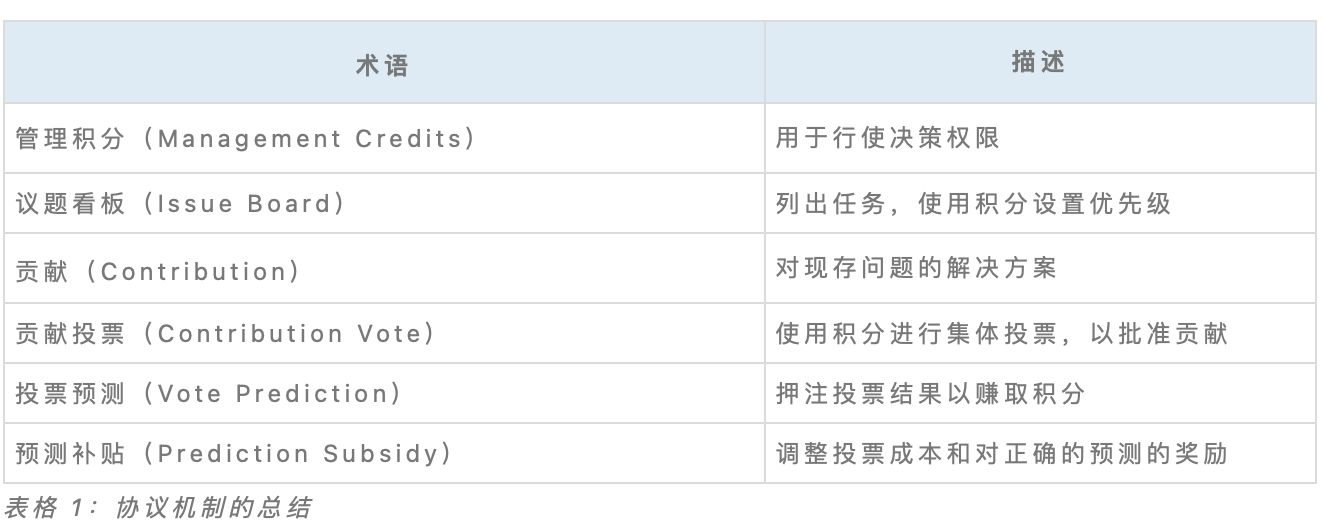
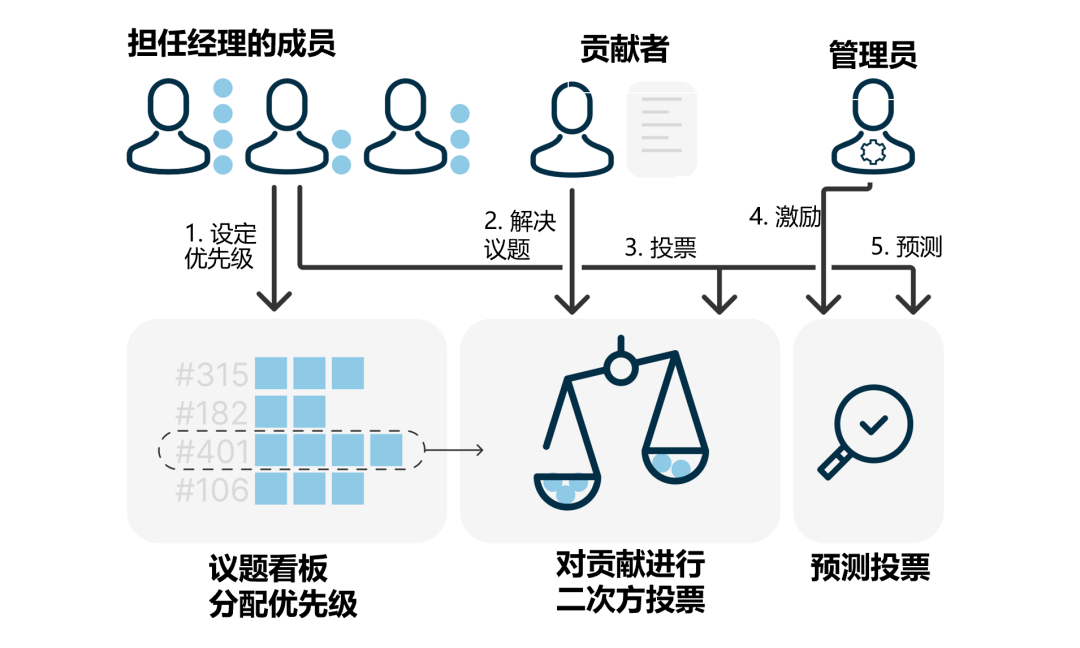
Figure 1: Key components of the Plural Management workflow. Any member can be a contributor or manager, exercising authority by spending credits and earning credits through contributions and accurate vote predictions.
3.1 Application to Open Source
Although the Plural Management protocol is broadly applicable to organizations and communities, it is especially relevant to the world of open-source software and other domains characterized by peer production (Benkler, 2017). Git-based open-source software is far from niche—it underpins over 93% of modern software applications (Daigle, 2023)—and already operates through community governance models. In this model, code contributions undergo evaluation for quality and relevance before being merged into existing projects. Despite these significant contributions, well-known governance and management challenges persist in open-source communities, most famously documented by Eghbal (2020), including:
While contributions by open-source contributors are recorded, their relationship to higher-level goals is often unclear, making value attribution difficult to track and trace. This undermines motivation and sustainability.
Although contribution to open-source projects is typically open and participatory, governance—often called “maintenance”—is usually concentrated in the hands of a “benevolent dictator for life,” contradicting the underlying democratic values and leading dissenters to “fork” the project, fragmenting efforts.
Worse, because distributed participation cannot assist in management, maintainers bear heavy burdens. Projects begin with enthusiasm, but maintainers must sustain quality over years, forced to triage growing numbers of questionable-quality contributions amid insufficient community support.
As projects grow and gain wider usage, potential improvement paths grow exponentially, yet user-need clarity diminishes, resulting in feature-rich but usability-poor software.
By providing contributors with clearer direction and greater empowerment, Plural Management helps founders gradually transfer managerial authority to those who prove their value through code contributions, diligence, or support within the community. Because this model is lightweight, iterative, and autonomous, it fits naturally within the agile environments and tools commonly used by open-source communities.
Take GitHub, the most popular open-source hosting platform. For any project, administrators or maintainers establish a repository, with contributors listed as members. Each repository includes an “Issues” section (similar to our described issue board, though lacking explicitly ranked digital priorities). Anyone on GitHub can create a contribution via a “Pull Request” (PR) addressing one or more open issues. After discussion in comment threads, the community decides whether to accept or reject the PR, and maintainers may then add or “merge” the contribution into the codebase. With minimal changes to this workflow, any maintainer or administrator could implement Plural Management on GitHub by setting priority tags linked to credit-denominated prices, driving more contributions into their repositories—this being a first step toward improving low average bus factors (Metabase, 2022).
Notably, while contributions are typically code, anything can become a PR. For instance, if someone is to be appointed social media manager for a project, an issue may first be opened stating the need. Once appointed, the new manager can submit a simple PR adding their name to community records. If the community approves this new role via voting, the social media manager receives additional management credits reflecting their new responsibilities.
3.2 A Concise Use Case
Beyond typical open-source contexts, a concrete application of Plural Management is the book Plurality, a Git-based collaborative writing experiment initiated by E. Glen Weyl and Audrey Tang. Fifty contributors from around the world participated in developing Plurality: The Future of Collaborative Technology and Democracy without expected reward. The project uses the Plural Management protocol to progressively transfer ownership of future improvements—including content updates, translations, and links to related materials—over time. Those making the most meaningful contributions will not only guide the evolution of the book but also help shape the field itself.
Imagine an undergraduate student in political economics at an obscure university. She spots a typo, opens an issue, and submits a PR. During voting, this action earns few credits, but even this small amount allows her to begin participating in priority-setting. Encouraged, she continues seeking opportunities and discovers her academic research could address an unresolved issue tied to a chapter. She submits a PR adding key references cited in the book and receives a substantial credit reward.
Given the inclusivity challenges present in higher education today, without the permissionless, community-judged structure enabled by Plural Management, such a student might never have had the opportunity to engage in such impactful work (Gvozdanović and Maes, 2018).
Join TechFlow official community to stay tuned
Telegram:https://t.me/TechFlowDaily
X (Twitter):https://x.com/TechFlowPost
X (Twitter) EN:https://x.com/BlockFlow_News
 @SSRN
@SSRN