









Compared to Web2, why does FHE have better application prospects in Web3?
TechFlow Selected TechFlow Selected
Compared to Web2, why does FHE have better application prospects in Web3?
As technology continues to advance and innovate, FHE is expected to play a key role in the future of privacy protection and secure computing.
 Navigating Web3 tides with focused insights
Author: IOSG Ventures
Privacy is a fundamental right for individuals and organizations. For individuals, it enables free expression without having to disclose unwanted information to third parties. For most organizations today, data is treated as a primary commodity, and data privacy is crucial to protecting this asset. The cypherpunk movement and the commodification of data have accelerated research and development in cryptographic primitives.
Cryptography is a broad field. When viewed in the context of computing, we’ve seen many different schemes—such as zero-knowledge proofs, homomorphic encryption, and secret sharing—that have continuously evolved since their inception in the 1960s. These schemes are essential for unlocking private computation methods (data is valuable because insights can be derived from it). To date, significant progress has been made in private computing, particularly in multi-party computation (MPC) and zero-knowledge proofs, yet the privacy of input data itself remains an unresolved challenge.
When the most valuable asset—data—is public, it becomes extremely difficult for any data owner to outsource its computation without legal agreements. Today, everyone relies on compliance standards for data privacy, such as HIPAA for health data and GDPR for data privacy in Europe.
In the blockchain space, we place more trust in technological integrity than regulatory oversight. As believers in permissionless systems and maximal ownership, if we believe in a future where users own their data, we need trustless methods to compute over that data. Before Craig Gentry’s work in 2009, performing computations on encrypted data had seen no breakthrough. It was the first time someone could perform operations (addition and multiplication) directly on ciphertext (encrypted data).
1. How Fully Homomorphic Encryption (FHE) Works
So, what exactly is this “magical math” that allows computers to perform calculations without knowing the inputs?
Fully Homomorphic Encryption (FHE) is a class of encryption schemes that allow computations to be performed on encrypted data (ciphertext) without decryption, opening up a wide range of use cases for privacy and data protection.
In FHE, when data is encrypted, additional random data called "noise" is added to the original data. This is part of the encryption process.
Each time a homomorphic operation (addition or multiplication) is performed, more noise is introduced. If computations become too complex and noise accumulates with each step, decrypting the final ciphertext becomes extremely difficult (computationally intensive). This process is better suited for addition, where noise grows linearly, whereas for multiplication, noise grows exponentially. Thus, for complex polynomial multiplications, decrypting the output becomes nearly infeasible.
If noise is the main issue, and its accumulation makes FHE impractical, then it must be controlled. This led to the development of a new technique called "Bootstrapping." Bootstrapping involves re-encrypting the data using a new key and performing decryption within the encrypted domain. This is critical because it significantly reduces both computational overhead and the cost of decrypting the final output. While bootstrapping reduces final decryption costs, it introduces substantial operational overhead during the process, making it expensive and time-consuming.
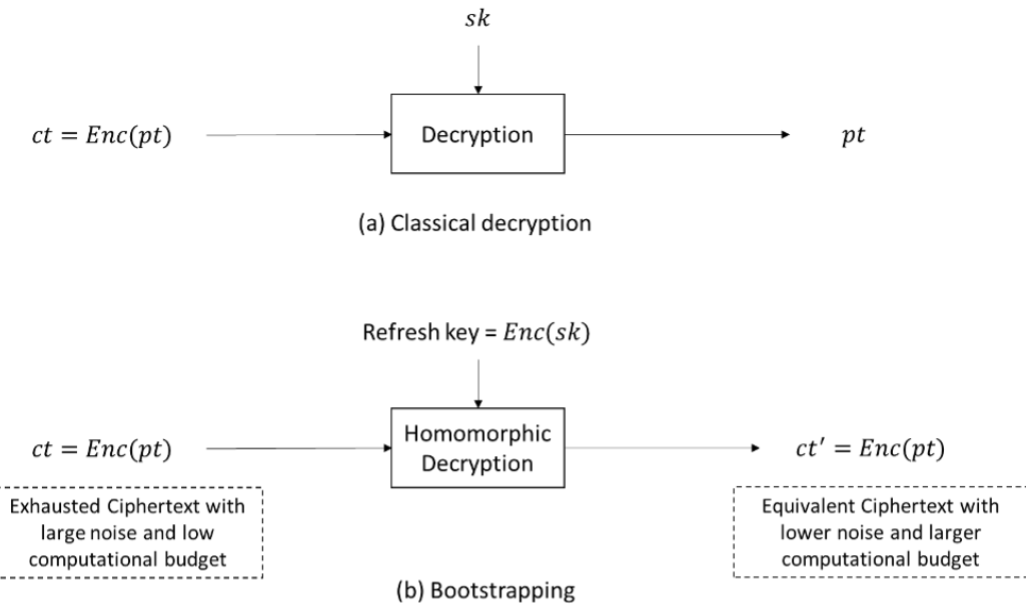
The main FHE schemes currently in use are: BFV, BGV, CKKS, FHEW, and TFHE. Except for TFHE, these acronyms are derived from the names of their authors.
These schemes can be thought of as different languages spoken within the same country, each optimized for different purposes. The ideal scenario would be unification—enabling all these "languages" to be understood by the same machine. Many FHE working groups are actively pursuing composability across these schemes. Libraries like SEAL (combining BFV and CKKS) and HElib (BGV + approximate number CKKS) help implement FHE schemes or combine them for different types of computation. For example, Zama’s Concrete library is a Rust compiler tailored for TFHE.
2. Comparison of FHE Schemes
Below is a performance comparison of different libraries from Charles Gentry, Dimitris Mouris, and Nektarios Georgios Tsoutsos in their paper "SoK: New Insights into Fully Homomorphic Encryption Libraries via Standardized Benchmark" (2022).
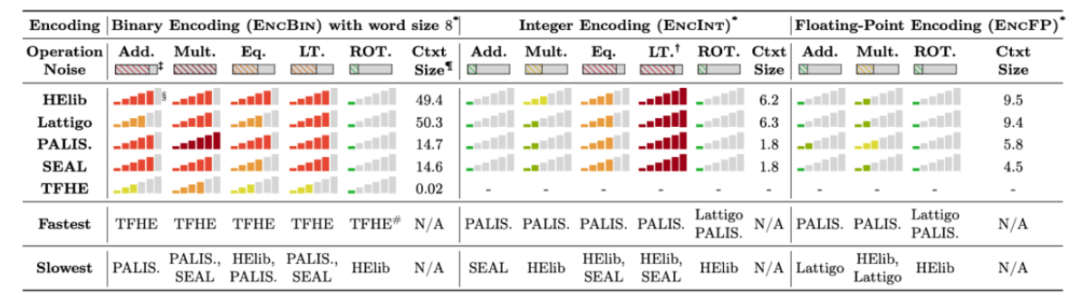
Web3 Use Cases
Today, when we use blockchains and applications, all data is public and visible to everyone. While this transparency benefits many use cases, it severely limits those requiring default privacy or data confidentiality (e.g., machine learning models, medical databases, genomics, private finance, tamper-proof gaming, etc.). Blockchains or virtual machines powered by FHE inherently allow the entire chain state to remain encrypted from inception, ensuring privacy while enabling arbitrary computation on encrypted data. All data stored or processed on an FHE-enabled blockchain network is inherently secure. Zama has an fhEVM scheme that enables EVM computations within a fully homomorphic environment. This ensures privacy at the execution layer for any L1/L2 project built using this library. Although privacy chains are impressive technically, adoption and token performance have not significantly improved.
In outsourcing general computation, FHE is not intended to replace ZK or MPC. Instead, they can complement each other to create a powerful trustless private computing infrastructure. For instance, Sunscreen is building a "privacy engine" that allows any blockchain application to outsource computation to their FHE environment and retrieve verified results. The resulting computation can be validated via ZK proofs. Octra is doing something similar but uses a different encryption scheme called hFHE.
ZK proofs excel at proving statements without revealing data, but the prover still accesses the raw data at some point. ZK proofs cannot be used for private data computation; they only verify whether certain computations were correctly executed.
MPC distributes encrypted computation across multiple machines, performs parallel processing, and combines results. As long as most participating machines are honest, the original data cannot be retrieved—but this still assumes trust. Due to constant communication required among parties (data must be repeatedly split, computed, and reassembled), scaling via hardware is challenging.
With FHE, all computations occur on encrypted data without decryption and can be performed on a single server. FHE performance can scale through better hardware, increased computational resources, and hardware acceleration.
Currently, the most promising use cases for FHE in blockchain focus more on outsourcing general computation rather than building native FHE L1/L2 blockchains. Here are some interesting applications FHE can unlock:
-
First Generation (Crypto-native): On-chain DID, casinos, betting, voting, gaming, Private DeFi, private tokens, dark pools, 2FA, backups, passwords.
-
Second Generation (Modular): "Privacy chains" (Chainlink for privacy), outsourced private computation, end-to-end encryption between blockchains and contracts, encrypted data availability, verifiable secure data storage.
-
Third Generation (Enterprise-grade): Complex consumer apps, encrypted and decentralized LLMs, AI, wearables, communications, military, healthcare, privacy-preserving payment solutions, Private P2P payments.
Current Industry Projects Based on FHE
The advancement of Fully Homomorphic Encryption (FHE) has inspired several innovative blockchain projects leveraging this technology to enhance data privacy and security. This section explores the technical details and unique approaches of notable projects such as Inco, Fhenix, and Zama.
Inco
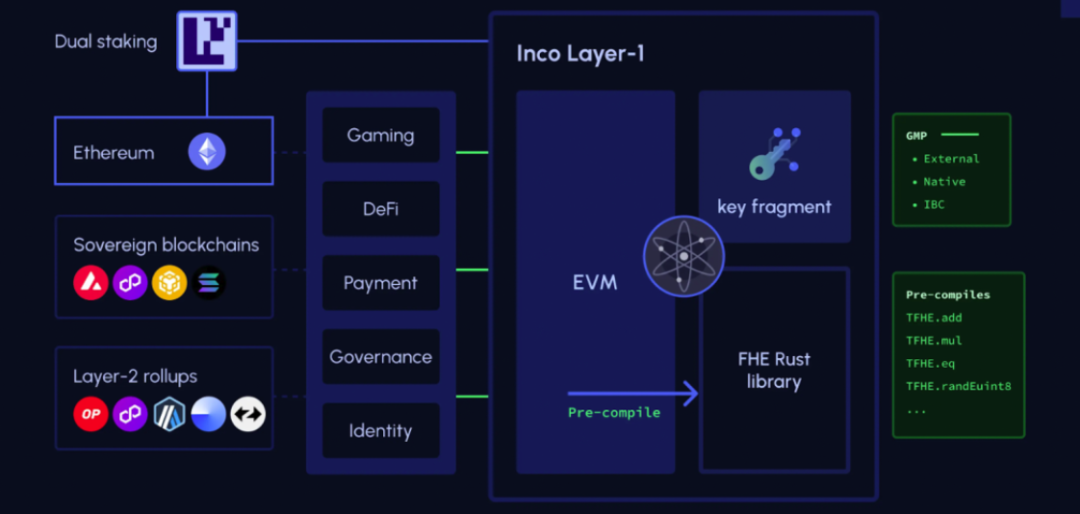
Inco is pioneering the integration of FHE with blockchain, creating a platform where data computation is both secure and private. Inco employs lattice-based cryptography for its FHE implementation, ensuring operations on ciphertext (encrypted data) can be performed without exposing the underlying plaintext. The platform supports privacy-preserving smart contracts, enabling direct processing of encrypted data on-chain.
-
Lattice-Based FHE: Inco leverages lattice-based encryption due to its post-quantum security properties, ensuring resilience against potential future quantum attacks.
-
Privacy-Preserving Smart Contracts: Inco’s smart contracts can execute arbitrary functions on encrypted inputs, ensuring neither the contract nor the nodes executing it can access the plaintext data.
-
Noise Management and Bootstrapping: To address noise accumulation during homomorphic operations, Inco implements efficient bootstrapping techniques to refresh ciphertexts, maintain decryptability, and support complex computations.
Fhenix
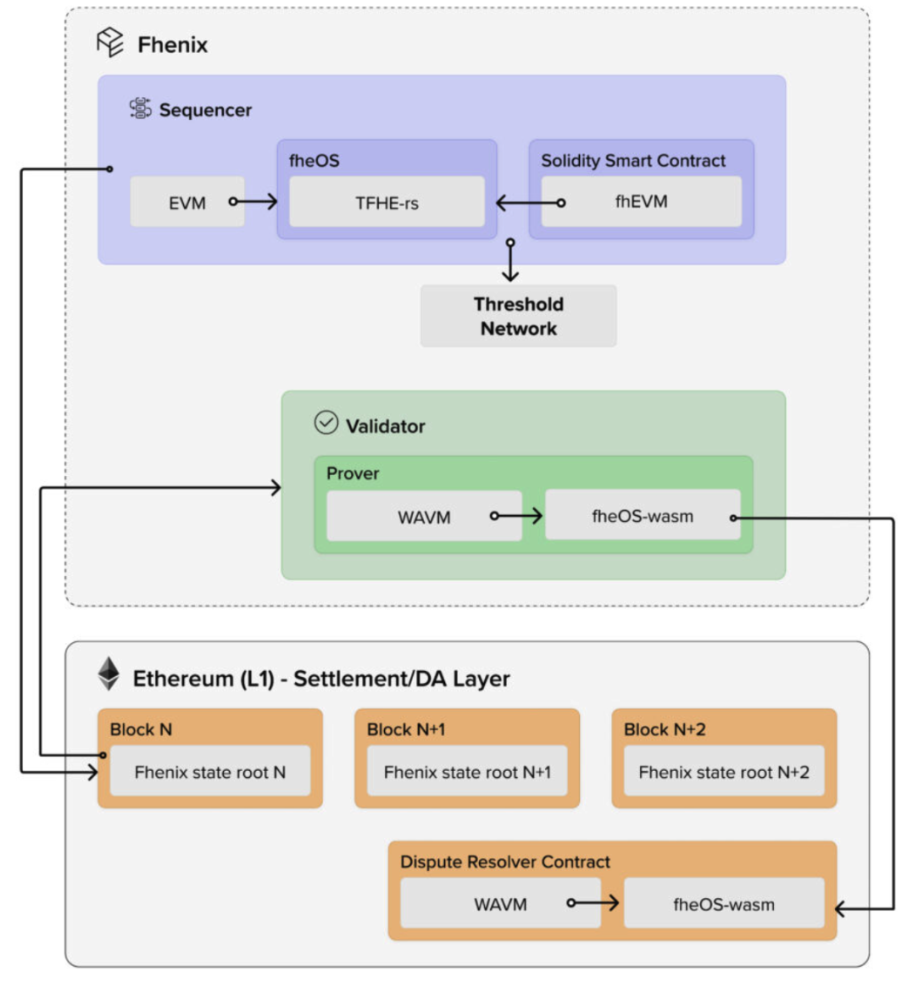
Fhenix focuses on providing robust infrastructure for privacy-preserving applications, leveraging FHE to deliver end-to-end encrypted solutions that protect user data. Fhenix’s platform supports diverse applications—from secure messaging to private financial transactions—ensuring data privacy throughout all stages of computation.
-
End-to-End Encryption: Fhenix ensures data remains encrypted from input through processing and storage, achieved by combining FHE with secure multi-party computation (SMPC) techniques.
-
Efficient Key Management: Fhenix integrates advanced key management systems to enable secure key distribution and rotation, which is essential for long-term security in FHE environments.
-
Scalability: The platform uses optimized homomorphic operations and parallel processing to efficiently handle large-scale computations, addressing one of FHE’s major challenges.
-
Co-Processors: Fhenix is also pioneering specialized co-processors designed to accelerate FHE computations. These co-processors handle the intensive mathematical operations required by FHE, significantly improving performance and scalability for privacy-preserving applications.
Zama
Zama is a leader in the FHE space, best known for its fhEVM solution, which enables Ethereum EVM computations within a fully homomorphic environment, ensuring privacy at the execution layer for any L1/L2 project built using this library.
-
fhEVM Solution: Zama’s fhEVM integrates FHE with the Ethereum Virtual Machine, enabling encrypted execution of smart contracts. This facilitates confidential transactions and computations within the Ethereum ecosystem.
-
Concrete Library: Zama’s Concrete library is a Rust compiler targeting TFHE (a variant of FHE). It provides high-performance implementations of homomorphic encryption schemes, making encrypted computation more efficient.
-
Interoperability: Zama is committed to developing solutions that seamlessly integrate with existing blockchain infrastructure. This includes supporting various cryptographic primitives and protocols to ensure broad compatibility and ease of integration.
3. The Critical Role of FHE in Crypto, AI Infrastructure, and Applications
Today, the intersection of cryptography and artificial intelligence is rapidly evolving. While not delving deeply into this convergence, it's worth noting that innovation in new models and datasets will be driven by open collaboration among multiple parties. Beyond computation, the most critical element is ultimately the data itself—the cornerstone of this collaborative pipeline. The utility of AI applications and models depends fundamentally on the data they are trained on, whether base models, fine-tuned models, or AI agents. Keeping this data secure and private opens up vast design possibilities for open collaboration while allowing data owners to continuously monetize trained models or final applications. If this data is inherently public, monetization becomes difficult (as anyone can access valuable datasets), so such data is likely to remain tightly protected.
In this context, FHE can play a pivotal role. Ideally, it could train models without revealing the underlying dataset, potentially unlocking data monetization and greatly facilitating open collaboration among data owners.
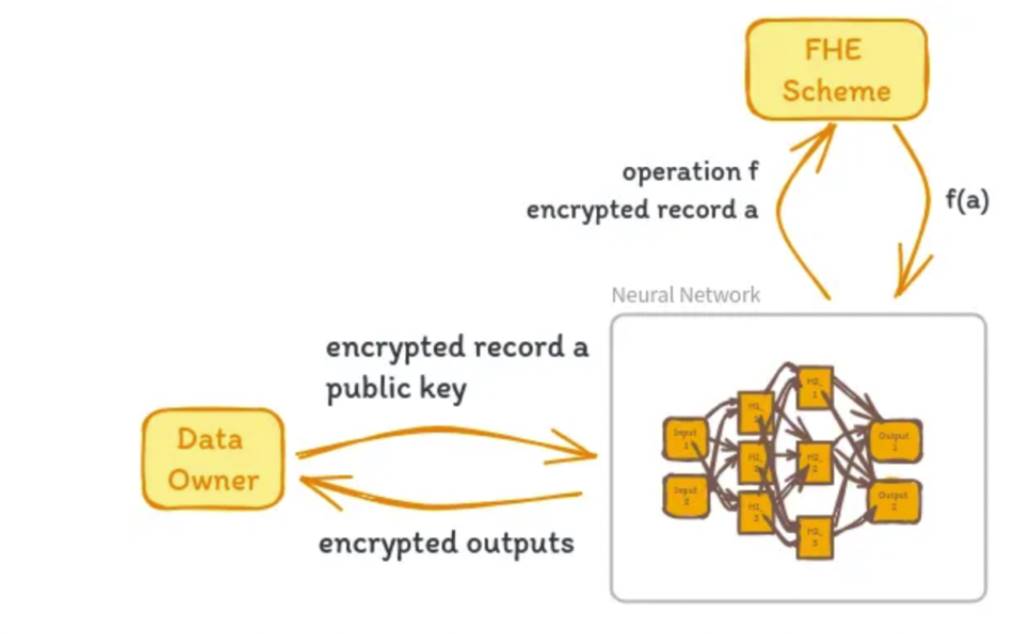
Source: Bagel Network
How FHE Enhances Privacy-Preserving Machine Learning (PPML)
-
Data Privacy: By using FHE, sensitive data such as medical records, financial information, or personal identifiers can be encrypted before being fed into ML models. This ensures data remains confidential even if the computing environment is compromised.
-
Secure Model Training: Training ML models typically requires large volumes of data. With FHE, this data can remain encrypted, enabling model training without exposing raw data—critical for industries handling highly sensitive information under strict data privacy regulations.
-
Confidential Inference: Beyond training, FHE can also be used for encrypted inference. Once a model is trained, predictions can be made on encrypted inputs, ensuring user data remains private throughout the inference process.
Application Areas of FHE in PPML:
-
Healthcare: Training ML models with privacy guarantees can lead to more personalized and effective treatments without exposing sensitive patient data.
-
Finance: Financial institutions can analyze encrypted transaction data for fraud detection and risk assessment while preserving customer privacy.
-
IoT and Smart Devices: Devices can collect and process data in encrypted form, ensuring sensitive information such as location data or usage patterns remains confidential.
Challenges with FHE:
As previously mentioned, there is no “unified” standard among FHE schemes. They are not composable, and often require combining different FHE schemes for different types of computation. Experimenting with different schemes for the same computation is also quite cumbersome. The CHIMERA framework under development aims to enable switching between different FHE schemes like TFHE, BFV, and HEAAN, but it is far from production-ready. This leads to another issue: the lack of benchmarking. Benchmarks are crucial for developer adoption and would save significant time. Given the computational overhead (encryption, decryption, bootstrapping, key generation, etc.), most existing general-purpose hardware is poorly suited. Some form of hardware acceleration—or possibly dedicated chips (FPGA and/or ASIC)—will be needed for mainstream FHE adoption. These challenges mirror those seen in the ZK (zero-knowledge) industry. As long as a group of brilliant mathematicians, applied scientists, and engineers remain interested in this field, we remain bullish on both: FHE for privacy and ZK for verifiability.
4. What Will an FHE-Driven Future Look Like?
Will one FHE scheme dominate all others? This is still debated in the industry. While a unified scheme is ideal, the diverse needs of different applications may always require specialized, task-optimized schemes. Is interoperability between schemes the best solution? Interoperability may indeed be a practical approach, offering flexibility in handling diverse computational needs while leveraging the strengths of various schemes.
When will FHE become usable? Usability is closely tied to reducing computational overhead, improving benchmarking standards, and advances in dedicated hardware. As progress continues in these areas, FHE will become increasingly accessible and practical.
In summary, FHE offers powerful tools for data privacy and secure computation. Despite current challenges in interoperability, computational overhead, and hardware support, the potential of FHE in blockchain, privacy-preserving machine learning, and broader Web3 applications cannot be overlooked. As technology continues to advance and innovate, FHE is poised to play a critical role in the future of privacy and secure computing.
Join TechFlow official community to stay tuned
Telegram:https://t.me/TechFlowDaily
X (Twitter):https://x.com/TechFlowPost
X (Twitter) EN:https://x.com/BlockFlow_News
 IOSG Ventures











