








The next iteration of the internet: AVS will bring Web3's trust mechanisms to Web2
TechFlow Selected TechFlow Selected
The next iteration of the internet: AVS will bring Web3's trust mechanisms to Web2
This article will provide a brief overview of EigenLayer's Active Validation Service (AVS) ecosystem.
 Navigating Web3 tides with focused insights
Author: Sumanth Neppalli, Polygon Ventures
Translation: Yangz, Techub News
Active Validation Services (AVS) merge the scalability of Web2 with the trust mechanisms of Web3, ushering in the next iteration of the internet. This article provides a brief overview of EigenLayer's Active Validation Service (AVS) ecosystem.
While blockchains are effective at settling transactions, moving all computation onto smart contracts is highly challenging due to limitations in latency and throughput. Even rollup solutions cannot fully meet comprehensive needs such as front-end hosting, oracles, and databases.
Smart contracts must interact with account layers, and designing them requires careful consideration due to the high cost of gas fees for every transaction. Take Uniswap as an example: its latest v4 version adopts a Hook mechanism—externally deployed contracts that offer market makers and users highly customizable features such as limit orders, dynamic fee structures, custom oracles, and TWAMM (Time-Weighted Average Market Maker).
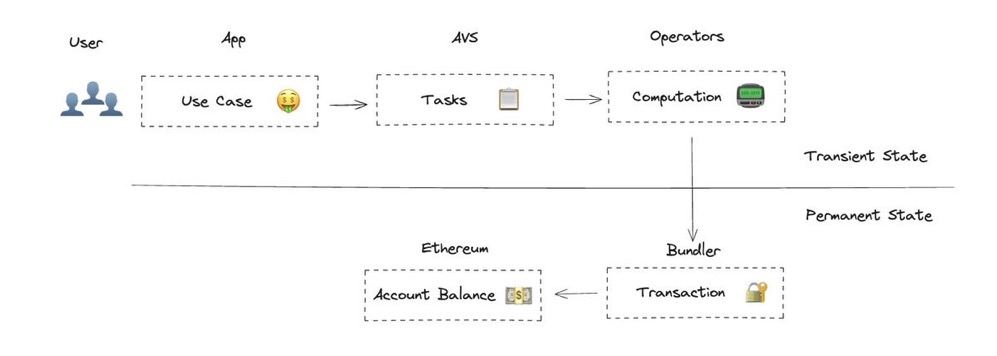
The future of blockchain computing may lie in a hybrid architecture that separates computation and storage into transient and persistent layers. In this model, blockchains serve as the persistent layer with strong security guarantees, maintaining shared state across multiple validators. Lower validator requirements ensure broad decentralization, minimize censorship, and protect critical data such as transaction logs and identities. AVS introduces the transient layer, maintained by a decentralized network of operators providing hardware like GPUs, ZK provers, and solid-state drives. This operator network delivers specialized services including execution engines, virtual machines, oracles, and distributed key generation.
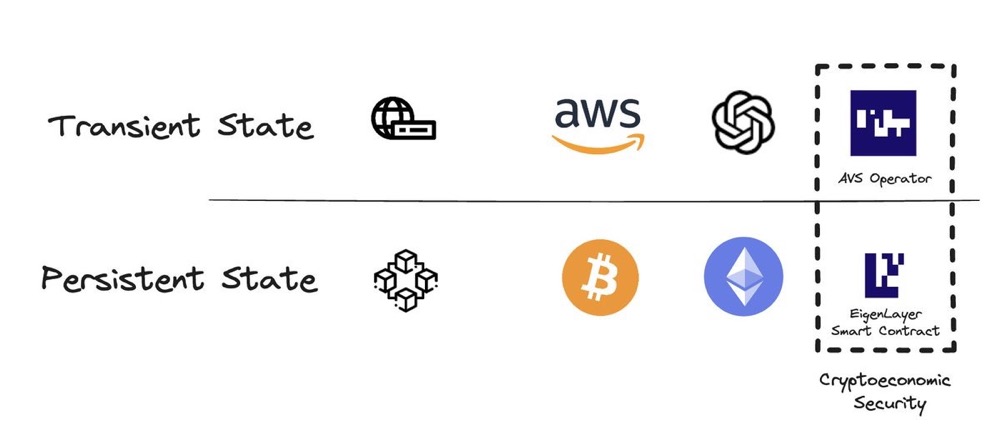
Web2 relies on centralized cloud service providers for storage and computation, resulting in lower security and greater vulnerability to censorship. Although AWS replicates data across locations for redundancy, sensitive information such as bank accounts still requires government custody.
Unlike centralized cloud providers, AVS services are supported by a subset of Ethereum operators who stake their crypto assets to prove their honesty and reliability. Even if the state of the transient layer is compromised, user funds remain secure on the persistent blockchain layer.
The core promise of AVS is to provide Web3 trust guarantees for any computation—whether on-chain or off-chain. Its architecture supports verifiable cloud services and verifiable computing.
First, verifiable cloud services.
Versatus has launched "Allegra," a cloud service AVS that offers dApps censorship-resistant, transparent infrastructure at 50% lower cost than traditional cloud providers. These applications are hosted on an AVS node network, eliminating single points of failure.
In the future, we are likely to see a new class of applications distinct from traditional DApps that reside entirely on-chain. Versatus calls them "Unstoppable Apps" and introduces a new framework similar to the HTTPS standard we are familiar with.
Applications requiring recommendation feeds, such as decentralized social media, are now feasible. AVS enables this by supporting advanced algorithms that continuously update user feeds based on user history, creating dynamic experiences when accessing on-chain media NFTs.
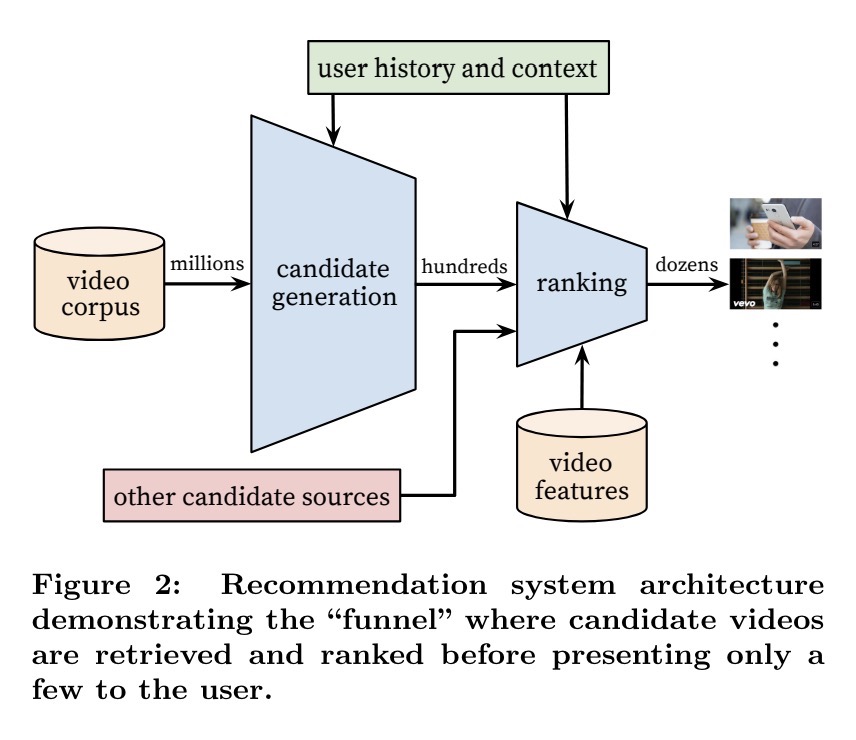
For such services, do we need "trust"?
Just as we expect quality from physical services, we also demand integrity in every software computation. Unlike tangible goods whose quality is visible, software trust depends on invisible processes behind each function. The algorithms shaping our lives often lack transparency. Consider the recent leak of Google’s search engine optimization (SEO) algorithm—it became clear that Google had misled the public about its web page rankings.
Then, how high is the cost of this "trust"?
Since we are still in the early stages, it is difficult to calculate the additional operating costs of AVS software. Sreeram Kannan, founder of EigenLayer, estimated that achieving cryptoeconomic security for financial transactions would incur an additional 0.1% operational cost.
Beyond "trust," the second key advantage of AVS is "verifiable computation."
AVS node networks can perform off-chain computations backed by cryptoeconomic/ZK proofs (usable as inputs to applications), opening possibilities for experimentation with AI agents.
For instance, Uniswap v4’s Hook mechanism can be combined with a decentralized matching engine hosted on dedicated AVS nodes. This pool of operators can efficiently match thousands of trade requests with counterparties, creating batches of transactions settled on-chain.
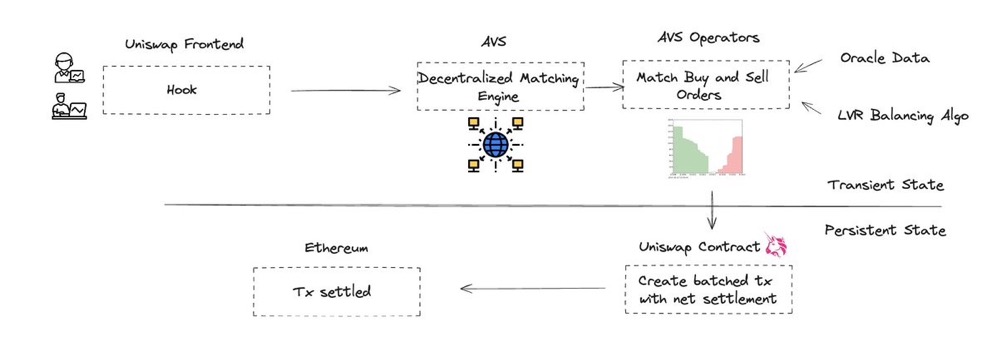
AVS operators cannot steal user funds; they can only match trades according to user-defined intents. This architecture allows operators to process intents, integrate AI-driven results, manage dark pools, and develop applications with variable fees, thereby enhancing functionality.
AVS delivers neutral, accessible, and unstoppable network services. It provides developers with a powerful node network capable of handling any specialized computation on demand, simplifying development without starting from scratch. Currently, there are 1,459 AVS operators and 16 AVS services. Among them, EigenDA leads with 264 active operators.
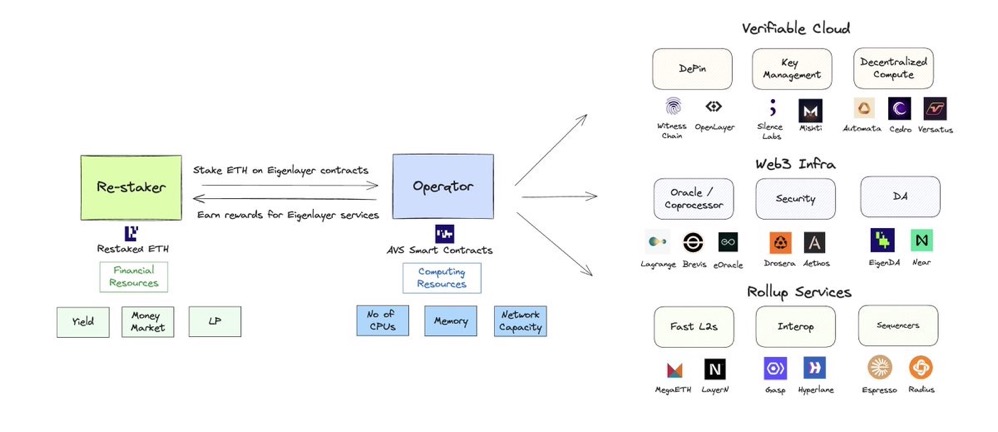
The potential unlocked by AVS is vast and spans multiple domains. We categorize them into three major groups:
-
Verifiable Web2 Infrastructure
-
Web3 Infrastructure
-
Rollup Services
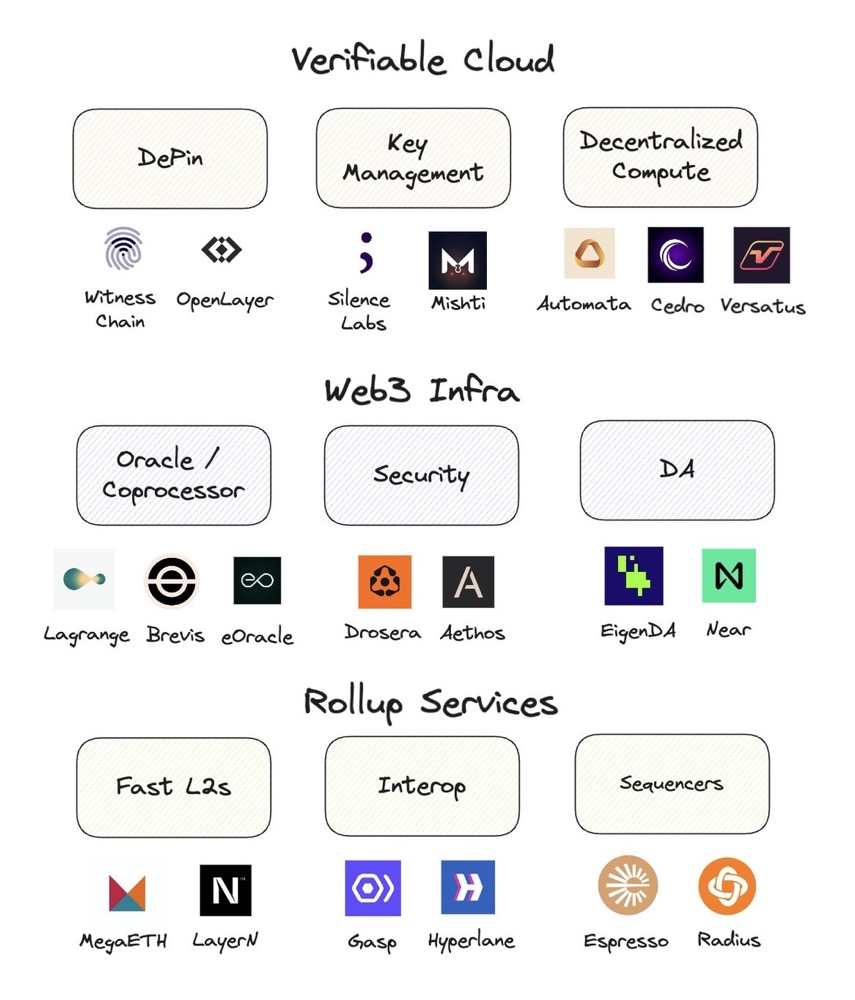
First, trustless Web2 services, including content delivery, key management, and decentralized computing.
For example, Witness Chain leverages a global network of AVS "Watchtower" services to provide proof of location by analyzing network latency. Another example is Mishti, which combines MPC and threshold signatures with AVS through a distributed set of nodes that generate private keys from biometric data, offering smoother login methods and enhanced privacy protection. Additionally, AVS is transforming decentralized computing by providing innovative technologies such as off-chain matching engines for traders. Cedro Finance is preparing to launch an AI agent layer enabling LPs to dynamically compute prices across CEXs and DEXs to deliver timely liquidity.
Second, Web3 infrastructure. AVS can power foundational elements relied upon by blockchains and rollups. By securing DA layers, providing ZK-powered oracles, and deploying easily integrable monitoring systems, AVS strengthens the Web3 ecosystem.
For instance, in the decentralized verification processes of Lagrange and Brevis, queries are offloaded to AVS networks for execution and validation before being reintegrated into contracts. Another example is EigenDA—an innovative DA solution inspired by the Danksharding roadmap—where AVS operators provide enterprise-grade SSDs for data storage, achieving test speeds up to 10 Mbps, with the goal of reaching 1 Gbps as more operators join.
Finally, rollup services secured by AVS, such as cross-chain bridges, interoperability solutions, fast settlement layers, shared sequencers, and restaked rollups. Currently, NEAR is developing a fast finality layer called NFFL, using AVS to prove rollup states across L2s.
In summary, AVS is a transformative cryptoeconomic layer atop blockchains, empowering developers to build trustless applications using any programming language.
Join TechFlow official community to stay tuned
Telegram:https://t.me/TechFlowDaily
X (Twitter):https://x.com/TechFlowPost
X (Twitter) EN:https://x.com/BlockFlow_News
 @0xSumanth






