Interview with EigenLayer Founder: Can It Overcome Challenges with $1.1 Billion in Deposits and Its Role in Ethereum?
TechFlow Selected TechFlow Selected
Interview with EigenLayer Founder: Can It Overcome Challenges with $1.1 Billion in Deposits and Its Role in Ethereum?
Since its launch, EigenLayer has been mired in controversies. It first drew criticism for offering high salaries to "hire" researchers from the Ethereum Foundation, followed by disputes over token allocations.
 Navigating Web3 tides with focused insights
By Aleks Gilbert, DL News
Translation: Felix, PANews
In an exclusive interview with EigenLayer founder Sreeram Kannan, he discussed the protocol's explosive launch and the lessons learned amid the controversies following EigenLayer’s debut.
Within a year of launching in June 2023, EigenLayer achieved the kind of start many crypto projects dream of.
EigenLayer has accumulated around $20 billion in user deposits, and its parent company secured a $100 million investment from a16z.
Even better, the project quickly proved its value: over 100 projects have flocked to EigenLayer, including crypto exchange Kraken and interoperability protocol developer LayerZero Labs, according to founder Sreeram Kannan.
But EigenLayer may have grown too aggressively, attracting a series of controversies—including allegations that it attempted to pay off influential (and critically important) crypto researchers.
"Somehow, EigenLayer became central to Ethereum," founder Sreeram Kannan said in the interview. "And we weren't prepared to be at the center of a major ecosystem."
EigenLayer currently holds $11 billion in deposits. Though it originated in academia (Kannan is a professor at the University of Washington) with the goal of creating a "free market for decentralized trust," its rollout has become a classic overnight success story.
EigenLayer makes it easier for protocols to launch by allowing projects to piggyback on the computers and ether (ETH) securing Ethereum itself—a process known as restaking.
At last year's Istanbul conference, Kannan likened this concept to a military alliance.
"Cities don’t have armies; nations do. Sometimes even multiple nation-states coordinate to build truly cooperative alliances. It's exactly the same phenomenon. Shared security is absolutely better."
Some Ethereum researchers quickly saw EigenLayer as a breakthrough. But others warned that too many services relying on the same pool of ETH for security could undermine blockchain stability.
In other words, if a project built on EigenLayer fails, the restaked ETH could also fail. To extend Kannan’s analogy: if one city falls, the entire army collapses with it.
In short, critics worry this could trigger a cascade of failures, ultimately harming Ethereum itself.
To ease concerns, EigenLayer rolls out new features every few months. Later this year, EigenLayer will change its security model to limit the impact when certain applications fail.
But one attempt to emphasize safety didn’t go so well.
Earlier this year, EigenLayer hired prominent Ethereum Foundation researchers Justin Drake and Dankrad Feist as advisors.
They were brought on to address the risks restaking poses to Ethereum—and were handsomely compensated. Drake’s daily pay could amount to millions of dollars in crypto.
Conflict of Interest
But these financial ties only came to light after a crypto influencer disclosed them on social media.
The lack of transparency not only contradicted DeFi values but also drew criticism toward the Ethereum Foundation for allegedly overlooking conflicts of interest.
Lefteris Karapetsas, founder of Rotki, wrote: "I’m shocked that our Ethereum Foundation researchers—the very people guiding protocol development—are receiving six- or seven-figure compensation from protocols."
Both Drake and Feist insisted they wouldn’t compromise their integrity for EigenLayer’s money.
Feist said that if properly implemented, EigenLayer would bring "tremendous benefits" to Ethereum. "I believe the current leadership intends to do so, and I plan to hold them accountable. If I no longer believe that’s the case, I’ll speak up and/or resign without hesitation."
Drake pledged to reinvest all earnings from EigenLayer into other Ethereum projects via grants or investments. "I also stand ready to terminate my advisory role—for instance, if EigenLayer moves in a direction I believe harms Ethereum’s interests."
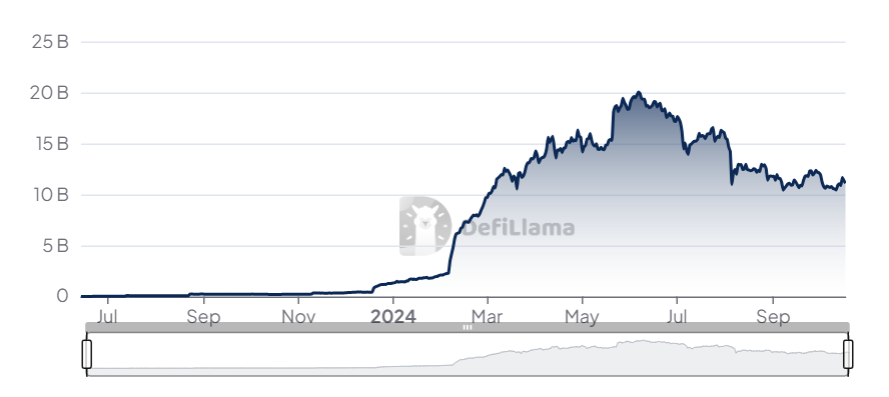
The value of crypto deposited into EigenLayer peaked at $20 billion
According to Kannan, EigenLayer delayed announcing the partnership at the Ethereum Foundation’s request, as the foundation wanted to disclose the relationship themselves.
But Jordan Fish (better known as Cobie), a crypto influencer, wrote on X that Ethereum Foundation researchers were taking "life-changing money" from projects "that may have incentive misalignments with Ethereum," referencing EigenLayer.
Drake confirmed the relationship on his website and X, adding that the crypto he received could eventually be worth millions of dollars.
Feist also confirmed the arrangement, though he described his compensation simply as "a certain amount of tokens."
In response, Kannan claimed: "Despite what people think, this isn’t some subversive act. That’s just not the case."
Full Transparency
"It’s fully transparent. We talked to the Ethereum Foundation. They asked us not to promote it. … They said, 'We’ll promote it ourselves, the right way.'"
But according to Kannan, the payments were also meant as gratitude to the two researchers for significantly shaping EigenLayer’s direction.
"EigenDA is a protocol built on ideas from Dankrad and Justin. We wanted to reward those who actually invested and created these ideas," Kannan said.
Yet another controversy soon followed.
Token Vesting
An article in August reported that Eigen Labs had pressured partner companies to grant shares of newly issued tokens to employees.
Eigen Labs denied the allegations. Then in September, critics pointed to evidence suggesting early, well-funded EigenLayer investors could bypass token vesting schedules—claims the company dismissed as overstated.
"In crypto, being right isn’t enough," Kannan said. "Generally, when you want to build trust, you have to prove you’re right—that’s a higher bar. It’s really hard, especially for a project of this scale."
To meet this challenge, Kannan said the company is dedicating more resources to raising transparency standards.
"If we want to be a coordination engine for humanity, we need to withstand this level of scrutiny."
Kannan once doubted crypto was anything more than a speculative bubble, but now he speaks like a true believer, often using passionate rhetoric.
"I had dinner with a U.S. congressman who asked me, ‘Can you tell me why you got into crypto?’" Kannan recalled.
"Many DeFi founders say things like ‘improve the financial system’ or ‘make it inflation-resistant’—all familiar, crowd-pleasing lines. But I said, ‘This is the biggest leap forward for human civilization since the Constitution.’"
Enthusiastic about peer-to-peer networks, Kannan entered the crypto space in 2018. He wrote academic papers on the topic and eventually set out to build his own blockchain, called 'Trifecta.' But he failed to raise funding.
Had he successfully attracted venture capital, launching a blockchain would’ve been easier. Alternatively, building a new chain atop Ethereum would also allow for a smooth launch.
"EigenLayer was conceived as a mechanism to solve that very problem."
Join TechFlow official community to stay tuned
Telegram:https://t.me/TechFlowDaily
X (Twitter):https://x.com/TechFlowPost
X (Twitter) EN:https://x.com/BlockFlow_News
 @DLNewsInfo