









Bitcoin pullback triggers $250 million liquidation, "Super Wednesday" could be key to next market move
TechFlow Selected TechFlow Selected
Bitcoin pullback triggers $250 million liquidation, "Super Wednesday" could be key to next market move
This downturn presents a good opportunity to buy the dip.
 Navigating Web3 tides with focused insights
Compiled by: Jordan, PANews
On June 12, financial markets are referring to today and the early hours of tomorrow as a "Super Wednesday," as two major events—the latest CPI data release and the Federal Reserve's interest rate decision—are set to unfold consecutively. These developments could serve as key indicators for the next phase of movement in the crypto market.
Increased volatility in crypto markets triggers $250 million liquidation as Bitcoin and altcoins fall together
Amid growing uncertainty about future market direction, the cryptocurrency market experienced significant volatility ahead of "Super Wednesday." Although Bitcoin opened near $70,000 yesterday, it failed to hold that resistance level and dropped into the $66,000 range, briefly touching $66,170 on Tuesday night—the lowest level in nearly three weeks.
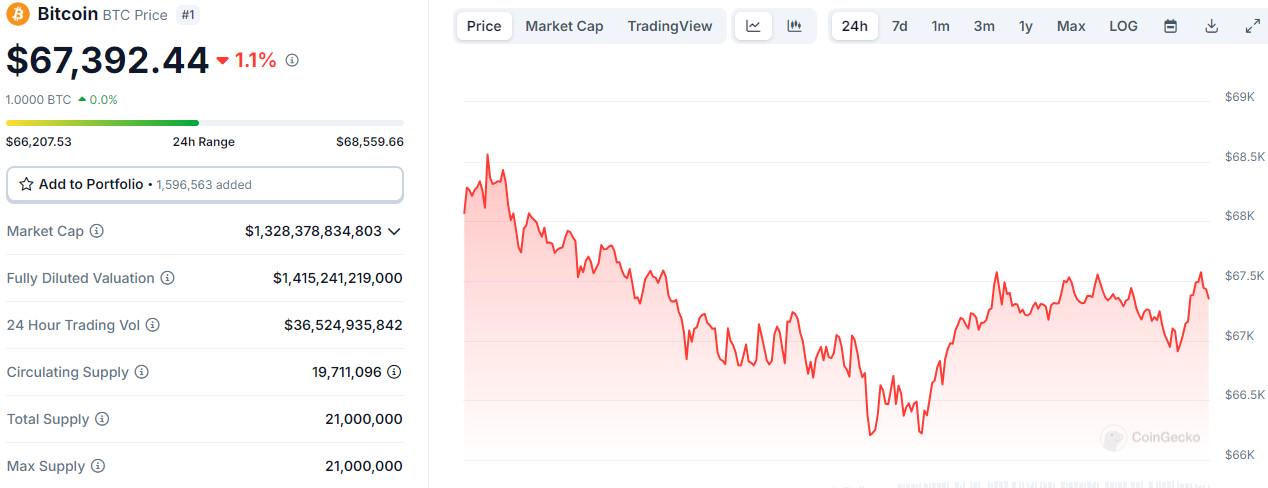
According to Coingecko data, although Bitcoin has rebounded to around $67,000 at the time of writing, it still shows a 24-hour decline of 1.1%. Altcoins have seen even steeper corrections, with the Coindesk 20 Index down more than 6%. All 20 cryptocurrencies within the index registered broad declines—Ethereum fell below $3,500 (down 6.5%), while Solana (SOL), Dogecoin (DOGE), Cardano (ADA), and Chainlink (LINK) declined between 6% and 9%.
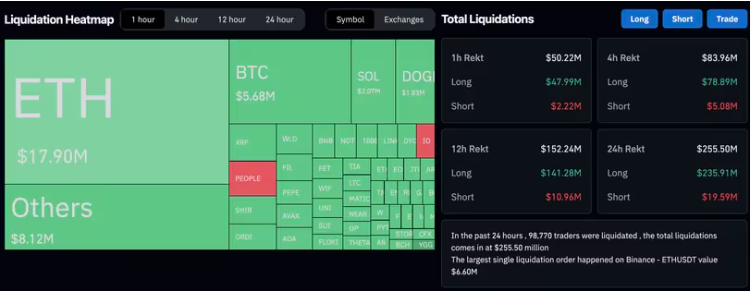
Clearly, the sudden market pullback caught investors off guard. When traders fail to meet margin requirements or lack sufficient funds to maintain their positions, exchanges may forcibly close leveraged positions, resulting in partial or total loss of initial capital—known as liquidation. According to Coinglass data, over $250 million in leveraged derivative positions across the entire crypto market were liquidated this morning, mostly long positions. This marks the second major wave of leverage liquidations within a week, following last Friday’s $400 million wipeout. Total network-wide liquidations have since slightly decreased to $219 million.
Industry analysis: Despite macroeconomic turbulence, lower crypto volatility may signal future upside
Within the cryptocurrency industry, sentiment is not overly pessimistic despite current macroeconomic confusion. Overall, while the environment appears somewhat chaotic, several fundamental indicators remain strong:
1. On-chain data shows Ethereum's user base continues to grow, with active addresses and new address creation reaching relatively high historical levels—potentially signaling long-term network health and growth potential;
2. In terms of on-exchange capital flows, stablecoin holdings on exchanges—often considered a safe-haven asset—have sharply declined, suggesting renewed market confidence. Investors may be redeploying funds from risk-off观望 modes back into higher-risk assets in pursuit of better returns;
3. On the macro front, the Personal Consumption Expenditures (PCE) index released on May 31 came in at 2.8%, similar to CPI expectations. This figure appears already priced in by the market and is unlikely to shift the Fed's current wait-and-see stance. As long as rate cuts aren't imminent, there remains underlying momentum for markets to rise. Until inflation shows clearer improvement, markets will likely continue pricing in prolonged higher rates.
Additionally, some institutional investors remain optimistic about continued upward momentum in the crypto market.
Singapore-based crypto investment firm QCP Capital believes that despite short-term pressure and risk-averse trends, this remains a good opportunity to accumulate crypto assets. Positive catalysts include the expected launch of spot Ethereum ETFs and verbal sparring between Biden and Trump competing for pro-crypto voter support. Recent downward pressure in the crypto market can be attributed to several factors:
1. Stronger-than-expected U.S. nonfarm payrolls data pushed up Treasury yields, removing market expectations for rate cuts in July and September;
2. French President Macron's call for snap elections triggered a sharp drop in the euro against the dollar, strengthening the greenback and fueling risk-off sentiment;
3. Market caution ahead of the CPI report and the FOMC meeting;
4. A $64 million outflow from Bitcoin ETFs on Monday, possibly reflecting traders reducing exposure before key events.
Another research firm, K33 Research, noted in its Tuesday market analysis that Bitcoin may see frequent fluctuations recently due to the crypto market being "highly sensitive" to recent economic data and "highly correlated" with U.S. equities. Their data shows bullish offshore traders’ Bitcoin positions over the past two weeks are currently underwater, exposing the market to potential long squeezes. Meanwhile, after the record-setting 19-day streak of net inflows into U.S. spot Bitcoin ETFs ended, Bitcoin’s correlation with U.S. stocks has reached an 18-month high. Last week, Bitcoin’s 30-day correlation coefficient with the Nasdaq rose to 0.64—the first time since 2022 it has exceeded this level.
Is the crypto market entering the "preparation phase" of the next bull run?
Currently, market expectations in the cryptocurrency space are primarily driven by shifts in monetary policy, and signs suggest the market may be entering the preparatory stage of the next bull cycle. Zoe Zhou, Deputy Chief Operating Officer at Victory Securities, said rising prices combined with inflows from off-chain capital (ETFs) and stable on-chain holding behaviors may now be reinforcing each other, becoming key drivers for upward price movements and increased volatility. Key areas of focus going forward include:
1. When the Fed will begin cutting rates, and how the expectation gap around 300,000 nonfarm payroll gains might accelerate timing.
2. Recovery of legacy DeFi projects following approval of Ethereum ETFs, and the expectation gap stemming from overly bearish sentiment toward ETH ETFs.
3. The divergence between shifting investor sentiment on Bitcoin ETF inflows and underlying fundamentals in the digital asset market.
4. The gap between macroeconomic trends and actual market reactions.
Overall, this week’s correction in the crypto market has not derailed the broader positive trend. Some market observers point out that certain positive signals emerging during the sell-off may indicate a swift recovery ahead. In fact, Fed Chair Powell hinted two months ago at a Stanford Graduate School of Business forum that most FOMC members believe it will be appropriate to lower policy rates at some point this year. However, the committee still needs greater confidence that inflation is sustainably moving toward the 2% target. Cutting too early or too late both carry risks, and it is still too soon to determine whether recent inflation readings represent only temporary fluctuations.
On another note, as other countries around the world continue lowering rates, the U.S. may find it increasingly difficult to ignore such global trends. Bitcoin appears to be gradually pricing in the impact of potential Fed rate cuts. Anonymous crypto analyst Gumshoe pointed out on X that Bitcoin has previously corrected multiple times ahead of FOMC meetings this year. As shown in the chart below, pullbacks during the four prior meetings reached 10%, 11%, 10%, and 4% respectively—but each time, the downtrend was quickly reversed shortly afterward.

As QCP Capital wrote in its report: “This dip presents a solid buying opportunity.”
Join TechFlow official community to stay tuned
Telegram:https://t.me/TechFlowDaily
X (Twitter):https://x.com/TechFlowPost
X (Twitter) EN:https://x.com/BlockFlow_News
 PANews











