
Awakening Billions of Dormant BTC: Asset Management and Yield-Generating Investment Strategies
TechFlow Selected TechFlow Selected
Awakening Billions of Dormant BTC: Asset Management and Yield-Generating Investment Strategies
Whether in BTC LRT, CeDeFi, or DeFi, the Cobo MPC solution opens multiple high-return and risk-controlled yield opportunities for Bitcoin holders, maximizing the unlocking of Bitcoin's intrinsic value.
 Navigating Web3 tides with focused insights
Author: Cobo Global
Background
As the oldest and first-generation cryptocurrency, Bitcoin's market is more top-heavy compared to Ethereum. Early participants in the crypto economy—longtime Bitcoin holders—have experienced countless bull and bear cycles and witnessed the rise and fall of various investment tools. Repeatedly "wiped out" in market downturns, they've come to understand the extreme risks associated with crypto assets. As a result, these veteran Bitcoin whales tend to adopt conservative investment philosophies and exhibit high levels of risk aversion.
On the other hand, to ensure security and decentralization, the Bitcoin network has made trade-offs in scalability and programmability. These limitations constrain its potential for expansion and hinder its ability to attract developers. As a peer-to-peer electronic cash system, Bitcoin’s blockchain cannot support the deployment of new financial applications like Ethereum can, making it difficult to serve as an ideal financial infrastructure.
This results in a very limited range of financial products available to investors within the Bitcoin ecosystem. Existing offerings are often too simple and actively managed, lacking sophisticated structural designs or risk hedging strategies, thus failing to meet investors’ diverse needs for returns and risk management.
A widely circulated meme about Bitcoin sharply highlights this issue: “As an investment asset, Bitcoin seems to offer no alternative but long-term holding (‘hodl’).” This meme underscores a key truth: while Bitcoin is a powerful store of value, it still has significant room for growth in terms of functionality and use cases in the realm of financial asset management.

Demand for Yield Fuels New BTC Staking Models
The Bitcoin ecosystem urgently needs new sources of yield, especially after the Bitcoin halving.
This stems primarily from two demands.
First, miner revenues have significantly decreased. After Bitcoin’s fourth halving, block rewards dropped to 3.125 BTC. At current prices and electricity costs, miners’ shutdown price is around $55,000—far higher than last year’s $14,300. According to The Block Pro data, May’s BTC miner revenue fell 46% month-on-month (due to the fourth halving), reaching $963 million. If Bitcoin’s price does not rise substantially, miner profits will plummet; if prices fall further, miners may struggle to break even and be forced to shut down. Therefore, finding new revenue models for miners has become a driving force behind the sustainable development of the BTC ecosystem.

Data source: The Block Pro
Additionally, early BTC holders possess large amounts of idle assets and urgently need yield-generating investment channels. According to DefiLlama data, the single-sided BTC yield market exceeds $10 billion, with a significant portion earning extremely low yields through centralized service providers. This reflects strong market demand for safe, risk-free yield opportunities on idle BTC holdings.
Against this backdrop, we’ve seen explosive growth in Bitcoin Layer 2 solutions. A surge of Bitcoin scaling projects and new BTC-based initiatives has emerged rapidly.
DefiLlama data shows that by 2023, the number of Bitcoin scaling projects had surpassed 60, with total value locked (TVL) across Bitcoin, bridges, and scaling solutions exceeding $12 billion. This marks Bitcoin’s transformation from a single asset into a more dynamic ecosystem, fostering broader application scenarios, innovation, and investment opportunities.
BTC Staking is considered a highly promising and rational avenue. As a mature yield model fully validated within Ethereum’s EigenLayer module, once introduced into the Bitcoin ecosystem, it would enable Bitcoin to connect with a wider decentralized ecosystem, providing security support for other PoS chains or Layer 2 networks. Leveraging Bitcoin’s superior security consensus, BTC Staking could achieve higher security and decentralization than Ethereum staking. By reusing existing infrastructure and combining emerging innovative technologies such as EigenLayer and AVS, BTC Staking can unlock entirely new economic profit models and inject fresh revenue streams into the entire ecosystem.
BTC Asset Management: Three Major Yield Strategies for BTC
Currently in the crypto market, stable and secure yields mainly come from three sources: Staking, CeDeFi rate arbitrage, and DeFi:
Staking refers to passive income generated by holding cryptocurrencies and participating in their consensus mechanisms. The most typical example is Ethereum’s PoS staking, where users stake ETH and validate transactions to earn passive rewards. Staking yields are relatively stable and require minimal active management, though returns are also comparatively limited.
CeDeFi rate arbitrage involves exploiting interest rate differences between centralized finance (CeFi) and decentralized finance (DeFi) systems to conduct profitable interest rate arbitrage trades. CeDeFi arbitrage strategies combine CeFi’s security with DeFi’s flexibility, allowing users to leverage CeFi’s deep liquidity to execute profitable delta-neutral interest rate arbitrage, achieving substantial returns while maintaining relatively controllable risk.
DeFi broadly refers to income opportunities arising from innovative applications in emerging decentralized financial ecosystems, such as PointsFi user dividends, liquidity mining, yield aggregation, and others. These novel yield models often stem from community participation and incentive mechanisms, carrying uncertainty but also the potential for outsized returns.
Although all these models have been successfully validated on Ethereum and are naturally suited to permissionless blockchains, they are difficult to implement on Bitcoin due to its non-Turing completeness and scripting language limitations. The most effective solution would be upgrading Bitcoin’s underlying architecture—such as enabling OP Codes like OP_CAT—to support advanced functionalities and enable truly decentralized on-chain settlement.
But until then, are there any secure solutions that can introduce these three mainstream yield-generation models into the Bitcoin ecosystem while ensuring asset security?
In fact, Multi-Party Computation (MPC) technology can be used to build diversified yield strategies based on BTC—including BTC LRT fixed income, CeDeFi arbitrage gains, and various mining yields applicable across broader DeFi use cases.
MPC is a technique that enables multiple parties (each possessing private data) to jointly compute and verify results without revealing individual private information. In practice, each participant holds a segment of an encrypted private key, and these fragments are collectively used to execute secure transactions or operations.
In an MPC setup, the private key is split into parts and distributed among participants. When a transaction needs authorization, a predefined number of these participants or nodes must contribute their key fragments to sign the transaction. This ensures no single party can unilaterally control the transaction. The final digital signature is verified using the public key, confirming authenticity without exposing any individual key fragment.
MPC is particularly useful for cross-chain transactions, which require multiple approvals before execution. It offers strong security advantages, including no single point of failure, flexible signing processes, and granular control over who can access and authorize transactions.
Notably, in this context, Cobo MPC is not a custodial service but a trustless technical solution applied to Bitcoin asset management.
We illustrate how Cobo MPC applies to three Bitcoin asset management strategies below:
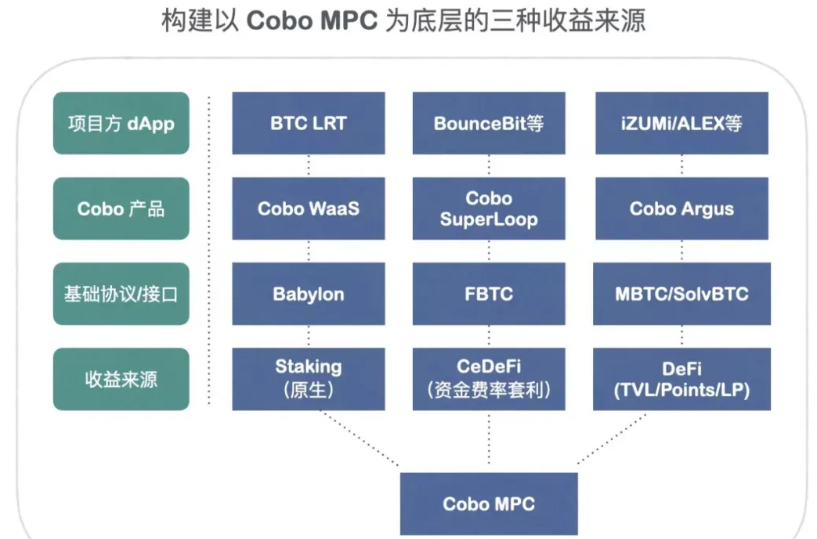
In the BTC LRT scenario, Bitcoin holders deposit BTC assets into Babylon to earn native BTC yield plus token incentives from other AVSs. Babylon is a decentralized, trustless Bitcoin staking protocol that leverages a shared-security open market to allow staked Bitcoin to provide security for PoS chains and Layer 2 networks, thereby extending Bitcoin’s security to other chains. In return, Bitcoin holders receive yield. Unlike centralized solutions, Cobo MPC provides Bitcoin holders with independent wallet addresses and employs a 2-of-3 threshold signature scheme to manage BTC—where two out of three private key shards are controlled by the user. Only when at least two shards approve can an operation proceed, protecting user assets from both external and internal threats. Even if one key shard is compromised, the assets remain secure, maximizing overall safety.
Under the CeDeFi model, Bitcoin holders do not need to directly entrust their assets to exchanges. Instead, they can use secure technologies like Cobo MPC to establish a dedicated, isolated OTC custody and settlement network between themselves and the exchange. Users lock their Bitcoin within this isolated network, where it is 1:1 mapped to exchange-side tokens. These mapped tokens can then be deployed into CeDeFi activities—such as delta-neutral interest rate arbitrage across markets—to capture yield spreads. Meanwhile, the actual Bitcoin remains securely stored in cold wallets completely segregated from the exchange. Only necessary fund movements occur between the custody platform and exchange accounts—for example, settling trading P&L or paying fees—and users can set their own settlement cycles and track earnings. This model maximizes Bitcoin asset security while enabling holders to generate substantial returns via CeDeFi.
In broader DeFi applications, Bitcoin holders can use Cobo MPC to deposit BTC and mint an equivalent amount of mBTC tokens on the Merlin protocol, then deploy these mBTC tokens into various liquidity pools offered by decentralized exchanges like iZUMi. Based on preset rules from the Cobo Argus risk management system, users can personalize their investment strategies and manage risk exposure to earn low-risk returns.
Whether in BTC LRT, CeDeFi, or DeFi, Cobo MPC solutions open multiple high-return, risk-controlled income avenues for Bitcoin holders, maximizing the intrinsic value of Bitcoin.
Looking ahead, beyond crypto assets, Cobo could even incorporate traditional assets such as ETFs into its asset management scope. Since MPC technology ensures users retain ownership and control over their assets, ETF holders in the future could leverage this technology to store physical ETF assets in custodial wallets, with MPC managing their participation in liquidity mining, staking, and other yield-generating operations—enabling interest-bearing appreciation.
Join TechFlow official community to stay tuned
Telegram:https://t.me/TechFlowDaily
X (Twitter):https://x.com/TechFlowPost
X (Twitter) EN:https://x.com/BlockFlow_News
 Cobo
Cobo