The Role and Impact of Actively Validated Services (AVS) in Ethereum
TechFlow Selected TechFlow Selected
The Role and Impact of Actively Validated Services (AVS) in Ethereum
EigenLayer is building a new Ethereum ecosystem that is rapidly expanding based on restaking.
 Navigating Web3 tides with focused insights
Author: Bedrock
Translation: Baihua Blockchain
Over the past two to three years, Ethereum's transition from Proof-of-Work (PoW) to Proof-of-Stake (PoS) has been highly anticipated, bringing some positive news to investors during the crypto winter. Even prior to these upgrades toward PoS systems, the Ethereum Foundation and community had continuously built and refined the network through multiple improvements and hard forks, achieving what we see today.
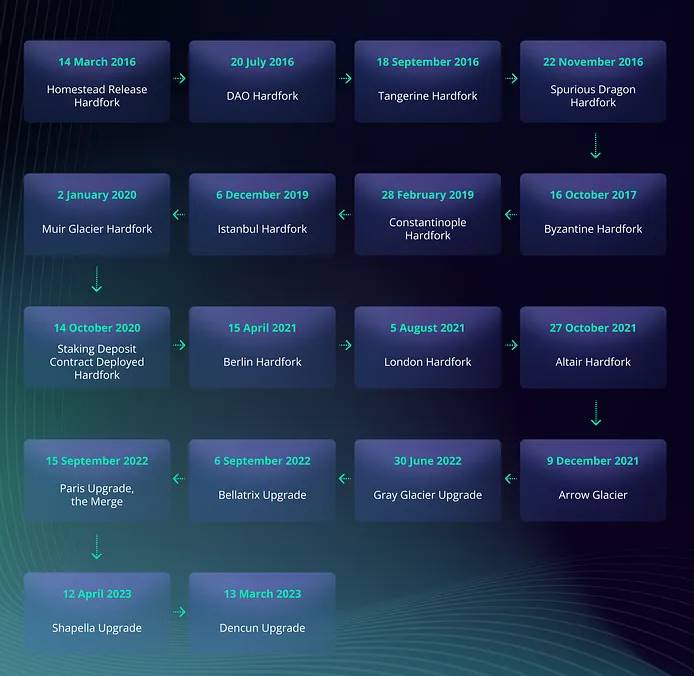
Ethereum's historical hard forks and network upgrade roadmap
Ethereum’s shift to a Proof-of-Stake (PoS) model marks a revolutionary advancement in blockchain technology, emphasizing energy efficiency and operational effectiveness, with security efficiency reaching 99.95%, according to the Ethereum Foundation. By allowing holders who own and are willing to "stake" a certain amount of ETH to validate transactions, PoS not only strengthens network security but also enhances scalability. Since then, we have seen the emergence of EigenLayer’s Restaking mechanism, which rapidly climbed to the top ranks of Total Value Locked (TVL), reaching an astonishing $15 billion at the time of writing. This process enables ETH stakers to effectively "reuse" their assets by validating Ethereum and other trusted networks. However, these networks must be compatible with EigenLayer and are known as Active Validation Services (AVS).
1. About AVS
Currently, there are 13 active AVSs (Active Validation Services) listed on EigenLayer’s ecosystem page. For existing DeFi dApps aiming to become valid AVSs and accept restaked ETH via EigenLayer, a series of rigorous procedures must be followed. However, once successful, developers can leverage Ethereum’s security layer and focus their efforts on developing other aspects of their products.
Unlike traditional staking or liquid staking, ETH restaked through EigenLayer benefits not only Ethereum blockchain protection but also secures listed AVSs (Application Validation Services). Since the M2 upgrade, AVS operators responsible for network security can choose which AVS to validate. Additionally, restakers can select which operator to delegate their ETH to. This flexibility allows restaked ETH to ensure network security while meeting participants’ personalized needs.
2. The AVS Ecosystem
Before proceeding, let’s clarify some key terms that often confuse those less familiar with EigenLayer.
Active Validation Service (AVS): As previously mentioned, these are dApps that gain access to restaked ETH through EigenLayer’s onboarding process.
AVS Operator: Individuals or institutions that operate penalizable nodes to support AVSs and receive predetermined rewards.
Validator: Nodes that may face penalties and form the infrastructure supporting EigenLayer’s restaking operations.
Essentially, validators operated by AVS operators help AVSs benefit from EigenLayer. In this tightly interwoven ecosystem, trust networks can benefit from Ethereum’s robust security layer. As the largest PoS chain, Ethereum is nearly immune to 51% attacks, which would cost approximately $34 billion to execute.
In their whitepaper, EigenLayer aims to address four pain points in building trust networks:
-
1) Launch (accessing capital)
-
2) Value leakage
-
3) Capital costs
-
4) Low trust (dApp security)
Launch — Trust networks operating on certain validation systems require participants to set up nodes to validate the network and pledge network tokens as stake. For developers, launching becomes problematic as they need to attract operators to set up nodes, purchase tokens, and stake them. This consumes time and effort that could otherwise be used for product development.
Value Leakage — In each trust network setup, users must pay fees to validate transactions beyond Ethereum when using these networks.
Capital Costs — Validators weigh the opportunity cost of validating a new network with high price volatility and uncertain returns against lower-yielding but relatively stable Ethereum. New networks must offer sufficiently high returns to attract validators, sometimes leading to expenditures exceeding data storage and network costs.
Low Trust — dApps rely on technical stacks such as the trust networks they’re built on and oracle networks. These layers can become attack vectors, increasing risk when lower stakes secure middleware and trust pools. Imagine a dApp built on Ethereum but relying on an oracle network valued at $1 million. An attacker could execute a 51% attack on the oracle network for just $510,000, compared to the $38 billion required to attack Ethereum.
For the Ethereum ecosystem, it benefits from more resilient and secure dApps, further enriching its already vibrant ecosystem. In fact, restaking has introduced a new wave of DeFi innovation known as "LRTfi." These are various protocols built atop EigenLayer’s technology, further benefiting Ethereum users. For example, ETH liquid restaking services like those offered by Bedrock allow users to restake ETH without losing liquidity. From there, rewards and additional yields across the ecosystem can be generated via protocols like Pendle.
As AVSs continue to build on Ethereum through EigenLayer, more value brought by these AVSs is introduced and aggregated into the chain’s base layer, eliminating the need for operators and users to choose between networks, while bringing greater value to stakers.
3. The Concept and Operation of AVS
AVS candidates include modules that cannot be directly deployed on Ethereum, such as oracle networks, guardian networks, data availability layers, and cross-chain bridges. To leverage Ethereum’s security, EigenLayer provides infrastructure so Ethereum node operators can adopt these modules. AVSs must list software requirements and deploy software for potential AVS operators to download, and must deploy a smart contract detailing penalty terms and payment structures.
AVS Operators are validators running Ethereum nodes who choose to support AVSs through EigenLayer. They enable native Ethereum staking by changing withdrawal credentials to EigenLayer’s smart contract.
AVSs can design their own consensus mechanisms (e.g., PoS, PPoS, DPoS) but can rely on these AVS operators to run nodes and secure their trust networks. This means trust networks enjoy enhanced security, while project teams can focus more resources on developing intended functionalities. Additionally, this reduces value leakage from the Ethereum network, as stakers and validators no longer need to choose between Ethereum and other projects. In return, stakers and validators earn higher yields from their staked ETH, as AVSs reward participants securing their networks.
4. Security and Risks Behind AVS
EigenLayer’s TVL of up to $15 billion has sparked discussions, with some questioning potential risks that excessive growth might lead to a sharp decline in TVL. Some propose solutions like increasing security budget requirements, but many believe the best remedy is increasing utility or introducing more AVSs. However, as this is an emerging innovation, it's difficult to accurately assess whether this will become an issue and what possible solutions might exist.
The proposal-builder-separation design aims to prevent centralization risks caused by staking, but since AVS operators can serve as many AVSs as possible, staking goes beyond this solution. Increasing the combination of AVS services can boost validator earnings, thereby increasing payouts to delegators. However, providing operational services isn't as simple as "clicking buy/sell" on Robinhood.
Operators must make trade-offs, researching the risks and returns of running AVSs, requiring investment of funds and resources. Operators need to market their services to attract delegators, which also requires funding and resources. Operators must manage full operations of AVS nodes, again consuming resources and capital. Operators with stronger teams and expansion capabilities can handle more services, earn higher returns, and attract more delegators. Moreover, delegators prefer to delegate to operators that appear more mature and well-funded. This leads to staking concentration among a few validators, creating centralization risks.
Operators need to quantify and consider the security of provided AVSs to understand risk-adjusted returns. Considered risks include maximum penalty amounts an AVS might face, liquidity risks of AVS tokens, marginal costs, and risks posed to other AVSs by taking on more services. Some suggest applying principles of the Sharpe ratio.
Enzo Protocol suggests identifying the maximum possible loss for serving a specific AVS—for example, a 2% penalty due to downtime and a 7% penalty due to double-signing—resulting in a maximum loss of 7% for serving that AVS. The sum of all maximum losses provides a concept of staking risk involved in securing multiple AVSs.
On the other hand, the total return from this AVS portfolio minus infrastructure costs for operations can be viewed as excess return. Excess return minus maximum loss risk can roughly estimate punishment-risk-specific risk-adjusted returns.
This example illustrates the risks AVS operators must consider when taking on more services.
As a leading blockchain infrastructure provider, RockX is committed to transparency and decentralization. As an AVS operator, we are fully dedicated to security and take pride in being responsible and transparent to our users.
5. The Future of AVS
In EigenLayer’s mainnet announcement, they discussed future developments and a phased rollout plan, mentioning the creation of tools to facilitate smooth onboarding and integration for AVSs.
With the launch of EigenDA, EigenLayer plans to lay the foundation for its vision, as operators register and begin opting into EigenDA. EigenLayer mentioned that many new AVSs are in preparation and ready to launch. This implies better innovation in the field, as teams can reduce focus on protocol launches and concentrate on delivering innovative solutions. As EigenLayer continues evolving, more features will roll out to ease AVS onboarding and improve the ecosystem.
6. Solutions Behind AVS
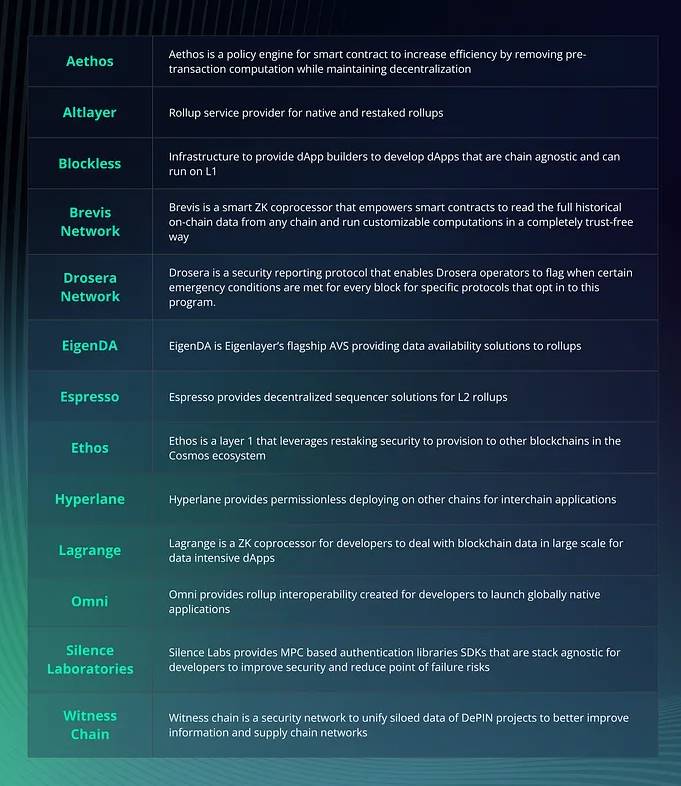
These AVSs bring numerous innovative solutions and middleware to developers, aiming to introduce more applications to the field. EigenLayer provides infrastructure addressing the four major issues faced by these trust networks. These trust networks can now freely focus on their solutions, such as decentralized sequencers, coprocessors, or secure reporting. Overall, these AVSs provide middleware solutions enabling dApps to develop safer, more efficient, interoperable, and decentralized products.
As an official AVS operator, RockX proudly supports EigenDA and Brevis coChain AVS. Just as becoming an AVS early in EigenLayer’s development required significant preparation, becoming an AVS operator demands thorough readiness. All hardware and software requirements are listed on EigenLayer’s documentation page. In short, operators must at minimum meet delegation and system requirements and comply with protocol service-level agreements (SLA).
A simpler approach is delegating ETH to existing AVS operators like RockX. With over 13,300 validators and nearly 426,000 staked ETH, RockX is a leader in the native restaking community. Furthermore, RockX boasts an impressive zero-penalty record, offering greater peace of mind when delegating to its validators. Our previous blog on the EigenLayer M2 upgrade may provide clearer insights into AVS operators and EigenLayer’s specific operations.
1) Brevis coChain AVS
In April 2024, Brevis announced the mainnet launch of Brevis coChain AVS, with 29 operators choosing to join. RockX is proud to be one of these 29 operators.
Brevis is an intelligent ZK coprocessor enabling smart contracts to read full historical on-chain data from any chain and run customizable computations in a fully trustless manner. Brevis coChain introduces a new "proposal-challenge" ZK coprocessor model. In this model, proposers can generate and submit coprocessing results on-chain without completing the entire ZK proof computation. Brevis coChain is a PoS network accepting coprocessing requests from smart contracts and optimistically generating coprocessing results via PoS consensus. These PoS-generated results are submitted on-chain as "proposals" and can be challenged via ZK proofs. If no challenge is initiated, results can be directly used by dApps without incurring ZK proof generation costs. Brevis coChain AVS has launched on mainnet alongside EigenLayer, introducing a new ZK coprocessor architecture combining cryptographic-economic security and zero-knowledge proofs into one model.
As a node operator for Brevis coChain AVS, RockX will perform coprocessing alongside other operators, leveraging EigenLayer’s restaking infrastructure to generate optimistic results for requests from smart contracts and dApps. The collaboration between Brevis coChain and RockX fully utilizes Ethereum’s security and decentralization while significantly reducing costs, lowering latency, and improving scalability.
"We are thrilled to partner with Brevis to bring more innovation to the blockchain world. This collaboration will make the Ethereum ecosystem stronger, more efficient, and easier to use. By combining Brevis’s cutting-edge technology with RockX’s reliable infrastructure, we can help developers create better, more secure applications. This partnership represents a significant step forward for us, and we look forward to seeing its positive impact on the broader blockchain community," said RockX CEO Chen Zhuling.
2) RockX Native Restaking Solution
As a top-ten operator by Total Value Locked (TVL), RockX has invested heavily in the restaking space. As an experienced staking service provider, they currently offer staking solutions for over 20 PoS blockchains. With extensive experience accumulated in the crypto industry since 2017 and a team of professionals, investors can confidently delegate their assets to them. Additionally, well-known crypto institutions like Amber Group are long-time clients of RockX. Combined with their advantage of a zero-penalty record, you get a reliable restaking solution.
In their April post, they revealed recently surpassing $11 billion in staked ETH and further expanding their staking solutions to include Bitcoin.
7. Conclusion
AVSs can be any trust network requiring protection. Many include middleware utilized by dApps for functionality and building user-facing products. As EigenLayer introduces a method to solve a major pain point for these trust networks, teams can focus more energy on delivering innovative and secure solutions.
In shaping the future of permissionless innovation and with the emergence of AVS solutions (beyond EigenDA), RockX fully supports this initiative. As an AVS operator and one of the leading multi-asset restaking protocol providers, we are excited about opportunities in restaking/staking utility and remain steadfast in our commitment to decentralization and security, continuously supporting the AVS community.
Join TechFlow official community to stay tuned
Telegram:https://t.me/TechFlowDaily
X (Twitter):https://x.com/TechFlowPost
X (Twitter) EN:https://x.com/BlockFlow_News