
Numbers Tell the Story of Base Chain: Consumer-Grade Apps Emerge—Beyond the Meme Hype, Which Projects Are Worth Watching?
TechFlow Selected TechFlow Selected
Numbers Tell the Story of Base Chain: Consumer-Grade Apps Emerge—Beyond the Meme Hype, Which Projects Are Worth Watching?
This article explores the growth story of Base and its vision for the future of on-chain applications.
 Navigating Web3 tides with focused insights
Authors: Pillarbear & ISKRA
Translation: TechFlow
Key Takeaways
-
Base, launched its mainnet last June with the mission of bringing more users onchain. Through branding and marketing campaigns focused on community, creators, and developers, it has become a hub for consumer-facing dApps in less than a year.
-
Recent surges in user activity and transaction volume on Base stem from market factors such as reduced rollup fees due to EIP-4844 and meme-driven speculation, combined with internal drivers like the growth of the Farcaster community and increasing onchain applications.
-
Unlike other blockchain ecosystems primarily focused on DeFi and infrastructure, Base offers consumer-oriented applications similar to traditional Web2 services. This unique, community- and brand-driven approach has attracted a broader range of applications onto the chain.
-
Currently, Base’s ecosystem is growing fastest around social and community apps centered on Farcaster. However, new categories of onchain applications—spanning content, gaming, and commerce—are emerging, indicating broad potential for user expansion.
1. Introduction
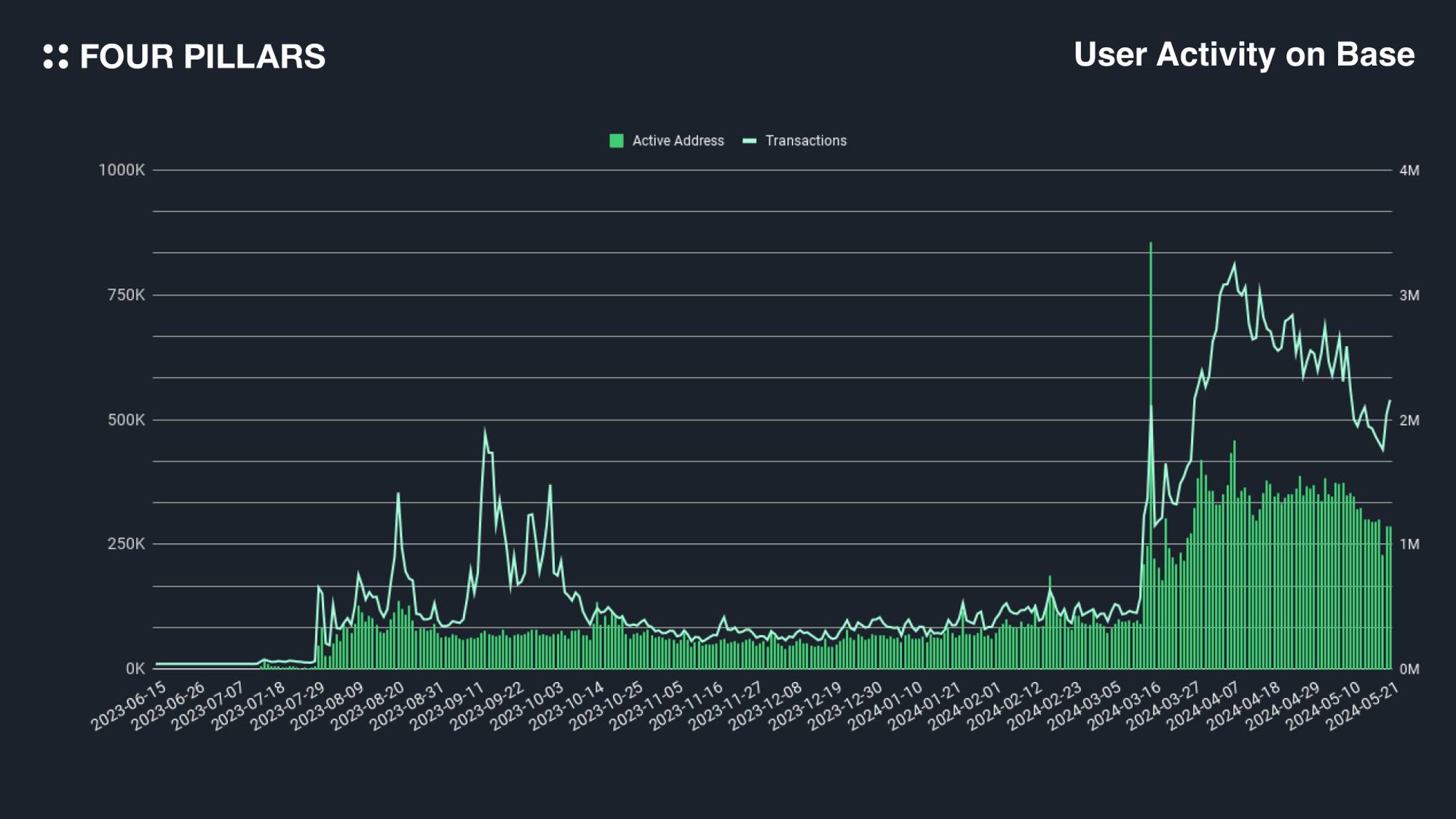
Despite launching its mainnet less than a year ago, Base has seen impressive growth and influence. The surge in user activity stems from multiple factors, including lower transaction fees via EIP-4844 implementation, meme-driven speculation, and the growth of the Farcaster community. Since the beginning of this year, transaction volume on Base has increased ninefold, while user numbers have quadrupled. While Base benefits from Coinbase's strong brand recognition and capable team, these alone don't fully explain its success. Similarly, technical advantages or platform-specific features are insufficient to account for Base’s achievements. Currently, Base is an OP Stack-based Layer 2 blockchain developed in collaboration with OP Labs, making its functionality largely equivalent to Optimism or other OP Stack forks.
Onchain applications within the Base ecosystem also differ significantly from those on other chains. Unlike ecosystems dominated by DeFi, Base centers on social networks built around Farcaster and retail-focused consumer applications. This article explores Base’s growth story and its vision for the future of onchain applications.
2. Origins
-
Mission: Bring One Billion Users Onchain
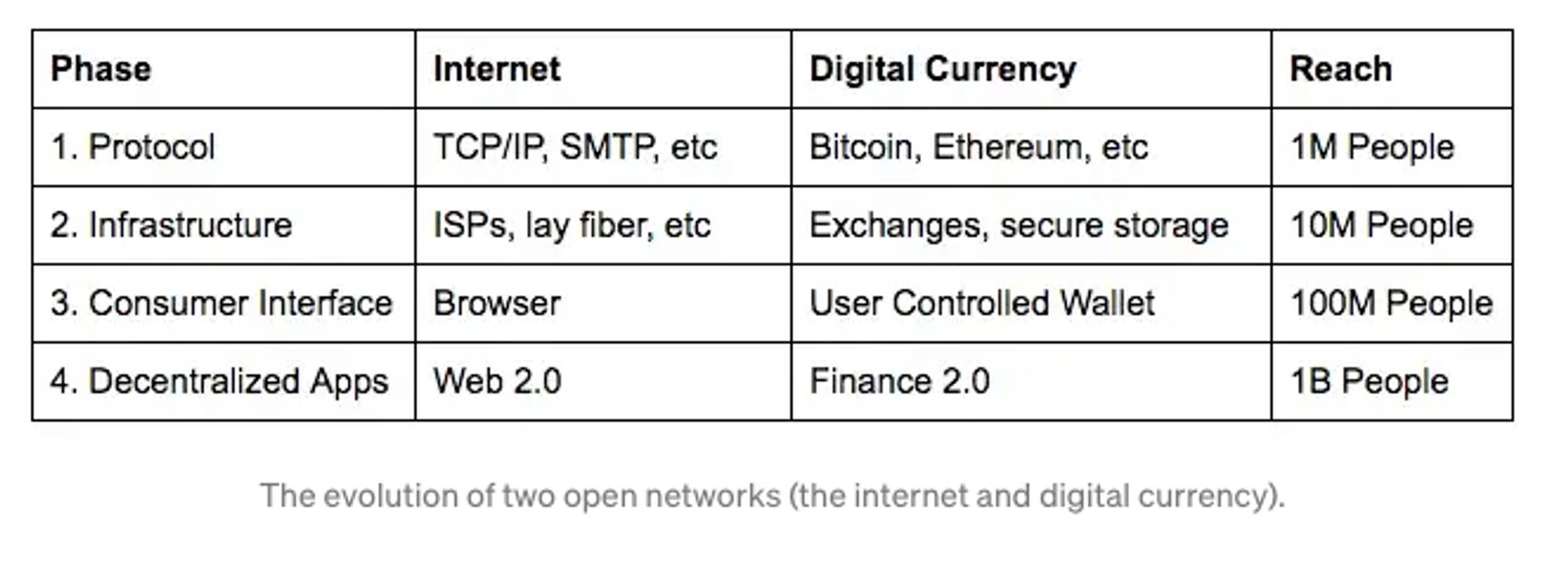
(Source: The Coinbase Secret Master Plan)
Base’s vision closely aligns with that of Coinbase. As early as 2016, when the concept of onchain products barely existed, Coinbase outlined a vision for an open economic system powered by cryptocurrency and set a milestone of bringing one billion users onto blockchains. At that time, the market was in its second phase—the “single-player mode”—and today we’re entering the third stage, marked by wallet activation and application development.
Base was created to propel the crypto industry into its next phase. Jesse Pollak, Base’s creator, stated they initially didn’t consider building a chain. Before creating what is now Base, the team went through several internal iterations experimenting with user-facing onchain services. After a year of operation, they tried four different services—including an onchain app marketplace and user identity service (the precursor to cb.id). While achieving minor successes, their impact remained limited. However, this process revealed that the infrastructure and tools for building onchain services were still weak.
This realization about poor infrastructure and lack of user-friendly services led directly to the creation of the current Base project. By launching its Layer 2, Base aims to achieve three primary goals:
-
Improve access to onchain services: Currently, the barrier for average users to directly utilize onchain services within the crypto ecosystem remains high. Base seeks to address this by providing a more accessible platform for engaging with onchain services.
-
Support developers: Frameworks and tools for building onchain services are far more limited compared to Web2 development environments. Base not only provides a Layer 2 blockchain but layers on various developer tools to make onchain development easier, enabling smoother participation in the Base ecosystem.
-
Expand Coinbase’s onchain offerings: Coinbase’s investment in Base allows it to actively support the platform’s growth, enabling the Coinbase team to build new onchain services more stably and expand its product base.
-
Built on OP Stack
(Source: Decentralizing Base with OP Stack and Optimism)
Base is an Ethereum Layer 2 chain built using the OP Stack. While newer chains like Solana have successfully established meaningful user bases and independent ecosystems, in 2022—when Base was conceived—it was clearly advantageous to build on Ethereum, which led in user and developer adoption. Choosing a Layer 2 solution also aligned with goals of scalability and low transaction fees. While the technical maturity of OP Stack was a major factor, Optimism’s decentralized governance structure played a crucial role in Base’s decision to partner with OP Labs.
Although OP Stack was considered the most refined technical solution at the time, Optimism’s commitment to decentralized governance was pivotal in Base’s collaboration with OP Labs. While Coinbase operates in crypto, it functions as a typical Web 2.0 organization—naturally centralized, skilled at fast and efficient decision-making. Yet, their ambition extended beyond launching another trading chain; they aimed to provide a foundation that many users and developers could trust securely. For them, decentralization isn’t just a slogan.
“Coinbase will gradually transition into a contributor to Base, offering services and products based on Base—we won’t be the sole decision-makers across all Base network operations. These decisions will instead be made through increasingly decentralized governance.” — Jesse Pollak, Creator of Base.
For years, Optimism has committed not only to decentralizing its rollup framework but also its chain governance—an effort that provided Coinbase with the organizational culture and operational foundation it lacked. Currently, both Coinbase and the Optimism Foundation jointly hold the authority to upgrade Base’s mainnet bridge and submit fraud proofs during dispute resolution. Though unlikely, if Coinbase attempts to maliciously alter the rollup chain, it could lose governance control over Base. Base should not be viewed merely as a customer or abstract partner of the rollup solution, but as an active collaborator co-developing and operating with the Optimism Foundation. Recent initiatives like the EIP-4844 upgrade supported by Coinbase and OP Labs, and ongoing development of op-geth—the client for OP Stack-based chains—demonstrate sustained research and cooperation beyond chain construction and governance.
-
A Call to Developers and Creators
From the outset, Base has targeted developers and content creators as its primary audience, consistently conveying the same message. Coinbase has a history of impactful marketing campaigns that emphasize value propositions over product features—such as “Update the System” and “Stand with Crypto.” Base effectively integrated Coinbase’s existing brand and DNA into this new initiative, leveraging it powerfully in marketing.
From announcing the Base mainnet at Onchain Summer, to collaborations like “Build on Base” with Prop House, the Superhack event co-hosted with Optimism and ETH Denver, and Zora’s release of the “Base, Introduced” NFT, Base established a distinct brand identity early on. Although most activities occurred before Base’s mainnet launch in August, they were sufficient to generate market anticipation and convey its intended message. Notably, the Onchain Summer campaign was highly successful, minting over 700,000 NFTs.
Even after the mainnet launch, Base continues running various programs for developers and creators. Currently, Base operates the Base Grants program, funding developer projects, and runs Base Bootcamp to help newcomers enter Web3. Additionally, it provides infrastructure like OnchainKit and Base Camp, offering libraries and tutorials essential for developers. Collaborations with content and service creators are also underway. Through the Mint A Penny project, they introduced token-based commerce experiences, and recently released a short film titled “Delivery at Dawn” alongside the EIP-4844 upgrade, which generated significant interest.
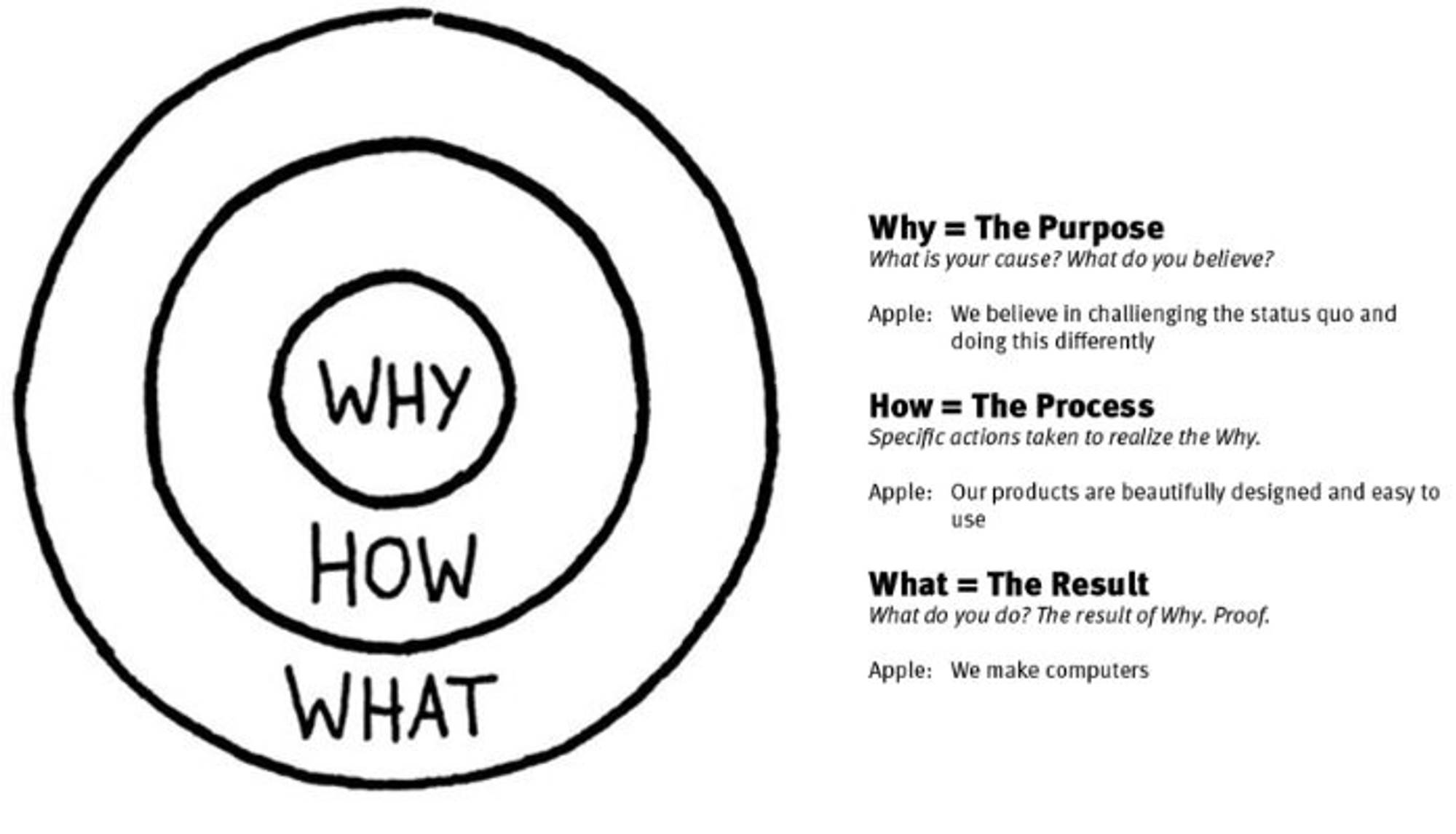
(Source: The Golden Circle)
Base’s approach vividly illustrates the Golden Circle concept, starting with a compelling “why,” forming the core of its operations. Base’s fundamental purpose is democratizing blockchain technology, making it accessible to builders and creators. This purpose drives every aspect of their work, aiming to inspire innovation and engagement within the crypto community. It’s not just about providing a platform—it’s about cultivating an ecosystem where the intrinsic desire to create and innovate is fully supported and encouraged. It’s worth noting that Base did not begin by building a blockchain. Base is the embodiment of its vision and mission—not only establishing itself as one of the leading rollups in terms of users and TVL, but also becoming a pioneering crypto brand looked up to by builders and creators.
3. Deep Dive into the Base Ecosystem
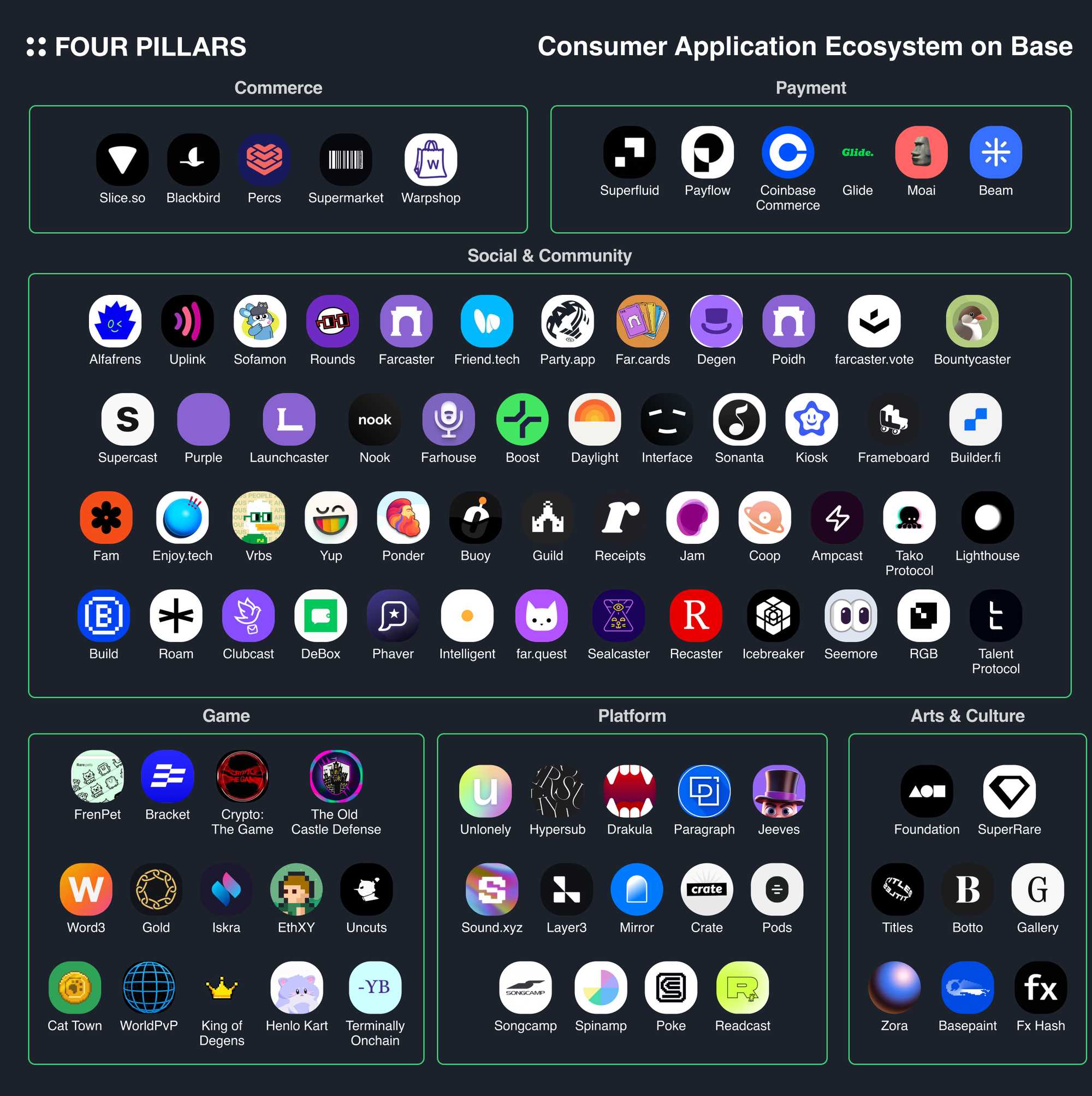
Despite being less than a year since mainnet launch, the Base ecosystem is rapidly emerging as a center for consumer applications. Unlike other blockchain ecosystems focused mainly on DeFi and infrastructure, Base supports diverse apps spanning social media, content, gaming, and commerce. These applications are actively developed and operated, delivering unique and engaging user experiences rarely seen in either Web2 or Web3. The diversity of the Base ecosystem is not just proof of a single rollup’s success—it serves as a practical demonstration of how onchain applications can become part of more people’s daily lives.
This chapter highlights promising consumer-facing projects within the Base ecosystem, categorized into social & community, content platforms, gaming, and commerce. Compared to other blockchain ecosystems, the categories of onchain apps on Base closely mirror those in Web2, underscoring its uniqueness. Additionally, numerous smaller and emerging projects within the Base ecosystem are not included here. Readers interested in exploring further can refer to the provided project database.
-
Social & Community
Social and community applications are central to driving growth in the Base and Farcaster ecosystems for consumer-facing use cases. These apps are crucial for attracting early users to the mainnet and generate ongoing demand for user interaction and transactions. In particular, apps like Friend.tech and Farcaster on Base achieved unexpected success, significantly influencing early user inflow.
Following Base’s mainnet launch last year, Friend.tech pioneered a new category known as SocialFi. The emergence of SocialFi led to large-scale applications surpassing revenues of L1 and L2 protocols, such as Blast’s Fantasy.top and Solana’s Pump.fun. Beyond SocialFi, applications focused on user interaction—resembling traditional Web2 social apps—also show high growth in user base and transaction volume. Farcaster is a prime example, focusing on features needed for stable and continuous community activity without direct transaction capabilities. Growth in the social and community sector distinguishes onchain social apps from traditional social networks through several key characteristics:
-
Interoperability between onchain apps:
Seamless interoperability between onchain applications delivers unique user experiences unlike traditional apps. Apps built on blockchains or protocols like Farcaster share user data and social graphs, enabling interconnected experiences across multiple services. For example, users can switch between different Farcaster clients, or comments made on Paragraph appear directly in Farcaster clients and vice versa.
Openness of data and networks acts as a lever, allowing onchain apps to overcome entry barriers caused by network effects and enabling diverse experiments. Unlike the Web2 environment, where user data and social graphs are strictly siloed, apps built on open protocols like Farcaster can port existing social graphs, overcoming bootstrapping challenges and focusing on UX and functionality.
-
Memecoins as a marketing strategy: Memecoins have recently drawn massive attention due to their high volatility and unusual price surges. Despite criticism over their value and ethics, they are clearly effective marketing tools for apps—especially social apps—to attract initial users and promote services. In the Base ecosystem, memecoins like DEGEN incentivize community activity among Farcaster users. Other effective examples include the BUILD token launched by talent platform Talent Protocol and the Onchain token by community platform Guild.
-
Gameified social networks and incentive mechanisms: Token-based incentives are vital for Web3 onchain apps and have evolved significantly. Moving beyond uniform rewards for all users, recent innovations introduce more sophisticated mechanisms. For instance, Blur launched a points and leaderboard system later expanded by Blast, while social apps and tokens on Base adopt token distribution strategies based on community contribution and game theory. These developments encourage users to compete and cooperate, strategizing to maximize economic gains. In this process, apps skillfully drive community engagement and desired behaviors, seamlessly integrating their services into user interactions.
-
Key Projects
1) Farcaster
Farcaster is a sufficiently decentralized social network protocol founded in 2020 by former Coinbase employees Dan Romero and Varun Srinivasan. Decentralization means any two users on the network can interact without needing permission from others. Farcaster operates as a protocol composed of smart contracts on the Optimism network, storing user accounts, posts (Casts), and reactions.
A notable feature of Farcaster is its open protocol model, differing from traditional Web2 social networks. Platforms like X and Facebook maintain a one-to-one relationship between protocol and client, prohibiting unauthorized third-party clients. Farcaster takes a different approach: it allows anyone to develop their own client that connects to its protocol, freely reading and writing data without operator approval. In this context, a client refers to the user interface used to post Casts or browse feeds.
Currently, Warpcast is the most popular Farcaster client and the only one developed and managed by the Farcaster team. Other third-party clients such as Supercast, Nook, Jam, and Ampcast are available, each offering unique user experiences or customized features. This open protocol model encourages innovation and continuous experimentation, contrasting with Web2 services that centrally control user data and social interactions.
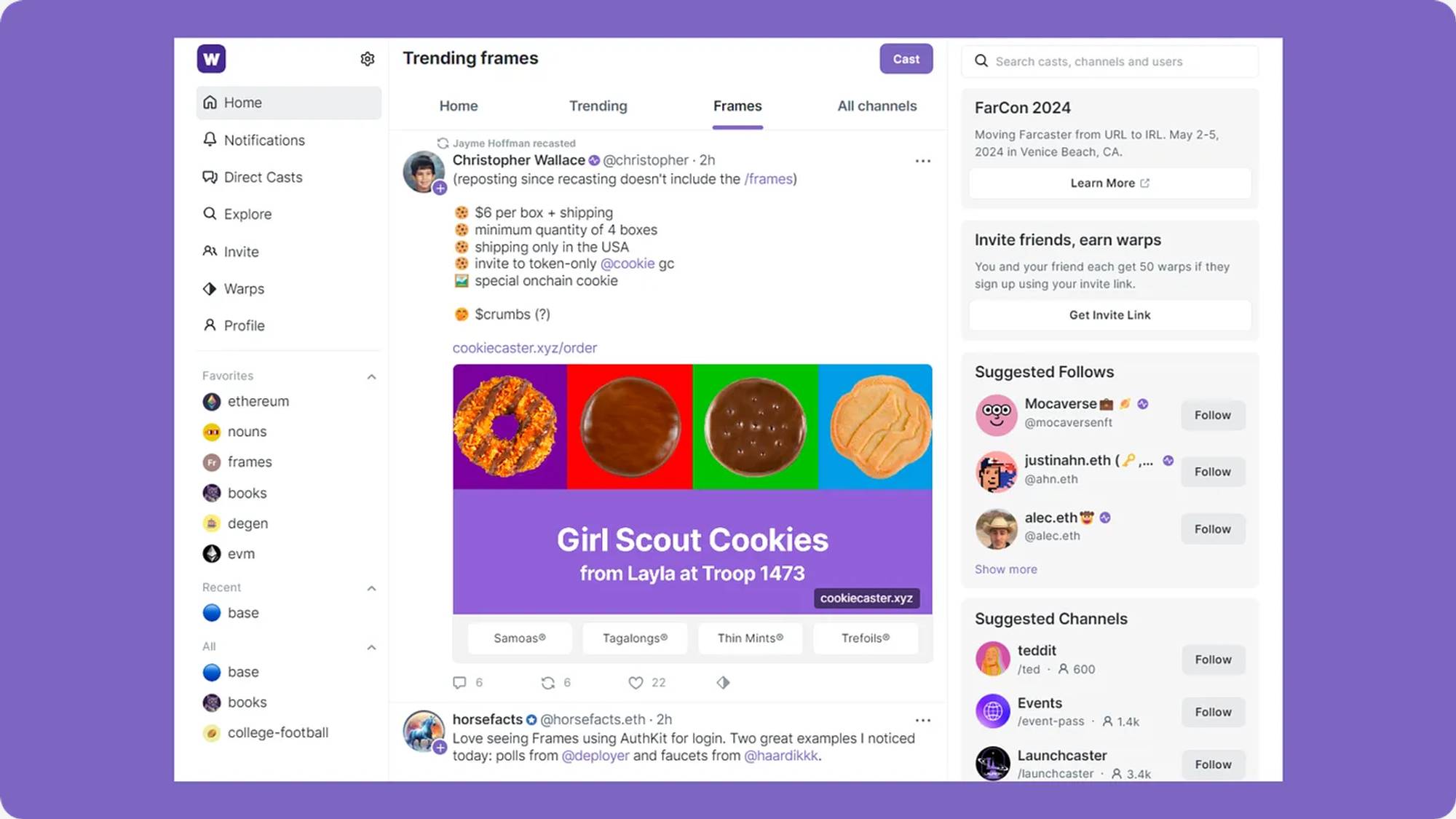
(Source: Farcaster Frames: The Crypto Game Changer)
The rapid growth in Farcaster’s user count this year is largely attributed to the introduction of the Frame feature. Frames allow users to run simple interactive apps within a Cast. The feature received widespread attention from the community and influencers due to its embodiment of core crypto values—openness and composability. While a Frame is essentially just an interactive button within a Cast, its significance goes much deeper. Frames lay the foundation for various experiments atop existing social graphs and protocols. Initially, experimental Frames like running Doom or selling Girl Scout cookies captured community interest. Today, the feature is mainly used to enhance user engagement, including NFT mints, mini-games, dashboards, or command bots.
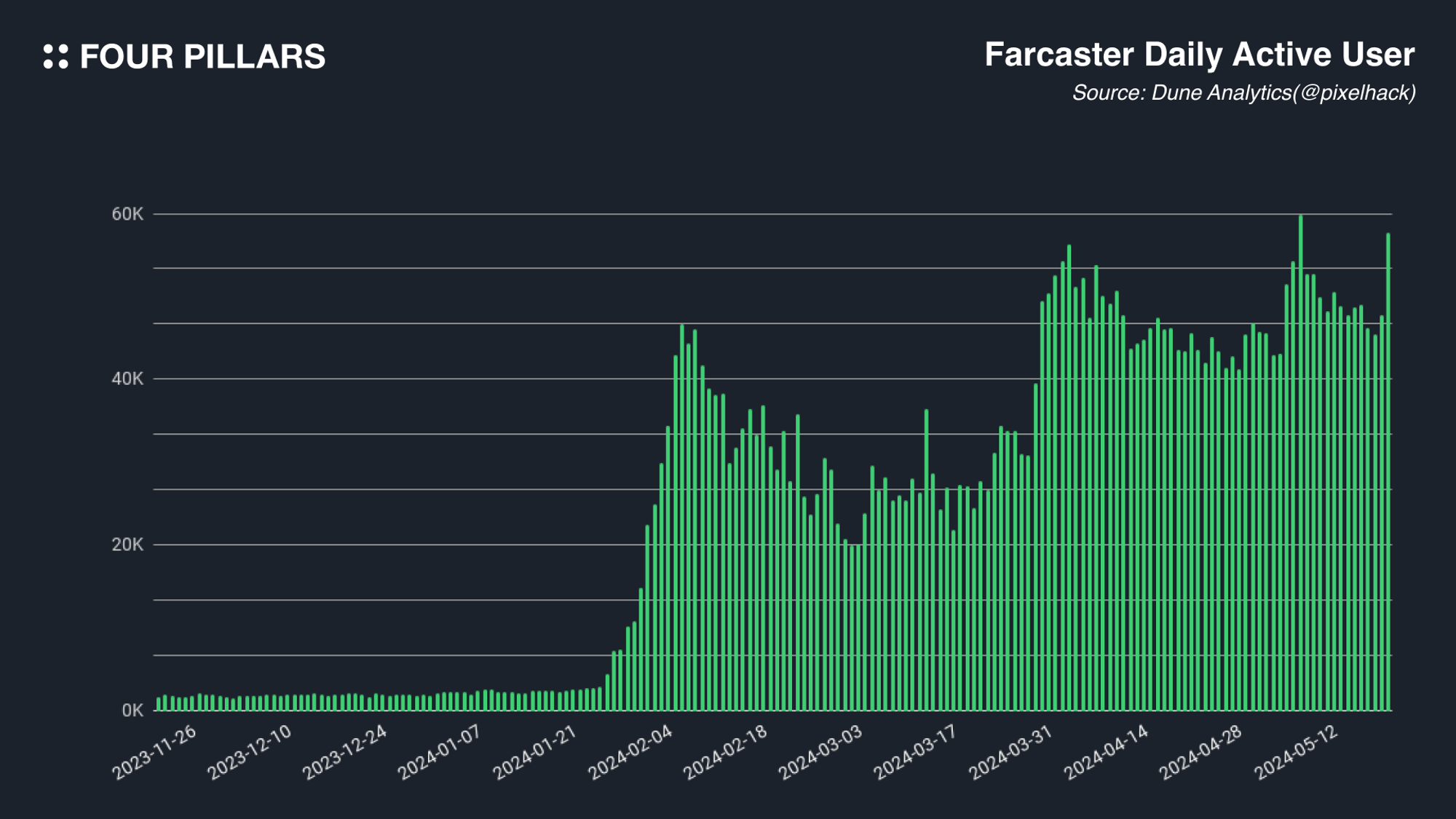
Beyond the introduction of Frames, Farcaster’s growth has been positively influenced by favorable market conditions, Base ecosystem expansion, and the memecoin craze. Following the bootstrap phase, Farcaster has become one of the most active and critical networks within the Base ecosystem. Many new projects launching on Base choose to build their communities and user bases on Farcaster rather than X. Despite relatively small user numbers, Farcaster’s community is highly active, driven largely by a concentration of influencers, creators, and developers. As the Base ecosystem grows and integrates more consumer applications, Farcaster’s network is expected to continue expanding and evolving.
2) Degen
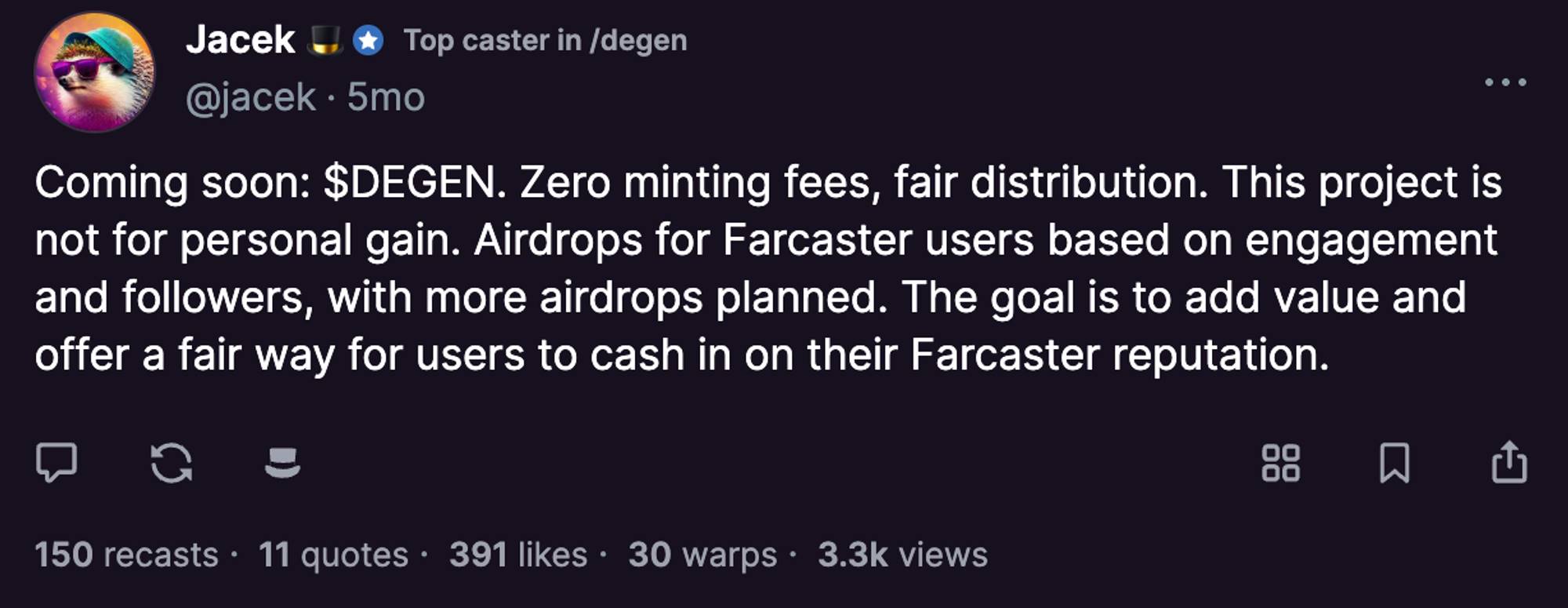
(Source: Farcaster (@jacek))
Degen is an ERC-20 token on Base playing a central role in the Farcaster community and ecosystem. It greatly benefits from—and contributes to—the growth of the Farcaster network. The Degen project aims to incentivize community participation and content creation. Users can tip others’ posts within limits determined by community activity rankings. Since launch, Degen has gained strong community endorsement, becoming the de facto currency for various projects on Farcaster—even prompting the launch of its own Layer 3 chain to extend its reach.
Although Degen’s launch seemed like just another experimental token, its impact far exceeds typical memecoin price spikes. It profoundly influenced the Farcaster ecosystem by promoting more content creation and user interaction, enhancing overall platform activity. It triggered an influx of developers, creators, and influencers, forming a vibrant community. Since Degen’s success, community tipping—similar to Blur’s points system on Ethereum—has become a strategic playbook for many projects and apps aiming to drive user engagement and network growth.
Moreover, it’s noteworthy how third-party tokens like Degen significantly contribute to the non-tokenized Farcaster protocol. Previously, most protocols relied on their own tokens to incentivize user acquisition, often resulting in mass user exodus when prices dropped. However, by integrating external memecoins as core features or base currencies, apps can attract new users while isolating app utility from price volatility. Using Degen as the base currency has been adopted by apps like Drakula, Perl, and Bracket. This marketing strategy combining memecoins and speculation is expected to grow more popular and refined, minimizing risks of launching native tokens while still driving user participation.
3) Friend Tech
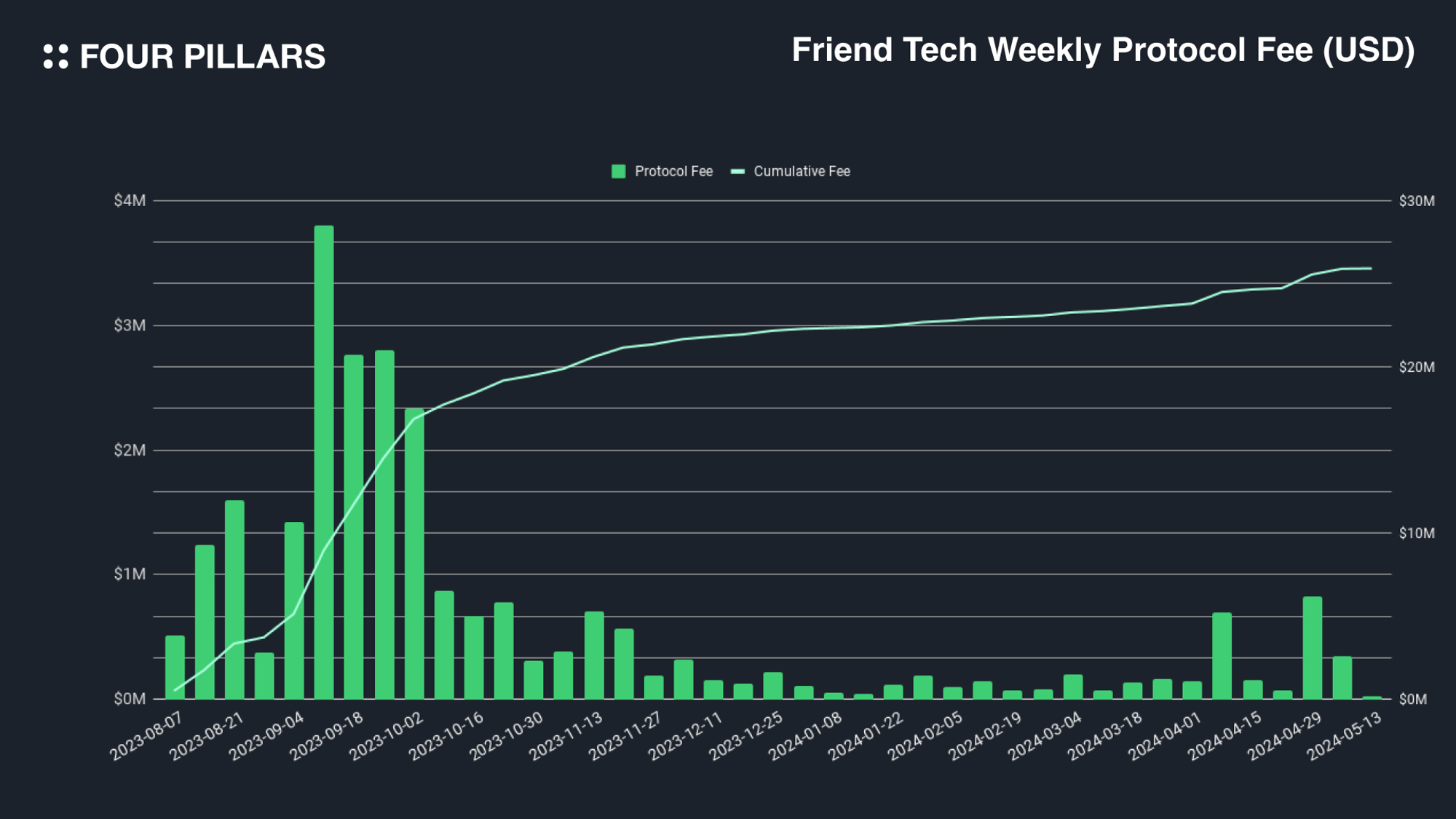
Friend Tech is a social trading app launched alongside Base’s mainnet in August last year. It allows users to buy and sell “keys” (shares) in each other to join private chat groups. Users can also profit from trading keys or earning fees when others trade their keys.
Since launch, Friend Tech has faced mixed controversy and market reactions. However, it pioneered a new SocialFi category previously dominated by DeFi and NFTs. Strategic moves such as Twitter integration embedded in wallets, support from investor Paradigm, and invite-only access quickly boosted its visibility. Within just two weeks, Friend Tech attracted 100,000 users and generated $3 million in fees, significantly aiding Base’s early growth.
Despite innovative strategies, low app quality and Ponzi-like tokenomics led to rapid user and capital loss after initial success. Friend Tech recently launched a second version with a token airdrop, aiming to regain its initial popularity. The new version restricts FRIEND token transfers and allows trading only on its proprietary DEX—a departure from standard practices. However, most users still seem focused on speculation and airdrops, leaving the platform’s revival uncertain. Regardless of outcome, Friend Tech has pioneered a new category in SocialFi and consumer apps, and its continued efforts to break conventions will serve as a valuable case study.
Projects to Watch
-
AlfaFrens
(Source: AlfaFrens)
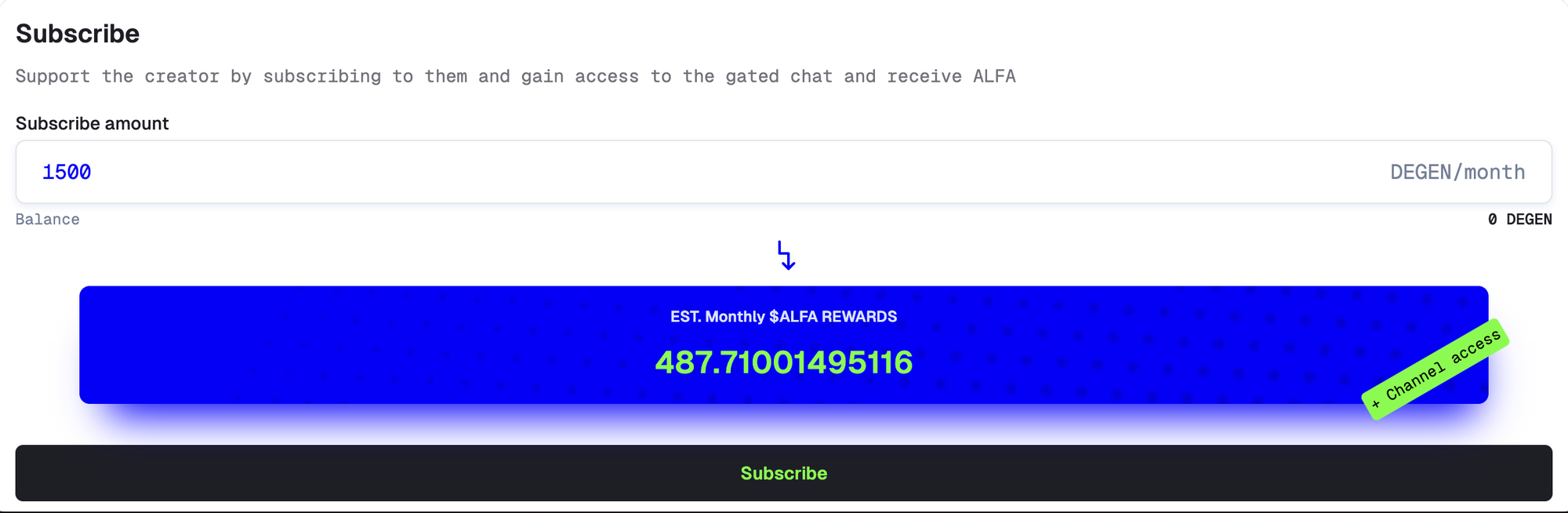
AlfaFrens is a Farcaster-based SocialFi app similar to Friend Tech, distinguished by allowing users to subscribe to specific influencers for access to exclusive chat rooms. When users subscribe to an influencer on AlfaFrens, their assets decrease in real-time based on subscription fees. The platform uses Degen as its primary currency, fostering active interaction within the Farcaster community.
A unique feature of AlfaFrens is its subscription-based interaction. Developed by startup Superfluid, which supports onchain asset streaming, AlfaFrens occupies a niche in the retail-driven crypto market. Their strategy leverages minimal functionality and memecoins to stimulate speculative interest, effectively attracting new users and boosting brand visibility.
2) Interface
(Source: Interface)
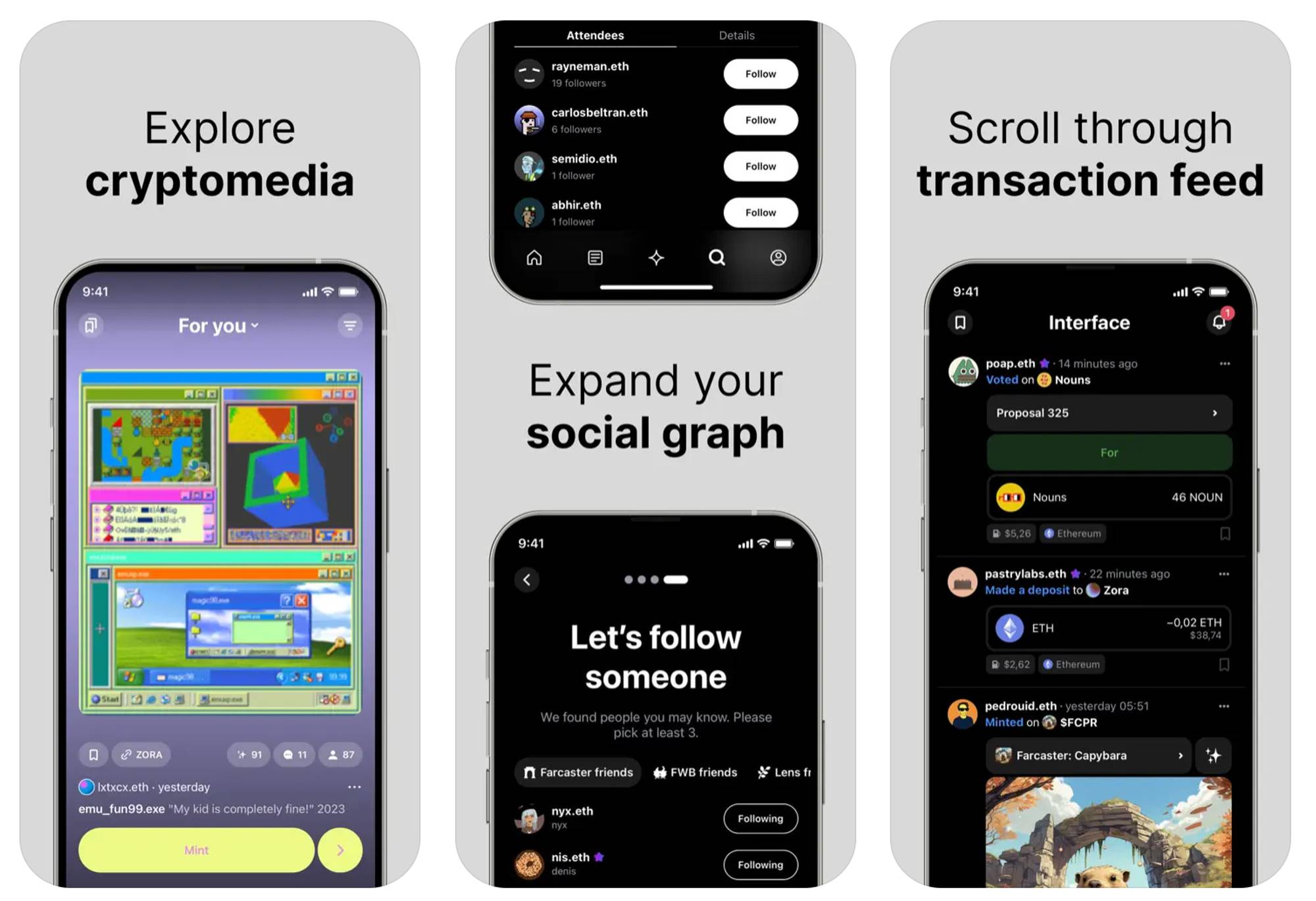
Interface is a social platform displaying wallet activity in a feed format. Users can follow wallets registered via ENS or address and view real-time actions like contract calls, token purchases, and NFT mints. With the growth of Farcaster-linked social graphs, it’s now easier to follow connected accounts, greatly enhancing the app’s utility. As social activity and content platforms grow in areas like art and music, the fun and value of onchain social graphs are expected to increase further.
Interface stands out for its smooth experience and solid design. Especially given that most Web3 products still offer poor UX, Interface’s quality is particularly notable. As consumer apps grow in importance, excellent UX shifts from optional to essential. For example, OKX Wallet is popular due to its superior user experience and multi-chain functionality. Currently, wallet apps are the primary gateway for onchain activity. However, apps with strong social features are expected to become the next super apps in crypto. With more social-focused onchain browser apps emerging, the adoption of Interface and its alternatives deserves close attention.
3) Kiosk
(Source: Introducing Kiosk)
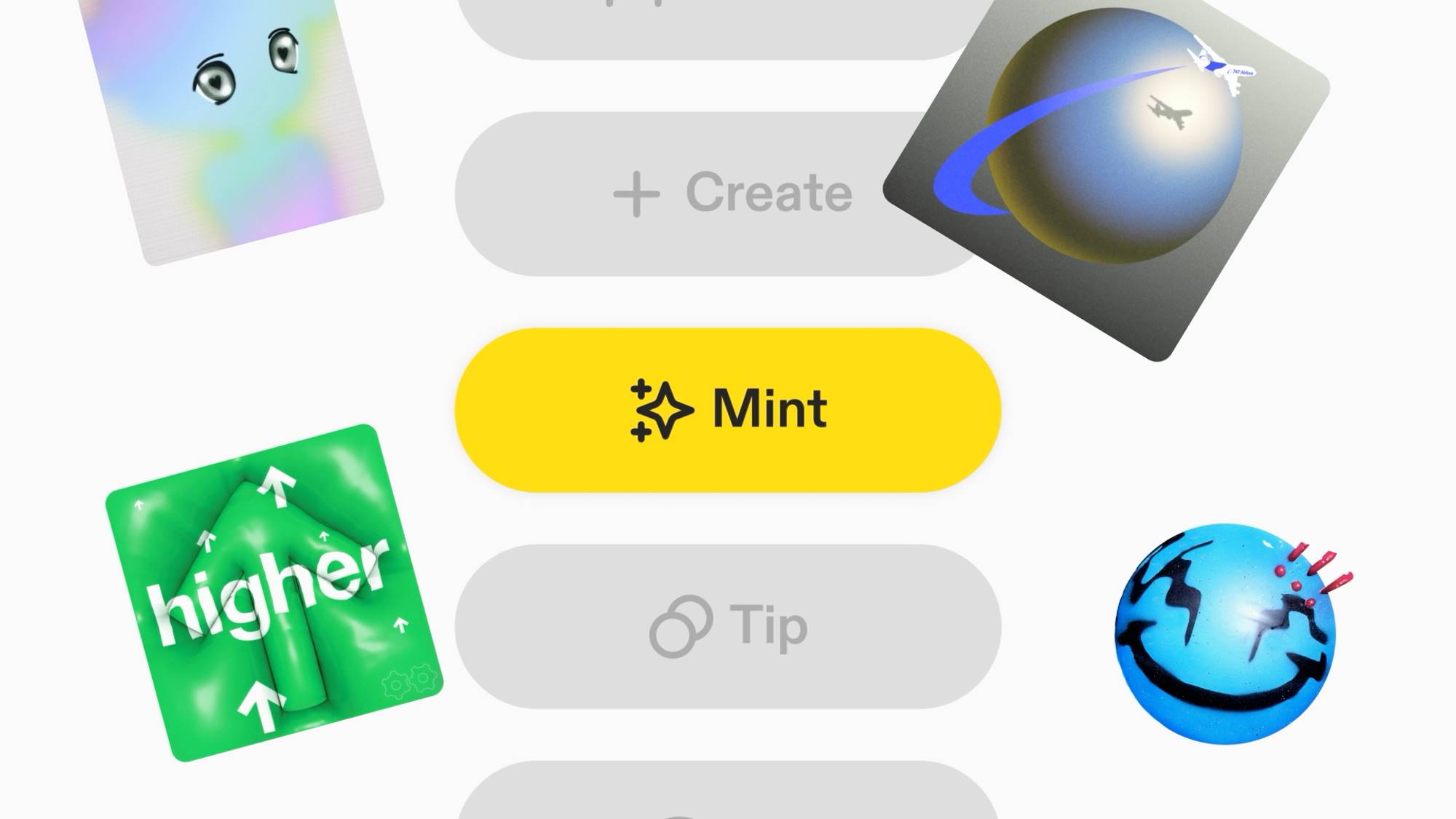
Kiosk is a new Farcaster client combining onchain social networking with commerce. Developed by the former Mirror team—Mirror being an onchain content platform later sold to Paragraph—Kiosk attracted $10 million in funding from firms like Electric Capital and A16Z before launch, generating significant buzz.
Kiosk plans to offer advanced features beyond standard social media. Users can easily convert images into NFTs or directly purchase assets created or collected by friends from their feed. Additionally, Kiosk will support creators in building communities and sharing content. Creators and influencers can form interest-based communities via token gating or subscription channels.
-
Content & Platforms
Within the Base ecosystem, social and community apps are currently the most active, offering interfaces and interactions similar to Web2 platforms like Facebook or X. Considering the historical evolution of the internet and platforms in Web2, the growth of onchain social graphs and community activities suggests new content platforms may emerge. In Web2, the rise of the internet and mobile devices fueled the expansion of social networks like Facebook and Twitter, later giving birth to specialized content services such as Instagram, YouTube, Twitch, and TikTok.
In the Base ecosystem, various content platforms are already emerging around Farcaster-centered community activities. As the onchain user base and activity grow, demand for platforms catering to different content types is expected to rise. Currently, apps focused on short-form text and photos in social feed formats are most common. However, apps optimized for different content types—like articles, videos, and live streams—are also appearing, suggesting imminent expansion in both user demand and service supply.
Compared to similar Web2 services, onchain content platforms are characterized by: 1) seamless interoperability between apps, 2) token-based interactions, and 3) especially strong incentives for creators and influencers. Like social and community apps, onchain content platforms offer seamless user experiences across multiple apps built on shared protocols like Farcaster. Second, most apps use tokens as a core mechanism for interaction, going beyond simple exchange transactions. Content created by creators can be minted as NFTs for ownership, exclusive communities can form around specific tokens, and tokens can reward and privilege loyal users. Finally, creators receive strong economic incentives via tokens, enabling more active engagement with fans or communities. Creators posting content onchain enables minting or community formation.
-
Key Projects
1) Unlonely Unlonely is a Base-based onchain livestreaming platform blending Web2 and Web3 elements to deliver a seamless user experience. The platform recently secured investments from prominent firms like Multicoin Capital and Coinbase Ventures, raising expectations for new consumer apps. Unlonely stands out by integrating gamified onchain features into its livestreaming service. Viewers can watch streams just like on traditional platforms—without connecting wallets or logging in. However, Unlonely enhances viewer interaction by incorporating various onchain features, enriching the connection between streamers and audiences. A standout feature is the ability for streamers to create temporary tokens tradable only if a target price is reached within 30 minutes. After introducing this feature, Unlonely’s founder Brian Guan generated $160,000 in trading volume and $6,000 in creator fees from a single stream. Additionally, the platform allows viewers to interact more deeply via betting, private chats, and using Unlonely’s native token, enriching the livestreaming experience.
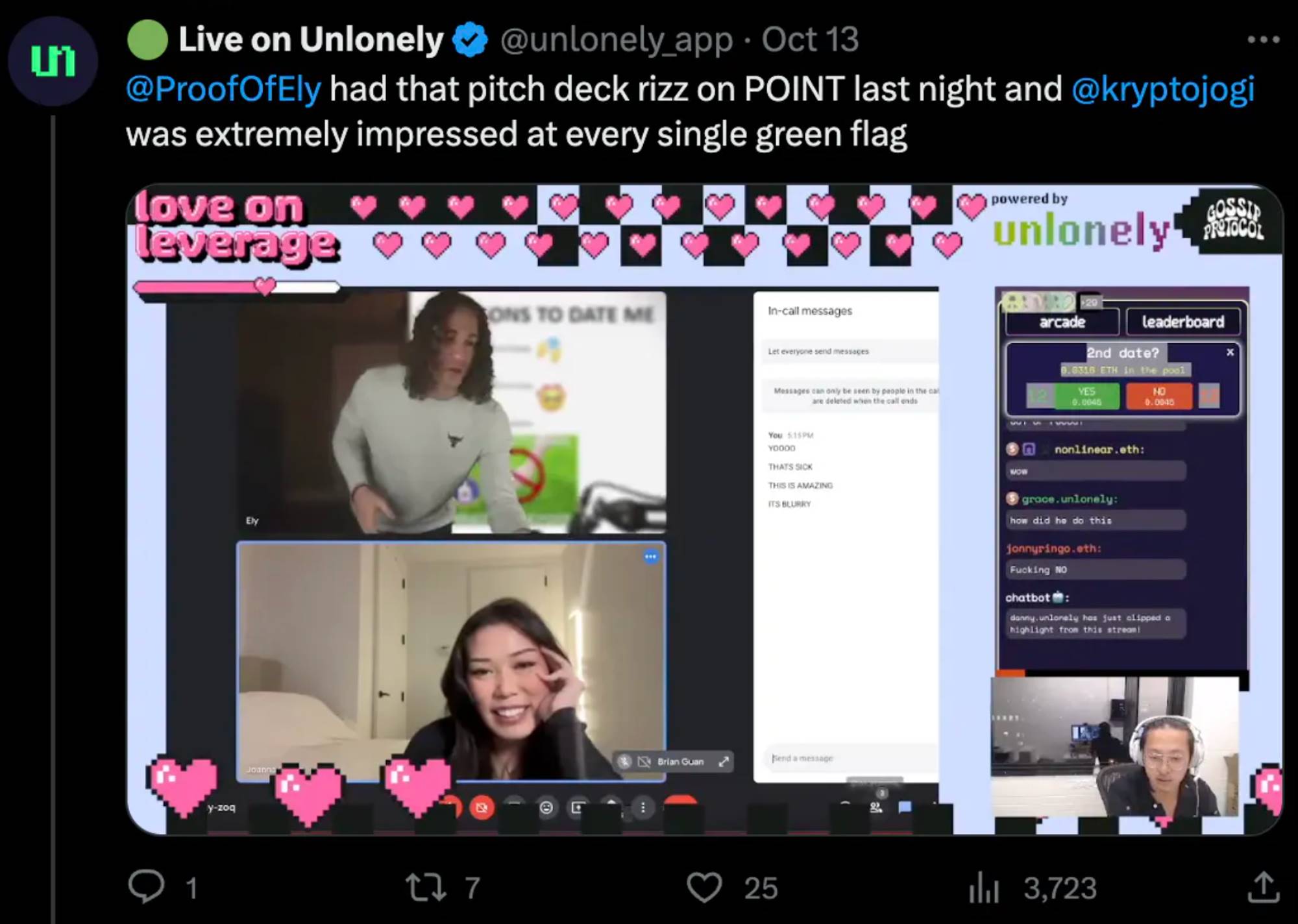
(Source: Bringing Love Onchain with Unlonely)
In February this year, Unlonely hosted an innovative event called “Love On Leverage,” which played a key role in promoting the platform and its unique onchain user experience. This engaging dating show brought male and female participants together online. As they interacted, viewers could bet on whether the pair would go on a second date. If total support exceeded a predetermined threshold, the couple would actually go on a date. Otherwise, if opposing bets dominated, new participants would be introduced. This creative and interactive event became a hit, attracting over 10,000 views, generating over $20,000 in token transactions, and tripling Unlonely’s social media following.
2) Paragraph Paragraph is an onchain newsletter and publishing platform allowing content creators to mint works as NFTs, send newsletters directly to wallet addresses, or monetize via subscriptions. Beyond typical content platform features, Paragraph integrates with social protocols like Farcaster, Lens, and XMTP, enabling token-gated channel creation. This integration helps individuals and brands build communities in Web3 and boost user engagement. Recently, Paragraph solidified its position as nearly the sole player in onchain publishing by securing a $5 million investment from Union Square and Coinbase Ventures and acquiring rival Mirror.
While minting articles themselves rarely holds direct economic value, they serve as verification tools, increasing community engagement and distinguishing early contributors. This feature is increasingly adopted in onchain social communities. Especially with Farcaster’s recent Frame feature, which allows reading and minting articles within core communities, adoption has become more active. However, the platform hasn’t yet succeeded in attracting large-scale user participation. Including content published on Mirror, weekly mints range between 10,000 and 20,000. As onchain activity and social graphs are expected to expand significantly, onchain publishing may become more attractive—especially for products and brands aiming to activate Web3 communities.
Projects to Watch
1) Drakula
(Source: drakula.app)
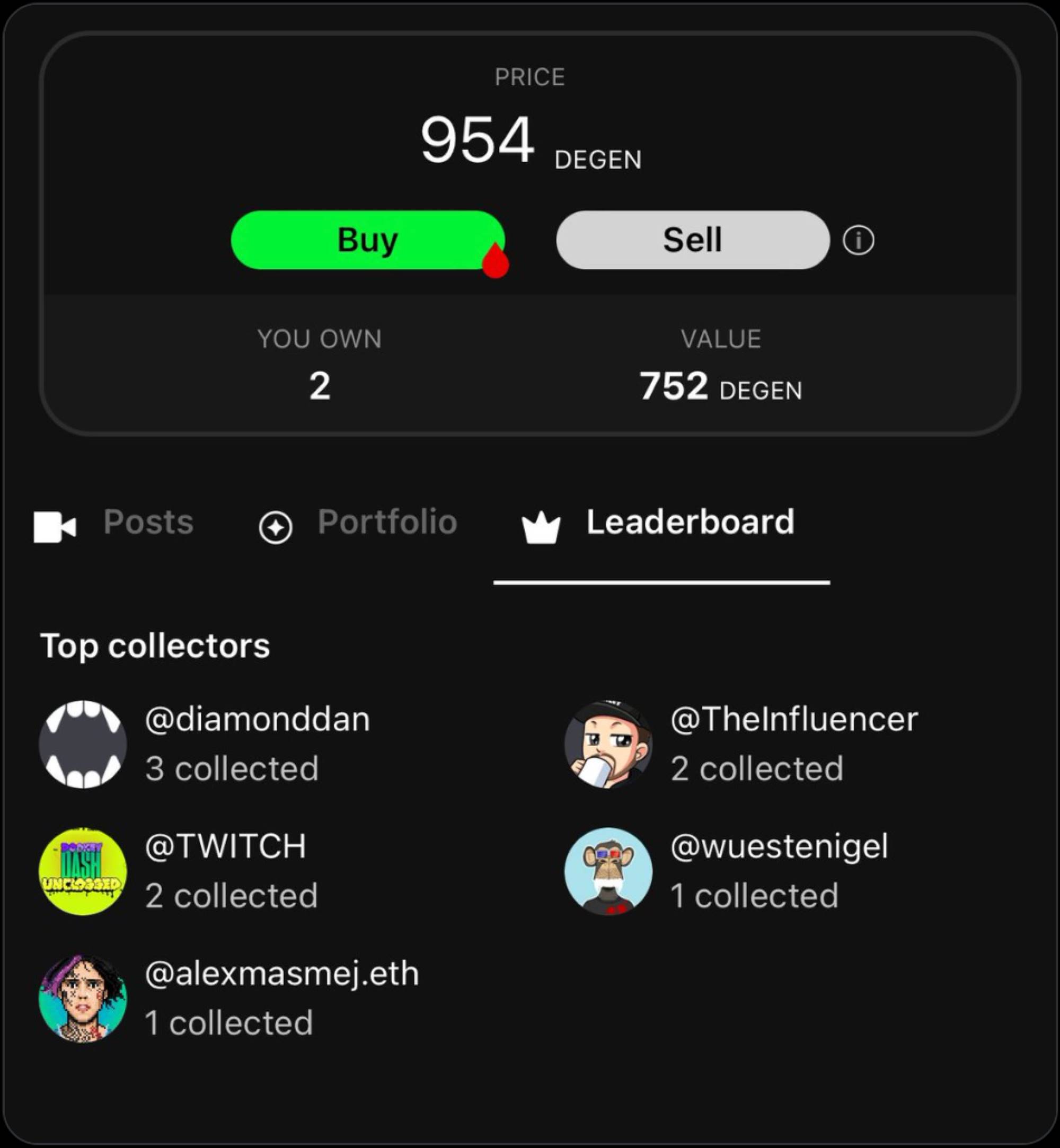
Drakula is an onchain short-video platform mimicking TikTok’s functionality. Like Friend Tech, Drakula allows users to trade tokens of content creators, who earn commissions from each trade. The platform uses Degen as its primary currency, and users can earn its proprietary points token Drip through content creation and sharing, or tip creators.
Initially, Drakula had little connection to established protocols or communities, and its first version failed to meet market expectations. However, with the rapid growth of Farcaster and Degen communities on Base, Drakula strategically pivoted and relaunched a second version. Updates included integration with the Farcaster protocol, enabling cross-platform uploads and better alignment with community interests. This adjustment proved successful, attracting 25,000 users and generating $10 million in transaction volume. Nonetheless, as speculative interest waned, the platform’s transaction volume and user engagement have recently declined.
2) Sound.xyz
(Source: Introducing Channels, Sound.xyz)
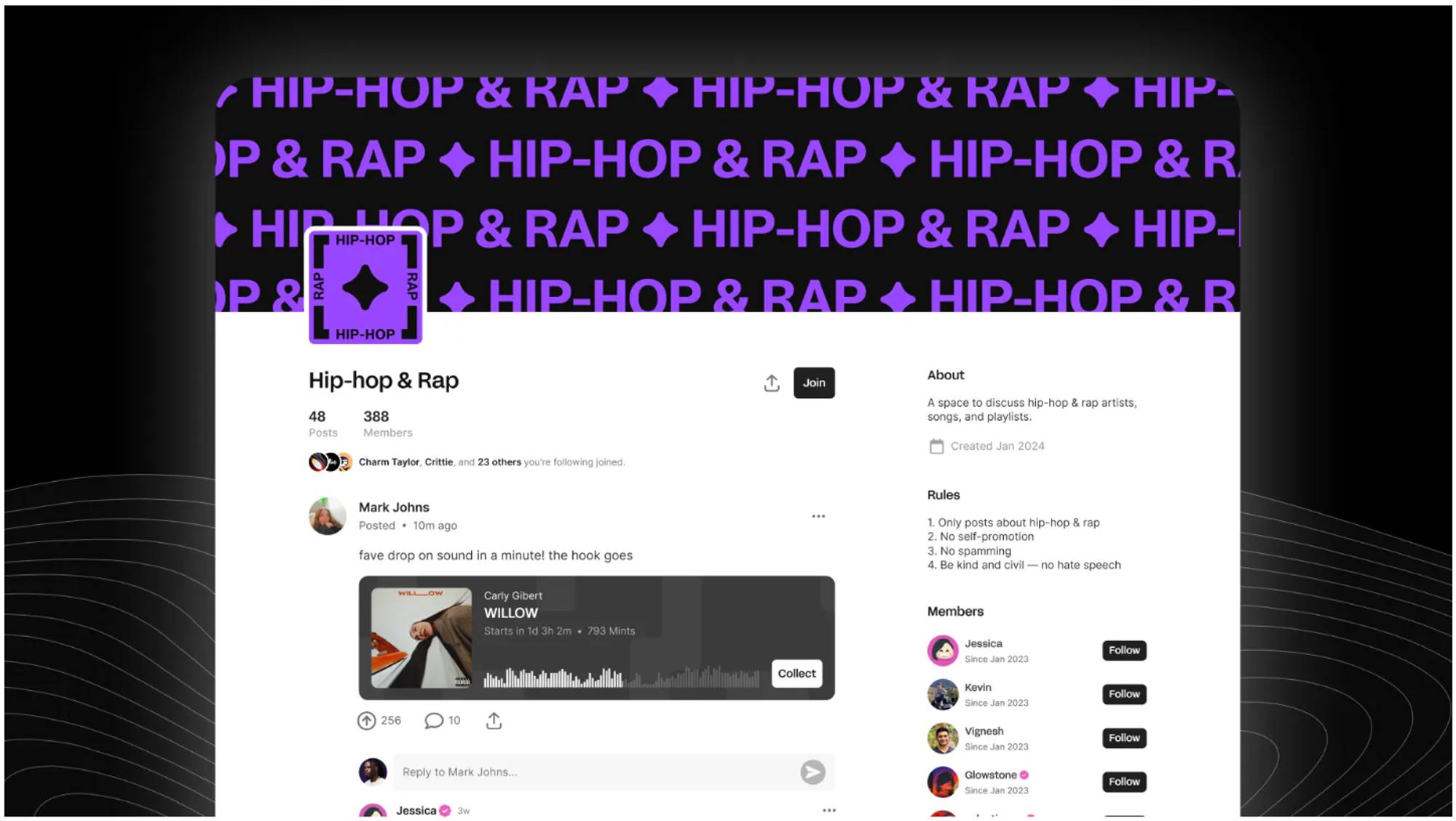
Sound.xyz is a music NFT platform founded in 2021, slightly predating Base. Backed by venture firm a16z, which invested $5 million in 2021 and $20 million in 2023, Sound.xyz has minted 1.2 million music NFTs and paid $6 million in creator rewards to over 2,500 artists since launch. Collaborations with Snoop Dogg and tracks released by the Optimism Collective are among its most successful mints. Currently, Sound.xyz operates on both Base and Optimism blockchains, with track data stored on IPFS.
Creators use Sound.xyz to release music as NFTs, allowing fans not only to listen but to own tracks and support artists beyond traditional means. Users can leave public comments, enhancing social interaction. Moreover, music NFTs offer unique perks like Discord invites or early access to unreleased tracks, strengthening artist-fan relationships. While onchain music listening and minting haven’t gone fully mainstream yet, the expansion of onchain social networks suggests a bright future for professional content services. With recent emergence of similar platforms like Crate and Songcamp, the onchain music platform category shows significant potential and warrants attention.
-
Gaming
Despite long-term experimentation, Web3 gaming hasn’t delivered many success stories as anticipated. Even within the Base ecosystem—where consumer apps are most active—adoption of onchain games remains relatively rare. This slow uptake is partly due to the crypto user base consisting primarily of investors and traders, not gamers.
Demand focuses mainly on games with simple mechanics, tokenomics, and user interaction. In contrast, traditional games emphasizing graphics and action are less popular. Meanwhile, social features are becoming crucial in Web3 games. Leaderboards, chat, and community-building features enable players to compete or collaborate within communities. These features help players stay engaged beyond the game and strategically plan their actions.
At the same time, projects resembling traditional games are beginning to appear in the Base ecosystem. Iskra is a prime example, recently announcing its L3 chain on Base. Given gaming’s focus on optimizing user experience over security and decentralization, L3s—which offer low transaction costs, fast processing speeds, and customizable features—may be a logical choice.
Key Projects
1) FrenPet
(Source: Fren Pet Next Steps)
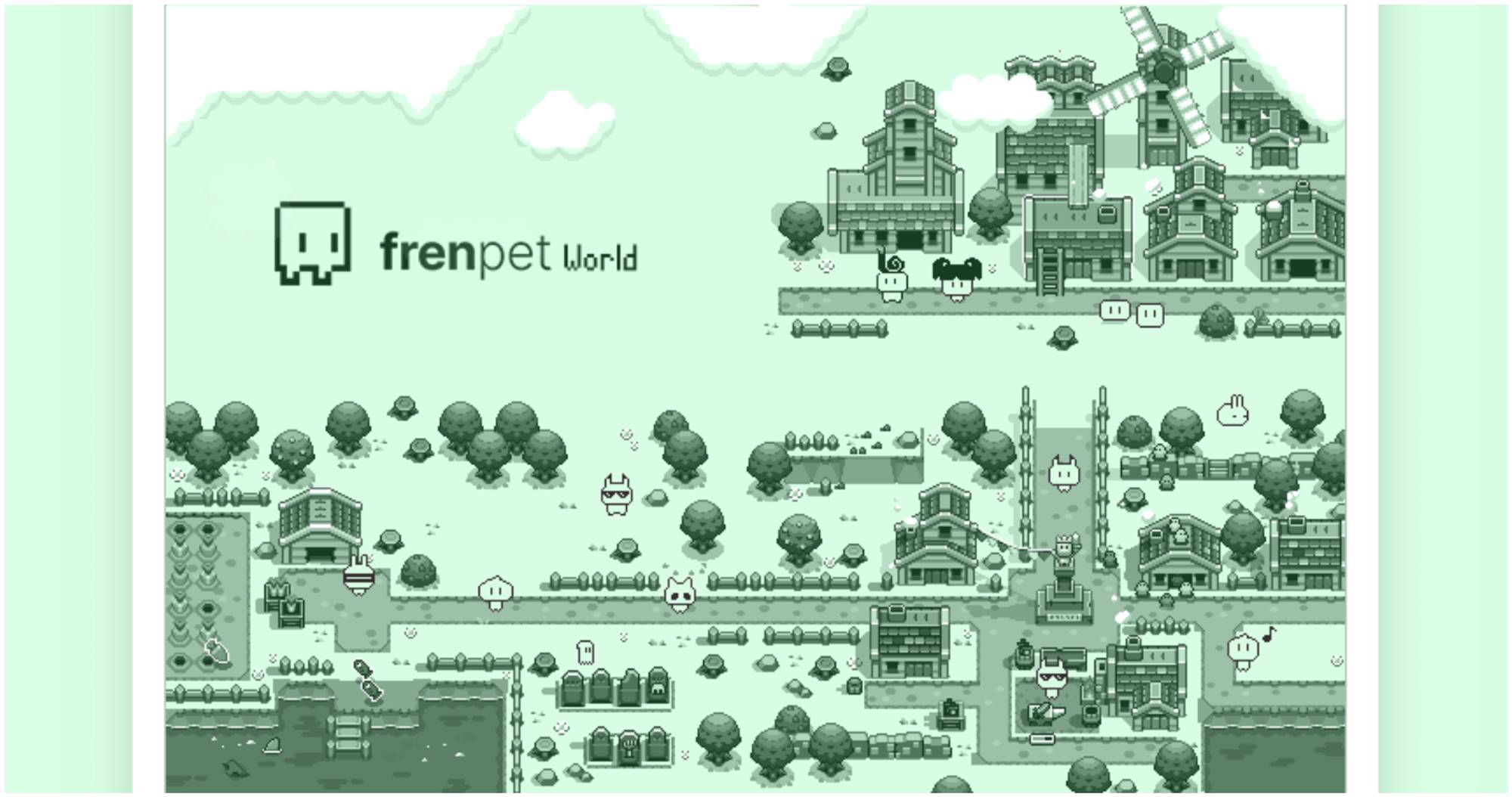
FrenPet is an onchain game where players raise virtual digital pets on Base, launched last year. It quickly attracted significant interest and user growth. To date, over 20,000 wallets have registered, and the game has generated over $3.5 million in protocol fees. Gameplay involves minting pets and nurturing them to earn points. FrenPet requires constant interaction—such as feeding pets or participating in pet battles—enhancing game activity.
The game’s main currency, $FP, serves both as a revenue source for the protocol and a reward for top players. A portion of each in-game purchase is burned, while another portion is redistributed to leaders on the leaderboard. This model increases active participation. FrenPet shares similarities with Friend Tech—token burning, redistribution, and in-app exchanges—but uses onchain pets to encourage sustained interaction instead of Friend Tech’s social elements. Like Friend Tech’s first version, FrenPet’s structure depends on a steady influx of new users to maintain token value; if inflows stop, existing users may exit en masse. As the game refines its mechanics and tokenomics, it will be important to see if FrenPet can sustain its momentum.
2) Iskra
(Source: Iskra Migration: Moving Iskra’s Hub Chain to Base)
Launched in 2022, Iskra is a Web3 gaming platform designed for developers and players. It offers intuitive, casual games accessible even to those unfamiliar with crypto. The platform hosts six games, including the RPG P2E title “3 Kingdoms Multiverse,” casino game “World of Win,” and cooking simulator “Norma in Metaland.” Additionally, Iskra boosts user engagement via initiatives like task walls and Iskra Arcade, where players complete tasks to earn in-game rewards.
Previously operating on Klaytn and Ethereum, Iskra recently migrated to Base’s L3 chain with major updates, raising expectations. With the migration, Iskra launched “ClashMon,” a game where players collect characters and form teams to battle, offering a SocialFi-like user experience and currently generating significant transaction volume and buzz. Iskra also plans to release new games, including the casual TPS title “Juicy Adventure” and tower defense game “Guardians of Spark.” The move to Base’s L3 chain is expected to bring higher accessibility and lower costs, attracting more users and creating a positive cycle for additional game projects to join the platform.
Projects to Watch
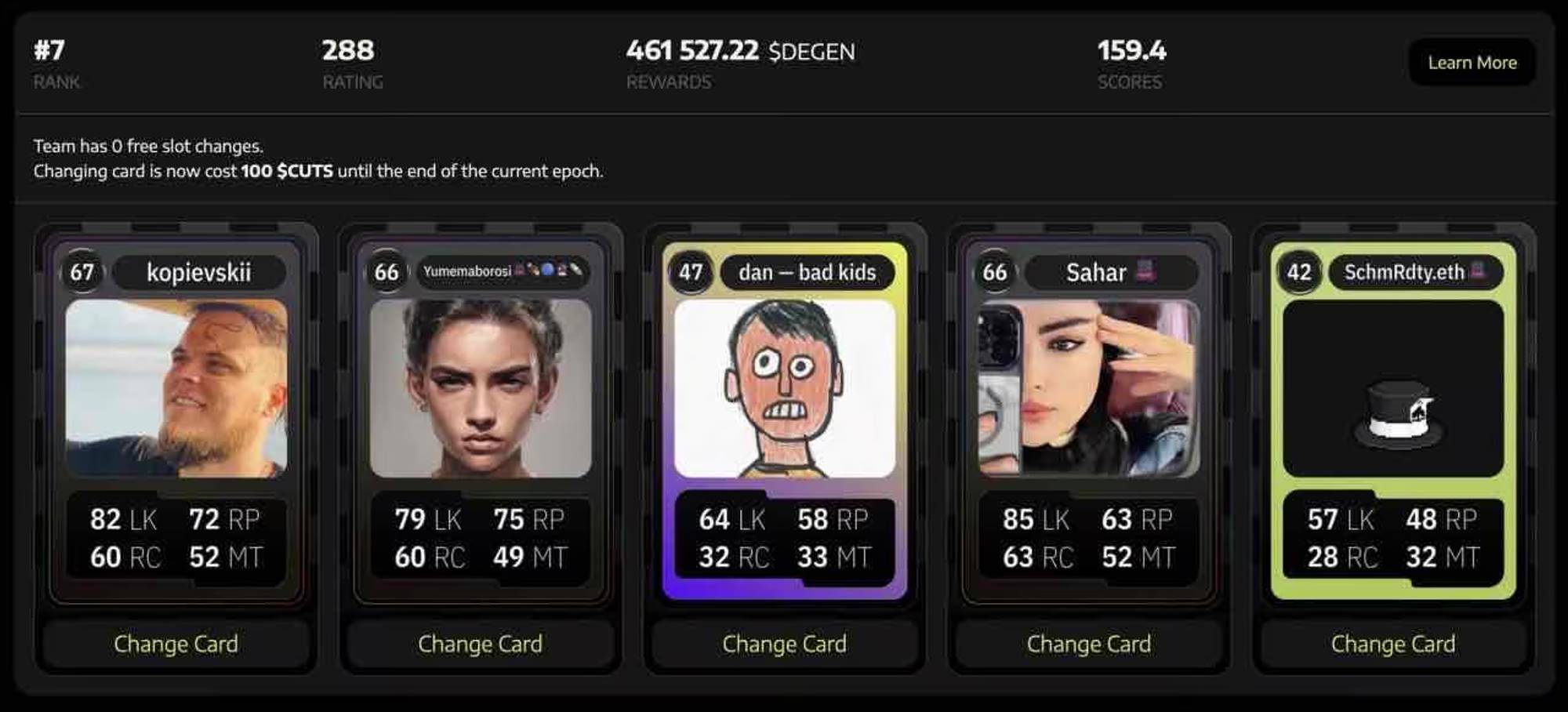
1) Uncut
(Source: Join TechFlow official community to stay tuned Telegram:https://t.me/TechFlowDaily X (Twitter):https://x.com/TechFlowPost X (Twitter) EN:https://x.com/BlockFlow_News
 Four Pillars