iOS18 "+AI": Apple Can't Avoid the "AI Smartphone War"
TechFlow Selected TechFlow Selected
iOS18 "+AI": Apple Can't Avoid the "AI Smartphone War"
On the热门 path of "AI phones," Apple can't afford to stay out.
 Navigating Web3 tides with focused insights
By Mu Mu
While tech giants worldwide race to develop large AI models, Apple—ranked among the world’s top 10 most valuable companies—has remained conspicuously quiet. Generative AI tools like ChatGPT, capable of seemingly anything, have made Siri appear “low-intelligence” by comparison.
As smartphone makers such as Samsung, Huawei, OPPO, and vivo launch AI-powered devices, Apple has stayed silent. That changed in May this year, when Mark Gurman, a longtime Apple watcher at Bloomberg, revealed that generative AI would be integrated into iOS 18—just days ahead of Apple's WWDC24 developer conference.
According to leaks from various Apple-focused media outlets, Apple does not intend to compete directly with ChatGPT by building its own massive model. Instead, it plans to bring high-quality models into its ecosystem, using generative AI to create new features or enhance existing ones—such as improving Siri’s ability to understand user intent and complex commands, delivering detailed and personalized responses through conversational interactions.
At the foundational model level, OpenAI—the company behind the globally popular GPT series—is likely to become Apple’s partner. On the trending path toward "AI phones," Apple can no longer afford to stay out.
iOS 18 to Feature Generative AI, Giving Siri an Intelligence Upgrade
Apple’s annual WWDC24 global developer conference is scheduled for June 10 (local time in the U.S.), which corresponds to 1 a.m. on June 11 in Beijing. With over ten days remaining before the event, the upcoming iOS 18 operating system remains the centerpiece of attention for Apple fans, while the question of whether it will include AI capabilities is the focus for industry observers.
Recently, Apple has already hinted at some answers through official press releases: iOS 18 will introduce new features, including a suite of integrated AI functionalities.
Based on information reported by sources including Bloomberg’s Mark Gurman:
-
iOS 18, integrating AI capabilities for the first time, will be released in beta or preview form;
-
AI features will include voice memo transcription, AI-powered photo editing, message reply suggestions, intelligent search in Safari and Spotlight, among others;
-
iOS 18 will include a standalone chatbot powered by OpenAI’s large model, with Apple and OpenAI expected to officially announce their partnership at WWDC24;
-
iOS 18 with AI features will debut on Apple’s latest smartphones.
Judging from current leaks, Apple is formally entering the “AI phone” race via a “system-first” strategy. By integrating OpenAI’s large model, Apple may allow users worldwide to access one of the most advanced AI models without geographical restrictions.
 Apple will unveil iOS 18 at WWDC24
From a functional standpoint, AI will help Apple’s hardware upgrade legacy features and deliver new experiences.
Siri is expected to receive a major AI-driven upgrade. Smart summarization is another key AI application project for Apple, capable of condensing incoming notifications, personal messages, web pages, articles, documents, notes, and other content. Generative AI will also be used to draft replies in emails and text messages.
Whether Apple’s AI features will truly impress remains to be seen when iOS 18 is officially unveiled. However, other smartphone manufacturers have already integrated AI-powered summarization, generation, and editing into their devices, having long promoted the concept of “AI phones.” Under such competitive pressure, Apple has little choice but to join.
In the “AI phone” race, Chinese brands are leading the charge.
At OPPO’s launch event earlier this year, CEO Pete Lau announced that OPPO had officially entered the AI phone era. Subsequent models, such as the Reno 12 series, launched with AI-enabled ColorOS right out of the gate. The vivo X100 series and vivo X Fold3 series feature vivo’s self-developed BlueLM (Blue Heart Large Model), enabling generative AI applications on mobile devices.
With the release of the Huawei P70 series, Huawei—the leading domestic smartphone brand—has now officially joined the generative AI competition. Even Xiaomi, busy with its automotive ambitions, hasn’t neglected its core business. Despite previously calling “AI phones a gimmick,” Xiaomi has fully embraced large models on mobile devices—its Xiaomi 14 Ultra features the Xiaomi Imaging Brain AISP (AI Large Model Computational Photography Platform), achieving significant photographic upgrades.
Overseas, “AI phones” are equally hot. Google, developing its own large model to rival OpenAI, announced last October that its Gemini model would be embedded in the Pixel 8 series during a hardware launch. Samsung also launched three Galaxy S24 series devices on January 25, emphasizing AI features powered by a combination of cloud and on-device large models.
In 2024, with Apple’s entry, “AI phones” have become one of the hottest segments in the industry. But are they really AI phones?
“AI Phones” Are Low-Purity—Performance Still Depends on Large Models
According to IDC, an AI phone is defined as a device equipped with an NPU offering over 30 TOPS (INT8) computing power, featuring a SoC that supports generative AI and enables on-device large models.
China Telecom’s White Paper on Artificial Intelligence Terminals also sets standards for AI phones (referred to as AI terminals): platform requirements include hardware compute units and deep learning frameworks; capability requirements cover facial recognition, voice assistants, scene detection, and system optimization; application requirements define user experiences such as beautification, background blur, photo categorization, AR video, and translation.
Simply put, a true AI phone should feature a deep learning framework or AI chip, run AI applications, and offer common AI functions.
By these standards, current “AI phones” on the market are still transitional products. Smartphones without dedicated AI chips are more accurately described as devices with AI applications and features.
Most integrate large AI models into existing operating systems or use API calls to access models, thereby giving native apps or features generative AI capabilities. For example, Samsung’s Galaxy S24 series uses large models to enable real-time translation, instant circle-to-search, and AI assistant-generated summaries.
A comparison reveals that current AI phone features are largely similar. Ultimately, the key to evaluating performance lies in the underlying large models.
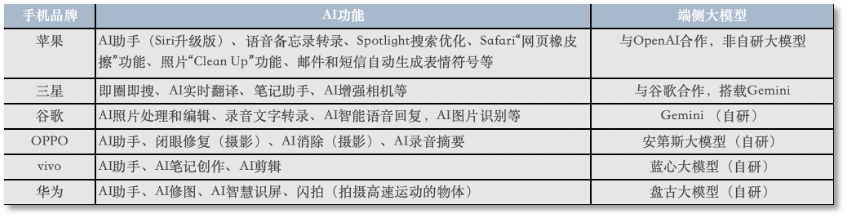 Comparison of AI phone features and models
Among the top five smartphone brands in China by market share, most have launched their own on-device large models, including Huawei’s Pangu, OPPO’s Andes, and vivo’s BlueLM. Samsung, taking a “pick-and-choose” approach, equips its AI-focused Galaxy S24 series directly with Google’s Gemini large model.
Regardless of actual experience, consumers benefit from added AI functionality without significant price hikes—a fair deal. For instance, the Samsung Galaxy S24 series starts at 5,499 yuan, just 300 yuan more than the previous-generation S23 series (5,199 yuan). The OPPO Reno12 series starts at 2,699 yuan, up 200 yuan from the Reno11 series (2,499 yuan).
The modest price increases for “AI phones” highlight one fact: core smartphone chips have yet to enter the AI era. Nevertheless, despite being largely marketing-driven, “AI phones” have driven sales growth.
According to the latest data from market research firm Counterpoint Research, during the first three weeks after launch—from January 28 to February 17, 2024—global sales of the Galaxy S24 series increased by 8% compared to the same period for the Galaxy S23 series in 2023. OPPO’s first AI-equipped Find X7 series saw a 132% year-on-year increase in sales during its first three months compared to the previous generation.
Now, Apple—the last major player to enter—is set to embed AI capabilities into its latest operating system, iOS 18, even without a self-developed large model. As usual, the upcoming iPhone 16 series, expected in the fall, could be the first to feature these capabilities. Leveraging Apple’s vast user base and the market testing already done by competitors, “Apple-style AI” could significantly boost sales of its new hardware.
Another issue for these transitional “AI phones” is how long their appeal will last once third-party apps can offer similar AI functions. After all, ChatGPT already has a mobile app—while installing it doesn’t make your phone an “AI phone,” users are still accessing AI features.
This explains why some users feel underwhelmed after experiencing so-called “AI phones”—the upgrade isn’t revolutionary. True AI phones still await breakthroughs in chip technology.
Join TechFlow official community to stay tuned
Telegram:https://t.me/TechFlowDaily
X (Twitter):https://x.com/TechFlowPost
X (Twitter) EN:https://x.com/BlockFlow_News