








Vitalik's latest article: L2 is a cultural extension of Ethereum
TechFlow Selected TechFlow Selected
Vitalik's latest article: L2 is a cultural extension of Ethereum
Every Ethereum L2 has a unique "soul."
 Navigating Web3 tides with focused insights
Author: Vitalik Buterin
Translation: Peng Sun, Foresight News
In my recent article on the differences between L1 and L2 scaling, I ultimately concluded that the most important distinction between these two approaches is not technical but organizational (in the sense similar to the field of "industrial organization"): it's less about what can be built, and more about what will be built—because the boundaries between different parts of the ecosystem shape people's incentives and capacity for action. In particular, an L2-centric ecosystem is inherently more pluralistic and naturally encourages greater diversity in scaling, EVM design, and other technical features.
One key point I made in my previous article was:
Because Ethereum is an L2-centric ecosystem, you are free to independently build a sub-ecosystem with its own unique features while still being part of the broader Ethereum network.
In this article, I argue that this is true not only technically, but also culturally. Blockchains have not only distinct technical trade-offs, but also distinct cultures. The day after Ethereum and Ethereum Classic diverged, the two chains were technically identical. Yet they already differed culturally, and this difference helped shape their divergent focuses, user bases, and even technical stacks eight years later. The same applies to Ethereum and Bitcoin: initially, Ethereum was roughly "Bitcoin with smart contracts," but ten years on, the divergence has become much deeper.
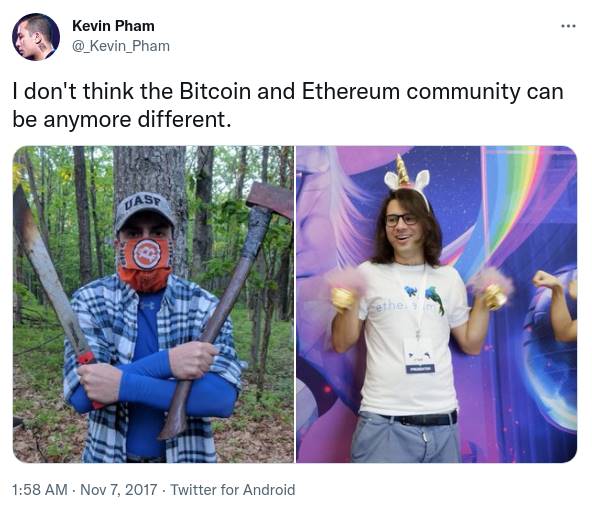
Kevin Pham compared Bitcoin and Ethereum culture in a now-old tweet from 2017. Both cultures have continued evolving: since 2017, we've seen the rise and fall of the "laser eyes" movement (alongside the emergence of movements like Ordinals), Ethereum has become L2-centric, and both cultures have grown more mainstream. Yet differences remain—and perhaps it’s best that they do.
What does culture influence?
Culture functions similarly to incentive structures—in fact, culture is part of the incentive structure. It affects who is attracted to or repelled by an ecosystem. It shapes motivations and feasible actions. It influences what is considered legitimate—whether in protocol design, or at the ecosystem and application layers.
Blockchain culture significantly impacts several particularly important areas, including:
-
Types of protocol changes—including quantity, quality, and direction
-
The protocol’s ability to remain open, censorship-resistant, and decentralized
-
The ecosystem’s ability to attract high-quality protocol developers and researchers
-
The ecosystem’s ability to attract high-quality application developers
-
The ecosystem’s ability to attract users—including both quantity and suitable user types
-
The public legitimacy of the ecosystem in the eyes of external communities and participants
If you genuinely value blockchain decentralization—even at the cost of inefficiency—you must care not only about how well today’s technology achieves these goals, but also about how much the blockchain’s culture values them. If a blockchain’s culture lacks curiosity and openness toward new technologies, it will likely fail on both decentralization and speed, because it won’t adopt innovations like ZK-SNARKs that enable higher decentralization and faster performance. If a blockchain is widely perceived as a "casino chain" with no other identity, it becomes difficult to attract non-gambling applications. Even non-commercial core protocol developers and researchers become harder to attract. Culture matters because culture is upstream of almost everything else.
Ethereum’s culture
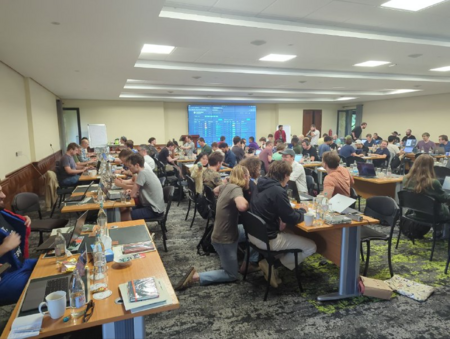
May 2024, Kenya, Ethereum Developer Retreat. Ethereum’s core research and development ecosystem is one of its subcultures, though it itself is quite diverse and internally divided.
Researcher Paul Dylan-Ennis has spent considerable time exploring and understanding Ethereum’s subcultures. He identifies three main ones:
-
Cypherpunks: Committed to open-source development with a DIY or punk attitude. In Ethereum, cypherpunks build infrastructure and tools neutrally, without prescribing how they should be used. Historically, cypherpunks emphasized privacy rights, which haven't always been central in Ethereum—though a new movement called "lunpunk" has emerged advocating for privacy-first principles.
-
Regens: Many influential voices within Ethereum advocate regenerative or restorative approaches to technology. Inspired by Vitalik Buterin’s interests in political and social science, many regens engage in governance experiments aimed at revitalizing, improving, or even replacing contemporary institutions. This subculture is characterized by its experimental nature and interest in public goods.
-
Degens: Users driven purely by speculation and wealth accumulation at all costs. Degens are financial nihilists focused on current trends and hype, hoping to strike it rich and escape the rat race of contemporary neoliberal capitalism. They often take extreme risks, but in a satirical, almost detached way.
There are more groups than just these three, and one could question how coherent each actually is: profit-driven individuals and those buying monkey pictures differ greatly in culture. The term "cypherpunk" here includes both those interested in end goals like protecting privacy and freedom, and those drawn to cutting-edge math and cryptography without strong ideology. Still, this classification serves as an interesting first approximation.
An important feature of these three groups within Ethereum is that, largely due to Ethereum’s flexibility as a developer platform (not just a currency), each has access to an arena where their subculture can act—not just talk. A rough approximation:
-
Cypherpunks participate in core Ethereum R&D and develop privacy software;
-
Regens run Gitcoin rounds, retroactive public goods funding, and other non-financial applications;
-
Degens trade memecoins and NFTs and play games
In my view, this cultural branching benefits Ethereum greatly. Ethereum’s core development culture values high-quality thinking in advanced cryptography, game theory, and increasingly software engineering; it values freedom, independence, cypherpunk ideals, and their blockchain equivalents (like "immutability"), along with an idealistic approach emphasizing values and soft power over hard power. These values are important and good; judging from the cultural impacts I listed earlier, they place Ethereum in a strong position regarding (1), (2), (3), and to some extent (6). But they are incomplete: the above description barely emphasizes appeal to application developers, and almost entirely neglects appeal to users. Values oriented toward stability help give confidence to those who "use" Ethereum by holding ETH—but little beyond that. Cultural pluralism is one way out of this dilemma, allowing one subculture to focus on core development while another focuses on building the "edges" of the ecosystem. But this raises a question: can we further strengthen such cultural pluralism?
Subcultures and L2s
This leads me to what may be L2s’ most underappreciated feature: L2s are the ultimate arenas for subcultures. L2s allow subcultures to emerge with substantial resources and feedback loops that force them to learn and adapt in real-world conditions: attracting users and app developers, developing technology, and building global communities.
Here, perhaps the key property of L2s is that they are simultaneously (i) ecosystems, and (ii) organized around building something. Local meetup groups can form their own ecosystems and often have unique cultures, but their resources and execution capacity are relatively limited. Applications can have significant resources and execution power, but they are just applications: you can use them, but you cannot build on top of them. Uniswap is great, but the idea of "building on Uniswap" is far weaker than "building on Polygon."
Concrete ways L2s might—and do—achieve cultural specialization include:
-
Greater willingness toward user outreach or "business development": deliberate efforts to bring specific external participants (individuals, companies, communities) into the ecosystem.
-
Diverse emphasis on values: Does your community prioritize "public goods," "high-quality tech," "Ethereum neutrality," "financial inclusion," "diversity," "scalability," or something else? Different L2s answer differently.
-
Participant diversity: What kinds of people does the community attract? Does it emphasize certain demographics, personality types, languages, or continents?
Here are a few examples:
Optimism
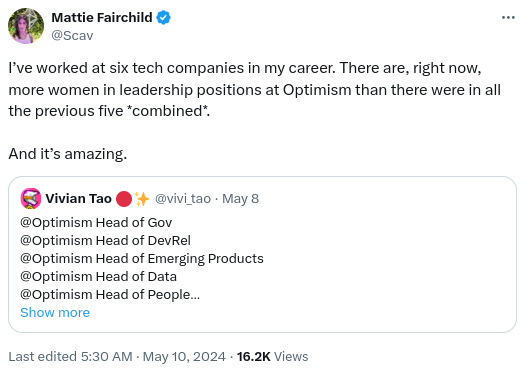
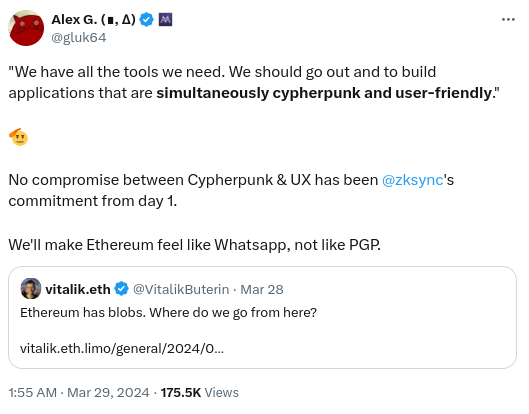
zkSync
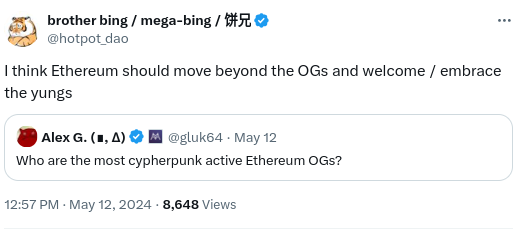
MegaETH
Starknet
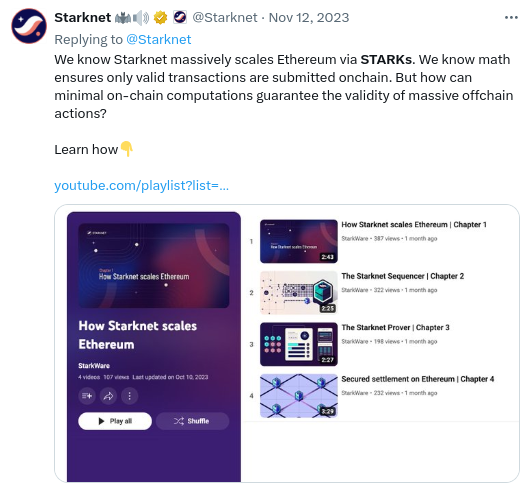
Polygon succeeded through partnerships with mainstream companies and an increasingly robust ZK ecosystem. Optimism, with Base and World Chain, has a strong cultural interest in retroactive fundraising and token-based non-majoritarian governance. Metis focuses on DAOs. Arbitrum has built a brand around high-quality developer tools and technology. Scroll emphasizes "preserving Ethereum’s essence—minimal trust, security, and open source." Taiko highlights "seamless user experience," "alignment with community," "security first," and "people-centered" values. Generally, every Ethereum L2 has a unique "soul": Ethereum culture blended with its own distinctive style.
How can the L2-centric approach succeed?
The core value proposition of this L2-centric cultural approach is that it attempts to balance the benefits of pluralism with cooperation, creating a range of distinct subcultures that still share some common values and collaborate on shared critical infrastructure to realize them.
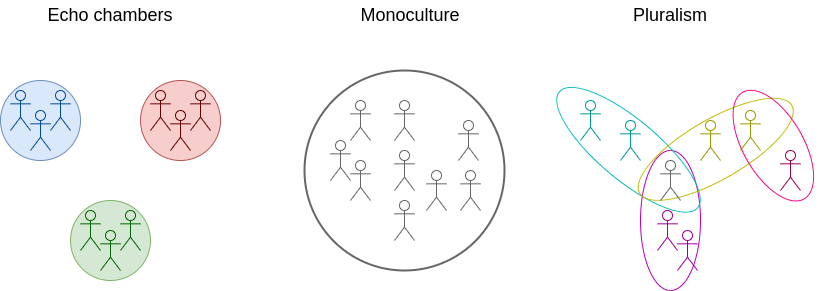
Ethereum is attempting a pluralistic path
Other attempts at similar two-tier models exist. The most notable example I can think of is EOS’s DPoS system in 2017. EOS’s DPoS allowed token holders to vote for representatives who would run the chain. These representatives were responsible for producing blocks and reaching consensus on others’ blocks, and they received large token allocations from EOS issuance. To win votes, representatives engaged heavily in community building, and many “nodes” (like EOS New York, EOS Hong Kong) became well-known brands.
Ultimately, this became an unstable system because token-based voting itself proved unstable, and some powerful figures in the EOS ecosystem turned out to be greedy individuals who misappropriated large funds raised by their representative communities for personal gain. However, while it worked, it demonstrated a remarkable feature: it created strong, highly autonomous sub-communities that were still working toward a shared goal.
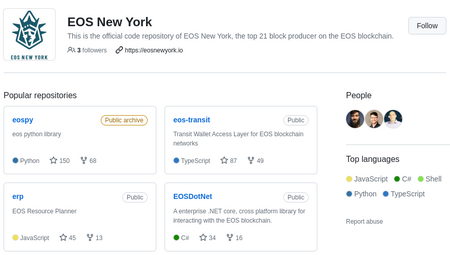
EOS New York was one of EOS’s top block producers and even wrote a significant amount of open-source infrastructure code
When this kind of approach works well, it also creates healthy competition. By default, communities like Ethereum naturally favor cohesion among long-standing members. This helps preserve community values during rapid growth—reducing the chance that Ethereum stops caring about free speech or open source despite external pressures. But it can also shift focus from technical competence to social maneuvering, allowing even underperforming "OGs" to maintain stable positions and limiting the culture’s ability to self-renew and evolve. With healthy "subcultures," these issues can be mitigated: entirely new sub-communities can rise and fall, and those who succeed within them can even begin contributing to other parts of Ethereum. In short, legitimacy comes less from continuity and more from performance.
We can also examine the above story to identify potential weaknesses. Here are a few I see:
-
Echo chamber effects: Essentially the same failure mode I discussed in my previous article, but on the cultural level. L2s begin to resemble isolated universes with almost no cross-pollination.
-
Convergence into a single culture: Whether due to shared human biases, shared economic incentives, or an overly uniform Ethereum culture, everyone ends up looking for similar applications to build—or even making similar technical choices—which may ultimately be wrong. Alternatively, a single L2 or small group of L2s becomes entrenched, leaving no effective mechanism for newcomers or sub-communities to rise.
-
Competition favors the wrong vectors: L2s that focus narrowly on economic success at the expense of other goals appear successful, and over time, more of the ecosystem moves in that direction.
It's hard to say there are perfect solutions to these problems; Ethereum is an ongoing experiment, and part of what excites me about this ecosystem is its willingness to confront hard challenges. Many difficulties stem from misaligned incentives; a natural solution is to create better incentives for ecosystem-wide cooperation. My suggestion in the previous article—creating a "Basic Infrastructure Guild" to complement the Protocol Guild—is one option. Another is explicitly subsidizing projects where multiple L2s choose to collaborate (similar to quadratic funding, but focused on connecting ecosystems rather than individuals). Exploring and expanding these ideas—and continuing to fully leverage Ethereum’s unique advantage as a pluralistic ecosystem—holds significant value.
Join TechFlow official community to stay tuned
Telegram:https://t.me/TechFlowDaily
X (Twitter):https://x.com/TechFlowPost
X (Twitter) EN:https://x.com/BlockFlow_News
 @VitalikButerin











