Decentralized Sequencer's Debut: Understanding Morph's Self-Incentivizing Ecosystem Flywheel
TechFlow Selected TechFlow Selected
Decentralized Sequencer's Debut: Understanding Morph's Self-Incentivizing Ecosystem Flywheel
Decentralized sequencers were never just a technical narrative; once profit distribution rights are decentralized, they will completely reshape the L2 economic system.
 Navigating Web3 tides with focused insights
What is your first impression of a "decentralized sequencer"?
Is it about adhering to the technical philosophy and architecture of decentralization? Avoiding single points of failure in the network? Or perhaps a revolutionary new ecosystem model reshaping the economics of Layer 2 (L2)?
At its core, the sequencer has never been merely a technical issue—it's fundamentally an intricate matter of利益 distribution: within the L2 economic system, who gets to divide the pie, who it’s allocated to, and how should it be distributed?
It acts like a conductor’s baton, directly determining which developers and DApps are attracted to the application layer, and indirectly shaping the overall direction and character of the entire L2 ecosystem. In essence, the decentralization of L2 sequencers is always a means, not an end.
Interestingly, on May 6, Morph launched its Morph Holesky testnet, offering a preview of all mainnet functionalities—including the world’s first fully implemented decentralized L2 sequencer network. How will this debut of a new mechanism that delegates control over L2 revenue influence various developers, DApps, and technological advantages? Can it catalyze a breakthrough for L2 ecosystems—from zero to one—and enable mass adoption?
The Hidden Battle Behind Decentralized Sequencers
A sequencer, as the name suggests, manages the order in which transactions are batched and submitted from L2 to L1, making it a critical component in L2 architecture.
From an economic standpoint, we can roughly calculate that L2 net income = sequencer net income = total user spending on L2 – total L2 costs on L1 – sequencer operating costs. This implies that the sequencer holds direct authority over profit distribution—the entity controlling the sequencer controls the financial pipeline of the L2.
Currently, most L2 projects operate their sequencers centrally—controlled by the project team, which retains pricing power and collects revenues. This centralized approach serves as their primary revenue model, and they’ve reaped enormous profits:
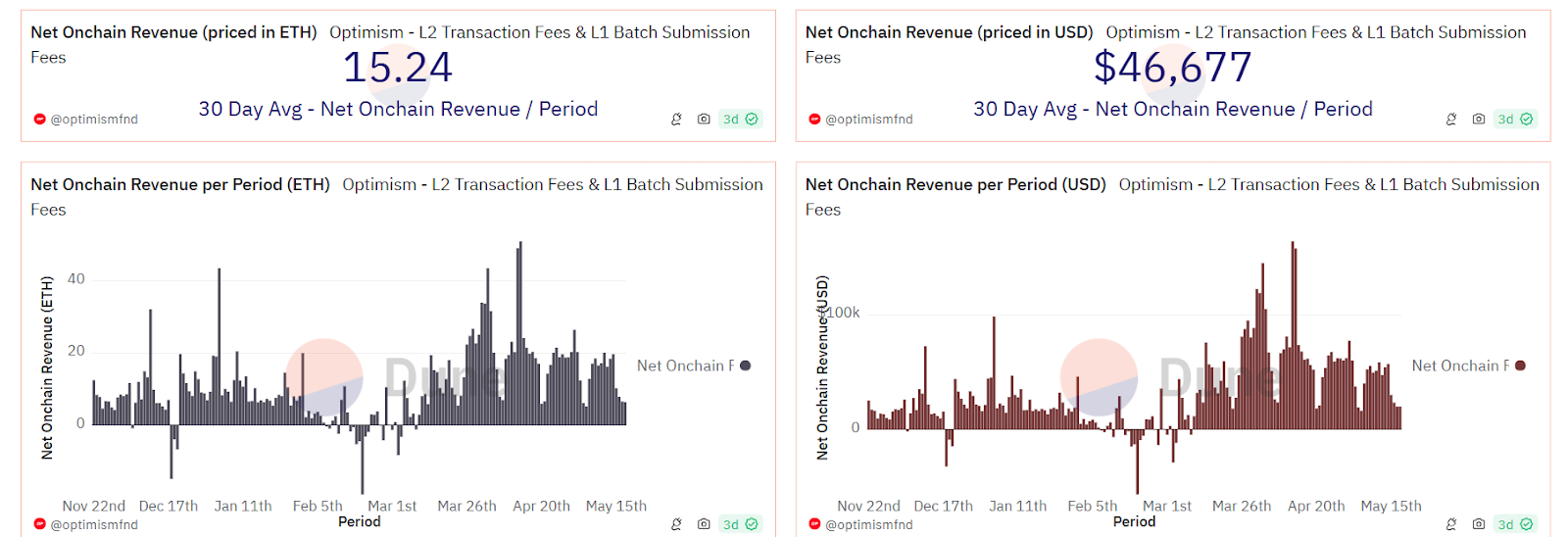
According to Dune data, Optimism averaged daily profits of $46,600 over the past 30 days—over $1.3 million per month—while Base generated more than $20 million in profit in March alone, demonstrating astonishing revenue-generating capabilities.
However, this model carries significant risks. If just a few centralized nodes go offline, the entire L2 network could suffer prolonged downtime. Moreover, these centralized sequencers may reorder transactions based on self-interest to maximize arbitrage opportunities, capture MEV value, delay user transactions, or even censor and reject them outright.
Thus, the benefits of decentralized sequencers are self-evident—they eliminate single points of failure, uphold the network’s decentralization, enhance security and stability, and allow broader sharing of sequencer-generated revenue across the network’s builders.
While Metis, Espresso, Astria, and Morph have all emphasized the importance of decentralized sequencers and included them in their roadmaps, only Morph has made tangible progress toward achieving true decentralization this month.
Looking closer, Metis represents the “in-house” model, while Espresso and Astria exemplify the “outsourced” or shared sequencer model—two primary approaches to building and maintaining decentralized sequencers. The former emphasizes internal management, security, and stability; the latter offers greater flexibility and openness, promoting interoperability and reducing operational burdens.
Metis: Representative of the “In-House” Model
For example, Metis operates its PoS sequencer pool similarly to rollups like Arbitrum and Optimism—using a PoS mechanism to elect sequencers and produce blocks. When users initiate transactions, they are sent to sequencer nodes in the network, which collect and bundle them into batches, signing each batch via TSS multi-signature.
This approach is gas-efficient for on-chain contract verification since a TSS signature behaves identically to an EOA address signature during validation.
However, the signing process is relatively complex and time-consuming. Each time the TSS node set changes, a KeyGen operation (generating private key shards and aggregated public keys) must be performed, which is also slow and subject to inefficiencies due to network uncertainty. As such, this method imposes strict limits on the number of signing nodes.
Espresso: Modular Design with Shared Sequencers
Shared sequencers, represented by Espresso and Astria, were designed to provide decentralized sequencing services to multiple Rollup networks. Their architecture prioritizes modularity and cross-Rollup interoperability.
Yet this comes with trade-offs:
-
Increased complexity in multiple areas—for instance, Espresso’s blocks contain transactions from multiple L2s, requiring filtering for relevant Rollup chains, and ZKP generation becomes more complex compared to standalone Rollup proofs;
-
Throughput for any individual L2 is inevitably reduced due to shared consensus load;
-
Difficulty accommodating specific L2 requirements—such as varying transaction caps per block (e.g., Chain A limited to 10M gas per block, Chain B capped at 500 transactions);
-
Since transactions aren’t executed during consensus, invalid transactions (e.g., incorrect nonce) might be included, leading to unnecessary gas loss for users;
-
Incentive and penalty mechanisms become significantly more complex;
Morph: Decentralized Sequencer Designed at the Foundational Level
As Ethereum’s first L2 network to implement a decentralized sequencer at the foundational level, Morph has emphasized this design from day one, creating a practical solution guided by principles of high efficiency, low cost, scalability, and maintainability.
In Morph’s operational model, a decentralized sequencer network allows multiple nodes (sequencers) to participate in transaction bundling and ordering, rather than relying on a single controlling node.
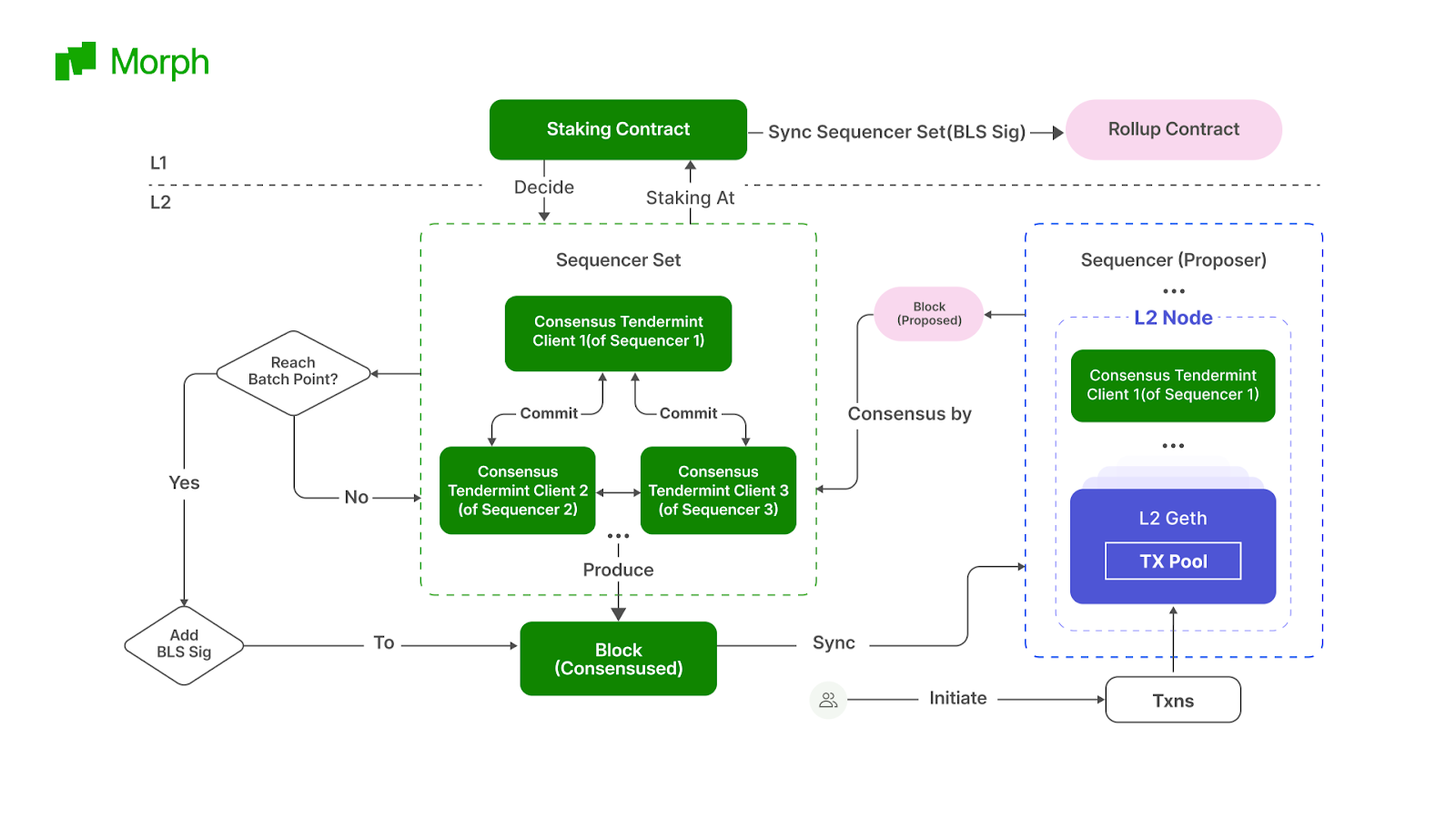
Compared to Metis, Morph employs Tendermint consensus with BLS aggregate signatures to reduce verification overhead.
Unlike TSS-based batch signing, this approach eliminates the need for additional P2P interactions, improves signature algorithm efficiency, simplifies node rotation, and maintains full decentralization without single-point-of-failure concerns.
Morph: Dual-Layer Mechanism Combining “Base Security + Multiple Revenue Streams”
To summarize Morph’s decentralized sequencer architecture in one sentence: it features a dual-layer design based on “L1 ETH staking for access” + “L2 Morph token staking for election.”
-
At the L1 layer, ETH staking enables an LST economy, allowing users to earn staking/restaking returns similar to those from ETH PoS. Effectively, Morph leverages the ETH LST capital pool to secure the decentralized sequencer at the base layer;
-
At the L2 layer, staking Morph tokens generates PoS interest income. With inherent yield-bearing properties, staked Morph tokens can further be used in on-chain use cases, enabling rich derivative yield scenarios;
L1: ETH Staking for Access
Users can deposit ETH into Morph on the mainnet as collateral to join the decentralized sequencer network. Malicious behavior by sequencers results in slashing of this collateral.
Once received, Morph leverages deeply integrated ETH restaking protocols to restake the deposited ETH, thereby inheriting Ethereum’s consensus security and realizing the vision of “sharing Ethereum’s mainnet security” at the L2 level.
This design allows ETH holders to achieve returns comparable to direct Ethereum staking, restaking, or liquid staking. By leveraging ETH, Morph secures its decentralized sequencer with Ethereum’s massive capital base—raising the cost of attacks prohibitively high—while simultaneously releasing liquidity through LSTs, greatly enhancing capital efficiency.
From an opportunity cost perspective, users no longer sacrifice potential LST/LRT yields by staking ETH with Morph to participate in the decentralized sequencer.
L2: Electing Block Producers via Morph Token Staking
Next, users stake Morph tokens (not yet issued) at the L2 level to participate in sequencer elections and block production.
Users can delegate their Morph tokens to any sequencer node to accumulate staking weight. The top X nodes by staked amount are elected and allowed to propose and submit blocks.
As rewards, elected and active block-producing sequencers receive newly minted Morph tokens—analogous to “PoS mining” at the L2 level, where emissions serve as PoS interest income.
This establishes the Morph token as a “native asset with underlying yield,” enabling the creation of a new LST economic mechanism and DeFi trading scenarios:
Eligible block producers can receive a new LST (e.g., stMORPH) based on their staked and delegated Morph tokens. stMORPH accumulates staking rewards and can be used across various on-chain applications—DEXs, lending platforms, LSD protocols—enabling rich yield-generating derivatives and immediate access to mature DApp ecosystems.
This integrates seamlessly with existing ecosystems—supporting liquidity pools on Curve, swapping or LP provision on Uniswap using stMORPH, or collateralizing stMORPH on Aave to borrow other crypto assets—unlocking diverse DeFi farming opportunities.
Overall, with multiple yield streams combined, Morph’s pioneering L2 decentralized sequencer mechanism creates multi-tiered returns for both ETH and Morph token holders—leveraging Ethereum’s capital for security while activating the Morph token to support a vibrant DApp ecosystem.
An Ecosystem “Racing Mechanism” Based on Sequencer Profits
Furthermore, this decentralized sequencer mechanism unlocks a grander potential vision: redistributing sequencer profits (or decision rights) back to project teams, DApp developers, and protocols on-chain, empowering the L2 ecosystem with genuine “self-sustaining growth.”
In short, Morph would oversee macro-level incentives for autonomous sub-ecosystems (developers, projects, DApps, protocols), while these micro-level communities manage actual implementation and user cultivation—sparking grassroots innovation. This developer- and DApp-centric model, rather than being user-facing, could become the inflection point for L2 ecosystem breakout and explosive growth.
In the future, after collecting gas fees from users, Morph’s sequencer could redistribute profits according to predefined rules to on-chain projects and DApps—creating a novel incentive framework.
Projects could fairly and transparently earn rewards based on contributions, fostering a “community racing” dynamic—a self-reinforcing growth loop where the sequencer fee becomes a lever to incentivize DApps to actively contribute to the Morph ecosystem.
This maximizes each project’s strengths, creating a highly competitive marketplace among DApps for marketing and innovation, motivating contributors to collectively ensure Morph’s long-term sustainability.
A simple example: if Morph ties incentives to the amount of gas consumed by a DApp’s smart contracts and its number of active users, developers are indirectly motivated to increase both metrics—driving the breakthrough from zero to one and enabling mass adoption.
This empowers B2B operators—developers, DApps, protocols, market makers—to leverage their existing user bases for user acquisition and promotion, rapidly forming diverse “Morph sub-ecosystem communities,” each implementing tailored strategies based on their unique circumstances:
-
For instance, DApps could offer tiered rewards (3%, 4%, 5%) tied to transaction volume levels, boosting user activity;
-
Wallet providers could introduce staged incentive programs for users holding different token amounts, retaining core users and reducing churn;
Theoretically, this design enables “a hundred flowers blooming, a hundred schools contending”—low-cost, rapid expansion and deployment for Morph from scratch, while offering users differentiated, efficient, and diverse on-chain service options.
Finally, project teams and DApps receiving sequencer fee revenues can redistribute these profits as incentives to end-users to meet their operational needs. This gives DApps an additional tool for user engagement while helping Morph achieve widespread adoption—a true win-win scenario.
Conclusion
In summary, decentralized sequencers are far more than just a technical narrative. Once profit distribution rights are decentralized, they represent a complete overhaul of the L2 economic system.
The long-awaited breakout moment for L2 ecosystems may well emerge under this new economic paradigm driven by decentralized sequencers.
The future often exceeds imagination. Looking back years later, this might mark a bold turning point—and pioneers like Morph, the first true decentralized sequencer, could reshape the Ethereum and broader L2 landscape in ways yet to be seen. The possibilities are worth anticipating.
Join TechFlow official community to stay tuned
Telegram:https://t.me/TechFlowDaily
X (Twitter):https://x.com/TechFlowPost
X (Twitter) EN:https://x.com/BlockFlow_News
 @MorphLayer