Cobo: The New Economic Script After the Bitcoin Halving
TechFlow Selected TechFlow Selected
Cobo: The New Economic Script After the Bitcoin Halving
The real future returns of Bitcoin will come from using it as an investment asset in ecosystem projects such as L2, DeFi, and CeFi, where holders will earn yields—a key development trend for the Bitcoin ecosystem.
 Navigating Web3 tides with focused insights
Post-halving Bitcoin is poised to hit new highs, while the BTC ecosystem continues to develop comprehensively, with Layer2 and (Re)Staking projects emerging constantly. Why does Bitcoin need its own (re)staking, and what justifies its existence? What new opportunities will emerge for entrepreneurs and investors after the BTC halving? How large is the market size for BTC staking? Is this a long-term opportunity or a short-lived trend?
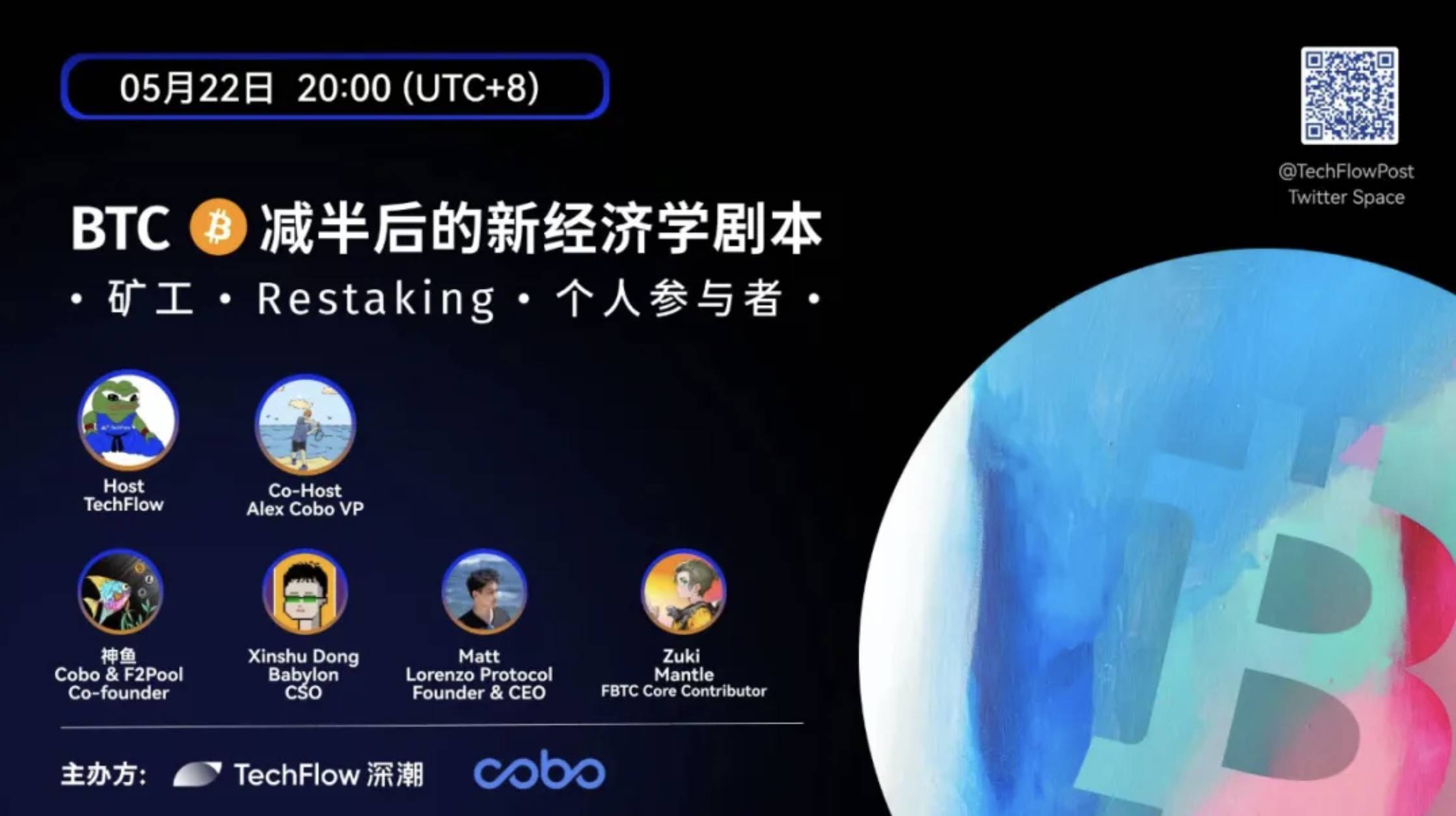
On the evening of May 22, Cobo co-hosted with TechFlow, Babylon, Lorenzo Protocol, and FBTC a Space on X titled "The New Economic Script After BTC Halving," diving deep into this topic.
Cobo has compiled key insights from the speakers and shares them here with Cobo users and readers.
As a global leader in digital asset custody solutions, Cobo now offers a convenient Babylon Staking API integration, enabling rapid access to the Babylon ecosystem and BTC yield opportunities. We welcome entrepreneurs building within the BTC staking ecosystem to contact us—Cobo provides strong ecosystem fund support and multiple developer-friendly tools.
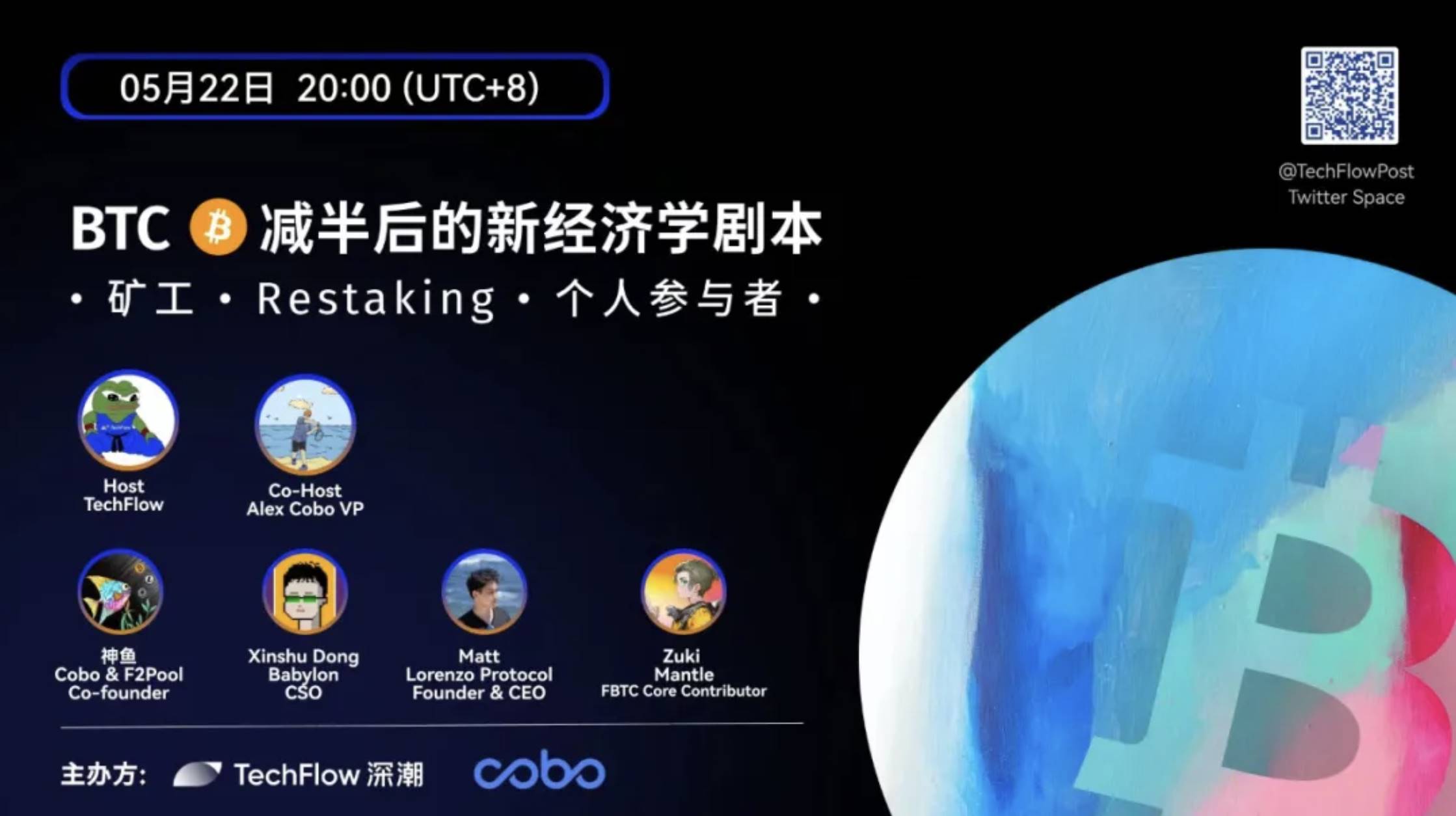
Participants included key players from the BTC ecosystem: Shen Yu, Co-founder and CEO of Cobo and veteran BTC miner; Xinshu Dong, CSO of Babylon, the first decentralized trustless Bitcoin staking protocol; Matt, Founder & CEO of Lorenzo Protocol, offering BTC restaking tokenization and financial derivatives solutions; and Zuki, core contributor of FBTC.
As participants and long-term believers in the BTC ecosystem, all four guests agreed that significant opportunities exist across short-, mid-, and long-term horizons. So how can one capture these opportunities and meet the overflow demand from the BTC ecosystem? Each speaker shared perspectives based on their background and products, discussing breakthroughs and opportunities for BTC entrepreneurship, and expressed optimistic outlooks on future potential.
Key takeaways are summarized below:
-
This Bitcoin halving is influenced by multiple factors, making post-halving market trends uncertain. The halving primarily affects supply, sharply reducing miner revenue—especially for those using older mining rigs (e.g., S19 Pro, M21). These miners face margin pressure, forcing upgrades, cost optimization, shutdowns, or relocation to low-cost electricity regions. However, due to strong risk resilience among large-scale mining firms and traditional capital, overall network hash rate decline remains limited.
-
Bitcoin mining rewards will gradually decrease, eventually converging to zero. Future returns on Bitcoin will come from investing it as an asset in L2, DeFi, CeFi, and other ecosystem projects. Holders will earn yields from such investments—an important development trend for the Bitcoin ecosystem.
-
Miner income will come from two sources: newly issued BTC and transaction fees—the latter depending on Bitcoin’s ecosystem activity. More engaging staking projects can incentivize ecosystem growth, drive more on-chain activity and transactions, enhance network security, and increase miner fee income.
-
PoS lacks external economic incentives; its security depends solely on the size of its on-chain economy, creating vulnerability to takeover. Bitcoin staking and restaking protocols introduce massive external assets (BTC) to secure PoS networks, solving this inherent flaw—this is the justification for Bitcoin (re)staking.
-
Shen Yu, Co-founder and CEO of Cobo, predicts: BTC staking will become a multi-billion-dollar market, comparable to early PoW mining, capable of meeting future demand from high-performance app chains needing robust security infrastructure.
-
Matt, CEO of Lorenzo Protocol: Four key areas to watch in the Bitcoin ecosystem—architectural innovation, L2 development paths, efficient asset circulation, and security assurance.
-
For ecosystem builders and entrepreneurs: Short-term focus should be solving BTC network congestion and capturing spillover demand; mid-term on yield needs of holders; long-term on ecosystem expansion following potential script language upgrades. Key questions: Will more Bitcoin-centric applications emerge? Better tools for Bitcoin usage? Novel programming models to overcome non-Turing completeness?
-
Babylon acts as the EigenLayer of the Bitcoin ecosystem, addressing objective misbehavior issues, whereas EigenLayer deals with subjective attacks.
How will the recent Bitcoin halving impact various participants—including miners, individuals, and projects—and what major changes can we expect in the ecosystem?
Shen Yu: The Bitcoin halving mainly impacts the supply side, affecting various stakeholders:
For miners: Halving drastically reduces miner income, severely impacting those using outdated hardware (e.g., S19 Pro, M21), whose marginal costs exceed revenues, forcing shutdowns or migration to cheaper electricity zones. This accelerates miner upgrades and cost optimization. However, due to resilient large public mining firms and institutional capital entering the space, the drop in total network hash rate is limited.
For individual investors: The main impact is psychological—expecting new market momentum months after halving. But this year, macroeconomic conditions and Bitcoin ETFs add uncertainty to price movements.
Xinshu: This Bitcoin halving was relatively smooth. With increasing institutional participation, the market is becoming more professional and institutionalized. People are now asking: beyond holding and mining, can Bitcoin serve other purposes and generate sustainable yields without relying on inflation subsidies? As the leading cryptocurrency, can Bitcoin extend its influence deeper into the broader crypto community?
Babylon’s initial step is extending Bitcoin’s security to other PoS chains. Currently, PoS chains rely on high inflation to maintain native token staking because low APY fails to attract long-term holders.
Babylon creates an open market allowing idle Bitcoin to participate in staking and provide security to other chains. Compared to small PoS chains chasing high APY, Bitcoin stakers have lower yield expectations. This allows PoS chains to leverage BTC staking—boosting holder returns while significantly lowering their own inflation rates.
Long term, more importantly, Bitcoin could gain broader utility and yield scenarios, attracting more participants beyond mining profits. Projects like Babylon will bring new use cases, diversifying the entire ecosystem.
Matt: Bitcoin’s quadrennial halving is a fixed trend—mining rewards will gradually decline until they converge to zero. At that point, true returns for BTC holders will come from investing in L2, DeFi, CeFi products, empowering these services, expanding Bitcoin’s ecosystem, and generating new yields—this will become a dominant trend.
Many BTC holders and projects are driving this shift—for example, Babylon deploys scarce Bitcoin capital into demand-side applications, securing PoS chains or L2s, allowing investors to earn returns. If Bitcoin evolves into an investment asset or currency, it will require efficient liquidity markets and asset liquidity mechanisms.
How do miners view staking, and what impact does it have on miner income and network security?
Shen Yu: From a miner’s perspective, staking benefits the Bitcoin ecosystem.
First, Bitcoin itself doesn’t need staking—but holders and miners want the yield benefits it brings. As a hard currency, Bitcoin has historically lacked native yield generation. Staking allows BTC holders to earn token rewards from new projects.
Second, miner income comes from two parts: newly minted BTC and transaction fees—the latter tied to ecosystem activity. More innovative staking projects stimulate ecosystem growth, increase on-chain activity and transactions, and thus improve network security.
Therefore, both miners and BTC holders benefit from more staking and restaking protocols. A more vibrant ecosystem means higher returns.
What is the market size of staking? Is this a long-term opportunity or a short-term hype?
Shen Yu: The core issue with PoS is the lack of external economic incentives. Its security relies entirely on the value of native tokens, limiting overall security to the size of its on-chain economy. During bear markets, attackers may gain control of nodes and compromise the entire chain.
Bitcoin staking and restaking protocols introduce large off-chain assets independent of any single chain, providing external economic incentives and enhanced security for PoS networks. With Bitcoin’s market cap exceeding $1 trillion, this continuous injection of external value greatly improves security. This innovation solves PoS’s inherent externality problem, is already being implemented, and holds massive potential.
I believe BTC staking is at least a multi-billion-dollar market—comparable to early PoW mining. With modular blockchain development, many high-performance application chains will emerge, demanding secure infrastructure—BTC staking protocols can fulfill that need.
In 2024, I’m actively investing in upstream and downstream assets in the restaking sector. At the company level, we’re allocating significant human and material resources to embrace this innovation.
For ecosystem builders, entrepreneurs, and other builders—how can they seize the opportunity presented by this BTC narrative wave? Which areas are most promising?
Shen Yu: Over the past six months, innovation has emerged in the Bitcoin ecosystem, sparked by grassroots innovations like inscriptions and runes over the last year, attracting many new users. Their demands cause network congestion and spillover effects, pushing us to explore better Layer2 solutions.
For builders and entrepreneurs, seizing the BTC narrative involves three stages:
-
Short-term: Address current network congestion by providing better services and solutions for overflow demand.
-
Mid-to-long term: Most BTC holders seek native asset yield. Entrepreneurs should consider how to offer stable, low-risk returns—exploring CeDeFi and restaking applications presents mid-to-long-term opportunities.
-
Long-term: If Bitcoin’s scripting language upgrades (e.g., OP Code, OP_CAT), truly scalable trustless, permissionless applications can emerge. That’s the long-term vision and opportunity.
Overall, major opportunities lie in short-term service improvements, mid-term yield solutions, and long-term post-upgrade ecosystem development.
Matt: Overall, the Bitcoin ecosystem faces several key challenges:
-
Architectural Innovation: Bitcoin’s architecture may need updates to support fully decentralized on-chain settlement—advancing OP Codes for advanced functionality would be a breakthrough milestone for DeFi and BTC L2s.
-
L2 Development Path: Will there be one dominant L2, or a network of interoperable L2s connected via common standards? Regardless, efficient movement of Bitcoin assets is crucial—requiring efficient markets, derivatives, etc.
-
Security: Providing stronger infrastructure-level security and financial safeguards for investors is critical. Insurance-like products on DeFi infrastructure can keep risks manageable.
In summary, architectural innovation, L2 path selection, efficient asset circulation, and security are central challenges for the Bitcoin ecosystem.
What was Babylon’s original mission? Why does BTC need staking? And how is it different from Ethereum staking or restaking (e.g., EigenLayer)?
Xinshu: Babylon’s design goal is to enable Bitcoin to participate in a broader decentralized ecosystem by providing security for other PoS chains or Layer2 networks. By staking BTC assets, Babylon creates a credible, “inexhaustible” collateral pool to enhance their security—distinct from Ethereum’s staking/restaking model:
-
Different goals: Ethereum secures its own chain; Babylon secures other chains/networks.
-
Different implementation: Ethereum aggregates deposits via smart contracts; each Bitcoin user independently stakes BTC locked in UTXO scripts—more decentralized.
Babylon leverages Bitcoin’s UTXO model to create a novel, decentralized, distributed staking architecture—fundamentally different from Ethereum’s pooled contract model. This is the core technical innovation.
Restaking makes sense because locking crypto as collateral enables slashing of malicious actors, ensuring network security. Traditionally, native tokens are staked, but they suffer from small supply and high inflation. Babylon brings the most secure blockchain asset—Bitcoin—into the staking system, vastly expanding staking use cases.
Why did Lorenzo choose the BTC restaking space? How big is this market? What opportunities exist?
Matt: Lorenzo chose this space because we strongly believe in BTC restaking. The US money supply is ~$2.4T, debt market ~$50T; Bitcoin’s market cap is ~$1.4T (~60% of USD supply). Extrapolating, the BTC restaking market could theoretically reach $30T—huge potential.
At its core, BTC restaking is lending Bitcoin liquidity—locking part as collateral to provide security, then reclaiming principal plus interest. It’s a risk-free lending mechanism, similar to buying government bonds.
Lorenzo is solving the first step: securitizing the principal and lending process. Through two standardized assets—STBTC (principal) and yield tokens (interest)—we unify liquidity and enable richer financial derivatives like options and futures. Lending also unlocks massive Bitcoin liquidity for integration with DeFi lending, stablecoins, exchanges. Our asset standard can collaborate with other restaking projects, providing additional collateral via STBTC.
What role does FBTC play in the BTC DeFi ecosystem?
Zuki: FBTC is a 1:1 Bitcoin-pegged asset, serving as a bridge between native Bitcoin holdings and DeFi/infrastructure projects. As a conduit, FBTC ensures security while allowing users to freely choose services and yield opportunities. Unlike WBTC, FBTC explores new mechanisms to improve Bitcoin capital efficiency, offers ecosystem incentives, and enables multiple returns for holding and trading. We aim to transplant Ethereum’s yield model to Bitcoin, fostering further innovation.
Babylon requires two transactions. If the second transaction involves slashing, the private key might be exposed—potentially losing all funds. How is this designed? Is it user-friendly for retail users?
Xinshu: Babylon’s slashing mechanism exposes a node’s private key if it signs two different blocks at the same height (double-signing). Once exposed, anyone can complete the missing signature to execute the slash. Important clarifications:
-
Only the node’s private key is exposed—not the staker’s private key.
-
The node key is only used for block signing and holds no other assets. Even if slashed, other assets remain safe.
-
Not all staked BTC is slashed during double-signing—partial slashing parameters are adjustable.
-
Slashing transactions require three signatures: two pre-signed, the third withheld. If a node misbehaves and exposes its key, anyone with the key can complete and broadcast the transaction.
-
Private key exposure occurs because digital signatures require unique nonces. Reusing the same nonce for two messages breaks privacy. Babylon mandates predetermined nonces per height—reusing one triggers exposure.
Will existing EigenLayer-based AVS migrate to Babylon? Will Babylon host entirely new types of projects? What forms will they take?
Xinshu: Babylon primarily addresses equivocation—signing two different blocks at the same height—also known as “double signing.” This fork-inducing attack is an objective safety violation. Only nodes controlling private keys can commit this act. Babylon specifically mitigates this objective threat, relevant to blockchains with multiple validators and valuable data (like Cosmos chains) or single-sequence Layer2s.
EigenLayer handles subjective slashing (inter-subjective slash), requiring social consensus to determine fault—fundamentally different from Babylon’s focus on objective violations. Some community projects can achieve subjective slashing using tokens derived from BTC staking on Babylon (e.g., Liquity staking tokens).
Technically, these projects face AVS scenarios similar to EigenLayer. But they tend to focus more on AVS forms related to Bitcoin ecosystem applications.
Join TechFlow official community to stay tuned
Telegram:https://t.me/TechFlowDaily
X (Twitter):https://x.com/TechFlowPost
X (Twitter) EN:https://x.com/BlockFlow_News
 Cobo
Cobo