
Not all crypto AI projects are BS—how to identify real use cases and fake demands?
TechFlow Selected TechFlow Selected
Not all crypto AI projects are BS—how to identify real use cases and fake demands?
Encryption technology is seen as a force against AI centralization.
 Navigating Web3 tides with focused insights
Author: 563
Compiled by: TechFlow
Navigating the intersection of crypto and artificial intelligence.

When hunting for new alpha, we inevitably come across noise. When a project can raise five- to six-figure sums with just a semi-coherent pitch deck and decent branding, speculators latch onto every new narrative. And as traditional finance rushes into the AI trend, the "crypto x AI" narrative has amplified this problem.
The core issue with most of these projects is twofold:
-
Most crypto projects don't need AI
-
Most AI projects don't need crypto
Not every decentralized exchange (DEX) needs an AI assistant built in, and not every chatbot requires a companion token to drive its adoption curve. This forced coupling of AI and crypto made me nearly collapse when I first dove deep into this narrative, as I shared earlier.
What's the bad news? Continuing down this path only further centralizes this technology—and will ultimately fail, while flooding the space with fake "AI x Crypto" projects that make it harder to turn the tide.
And the good news? There’s light at the end of the tunnel. Sometimes, AI genuinely benefits from cryptoeconomics. Likewise, in certain crypto use cases, AI solves real problems.
In today’s article, we’ll explore these key intersections—where niche innovation overlaps to form a whole greater than the sum of its parts.

A High-Level View of the AI Stack
Below is my take on the different verticals within the "crypto x AI" ecosystem (for a deeper dive, check out Tommy's thread). Note that this is a highly simplified view—but hopefully helpful in laying the groundwork.
At a high level, here's how it works together:
-
Massively collect data.
-
Process this data so machines understand how to ingest and apply it.
-
Train models on this data to create general-purpose models.
-
These models can then be fine-tuned for specific use cases.
-
Finally, deploy and host these models so applications can query them for useful implementation.
-
All of this requires massive compute resources, which can run locally or be pulled from the cloud.
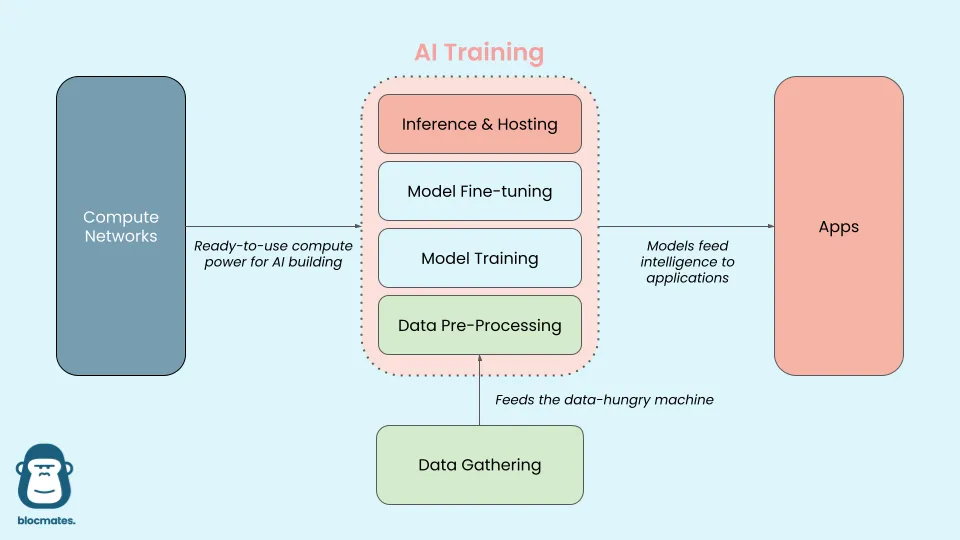
Let’s now examine each of these areas, focusing specifically on how different cryptoeconomic designs can actually improve standard workflows.
Crypto Gives Open Source a Fighting Chance
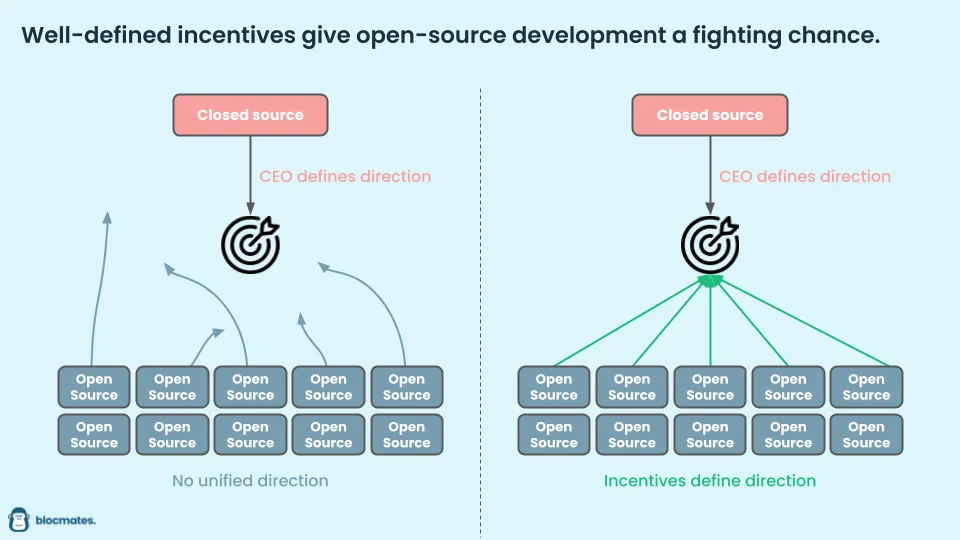
The debate between “closed-source” and “open-source” development traces back to the Windows vs Linux era and Eric Raymond’s famous “The Cathedral and the Bazaar”. While Linux is widely used among enthusiasts today, about 90% of users still choose Windows. Why? Incentives.
On the surface, open-source development offers many benefits. It allows the broadest possible participation and contribution. But in such a headless structure, there's no unified direction. A CEO doesn’t naturally prioritize widespread product usage to maximize their bottom line. In open-source development, projects risk becoming “chimeras,” splitting off at every conceptual crossroads.
So what’s the best way to align incentives? Build a system that rewards behaviors pushing toward the goal. In other words, put money directly into the hands of those whose actions bring us closer to our objective. With crypto, this alignment can be hardcoded into law.
Let’s look at some projects doing exactly that.
Decentralized Physical Infrastructure Networks (DePINs)
“Oh come on, again?” Yes, I know DePIN narratives are almost as overhyped as AI itself—but bear with me. I truly believe DePINs represent one of crypto’s most impactful real-world use cases. Think about it.
What is crypto really good at? Removing intermediaries and incentivizing behavior.
Bitcoin’s original vision was peer-to-peer money designed to cut banks out of the loop. Similarly, modern DePINs aim to eliminate centralized gatekeepers and introduce provably fair market dynamics. As we’ll see, this architecture is ideal for crowdsourcing AI-related networks.
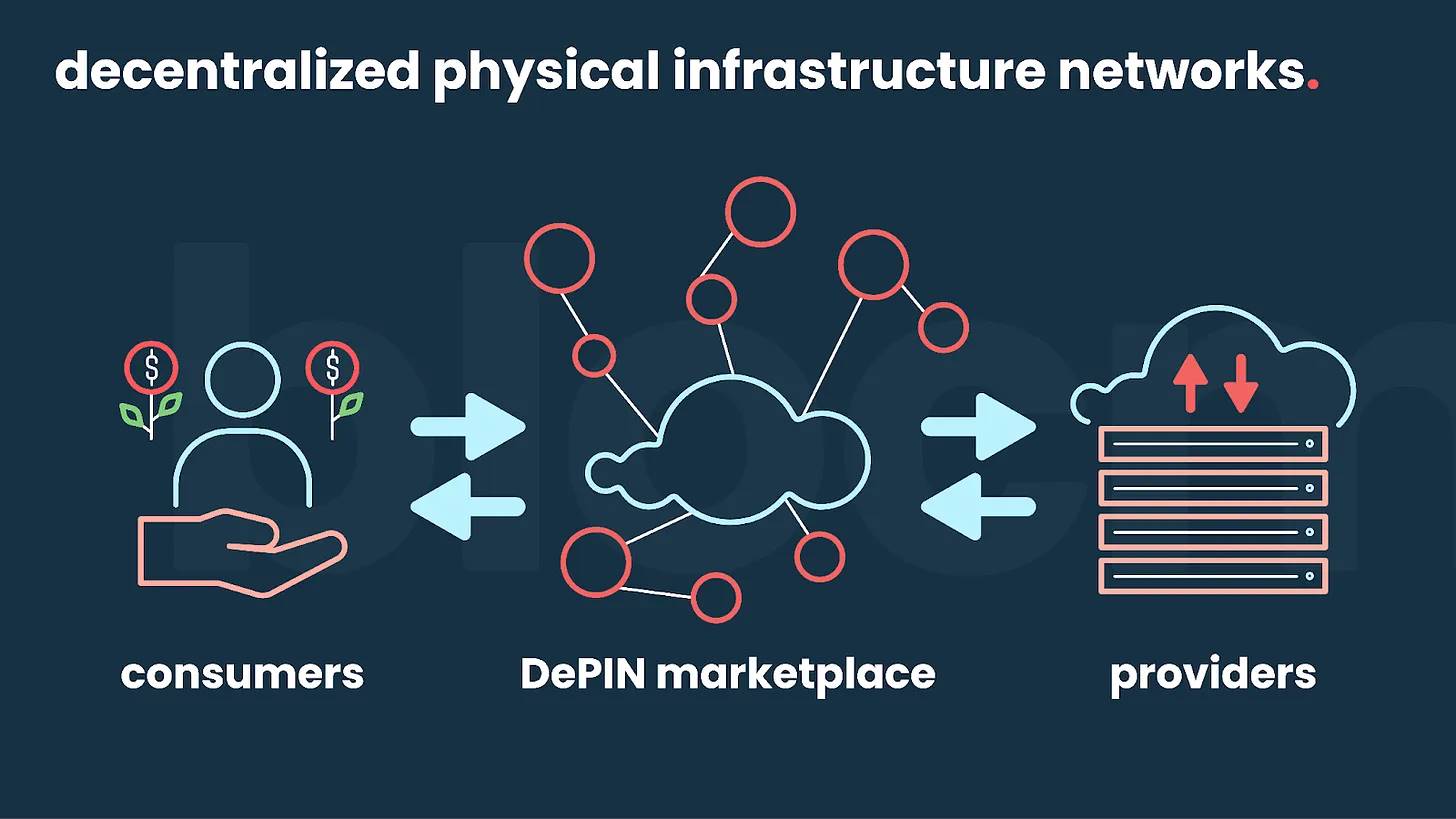
DePINs use early token issuance to bootstrap supply-side participants (“providers”), hoping this attracts sustainable demand. This aims to solve the cold start problem of new markets.
This means early hardware/software ("node") providers earn large token rewards and minimal cash. As users (in our case, ML builders) utilize these nodes and generate cash flow, this begins offsetting the declining token emissions over time—until a fully self-sustaining ecosystem emerges (which may take years). Early adopters like Helium and Hivemapper have demonstrated the effectiveness of this design.
Data Networks – The Case of Grass
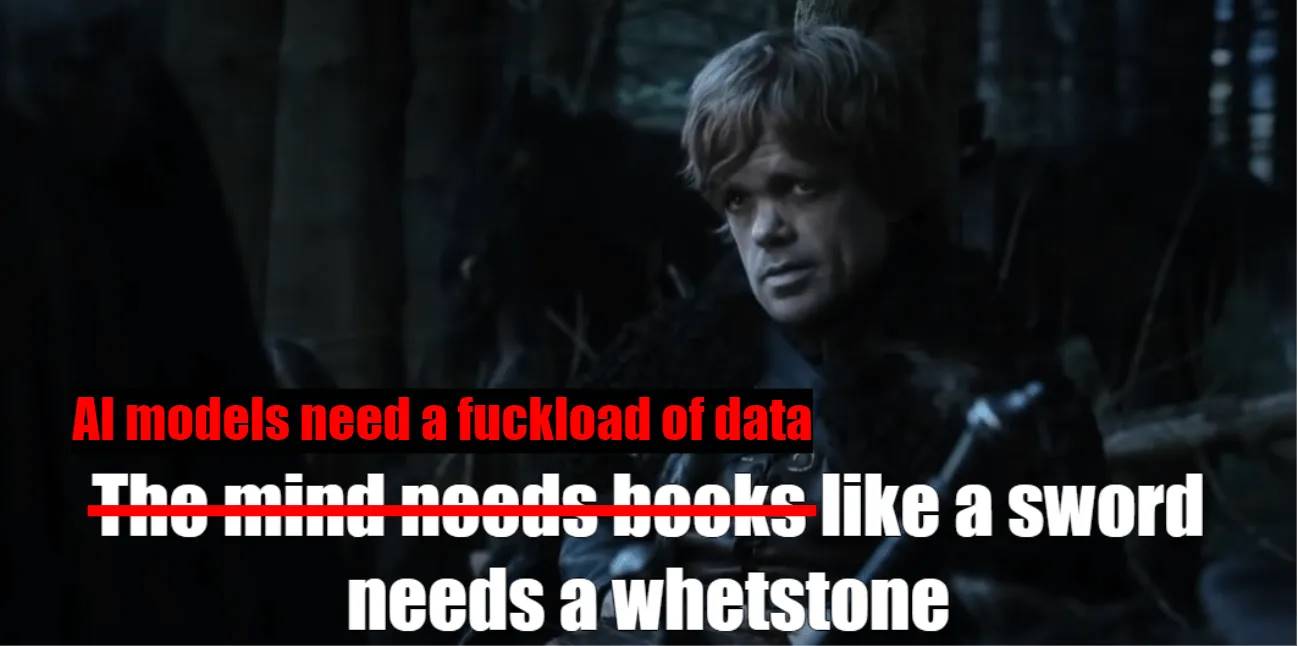
GPT-3 was reportedly trained on 45TB of raw text—equivalent to roughly 90 million novels (though it still can’t draw a circle). GPT-4 and GPT-5 require more data than exists on the entire surface web, making “data-hungry” the understatement of the century.
If you're not a top-tier player (OpenAI, Microsoft, Google, Facebook), accessing this data is extremely difficult. Most resort to web scraping—which works fine until you scale up. Attempting mass scraping via an AWS instance quickly hits rate limits. That’s where Grass comes in.
Grass connects over two million devices, organizing them to scrape websites from users' IP addresses, collecting, structuring, and selling the data to AI companies desperate for training material. In return, users participating in the Grass network earn steady income from AI firms using their data.
Currently, there’s no token—but a future $GRASS token could further incentivize users to install their browser extension (or mobile app). Still, they’ve already attracted massive user growth through an incredibly successful referral campaign.
GPU Networks – The Case of io.net
Even more critical than data is computational power. Did you know that in 2020 and 2021, China spent more on GPUs than oil? It sounds insane—but it’s just the beginning. Farewell oil coins; make way for compute coins.
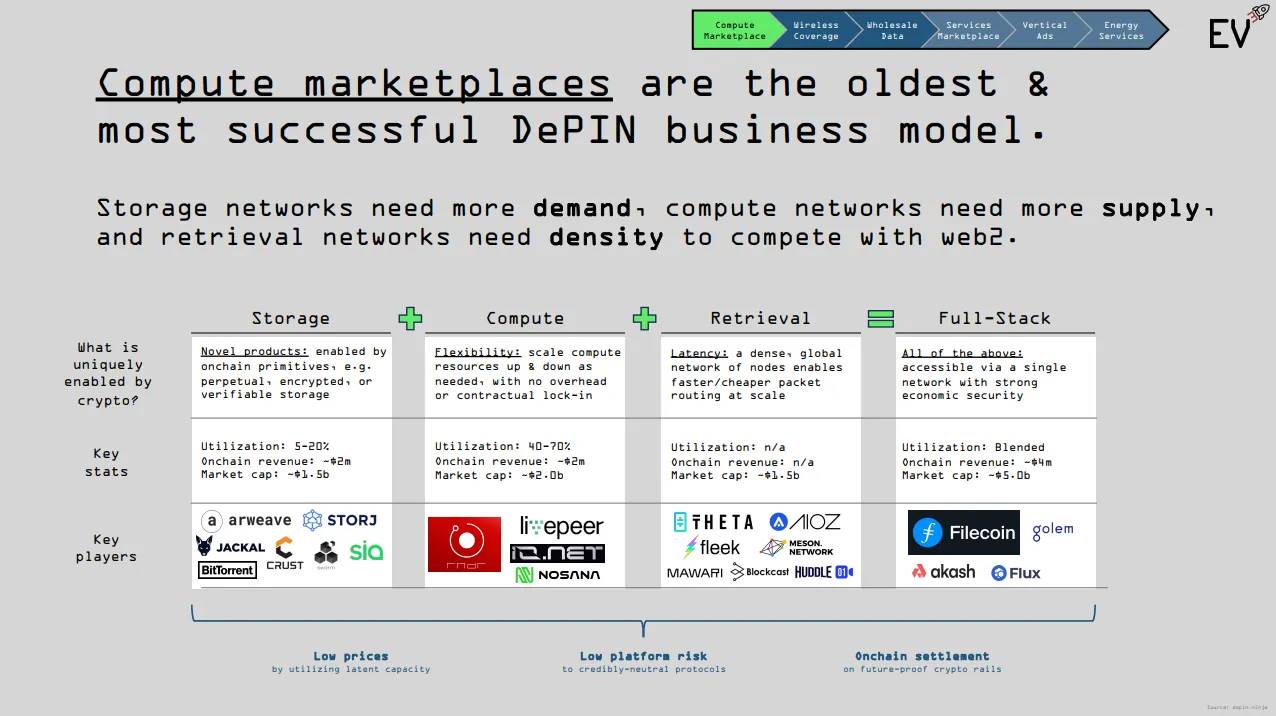
Today, numerous GPU DePINs exist, operating roughly as follows:
-
Machine learning engineers/companies desperately needing compute power
-
Data centers, idle mining rigs, and hobbyists with spare GPUs/CPU
Despite vast global supply, coordination is lacking. It’s not easy to contact 10 different data centers and solicit bids for your usage. A centralized solution would create a rent-seeking intermediary incentivized to extract maximum value from both sides—but crypto can help.
Crypto excels at creating market layers that efficiently connect buyers and sellers. A piece of code doesn’t answer to shareholder interests.
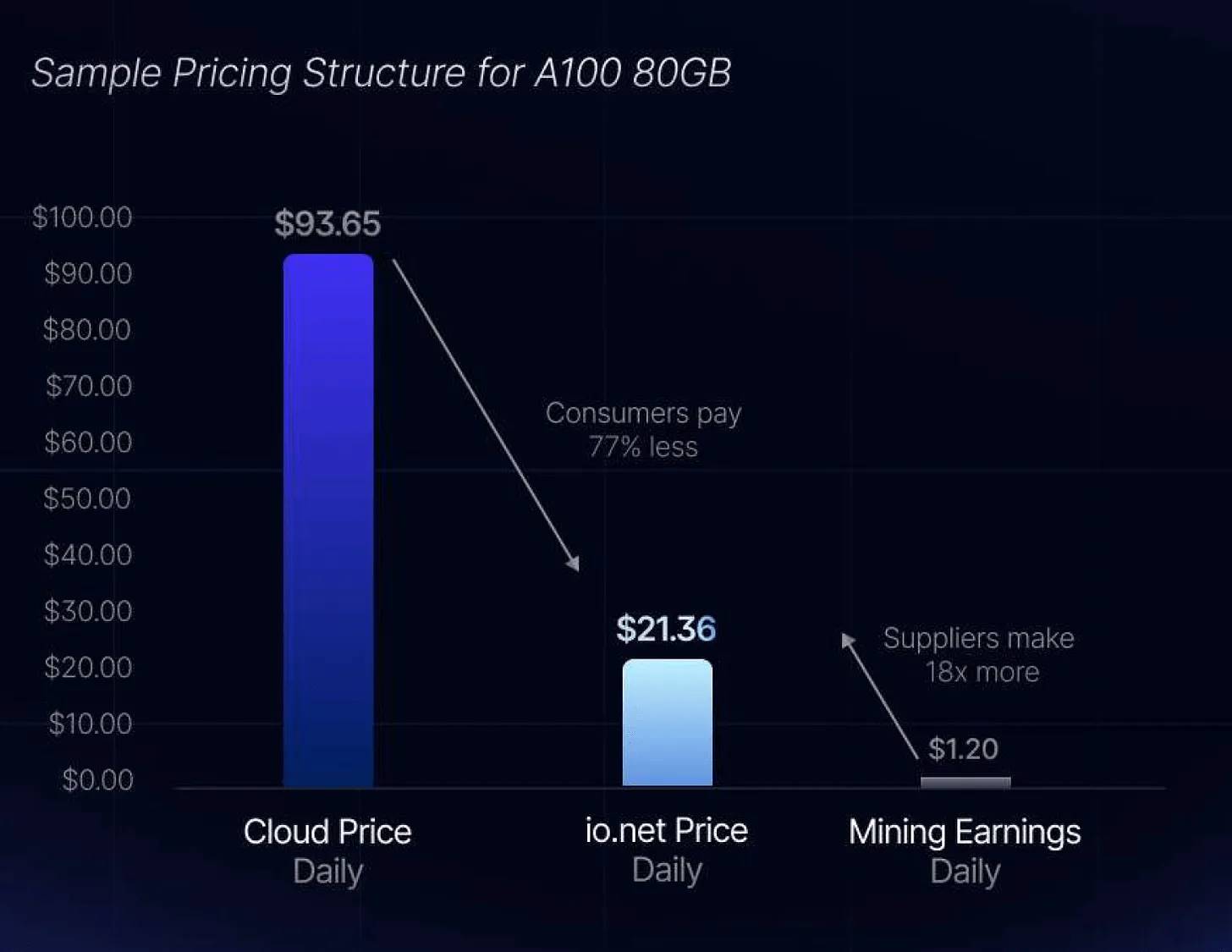
io.net stands out because it introduces cutting-edge tech crucial for AI training—their cluster stack. Traditional clusters involve physically connecting GPUs in the same data center to train models collaboratively. But what if your hardware is globally distributed? io.net partnered with Ray (used to build ChatGPT) to develop middleware that connects geographically dispersed GPUs into unified clusters.
Plus, while AWS registration can take days, clusters on io.net can launch permissionlessly in 90 seconds. For these reasons, I see io.net becoming the hub for all other GPU DePINs—each plugging into their “IO Engine” to unlock built-in clustering and seamless onboarding. All of this is only possible with crypto.
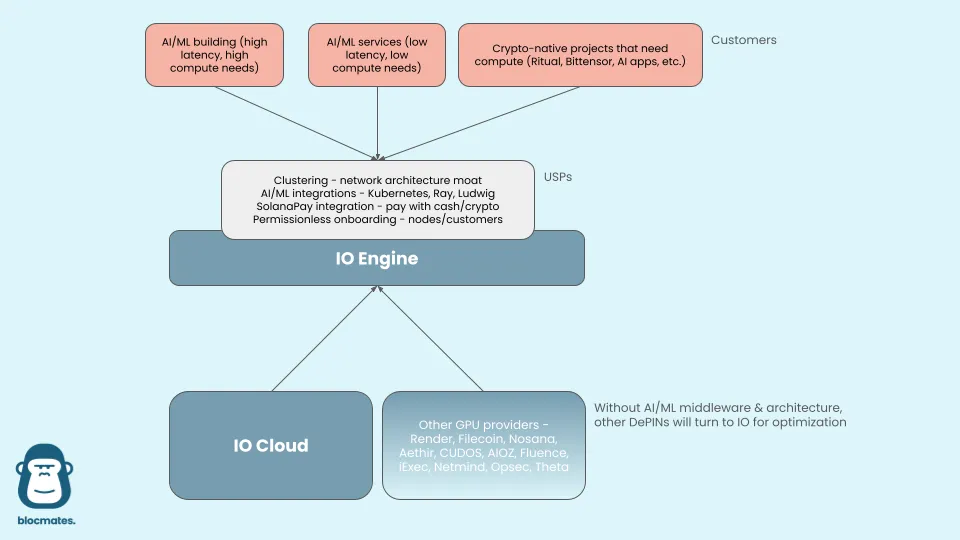
You’ll notice that most ambitious decentralized AI projects (like Bittensor, Morpheus, Gensyn, Ritual, Sahara) have clear “compute” demands—exactly where GPU DePINs should plug in. Decentralized AI needs permissionless compute.
Applying Incentive Structures
Back to Bitcoin’s insight. Why do miners continuously hash? Because that’s how they get paid—Nakamoto designed this architecture because it optimizes security. The lesson? The incentive structures baked into protocols determine the final product they produce.
Bitcoin miners and Ethereum stakers absorb all native tokens because that’s what the protocol wants to incentivize—participants become miners and stakers.
In an organization, this might come from a CEO defining the "vision" or "mission statement." But humans are fallible and may steer the company off course. Code, however, stays focused better than even the most dedicated wage slave. Let’s examine several decentralized projects whose built-in tokenomics keep participants aligned with noble goals.
AI-Building Networks – Exploring Bittensor
What if we had Bitcoin miners build AI instead of solving useless math puzzles? That’s Bittensor.
Bittensor aims to create multiple experimental ecosystems for experimentation, with the goal of producing “commoditized intelligence” within each. One ecosystem (called a subnet, or “SN”) might focus on language models, another on financial models, others on speech synthesis, AI detection, or image generation (see current active subnets).
For the Bittensor network, what you build doesn’t matter. As long as you can prove your project deserves funding, incentives flow. That’s the subnet owner’s job—they register the subnet and tune the game rules.
Participants in this “game” are called miners. These are ML/AI engineers and teams building models. They’re locked in a continuous review arena, competing fiercely to earn the highest rewards.
Validators are the other side, reviewing and scoring miner performance. Validators caught colluding with miners get expelled.
Remember the incentives:
-
Miners earn more when they outperform others within their subnet—driving AI advancement.
-
Validators earn more when accurately identifying high- and low-performing miners—maintaining subnet integrity.
-
Subnet owners earn more when their AI models prove more useful than others—pushing them to optimize their “game.”
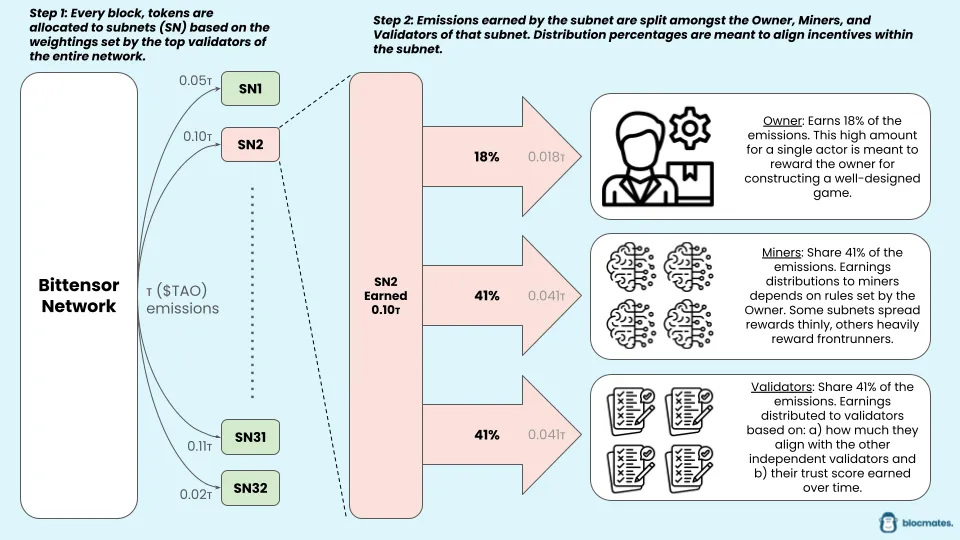
Think of Bittensor as a perpetual reward machine for AI development. An emerging ML engineer can try building something, pitch to VCs, and attempt to raise funds—or join a Bittensor subnet as a miner, go all-in, and earn substantial TAO. Which path seems easier?
Some top teams building on the network:
-
Nous Research is king of open source. Their subnet revolutionized fine-tuning open-source LLMs. By testing models against a continuous stream of synthetic data, they make leaderboards manipulation-proof (unlike traditional benchmarks like HuggingFace).
-
Taoshi's proprietary training network is essentially an open-source quant firm. They challenge ML contributors to build trading algorithms predicting asset price movements. Their API delivers quant-grade trading signals to retail and institutional users—and is rapidly approaching profitability.
-
Corcel team-developed Cortex.t serves dual purposes. First, it incentivizes miners to provide API access to top models (like GPT-4 and Claude-3), ensuring developer availability. It also provides synthetic data generation, valuable for model training and benchmarking (which is why Nous uses it). Check out their tools—chat and search.
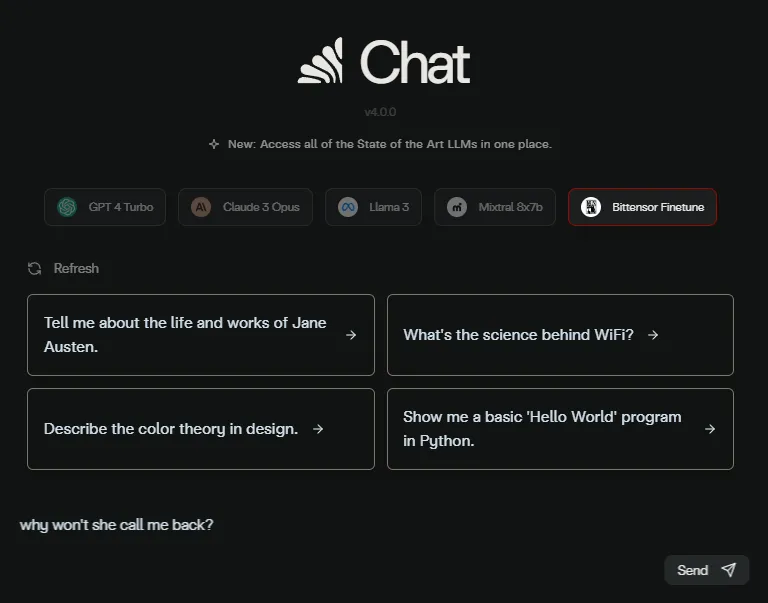
Unsurprisingly, Bittensor reaffirms the power of incentive structures—all made possible by cryptoeconomics.
Smart Agents – Exploring Morpheus
Now let’s examine Morpheus from two angles:
-
Cryptoeconomic structures building AI (crypto helping AI)
-
AI-powered applications enabling new crypto use cases (AI helping crypto)
“Smart agents” are simply AI models trained on smart contracts. They understand the inner workings of all top DeFi protocols, know where to find yield, where to bridge, and how to spot suspicious contracts. They are the future “auto-routers”—and in my view, they’ll be how everyone interacts with blockchains in 5–10 years. In fact, once we reach that point, you might not even realize you’re using crypto. You’ll just tell a chatbot you want to move some savings into another investment—and everything happens behind the scenes.
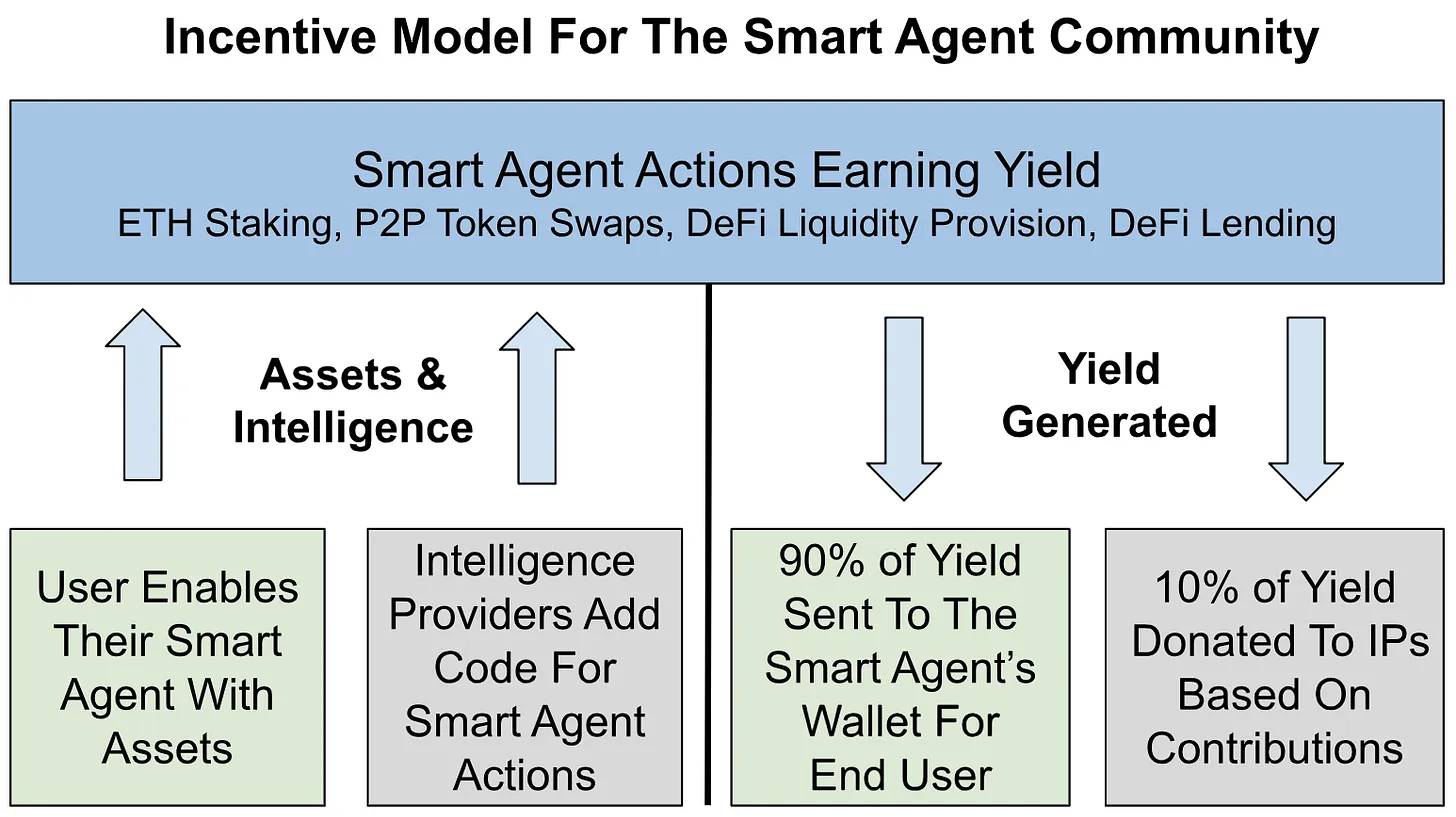
Morpheus embodies the “incentivize them and they will come” message in this domain. Their goal is a platform where smart agents can proliferate and thrive, each building upon the success of the last within an externality-minimized ecosystem.
The token inflation structure highlights four key contributors to the protocol:
-
Code—agent builders.
-
Community—builders of front-end apps and tools attracting new users.
-
Compute—providers supplying computing power to run agents.
-
Capital—those providing liquidity to fuel Morpheus’ economic engine.
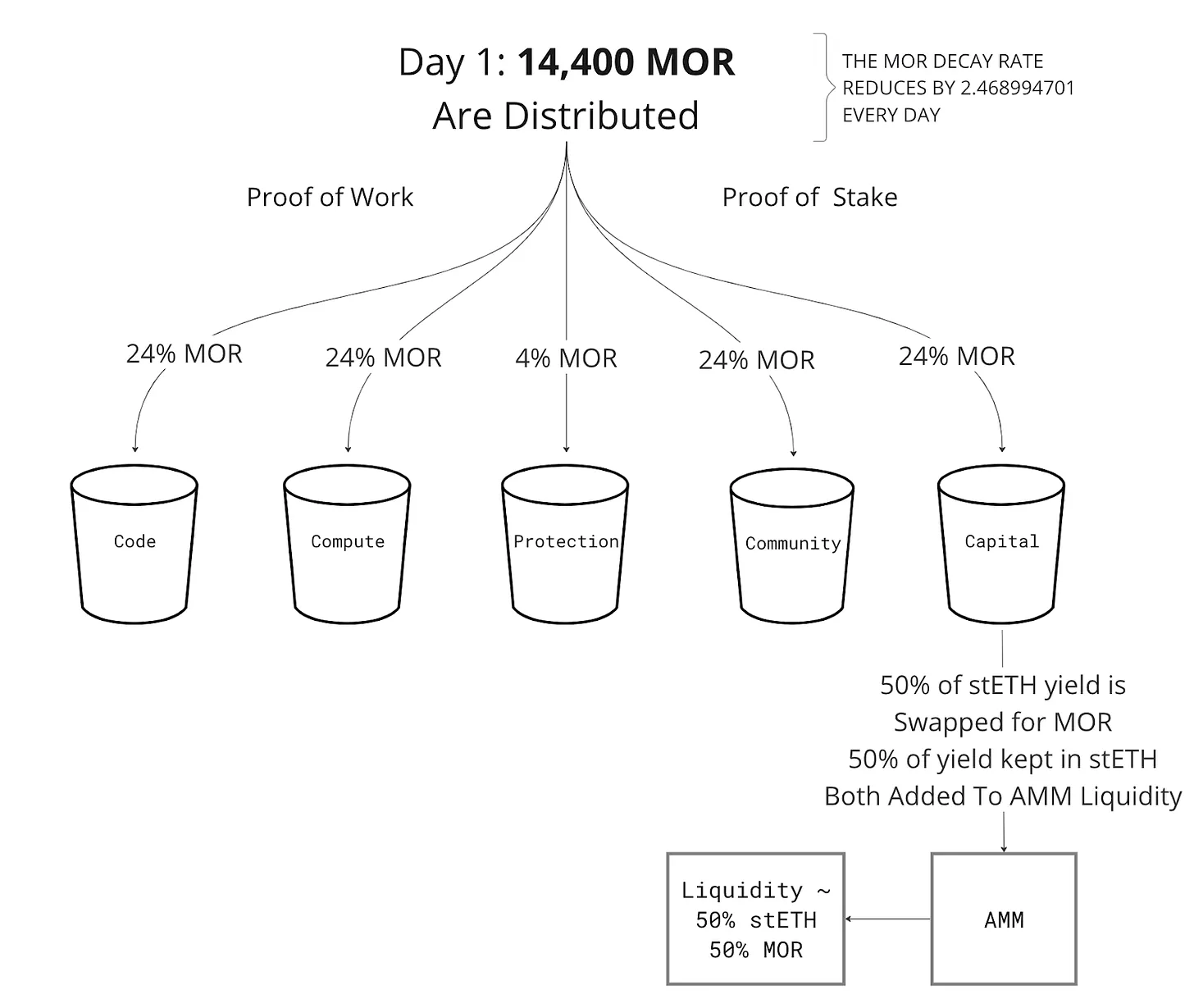
Each of these categories receives an equal share of $MOR inflation rewards (with a small reserve held for emergencies), compelling them to:
-
Build the best agents—creators are paid when their agents are consistently used. Unlike free OpenAI plugins, this pays creators instantly.
-
Build the best frontends/tools—creators are paid when their creations gain consistent usage.
-
Provide stable compute power—providers earn when lending compute capacity.
-
Provide liquidity—earn MOR share by maintaining project liquidity.
While many AI/smart agent projects exist, Morpheus’ tokenomics stand out for their clarity and effectiveness in aligning incentives.
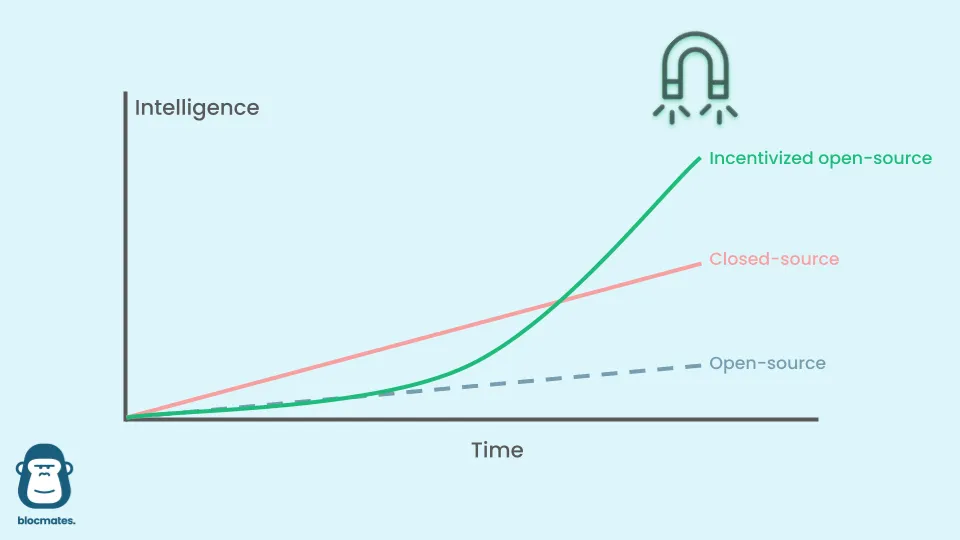
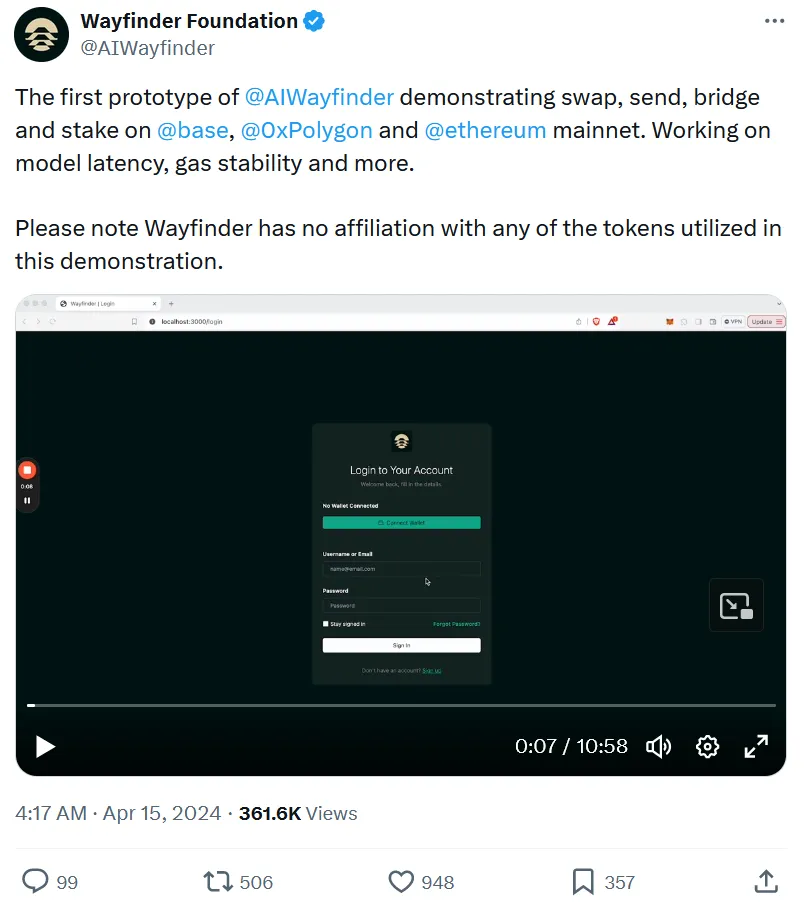
These smart agents represent the ultimate example of AI removing friction from crypto applications. dApp UX is notoriously poor (though much improved in recent years), and the rise of LLMs has reignited passion in every aspiring Web2 and Web3 founder. Despite rampant grifting, quality projects like Morpheus and Wayfinder (demo below) show how simple on-chain transactions could soon become.
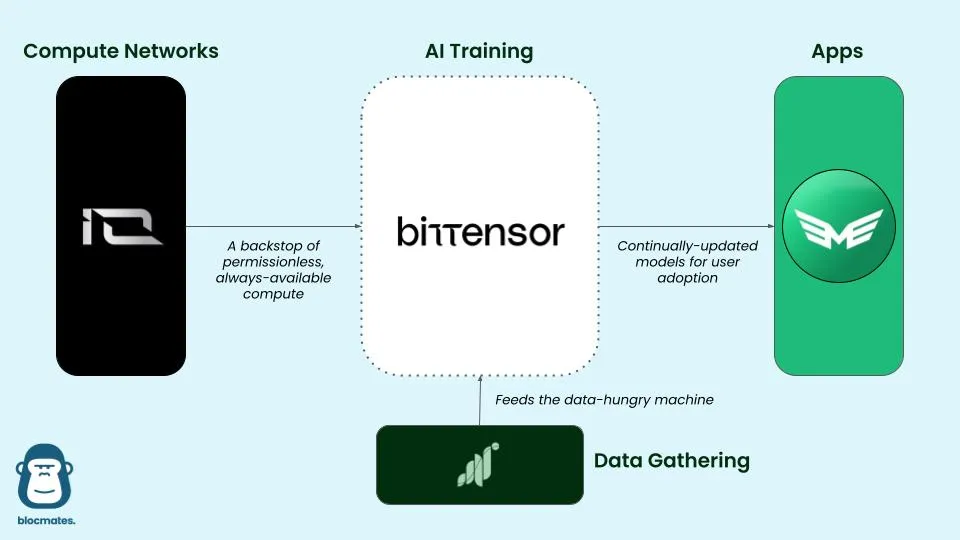
Putting it all together, the interaction between these systems might look something like this. Note: this is an extreme simplification.
How to Spot a Useless Project
Remember our two broad categories of “crypto x AI”:
-
Crypto helps AI
-
AI helps crypto
In this article, we've primarily explored the first category. As we’ve seen, well-designed token systems can lay the foundation for ecosystem-wide success.
Category 1 – Crypto Helps AI
DePIN architectures can bootstrap markets, and creative token incentives can coordinate open-source efforts toward previously unattainable goals. Yes, there are other legitimate intersections I haven’t covered due to length:
-
Decentralized storage
-
Trusted Execution Environments (TEE)
-
Real-time data acquisition (RAG)
-
Zero-knowledge x Machine Learning for inference/provenance verification
When evaluating whether a new project adds real value, ask yourself:
-
If it’s a derivative of an established project, is the difference significant enough to stand out?
-
Is it just a wrapper around open-source software?
-
Does the project genuinely benefit from crypto, or is crypto tacked on?
-
Do we really need 100 crypto versions of HuggingFace?
Category 2 – AI Helps Crypto
In this category, I personally see more junk—but some cool use cases do exist. For example, AI models can remove friction from crypto UX, especially smart agents. Here are some promising areas in AI-powered crypto applications:
-
Enhanced intent systems—automating cross-chain operations
-
Wallet infrastructure
-
Real-time alert infrastructure for users and apps
If it’s just a “chatbot with a token,” it’s garbage to me. Please stop shilling these projects to preserve my sanity. Also:
-
Adding AI won’t magically give your failed app/chain/tool product-market fit
-
No one will play a bad game just because it has AI characters
-
Slapping “AI” on your project doesn’t make it interesting

Where Do We Go From Here?
Despite the noise, serious teams are working toward the vision of “decentralized AI”—a fight worth having.
Beyond incentivizing open-source model development, decentralized data networks open new doors for emerging AI developers. When OpenAI’s competitors can’t strike large-scale deals with Reddit, Tumblr, or WordPress, distributed scraping levels the playing field.
No single company will ever own more compute than the rest of the world combined—and with decentralized GPU networks, anyone can match top firms. All you need is a crypto wallet.
We’re at a crossroads today. If we focus on genuinely valuable “crypto x AI” projects, we have the power to decentralize the entire AI stack.
The original vision of crypto was to create uncensorable sound money through cryptography. Just as this emerging technology gains traction, a far more dangerous adversary appears.
At its worst, centralized AI won’t just control your finances—it will impose bias on every piece of data you encounter daily. It will enrich a tiny elite of tech leaders through a self-reinforcing cycle of data collection, fine-tuning, and model deployment.
It will know you better than you know yourself. It knows which buttons to press to make you laugh more, rage more, and spend more. And despite appearances, it is not accountable to you.
Originally, crypto was seen as a force against AI centralization. Crypto can coordinate scattered individuals to work toward a common goal. Yet this power now faces a stronger enemy than central banks: centralized AI. This time, time is short—we must act swiftly to resist the centralization of AI.
Join TechFlow official community to stay tuned
Telegram:https://t.me/TechFlowDaily
X (Twitter):https://x.com/TechFlowPost
X (Twitter) EN:https://x.com/BlockFlow_News