









2 Million Airdrop Addresses Analysis Report: Only 25% of Tokens Rise After Airdrop, Broad Distributions Lead to 2x Increase in Sellers
TechFlow Selected TechFlow Selected
2 Million Airdrop Addresses Analysis Report: Only 25% of Tokens Rise After Airdrop, Broad Distributions Lead to 2x Increase in Sellers
Airdrop size has no significant impact on price performance or volatility, and "low circulating supply" may not be a primary driver of price fluctuations.
 Navigating Web3 tides with focused insights
Author: MUSTAFA & IMAGECARL
Translation: TechFlow
Airdrops as part of token generation events (TGEs) have become very common, yet remain relatively understudied. The mechanism is simple—distributing newly minted tokens to eligible wallets to help establish initial circulation, enable on-chain governance, drive trading activity, reward early contributors, and potentially attract new users.
We believe such a widespread token design element deserves quantitative research to identify best practices. We collected data from over 2 million airdrop events across 40 protocols and analyzed the two most critical choices facing token designers:
-
What percentage of supply should be airdropped?
-
Who should qualify for my airdrop?
We used multiple methods to answer these questions, including price performance, volatility, and wallet activity analysis. Our analysis and dataset will be made public (coming soon), and we encourage contributors to help expand both the dataset and analysis.
Dataset
Our final dataset includes 40 airdrop events across 40 protocols, along with activity from 2,098,698 unique wallets. Note that we only included airdrops from 2023 and earlier.
The following 40 token events were analyzed:
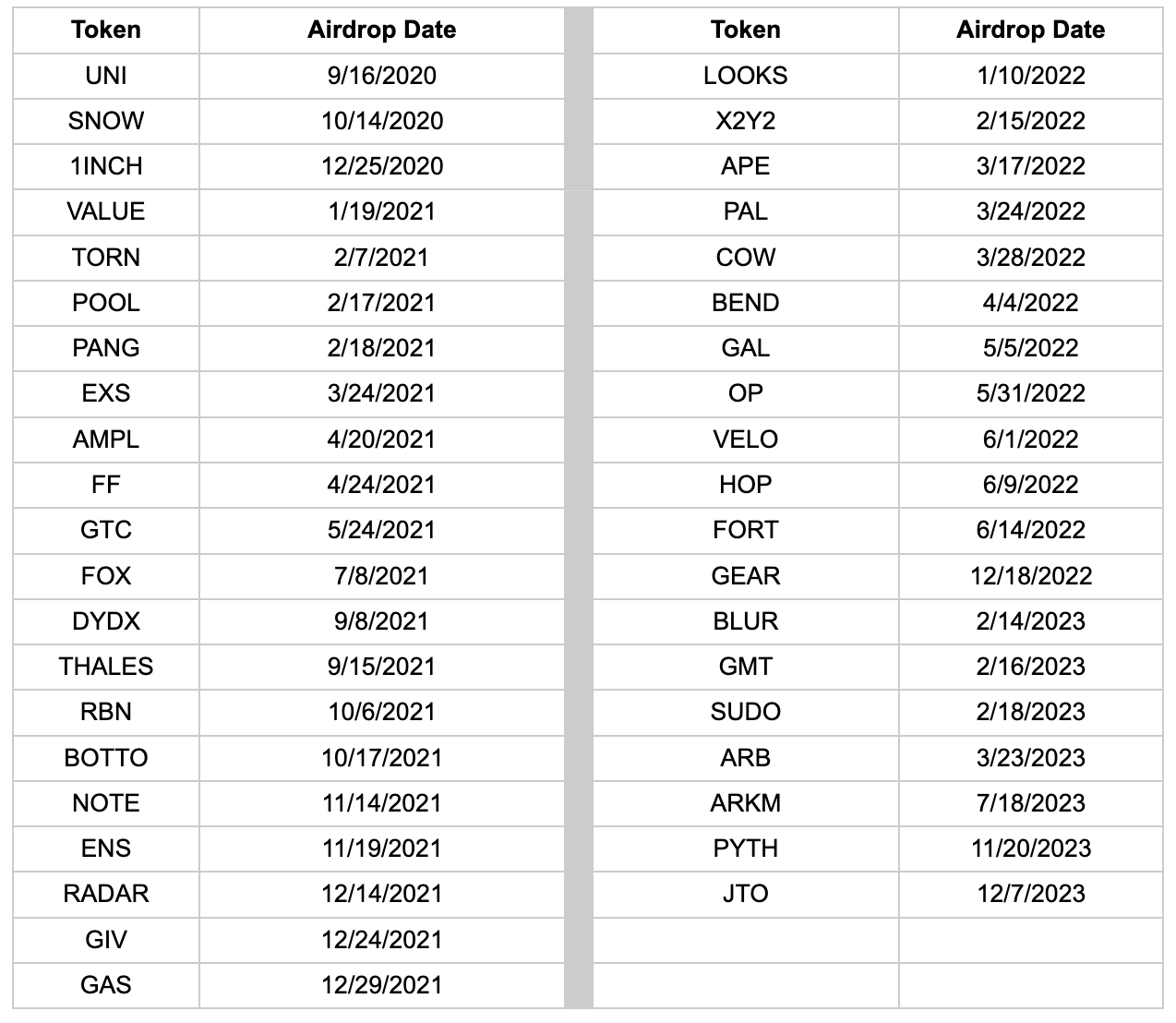
For each of these protocols, our analysis focused on the previously mentioned metrics: eligibility type and airdrop size.
Eligibility Type
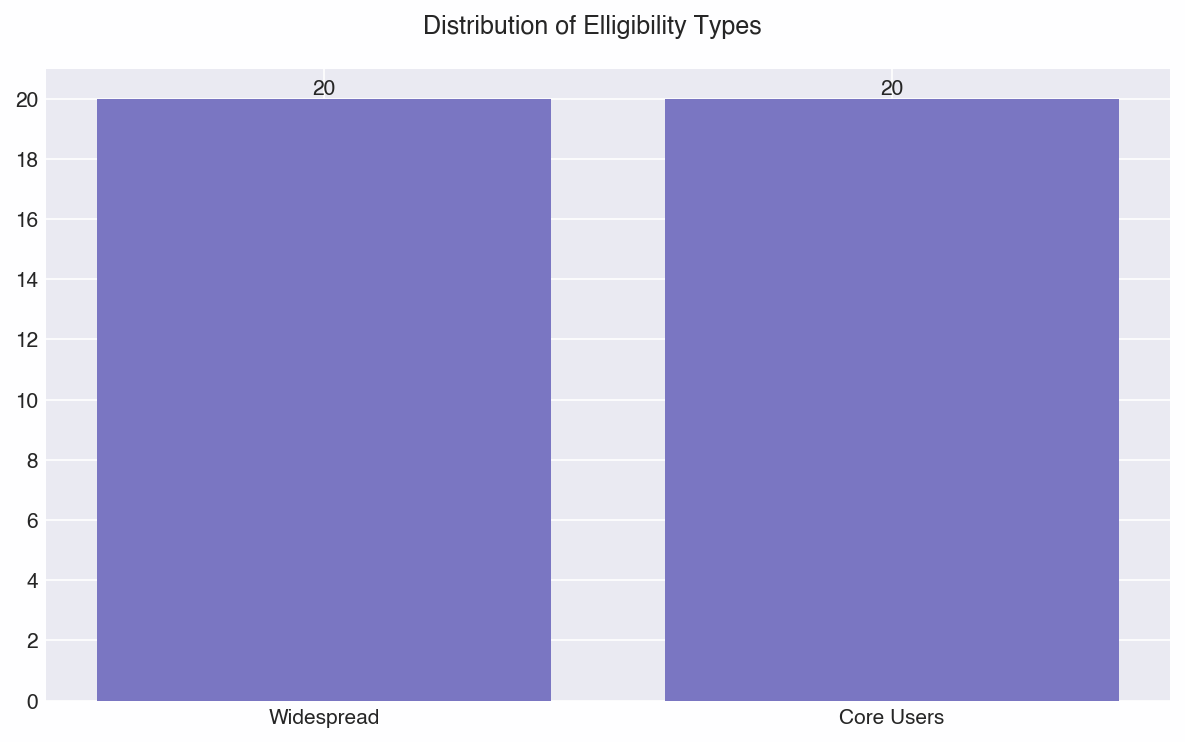
"Eligibility type" is divided into "broad users" and "core users." In the former, protocols distribute tokens to general ecosystem users—for example, a new DePIN protocol might airdrop to wallets that participated in other DePIN protocols within a certain timeframe, or to specific on-chain communities (e.g., NFT holders). In the latter case, only users who directly engaged with the pre-token version of the protocol are rewarded. Fundamentally, this distinction reflects two strategic choices: should the airdrop primarily serve as a marketing and growth tool, or should it focus on rewarding the most active users during the protocol's launch phase?
Airdrop Size
Another key factor is "airdrop size," defined as the percentage of total supply allocated to the airdrop. The motivation is straightforward: is there an optimal range for airdrop size? The distribution of airdrop sizes in our dataset is shown below:
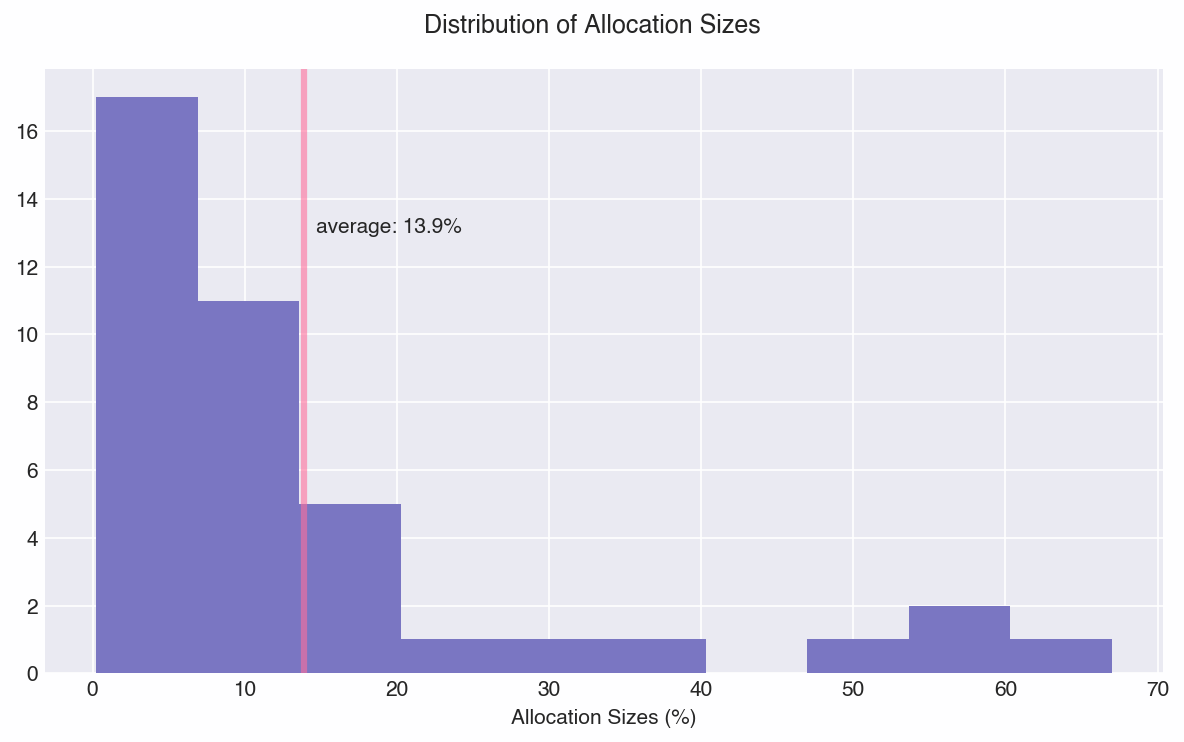
The median airdrop size is approximately 10%, resulting in a relatively balanced split of 19 small (<10%) and 21 large (≥10%) airdrops.
Categorization
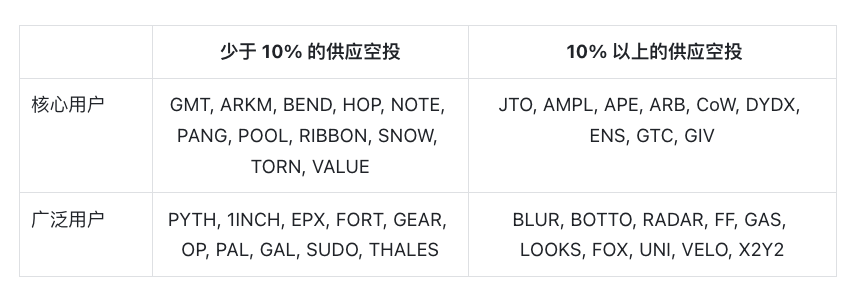
The goal of categorizing events is to compare overall design choices. To achieve this, we grouped the events into four distinct combinations:
Analysis and Insights
First, it's important to clarify that our analysis aims to balance rigor with insight—proving causality using only price or wallet data is difficult, especially in multifactor environments like token markets. While we can observe that certain design combinations perform better than others, we do not claim to strictly prove that these outcomes are caused by the design choices themselves. We believe a combination of factors, particularly the airdrop structure, may contribute to differences in average price performance across categories.
Price and Volatility Effects
A key metric for measuring airdrop impact is price effect. We aim to measure price movements during the time window potentially influenced by the airdrop. Since most airdrops occur at TGE, analyzing price data involves some confounding factors. We collected price data for two months post-airdrop, normalized against a crypto index (see Appendix), and calculated percentage price changes. Note that our baseline price is taken 24 hours after the airdrop, allowing for initial price discovery (i.e., immediate selling).
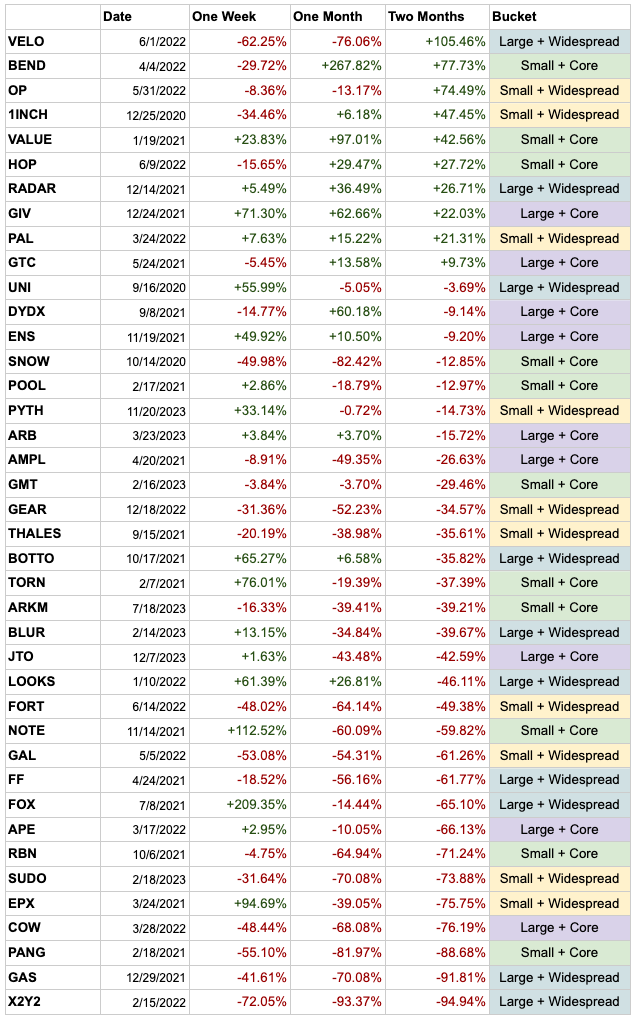
Post-airdrop price change
Out of 40 airdrops, only 10 saw price increases two months post-airdrop. Although performance varied widely, when we examine the four categories (shown below), all tend to decline by 10–40% after 60 days. This aligns with our observation in token unlock studies: large cliff-based token distributions (over 1% of supply) typically create sell pressure and stabilize at lower levels over time. This effect is likely amplified in airdrop accumulations.
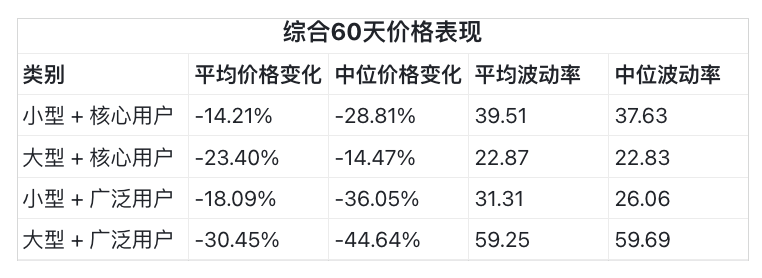
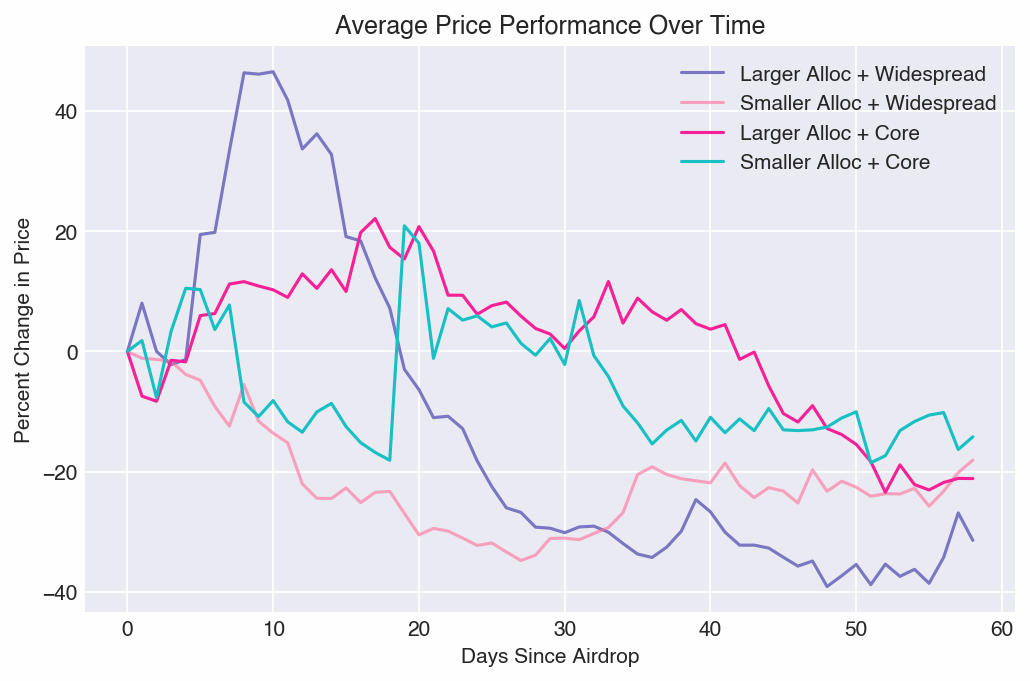
We derive several interesting insights:
-
The large + broad user group performed worst in terms of both price performance and volatility.
-
Overall, core user groups outperformed broad user groups in price performance and volatility.
-
Airdrop size had no decisive impact on price performance or volatility.
Additionally, four protocols airdropped the majority of their supply: DYDX (50%), GAS (55%), VELO (60%), and AMPL (67%). We expected a correlation between airdrop size and price, but observed none—neither within this subset nor across all tokens (not shown). However, the lack of correlation suggests teams can airdrop most of their tokens and still see positive price changes two months later (e.g., VELO +105%).
Wallet Behavior
Another valuable heuristic for measuring airdrop success is understanding how users handle received tokens. For each protocol, we analyzed recipient wallets over 60 days post-airdrop. Note that for complexity reasons, we did not track cases where users transferred tokens to other wallets or swapped them outside DEXs (e.g., sending to centralized exchanges). Tracking CEX deposits at scale becomes infeasible, so we propose using DEX data as a useful proxy for comparative analysis—likely representing a minimum threshold for sellers.
Users were generally classified into three types: sellers, holders, and buyers. This classification was based on net balance changes over 60 days—users with no change were labeled holders, those increasing holdings were buyers, and those reducing holdings were sellers.
60-Day Wallet Behavior Airdrop Analysis
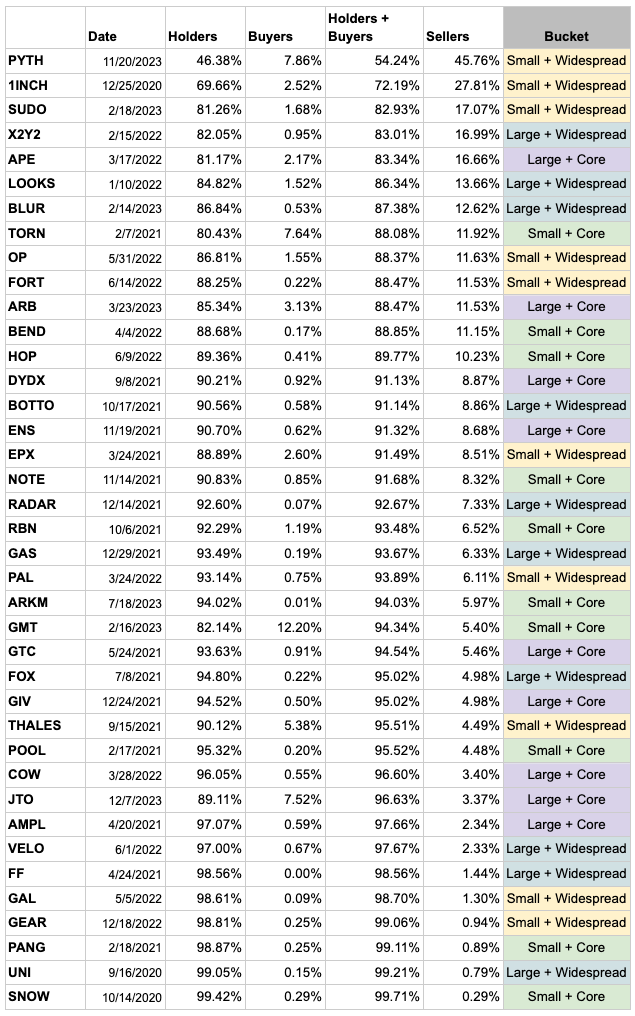
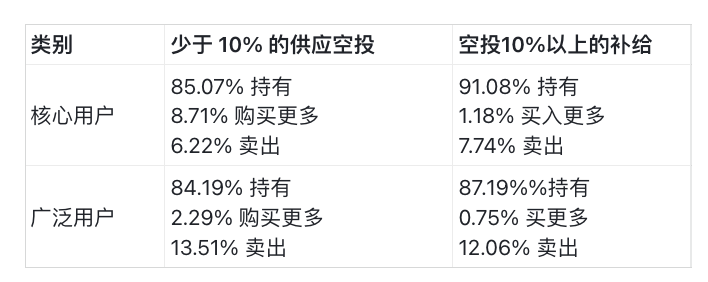
We draw two key insights:
-
Broad airdrops result in twice as many sellers. On average, recipients of broad airdrops are more likely to sell their tokens compared to core users. This is intuitive—if users receive tokens for something they’ve never used or barely heard of, they’re more likely to swap them for assets they care about. More compellingly, 8 out of the top 10 protocols with the highest seller ratios conducted "broad" distributions.
-
Small airdrops to core users lead to 4–8 times more buyers. Data shows the highest proportion of buyers occurs when airdrops are small (<10%) and targeted at core users. This is also intuitive—they are the most active users and most likely to buy additional tokens to participate in governance or liquidity voting.
Recommendations
Our analysis reveals four main insights:
-
Airdrops to core users show higher prices within two months post-airdrop.
-
Airdrop size has no significant impact on price performance or volatility, suggesting “low float” may influence price volatility less than other factors.
-
The number of sellers in broad airdrop groups is double that of core user groups.
-
The small airdrop + core user group sees a 4–8x increase in buyers (increased holdings).
We derive general biases in airdrop design from the data, but must emphasize that a protocol’s specific context and goals must always be considered.
Recommendation #1: Favor airdrops to core users over broad audiences
Given the opportunity cost of airdropping to users more likely to sell immediately, our first general takeaway is that airdrops should primarily target core users who helped bootstrap liquidity and/or usage, rather than broader audiences. Our intuition—that rewarding core users leads to higher holder retention—is validated by the data. Converting non-users into users via airdrops is unlikely; it’s often better to focus attention and capital on incentivizing the core community. Airdropping to core users may also foster buying momentum and sustain relatively higher prices.
Recommendation #2: Favor smaller airdrops
Since airdrop size shows no significant impact on price or volatility, we lean toward smaller rather than larger airdrops. Tokens help bootstrap usage and liquidity—especially if the team plans to continue iterating the product (rather than freezing it)—so maintaining larger reserves helps fund future incentives for user and liquidity growth. That said, airdrops should still be large enough to meaningfully reward early risk capital and serve as a motivating moment for the community.
In certain cases, larger airdrops may be preferable. For instance, larger distributions can prevent voting centralization and make it harder for bad actors to influence the network. However, allowing teams and investors to vote with their locked tokens may mitigate this risk.
Observation: “Low float” may not be a primary driver of price volatility
Finally, as an observation rather than a recommendation, the data does not support the idea that "low float" is a primary cause of extreme price volatility. Logically, low float restricts supply and should push prices up. However, we observed no significant relationship between large and small airdrop groups—all categories showed price declines 60 days post-launch. Additionally, analysis of relative volatility revealed no significant difference by airdrop size, despite expectations that low float would increase volatility. In fact, the large + broad user group exhibited by far the highest volatility!
If we had unlimited resources and knowledge, we would extend our study to include assessments of protocol TVL before and after TGE to evaluate whether airdrop size affects TVL stickiness, and analyze the ratio between TGE price and the last major funding round valuation.
Appendix
Crypto Index Correction
To balance analysis across different macro conditions, we applied beta normalization to remove macro-level price movements from individual token price changes. This was done using multivariate regression on BTC and ETH, removing each asset's beta relative to the macro market and reconstructing the adjusted price.
Join TechFlow official community to stay tuned
Telegram:https://t.me/TechFlowDaily
X (Twitter):https://x.com/TechFlowPost
X (Twitter) EN:https://x.com/BlockFlow_News
 @6thManVentures











