








Amid FUD and panic, will AI's new king Bittensor fall from grace?
TechFlow Selected TechFlow Selected
Amid FUD and panic, will AI's new king Bittensor fall from grace?
Every generation has its legend, no throne lasts forever.
 Navigating Web3 tides with focused insights
By: TechFlow
Each era has its narrative, each narrative creates its god.
Since the end of last year, as AI narratives heated up, Bittensor stood out. Its token TAO surged from around $80 in October last year to a peak of $730 in March this year, reaching a market cap high of approximately $4.7 billion.
Crypto deification is terrifyingly real.
Though not as absurdly explosive as meme coins, Bittensor has indeed become the new king of the AI sector over the past half-year, briefly entering the Top 30 in crypto market capitalization rankings.
From being ignored to becoming too expensive to buy into, then surging all the way to listing on Binance—markets have clearly paid handsomely for this project.
But beyond Bitcoin and Ethereum, there is no eternal monarchy in crypto.
From its price peak down to today’s level of around $450, an increasing number of FUDs (fear, uncertainty, doubt) about TAO have emerged in the market. Criticisms are growing louder, seemingly shaking the foundation of this newly crowned AI king.
As the view that “all AI tokens are just memes” gains traction, market participants have woken up and begun scrutinizing this top-tier project with a magnifying glass.
Sharp-eyed hunters have already sensed opportunity, seeking every vulnerability to profit richly from shorting the token during this demystification campaign aimed at dethroning the new king.
We’ve compiled the prevailing FUDs circulating about Bittensor to see whether beneath the glamorous robe, lice are crawling.
Resource Waste, Performing Redundant Work
In our previous article "Understanding Bittensor (TAO): The Ambitious AI Lego Making Algorithms Composable", we noted that Bittensor does not create algorithms—it merely sources high-quality ones, using a market-based incentive mechanism to select the best AI models or algorithms.
Within Bittensor's open AI supply-demand chain, some provide models, others evaluate them, and users consume results generated by the best-performing models.
But reality is leaner than idealism. During the process of model selection and evaluation, resource waste and redundant work are common.
Twitter user @ercwl pointed out that Subnet 1 of TAO is tasked with selecting "the best answers corresponding to text prompts." A user or system generates a query or question (i.e., a text prompt), and each node (miner) in Bittensor runs one or more machine learning models (such as large language models, LLMs) to generate responses.
Clearly, the better answer wins—but the situation is worse than imagined.
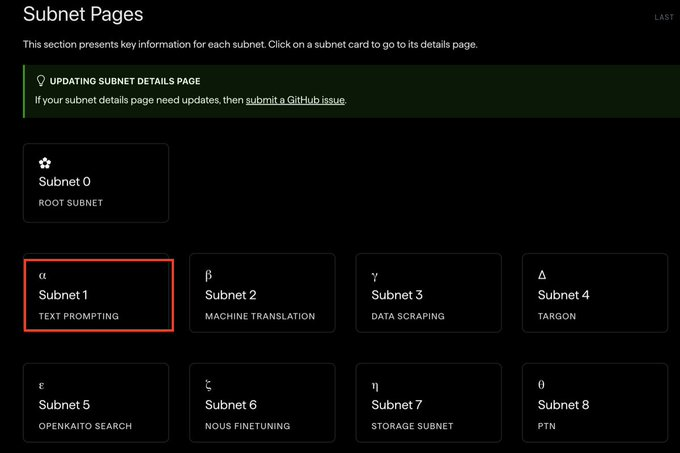
Miner nodes across the network run their models independently to respond to these text prompts. Each miner may use different models or configurations for the same prompt.
To ensure answer accuracy and maintain decentralization, multiple miners independently generate answers—leading to the first redundancy: identical questions being processed repeatedly.
Additionally, validator nodes assess the answers provided by miners. Since each miner tries to produce answers closest to what validators expect, they often adopt similar strategies and model configurations. This means multiple nodes perform nearly identical computational tasks—repetitive work that leads to significant resource waste.
For example, this subnet is flooded with basic queries like “What is water?” which might be simultaneously answered by thousands of miners with obvious, commonsense replies such as “Water is a compound with the chemical formula H2O.”
Because the system verifies and rewards miners based on answer similarity, this creates glaring redundancy—miners are simply duplicating work already done by others.
Using decentralization—the most expensive consensus method (since achieving agreement among strangers consumes massive resources)—to validate vast amounts of trivial, kindergarten-level Q&A, solely for incentives, results in answering for the sake of answering, wasting computing power from OpenAI or other LLM providers, along with API fees.
Not As Decentralized As You Think
Another AI project’s CEO, Hyperspace’s @varun_mathur, argues that Bittensor may not be as decentralized as people assume.
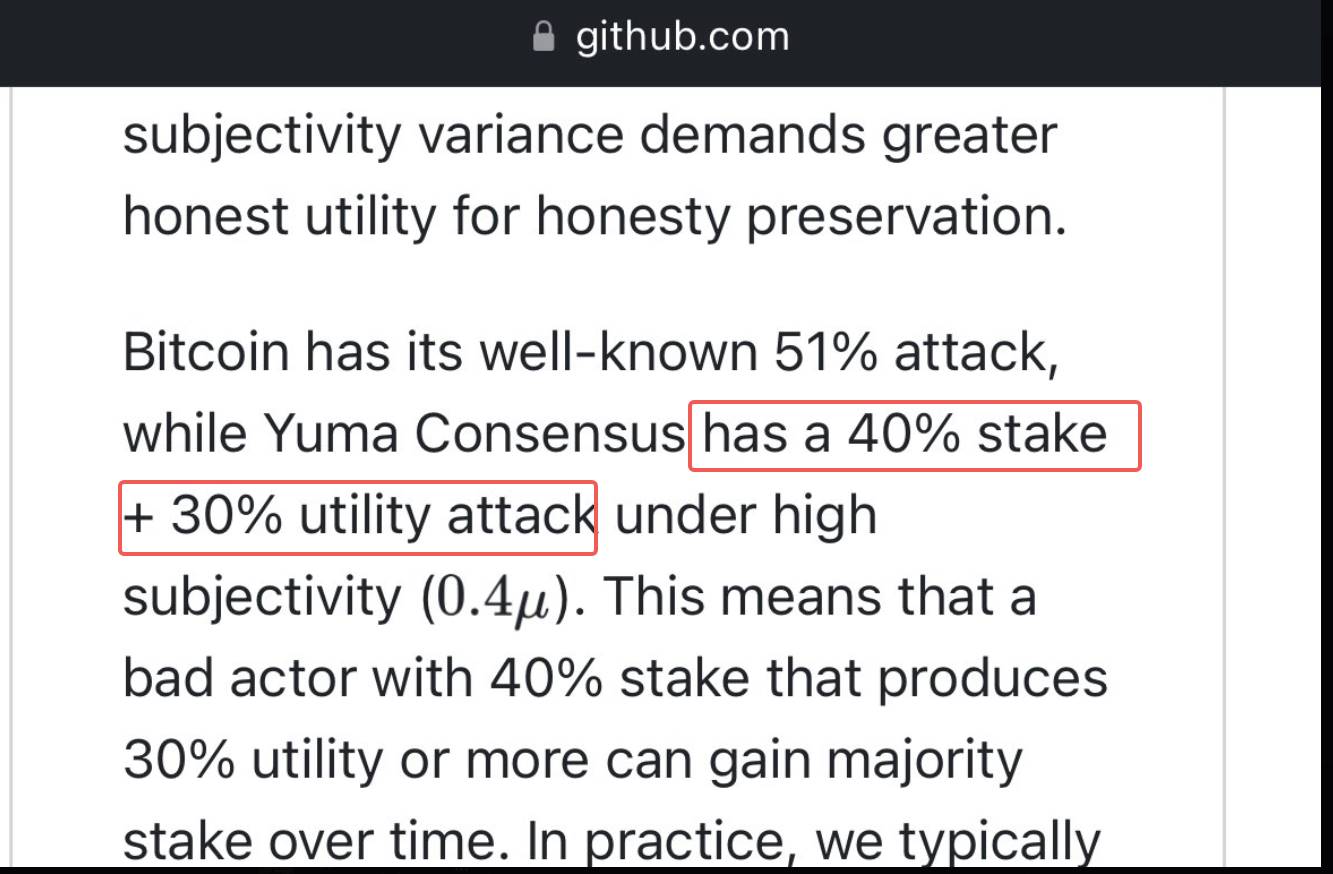
In many cryptocurrency networks, preventing attacks typically requires controlling over half the network (51% attack). In Bittensor’s case, because the network allows a lower control threshold (40%), the barrier to launching an attack is significantly reduced, increasing the risk of network manipulation or control by a few large nodes.
Varun believes Bittensor isn’t sufficiently decentralized—if just three entities collectively hold 40% of TAO tokens, they could launch an attack.
If Bittensor’s top three nodes control over 40% of validation power, they might collude for self-interest, mutually validating each other’s transactions or data to gain unfair advantages. Such behavior undermines the network’s fairness and transparency and could lead to security breaches by creating opportunities for malicious activity.
Another issue stemming from insufficient decentralization lies in how validators set “weights” for miners.
In the Bittensor network, weights refer to numerical scores validators assign to miners based on how well their answers match predefined standards or reference answers. Higher weights mean answers align more closely with validator expectations, resulting in greater TAO rewards.
Since weights are manually assigned, this introduces risks of subjectivity and manipulation. If validators favor certain miners or if weight-setting lacks transparency and fairness, the entire network’s trustworthiness and efficiency could suffer.
Clearly, under this design, small players have no room to survive:
Small or independent miners may struggle to achieve high weights due to insufficient resources or technical support, leading to further centralization—only large, well-funded miners can earn meaningful rewards.
The dragon-slayer ultimately becomes the dragon—toppling centralized AI but failing to eliminate centralized human governance.
Token Concentration, Selling Pressure Causes Anxiety
Xiao Wang, head of StinkyInsect Labs @0xInv1ctus, published a bold critique titled “My Big Character Poster—Why I Firmly Oppose BITTENSOR”, directly targeting suspicions around TAO token distribution.
The author claims TAO tokens are highly controlled by an internal clique through unclear origins, posing constant dumping risks.
The confidence behind this FUD stems from unsettling facts about TAO’s creation and distribution:
$TAO tokens began generating as early as 2021, yet no documentation explains the allocation rules or final distribution of tokens produced between January 3, 2021, and October 2, 2023, before subnets launched;
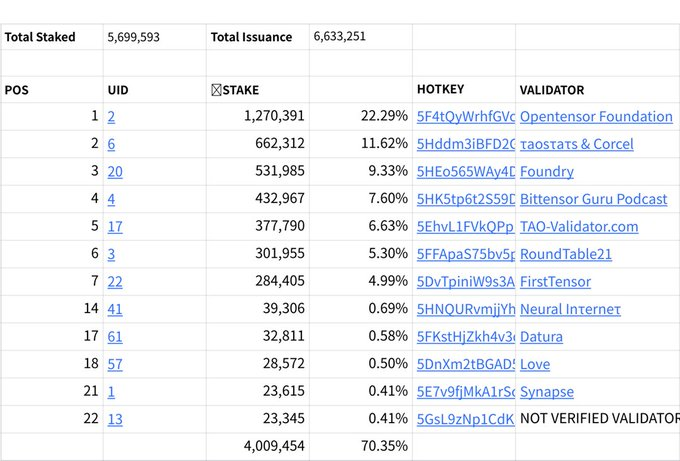
In outcome, the top 12 root network validators hold 79% of total staked volume. Given their public business statements focusing exclusively on Bittensor-related staking, it’s reasonable to suspect these validators—who control over $20 billion worth of $TAO—are closely connected, forming an insider group.
Most alarmingly, Bittensor staking has no lock-up period—anyone can unstake at any time. This means the current 85% of circulating supply that is staked could instantly flood the market for sale.
Meanwhile, the hedge fund affiliated with the author’s organization has publicly stated it shorted TAO around $420, expecting the price to fall back to $100–$150.
Each era has its narrative, each narrative creates its god—yet no throne lasts forever.
As the new king minted by the AI hype wave, Bittensor attracted attention and liquidity—but both are destined to flow out.
Perhaps, as these FUDs suggest, the actual business and real-world applications behind TAO cannot justify its lofty valuation and price. But when exactly the outflow will happen—and whether you can profit from shorting it—has no definitive answer.
Maybe, like the classic meme below, even when you clearly know the vast gap between what a project *wants* to do and what it *can* actually do, you still can’t reliably use superior information, sharper trading instincts, or stricter discipline to make big profits during the narrative rise or exit cleanly when the tide recedes and leaves everyone naked.
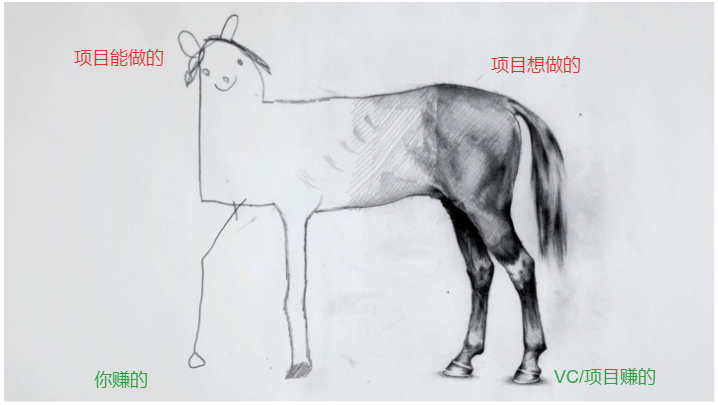
Who is really making money in this market?
Crypto retail investors grow increasingly confused amid waves of FUD and boastful “I’m financially free” posts.
Join TechFlow official community to stay tuned
Telegram:https://t.me/TechFlowDaily
X (Twitter):https://x.com/TechFlowPost
X (Twitter) EN:https://x.com/BlockFlow_News
 深潮TechFlow


