









Galaxy Partner: Crypto Payments Have Tremendous Potential, Stablecoins Will Be Everywhere
TechFlow Selected TechFlow Selected
Galaxy Partner: Crypto Payments Have Tremendous Potential, Stablecoins Will Be Everywhere
Payments will become a key use case and major consumer of future blockspace.
 Navigating Web3 tides with focused insights
Author: Mike Giampapa, General Partner at Galaxy Ventures
Translation: Luffy, Foresight News
Payments were highlighted as a primary use case in Bitcoin’s 2008 whitepaper. Over the past several years, blockchain-based payments have become increasingly viable and popular compared to traditional payment methods. Billions of dollars have been invested over the past decade into developing underlying blockchain infrastructure, and now we have systems capable of achieving “scaled payments.”
The cost and performance curves of blockchains follow a “Moore’s Law” trajectory. Over recent years, the cost of storing data on blockchains has dropped by several orders of magnitude. Following Ethereum’s Dencun upgrade (EIP-4844), average transaction costs on Layer 2 networks such as Arbitrum and Optimism have dropped to $0.01 per transaction, while alternative Layer 1s are approaching just a few cents.
Beyond better-performing and more cost-effective infrastructure, the rise of stablecoins has been explosive and sustained, clearly emerging as a long-term trend even amid the volatility of the crypto industry. Visa recently launched its public-facing stablecoin dashboard (Visa Onchain Analytics), offering a glimpse into this growth trend and demonstrating how stablecoins and underlying blockchain infrastructure can facilitate global payments. The total market volume of stablecoin transactions grew approximately 3.5x year-over-year. When focusing specifically on transaction volumes that appear to be directly initiated by consumers and businesses (excluding automated trades or smart contract operations), Visa estimates that stablecoin transaction volume was around $265 billion over the past 30 days—annualizing to roughly $3.2 trillion—approximately double PayPal’s 2023 payment volume and comparable to the GDP of India or the UK.
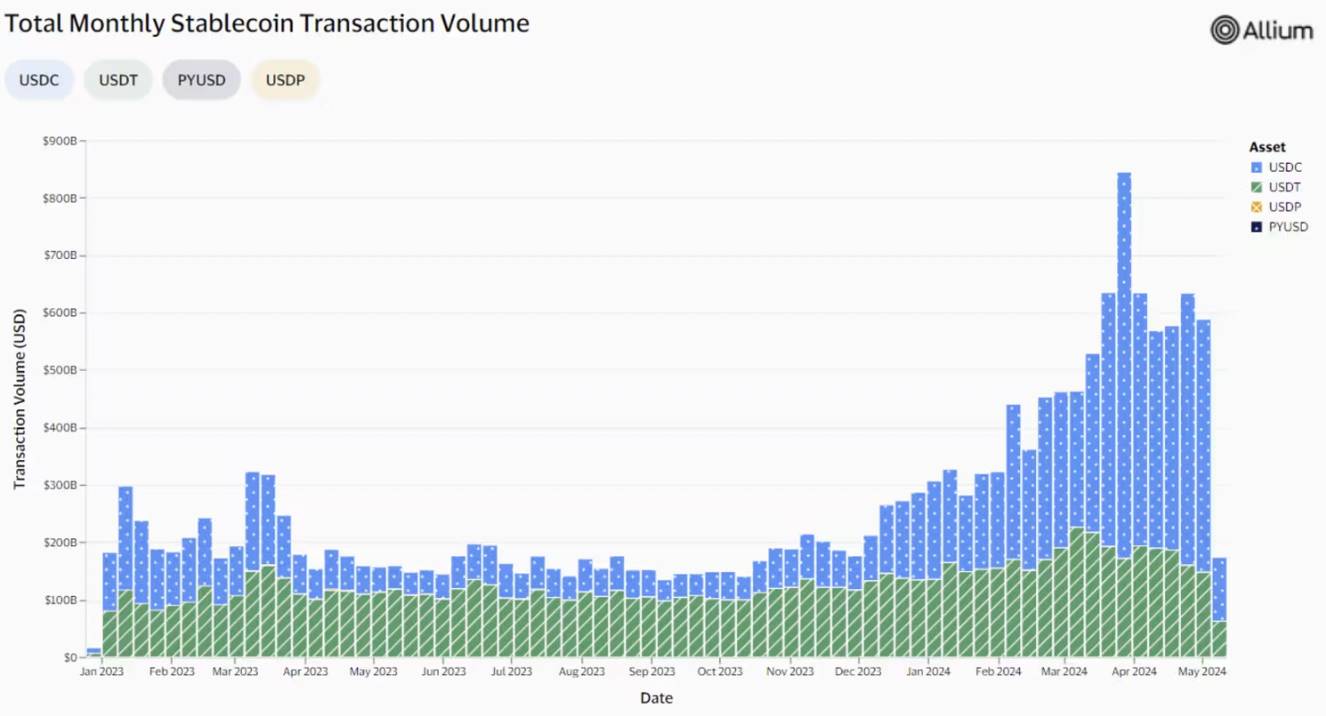
Source: Visa Onchain Analytics
We have spent significant time analyzing the fundamental drivers behind this growth and firmly believe that blockchains hold immense potential to become a mainstream method for future payments.
Background of the Payments Industry
To understand the fundamental drivers behind the growth of crypto payments, we must first consider some historical context. Today’s internationally used payment infrastructure (e.g., ACH, SWIFT) was established over 50 years ago in the 1970s. The ability to transfer funds globally was a groundbreaking achievement and a milestone in finance.
However, today’s global payment infrastructure is now largely outdated and fragmented. It is an expensive and inefficient system that operates only during limited banking hours and relies on numerous intermediaries. A key issue with current payment infrastructure is the lack of global standards. Fragmentation hinders seamless international transactions and complicates the establishment of consistent protocols.
The emergence of real-time settlement systems represents a major advancement in recent years. The success of international instant payment schemes such as India’s UPI and Brazil’s PIX has been well-documented. In the U.S., government-led and consortium-driven initiatives have introduced real-time settlement systems like Same Day ACH, The Clearing House’s RTP, and the Federal Reserve’s FedNow. Adoption of these new payment methods has been hampered by significant challenges arising from divisions among competing stakeholders.
Fintech companies have attempted to improve user experience atop this traditional infrastructure. For example, companies like Wise, Nium, and Thunes allow customers to pool liquidity across global accounts so users perceive transactions as instantaneous. However, they do not overcome the limitations of underlying payment channels and are not capital-efficient solutions.
Complexities of Today’s Payments
Given the fragmented nature of the existing financial system, payment transactions have become increasingly complex. This is best illustrated by the structure of cross-border payment transactions, which involve numerous pain points:

Source: Galaxy
-
Multiple intermediaries: Cross-border payments typically involve multiple intermediaries such as local banks, correspondent banks, clearinghouses, foreign exchange brokers, and payment networks. Each intermediary adds complexity to the transaction process, leading to delays and increased costs.
-
Lack of standardization: The absence of standardized processes leads to inefficiencies. Different countries and financial institutions may have varying regulatory requirements, payment systems, and messaging standards, making it challenging to streamline payment flows.
-
Manual processing: Traditional systems lack automation, real-time processing capabilities, and interoperability with other systems, resulting in delays and manual intervention.
-
Lack of transparency: The opacity of cross-border payment processes can lead to inefficiencies. Limited visibility into transaction status, processing times, and associated fees can make it difficult for businesses to track and reconcile payments, causing delays and administrative overhead.
-
High costs: Cross-border payments often incur high transaction fees, currency exchange markups, and intermediary charges.
Cross-border payments typically take up to five business days to settle, with average fees at 6.25%. Despite these challenges, the B2B cross-border payments market remains massive and continues to grow. FXC Intelligence estimates that the total market size for B2B cross-border payments was $39 trillion in 2023 and is projected to grow 43% by 2030, reaching $53 trillion.
Clearly, real-time settlement is imminent, but a unified global payment standard has yet to emerge. Fortunately, there is a solution available to everyone—one that enables instant and low-cost value transfer anywhere in the world: blockchain.
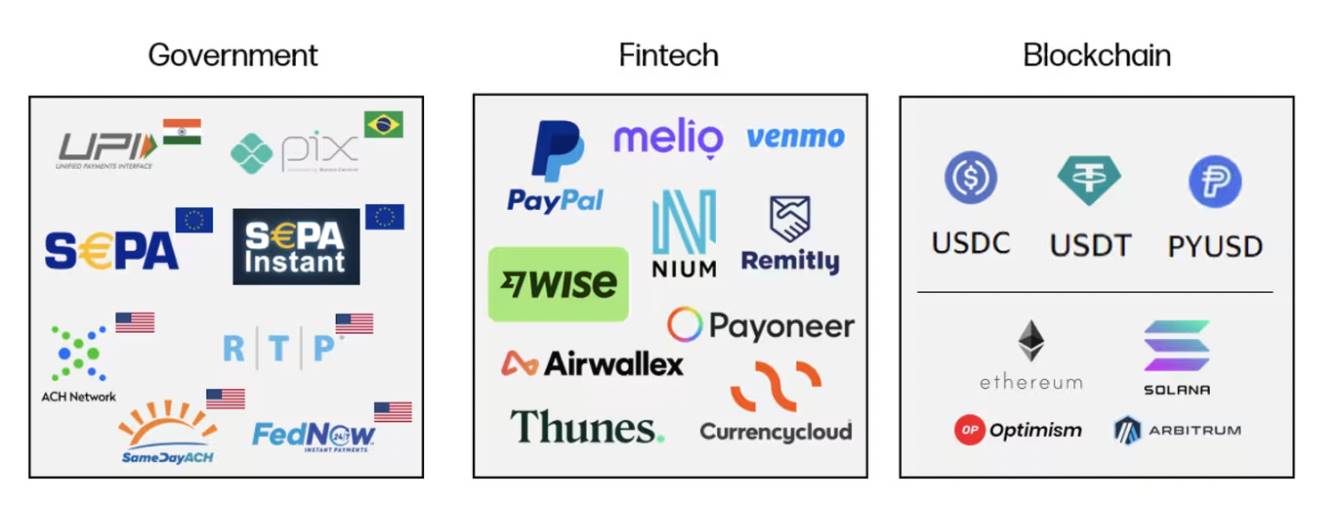
Source: Galaxy (All third-party company products and services mentioned in this presentation are for identification purposes only)
Adoption of Crypto Payments
Stablecoin payments offer an ideal solution to many of the challenges currently faced in areas like cross-border payments, and stablecoins are experiencing sustained growth globally. As of May 2024, the total supply of stablecoins is approximately $161 billion. USDT and USDC rank third and sixth respectively by cryptocurrency market capitalization. While their combined market cap accounts for about 6% of the crypto market, their on-chain transaction value represents approximately 60% of the entire crypto market.
Looking back at our earlier cross-border payment example, the streamlined fund flow offered by blockchain provides an elegant solution to today’s complexity:

Source: Galaxy
-
Near-instant settlement: Unlike most traditional financial payment methods that take days to settle, blockchain enables near-instantaneous settlement of transactions globally.
-
Lower costs: By eliminating various intermediaries and leveraging advanced technological infrastructure, crypto payments are significantly cheaper than existing alternatives.
-
Greater visibility: Blockchain offers a higher level of transparency in tracking fund flows and reducing reconciliation-related administrative costs.
-
Global standard: Blockchain provides a “high-speed rail” accessible to anyone connected to the internet.
Stablecoins can greatly simplify the payment process and reduce the number of intermediaries. Compared to traditional payment methods, fund flows become visible in real time, settlement times are faster, and costs are lower.
Overview of the Crypto Payment Stack
When examining the crypto payments market, we observe that the stack consists primarily of four layers:
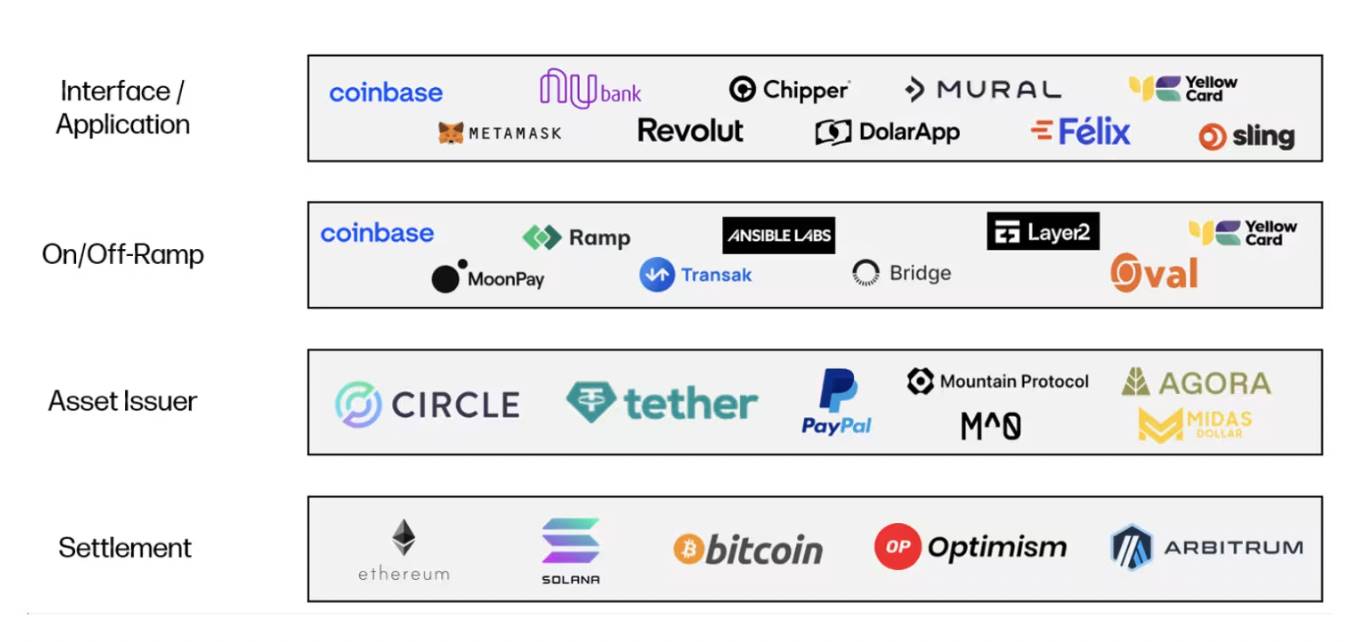
Source: Galaxy (All third-party company products and services mentioned in this presentation are for identification purposes only)
Settlement Layer
The underlying blockchain infrastructure that settles transactions. Layer 1 blockchains such as Bitcoin, Ethereum, and Solana, along with general-purpose Layer 2s like Optimism and Arbitrum, sell block space to the market. They compete across multiple dimensions including speed, cost, scalability, and security. We expect that over time, payment use cases will become a major consumer of block space.
Asset Issuers
Asset issuers are entities responsible for creating, maintaining, and redeeming stablecoins—crypto assets designed to maintain a stable value relative to a pegged asset or basket of assets, most commonly the U.S. dollar. Stablecoin issuers typically operate balance sheet-driven business models similar to banks: they accept customer deposits and invest them in higher-yielding assets like U.S. Treasuries, then issue stablecoins as liabilities, profiting from the interest rate spread or net interest margin.
On-Ramps / Off-Ramps
On-ramp and off-ramp providers play a critical role in enhancing the usability and adoption of stablecoins as a primary mechanism for financial transactions. Fundamentally, they serve as the technical layer connecting stablecoins on blockchains with fiat currencies and bank accounts. Their business models are often volume-driven, earning small commissions on the dollar amounts flowing through their platforms.
Interfaces / Applications
Front-end applications are ultimately the customer-facing software in the crypto payment stack, providing user interfaces for crypto payments and leveraging the other parts of the stack to enable such transactions. Their business models vary but often combine platform fees with volume-driven revenue generated from front-end transaction activity.
Emerging Trends in Crypto Payments
There are several trends at the intersection of crypto and payments that excite us:
Cross-Border Payments Are the First Battlefield
As discussed above, cross-border transactions are typically the most complex, inefficient, and expensive due to the numerous intermediaries extracting rent throughout the process. As a result, we see the highest market acceptance for blockchain-based alternative payment solutions in this domain. Providers supporting B2B payments (paying suppliers and employees, corporate treasury management, etc.) and remittance use cases are receiving strong market attention.
We view cross-border payments similarly to logistics, where the “last mile” (the on/off ramps between fiat and crypto) is particularly challenging to navigate. This is precisely where companies like Layer2 Financial deliver real value, taking on the burden of integrating with a wide range of backend crypto and fiat partners (blockchains, custodians, exchanges/liquidity providers, banks, traditional payment rails, etc.) to offer customers a seamless and compliant experience. Layer2 also helps route transactions along the fastest and lowest-cost paths, enabling end-to-end cross-border payments to be completed in as little as ~90 minutes using crypto—1–2 orders of magnitude faster than existing solutions.
Given the improvements in cost and efficiency, we see adoption of this technology across all regions and customer segments—both crypto-native and traditional enterprises. Demand is especially strong in regions where fiat currencies are less stable and access to the U.S. dollar is inconvenient. For these reasons, Africa and Latin America have become hotbeds for entrepreneurial activity. For example, Mural has achieved significant success helping clients facilitate payments to vendors and developer contractors between the U.S. and Latin America.
Early Stages of Payment-Grade Infrastructure
Most market infrastructure around the crypto ecosystem (e.g., custody platforms, key management systems, liquidity venues) was initially built for retail trading. Over the years, this ecosystem has matured to include more enterprise- and institution-grade software and services, but overall, this infrastructure was not built to support the real-time and scale demands of payments.
We see opportunities for both new entrants and existing providers to launch or expand their offerings to capture this emerging use case. For example, new custody and key management systems like Turnkey have improved transaction signing efficiency by approximately two orders of magnitude, reducing signing latency for millions of wallets to 50–100 milliseconds. They also enable companies to design asset operation policies that enhance automation and operational scalability.
Liquidity partners are also adapting their products to provide on-ramp and off-ramp providers with more frequent—ideally real-time—settlement capabilities. Greater automation is being implemented across the board, delivering a superior experience for end users.
On-Chain Yield Will Be Game-Changing
Issuing digital fiat currency on blockchains is the first instance of tokenization. As noted earlier, while stablecoin adoption has grown significantly, holders of these assets currently cannot earn yield (relative to the 4–5% offered by U.S. Treasuries).
Currently, Tether/USDT and Circle/USDC dominate the stablecoin market, collectively holding over 90% of the ~$160 billion stablecoin market. Recently, we’ve seen a wave of new entrants offering on-chain yield in various forms. Stablecoin issuers like Agora, Mountain, and Midas are introducing yield-bearing assets pegged to the U.S. dollar, offering returns or rewards to holders. We’re also seeing firms like BlackRock, Franklin Templeton, Hashnote, and Superstate launching tokenized U.S. Treasury products to provide on-chain yield. Finally, innovative structured tokenized products like Ethena offer a synthetically USD-pegged asset that uses ETH-based trading strategies to generate on-chain yield.
We expect these new assets to become a major catalyst for the expansion of on-chain finance. A market for yield-bearing assets is emerging, and we foresee users in the future being able to select specific tools based on their use case, risk-return preferences, and geographic location. This could have transformative implications for global financial services.
Early Signs of Stablecoin Utility
While stablecoins clearly demonstrate product-market fit across various use cases, non-crypto-natives still conduct most daily activities within the fiat world. For example, a company might be eager to use stablecoins and blockchains for cross-border payments, but most companies today still prefer to hold and receive payments in fiat currency.
One barrier is the ability of businesses to accept stablecoin payments. Stripe’s recent announcement enabling its merchant customers to accept stablecoins marks a significant shift. It can provide consumers with more payment options and make it easier for businesses to accept, hold, and transact digital assets.
Another barrier is the ability to spend stablecoins. Visa has expanded its stablecoin settlement capabilities, enabling tighter interoperability between blockchains and the Visa network. For instance, we are seeing organic demand for card products backed by stablecoins, allowing cardholders to use their stablecoins anywhere Visa cards are accepted.
As stablecoins become increasingly accepted and used within traditional payment systems, we anticipate these digital assets becoming ubiquitous alongside non-digital assets.
Conclusion
Blockchain-based payments represent one of the most important and exciting trends we see at the intersection of crypto and financial services. We believe blockchains will be used to settle an increasing number of financial transactions, and payments will become a key use case and major consumer of block space in the future.
Join TechFlow official community to stay tuned
Telegram:https://t.me/TechFlowDaily
X (Twitter):https://x.com/TechFlowPost
X (Twitter) EN:https://x.com/BlockFlow_News
 @galaxyhq











