








Coinbase: Understanding the EigenLayer AVS Landscape
TechFlow Selected TechFlow Selected
Coinbase: Understanding the EigenLayer AVS Landscape
As restaking and shared security models continue to evolve, their impact on the blockchain ecosystem will become increasingly evident.
 Navigating Web3 tides with focused insights
Author: JK, Coinbase Ventures
Translation: Jinse Finance xiaozou
Summary:
-
EigenLayer is an Ethereum-based protocol that introduces restaking—a new primitive in crypto-economic security—and has become a central narrative within the Ethereum community.
-
Restaking via EigenLayer enables developers to leverage Ethereum’s existing economic security infrastructure (i.e., the validator set and staked ETH) to bootstrap new Active Validation Services (AVS).
-
Just as traditional cloud platforms and SaaS solutions revolutionized web2 development, we believe the emergence of EigenLayer and its rapidly growing AVS ecosystem ushers in a “verifiable cloud” paradigm for web3.
-
As restaking and shared security models continue to evolve, driven by growing demand from stakers and developers seeking new on-chain opportunities, their impact on the blockchain ecosystem will become increasingly pronounced.
1. What is EigenLayer?
EigenLayer is an Ethereum-based protocol that introduces restaking, a new primitive in crypto-economic security. At its core, EigenLayer consists of a suite of smart contracts enabling users to opt into "restaking" their staked ETH or liquid staking tokens (LSTs) to bootstrap new proof-of-stake (PoS) networks and services within the Ethereum ecosystem, earning additional staking yields/returns.
The primary goal of EigenLayer is to enable a new era of permissionless innovation and free-market governance by reducing the complexity for developers to build and bootstrap these networks from scratch—achieved by leveraging Ethereum’s pre-existing trust assurances and economic security infrastructure.
Launched in 2023, EigenLayer allows users to restake their staked ETH or LSTs. As of May 14, 2024, over 4.9 million ETH (worth approximately $15 billion) have been restaked into the EigenLayer protocol.
2. Why does it matter?
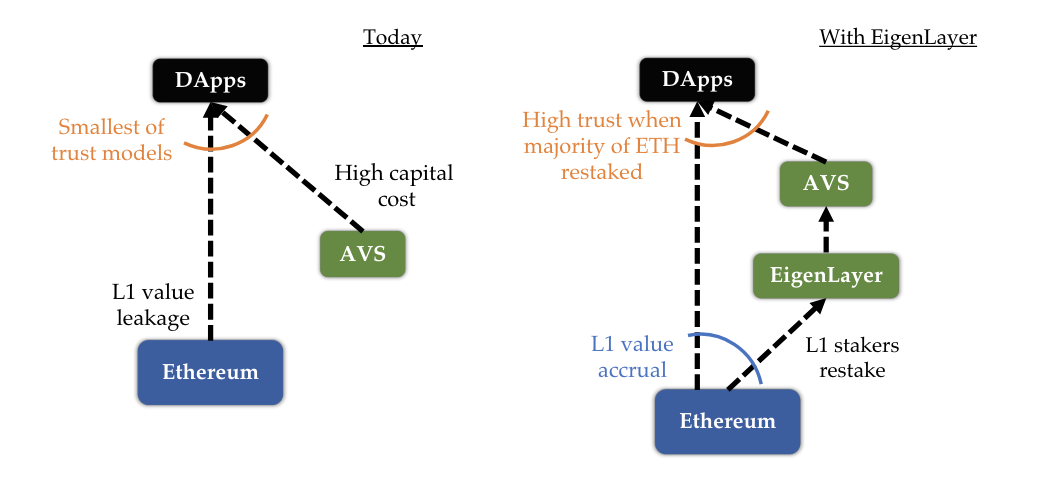
The Ethereum network uses a proof-of-stake (PoS) consensus mechanism, under which node operators stake ETH and run validator software to secure the network (e.g., storing data, processing transactions, adding new blocks to the beacon chain), earning rewards (a share of network fees). If node operators fail to perform their validation duties or act maliciously, they risk losing part or all of their staked ETH (i.e., slashing).
Now, developers building protocols on top of Ethereum that require external operators typically need to bootstrap their own PoS networks and ensure their security. This is a challenging task requiring developers to design and launch tokens, incentivize node operators to stake those tokens and run validator software, and implement fair reward distribution and slashing mechanisms. Moreover, requiring each new protocol to launch its own PoS network fragments Ethereum’s security and drains value (in the form of staked tokens) away from the beacon chain.
3. How EigenLayer Works
EigenLayer aims to address these challenges by allowing developers to leverage Ethereum’s existing validator set and enabling ETH staking from day one through a "shared security" model. The shared security and restaking mechanism not only promises to lower barriers to entry for developers and accelerate innovation within the Ethereum ecosystem but also aims to create new pathways for Ethereum stakers to actively participate across multiple networks requiring crypto collateral and external operators, thereby maximizing return potential.
The EigenLayer protocol architecture comprises four key components: restakers, operators, AVSs (Active Validation Services), and AVS consumers.
-
Restakers: Individuals or entities who restake their staked ETH or LSTs with the goal of extending security to services within the EigenLayer ecosystem—specifically, Active Validation Services (AVS).
-
Operators: Entities that run specialized node software to perform validation tasks for AVSs built on EigenLayer, earning predetermined rewards. Operators register on EigenLayer, are delegated by restakers, and then choose to provide validation services to various AVSs. Notably, operators must comply with the slashing conditions defined by each AVS.
-
Active Validation Services (AVS): Any system requiring a unique distributed validation method. AVSs can take diverse forms, including data availability layers, shared sequencers, oracle networks, bridges, coprocessors, application-specific cryptographic systems, and more.
-
AVS Consumers: End users or applications utilizing EigenLayer services.
4. The "Verifiable Cloud" for Crypto
EigenLayer founder Sreeram Kannan is often quoted saying, “EigenLayer is the verifiable cloud for crypto.” But what does this actually mean? In traditional cloud architectures, centralized entities provide computing, storage, and hosting services for various web2 SaaS solutions. These SaaS offerings typically fall into two categories: horizontal SaaS (i.e., general-purpose software solutions targeting broad end-user audiences regardless of industry) and vertical SaaS (i.e., software tailored to specific user groups, use cases, or industry standards).
Just as cloud platforms and SaaS solutions transformed web2 development, we believe the emergence of EigenLayer and its burgeoning AVS ecosystem represents a similar paradigm shift for blockchain. EigenLayer aims to provide crypto-economic security services for AVSs—essentially serving as “web3 SaaS.” Similar to how web2 SaaS solutions emerged and gained widespread adoption, we now see analogous trends unfolding for AVSs, driven by growing demand from protocols and dapps.
In summary, EigenLayer’s “shared security system” aims to accelerate on-chain innovation while delivering greater decentralization, trust, and transparency—ultimately redefining the future of verifiable cloud computing.
5. Current State of EigenLayer AVSs
On April 9, 2024, EigenLayer launched its Operator and AVS modules on mainnet, becoming home to a vibrant operator ecosystem (with over 200 operators as of May 14, 2024), and expecting a growing number of AVSs to launch in the coming months (currently at 11). We anticipate that, much like the traditional SaaS landscape, AVSs will naturally evolve into distinct categories—such as horizontal and vertical AVSs.
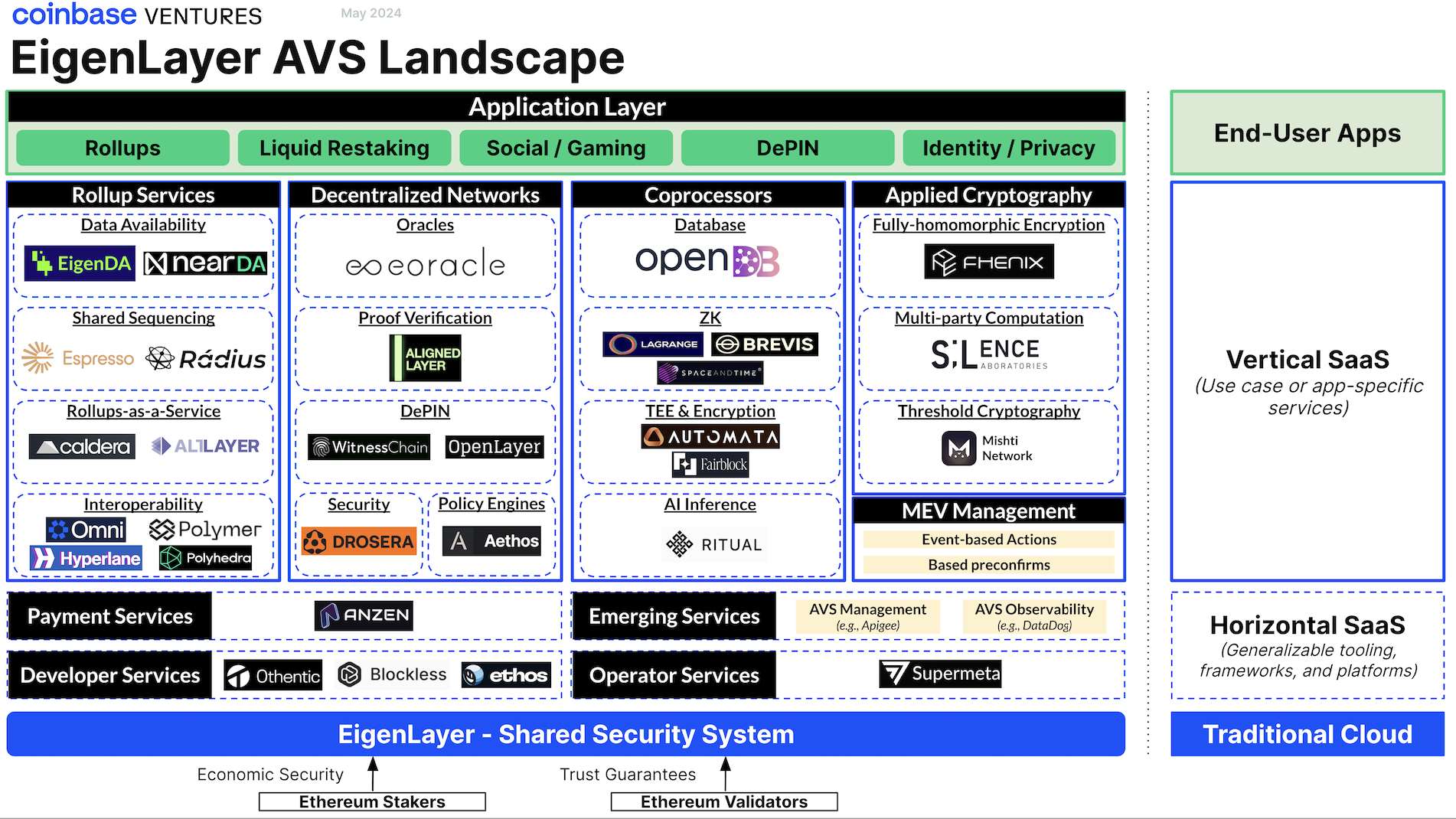
Within this framework, the current state of EigenLayer AVSs can be summarized as follows:
"Horizontal" AVSs
-
Developer Services: Frameworks and tools helping developers build and deploy PoS networks (e.g., AVSs, L1s/L2s) that require shared security infrastructure (e.g., Othentic, Blockless, Ethos).
-
Operator Services: Services assisting AVS operators in managing their node infrastructure, validator tasks, and/or staking operations (e.g., Supermeta).
-
Payment Services: Services handling delivery of payments (e.g., AVS rewards) to distributors and operators (e.g., Anzen).
"Vertical" AVSs
-
Rollup Services: Supporting development of Ethereum scaling primitives (e.g., rollups) while inheriting security from Ethereum’s trust network. Examples include data availability (e.g., EigenDA, NearDA), shared sequencing (e.g., Espresso, Radius), RaaS (e.g., Caldera, AltLayer), and interoperability (e.g., Omni, Polymer, Hyperlane, Polyhedra).
-
Decentralized Networks: Networks requiring distributed validator mechanisms. Examples include oracles (e.g., eOracle), proof verification (e.g., Aligned Layer), DePIN (e.g., WitnessChain, OpenLayer), security monitoring (e.g., Drosera), and smart contract policy engines (e.g., Aethos).
-
Coprocessors: Services providing cost-effective, verifiable off-chain computation for developers. Examples include database coprocessors (e.g., OpenDB), ZK coprocessors (e.g., Lagrange, Brevis, Space and Time), trusted execution environments and cryptographic coprocessors (e.g., Automata, Fairblock), and AI inference (e.g., Ritual).
-
Application Cryptography: Services for building reliable cryptographic systems. Examples include fully homomorphic encryption (e.g., Fhenix), multi-party computation (e.g., Silence Laboratories), and threshold cryptography (e.g., Mishti Network).
-
MEV Management: Emerging services enabling block proposers to add additional trusted commitments around block inclusion and ordering.
Application Layer
-
Above AVSs, we expect new on-chain applications to emerge that leverage EigenLayer’s unique economic security properties.
-
New examples include rollups, liquid restaking tokens (LRTs) and associated LRTFi apps (i.e., DeFi protocols using LRTs as underlying collateral), social and gaming applications, decentralized physical infrastructure networks (DePIN), and identity/privacy-preserving applications.
6. Outlook
As restaking and shared security models continue to mature, their impact on the blockchain ecosystem becomes increasingly evident. Growing demand from stakers/validators seeking to maximize yield potential and developers aiming to accelerate infrastructure-level innovation is expected to unlock new on-chain opportunities. While EigenLayer pioneered the restaking protocol, we are seeing similar mechanisms emerge in other ecosystems—such as Babylon Chain for Bitcoin, Solayer, Cambrian, and Fragmetric for Solana, Picasso Network for IBC, omnichain restaking (e.g., Exocore), and multi-asset restaking (e.g., Karak).
That said, while restaking and shared security models open many exciting on-chain opportunities, restakers must remain aware of risks related to smart contract security and unexpected slashing events. It should be noted that, at the time of writing, EigenLayer’s slashing and payment mechanisms (i.e., AVS rewards) have not yet launched and are expected to roll out later this year.
Join TechFlow official community to stay tuned
Telegram:https://t.me/TechFlowDaily
X (Twitter):https://x.com/TechFlowPost
X (Twitter) EN:https://x.com/BlockFlow_News






