
From Infrastructure to Applications: A Deep Dive into LeverFi's BTC Ecosystem Strategy
TechFlow Selected TechFlow Selected
From Infrastructure to Applications: A Deep Dive into LeverFi's BTC Ecosystem Strategy
LeverFi's strategic positioning within the Bitcoin ecosystem is also quite evident: it simultaneously advances on both technology and asset issuance fronts, leveraging liquidity and attention from different sources.
 Navigating Web3 tides with focused insights
By TechFlow
When discussing the Bitcoin ecosystem, people might first think of inscriptions like Ordinals or BTC Layer 2 solutions such as Stacks. Beyond mainstream attention, however, the veteran DeFi project LeverFi has quietly gained traction with its new strategic moves in the Bitcoin ecosystem—its token $LEVER surged by as much as 240% over three months.
While it’s not unusual for older tokens to see a revival during bull markets, $LEVER stands out through sustained upward momentum compared to other projects in the same sector and timeframe.
Behind this rapid rise lies LeverFi's strategic pivot toward Bitcoin-centric narratives. How has LeverFi reshaped its business—from legacy operations to new frontiers, from infrastructure to application scenarios?
OmniZK: Exploring Enhanced BTC Performance
Currently, market interest in the Bitcoin ecosystem primarily revolves around two areas: new asset issuance and improvements in BTC network performance. LeverFi is actively involved in both.
To address Bitcoin’s limitations in scalability and complex computation processing, LeverFi introduced a modular zero-knowledge proof protocol—OmniZK.
In simple terms, OmniZK leverages cross-chain technology to "outsource" data originating from the BTC network to EVM (Ethereum Virtual Machine). After EVM handles complex computations, the results are securely packaged via ZK proofs and sent back to the BTC network for final settlement on-chain.
An analogy:
Think of OmniZK as a highly efficient international courier service. You (a developer) need to send a heavy package (data and instructions requiring complex computation) from Location A to a company at Location B—the Bitcoin network. However, standard couriers can't handle such bulky shipments or properly seal them.
So you choose OmniZK, which has specialized equipment (EVM) for handling oversized cargo. They provide a secure container (zero-knowledge proof), displaying only essential verification details about the package—proving its legitimacy without revealing any sensitive content.
Finally, the package clears customs at Location B and is safely delivered to the recipient (transaction settled on the Bitcoin blockchain).
On the technical implementation side:

The diagram illustrates the full process from user request via OmniRelayer and zkOracle to final execution.
OmniZK operates a global network of service nodes called OmniRelayers, ready to handle users’ “shipping” requests. When a user initiates a request, the OmniRelayer first calculates the required amount of BTC; the user then locks funds into a pre-specified BTC script address.
Once funds are confirmed, the OmniRelayer begins security checks, uses the zkOracle oracle to sync real-time information throughout the delivery process, applies cryptographic packaging (ZK encryption), and executes the transfer across chains via L0 Endpoints.
Upon successful delivery, after confirmation via zkOracle, the OmniRelayer signs a Discrete Log Contract (DLC), releasing the previously locked BTC to the designated BTC address.
At this point, the transaction is complete.
The introduction of OmniZK doesn’t necessarily mean direct competition with existing BTC L2 solutions—it offers instead an additive value proposition.
OmniZK supports a wide range of cross-chain Bitcoin use cases, including but not limited to: non-custodial BTC staking, cross-chain Bitcoin DeFi markets, decentralized asset bridges, omnichain liquidity management, etc.
Applications built using OmniZK operate independently of Bitcoin Layer 2 networks, yet remain complementary to them.
By providing zero-knowledge proofs and advanced logic validation capabilities, OmniZK enhances BTC L2s with better settlement efficiency and privacy protection. For users and developers prioritizing privacy and security, OmniZK + BTC L2 could become a preferred solution.
LeverPro: A BTC Asset Issuance Platform
On the asset issuance side of the Bitcoin ecosystem, LeverFi launched LeverPro—a BRC20 asset issuance platform where users stake their $LEVER tokens to participate in new project launches (launchpad activities).
Since its launch, two projects have successfully raised funds through LeverPro: Orange Crypto, a DeFi protocol offering BTC ecosystem asset management tools, and Flash Protocol, enabling BTCFi functions such as native BTC asset staking, swapping, and lending.
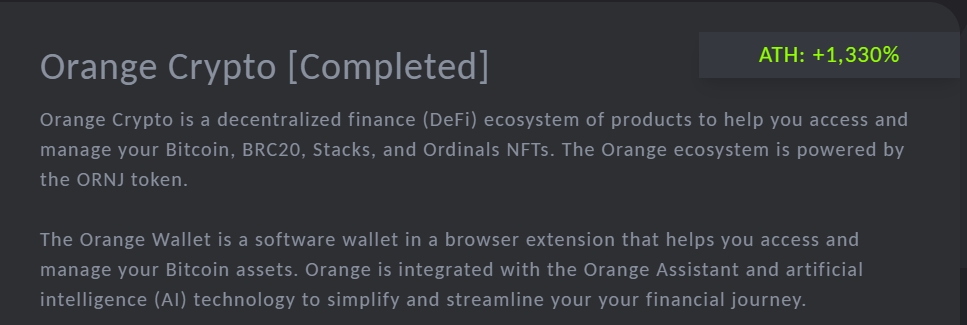

Both projects achieved peak price gains of 5x to 13x.
According to platform rules, not all participants who stake receive token allocations. To address this pain point, LeverPro is preparing to launch its latest initiative: $LEVP, a Launchpad Privilege Point system.
The utility of $LEVP can be simply described as a PASS CARD within the platform. Users who stake LEVER and hold LEVP gain special privileges, including guaranteed/preferred allocation of premium slots and access to top-tier distribution tiers on new LeverPro launches.
Each time a user claims a guaranteed allocation, a portion of their LEVP is burned, gradually reducing the circulating supply.
Indeed, whether enhancing BTC performance via OmniZK or issuing new assets through LeverPro, one can observe that the Bitcoin ecosystem is essentially replicating Ethereum’s earlier DeFi trajectory: faster performance, more asset issuance.
This is precisely where LeverFi’s strength as a veteran DeFi project shines—using BRC20 asset issuance as an entry point, leveraging its deep expertise and resource advantages in decentralized finance to systematically introduce proven DeFi mechanics into the BTC ecosystem.
Conclusion
In today’s market consensus—where speculation favors novelty over legacy projects and mutual support is scarce—LeverFi’s proactive shift toward trending narratives may offer a neutral reference point for older projects seeking relevance.
Moreover, LeverFi’s strategic footprint in the Bitcoin ecosystem is clearly defined: dual focus on technology and asset issuance, mobilizing liquidity and attention from diverse audiences.
Projects like LeverFi, striving to break stagnation through innovation—combining technological advancement with financial expansion—not only reinvigorate their ecosystems but also strengthen token utility, reinforcing confidence among supportive community members.
Of course, as market cycles shift and trends evolve, whether LeverFi’s journey in the BTC ecosystem will fizzle out or endure the test of time remains to be seen. We’ll keep watching.
Join TechFlow official community to stay tuned
Telegram:https://t.me/TechFlowDaily
X (Twitter):https://x.com/TechFlowPost
X (Twitter) EN:https://x.com/BlockFlow_News
 深潮TechFlow