








Interpreting AIOZ W3AI: The "Two-Layer Architecture" of Shared Computing Power and AI-as-a-Service—What New Possibilities Will Emerge After the Narrative Shift?
TechFlow Selected TechFlow Selected
Interpreting AIOZ W3AI: The "Two-Layer Architecture" of Shared Computing Power and AI-as-a-Service—What New Possibilities Will Emerge After the Narrative Shift?
As the AI赛道 becomes increasingly competitive, what new innovations can established projects offer?
 Navigating Web3 tides with focused insights
By TechFlow

On May 7, Bithumb added KRW trading pairs for two AI projects: AIOZ and NEAR. NEAR is a well-established Layer-1 blockchain, while AIOZ Network may be less familiar. Originally focused on decentralized storage and streaming, AIOZ Network is now leveraging its existing infrastructure to pivot toward AI-as-a-Service (AIaaS) and decentralized computing power sharing. Recently, it released the whitepaper for its new decentralized AI project, W3AI.
As competition intensifies in the AI sector, how can established projects innovate and capture attention and liquidity in an increasingly scarce market?
Given the complexity of the whitepaper, TechFlow has conducted an in-depth analysis to help readers quickly grasp the technical features and implementation of the AIOZ W3AI project.
Beneath the Wave: AIOZ’s Opportunity in the AI Market
AIOZ is not a new project, but its transition into AI is a natural evolution.
Previously, AIOZ Network was a Layer-1 blockchain with interoperability between Ethereum and Cosmos ecosystems. It powers over 120,000 global nodes through its AIOZ DePIN network, providing distributed computing resources that support high-speed AI processing, rapid iteration, scalability, and network security—key assets enabling its narrative shift into AI.
Externally, AI development faces challenges due to centralized cloud computing solutions struggling with massive data loads, leading to limited scalability and high costs. Moreover, because data control remains with centralized providers rather than users, concerns about data privacy and security are inevitable.
Additionally, access to top-tier AI resources often comes with high barriers, restricting participation by smaller enterprises and individuals, thus hindering innovation. Edge computing offers a solution by bringing computation closer to data sources. Applications run locally at the edge, resulting in faster response times. Since data is processed locally instead of being transmitted long distances to central servers, edge computing inherently reduces the risk of data breaches. With AIOZ DePIN’s globally distributed edge computing nodes, AIOZ is well-positioned for large-scale expansion into the AI domain.

Current node statistics of AIOZ Network
W3AI: The “Dual-Layer Architecture” of DePIN + AI-as-a-Service
A key move in AIOZ’s push into AI is W3AI—a dual-layer architecture combining infrastructure and application layers.
The dual-layer architecture lies at the heart of the AIOZ W3AI project, offering an innovative approach to address fundamental issues in AI computing related to scalability, cost efficiency, and user privacy protection.
This architectural design divides network operations into two main tiers: the Infrastructure Layer (W3AI Infrastructure) and the Application Layer (W3AI Application). Each layer serves distinct functions and roles, working together to ensure efficient network operation.
Infrastructure Layer (W3AI Infrastructure) as the Network Foundation
-
Global Human-Powered Nodes of AIOZ DePIN
At the core of AIOZ W3AI is its vast network of globally distributed human-powered edge computing nodes. Contributors provide computing resources including storage, CPU, and GPU capacity, forming a decentralized power source. A multigraph topology ensures efficient communication pathways among AIOZ DePIN nodes, minimizing communication costs and maximizing processing speed. These nodes collaborate using distributed computing methods to jointly train and execute AI models. In this way, the AIOZ W3AI platform effectively leverages dispersed computing power to reduce costs, improve efficiency for AI applications, and enhance data privacy. This decentralized model significantly lowers the risk of server bottlenecks and strengthens user privacy by eliminating single points of control.
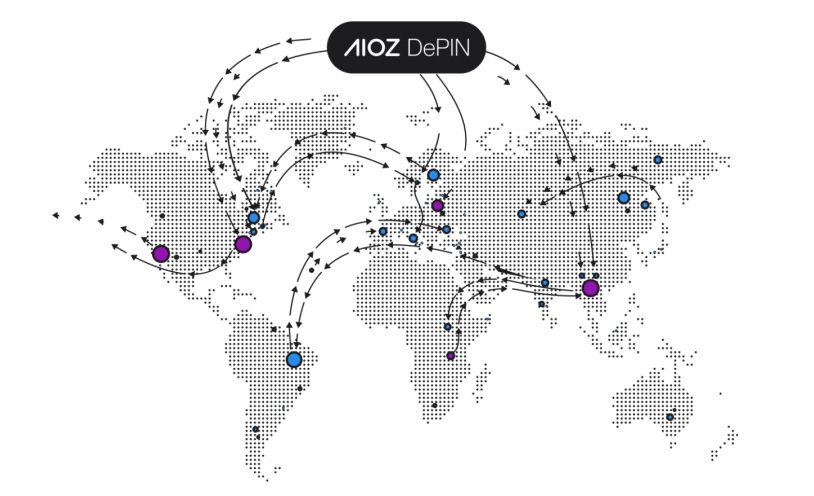
Decentralized computing infrastructure of W3AI powered by the AIOZ node network. Purple areas indicate storage node distribution; blue areas indicate computing node distribution.
-
Data Processing and Storage
Through AIOZ W3S, data is securely stored across multiple geographically dispersed nodes, enhancing both data security and processing responsiveness.
Using the distributed file system AIOZ IPFS and encryption technologies, data stored on nodes is protected against unauthorized access and data leaks.
Flexible Application Layer (W3AI Application)
-
Web3 AI Platform Offering AI-as-a-Service
AI-as-a-Service (AIaaS) refers to delivering AI technology as an online service, allowing businesses or individuals to benefit from AI without incurring high upfront costs.
For example, e-commerce merchants seeking to analyze customer purchase history and behavior for personalized shopping recommendations can leverage AI technology to collect and analyze user data, generating targeted sales strategies—an application of AIaaS in e-commerce.
In terms of product design, W3AI provides simplified AI training workflows and intuitive UI/UX, offering interfaces and APIs that allow developers to easily integrate with W3AI services, develop, and deploy AI models. This layer emphasizes user experience and service accessibility. The platform integrates various AIaaS offerings—including machine learning, deep learning, and neural networks—enabling users to select appropriate tools and services based on their needs.
-
Model Training and Inference
The W3AI platform supports model training and inference within a decentralized environment. W3AI Training (AIOZ W3AI Infrastructure) employs decentralized federated learning and homomorphic encryption techniques, enabling numerous edge computing nodes (DePINs) to collaboratively train shared AI models without exposing their private data—balancing improved training performance with strong data privacy. By running trained models directly on edge AIOZ DePIN nodes, AI processing occurs close to the data source. Supported by W3S technology, W3AI Inference (AIOZ W3S Infrastructure) allows users to upload their own datasets for model training or use pre-existing models on the platform for data analysis and predictions.
-
Decentralized W3AI Marketplace and Incentive Mechanism
The application layer also features decentralized marketplaces: the AIOZ AI dApp Store and the AI Model & Dataset Marketplace. Here, individual users and organizations can freely contribute, sell AI datasets and models, build and deploy innovative AI applications, and convert their contributions into token rewards.

Dual-layer architecture of AIOZ W3AI
“AI-Powered Routing” Bridging the Two Layers
While the dual-layer architecture is robust, managing the logical resources and task data flowing between layers requires intelligent coordination. To this end, W3AI introduces AI-powered routing to dynamically optimize each task, enhancing overall system efficiency.
In the infrastructure layer, AI-powered routing analyzes computational demands and real-time node load conditions to dynamically assign tasks, ensuring each node participates in suitable workloads based on its capabilities and current network status. It continuously monitors node health, promptly identifying potential failures or performance bottlenecks to prevent any single point of failure from affecting overall efficiency.
In the application layer, smart routing enables rapid response to user requests by dynamically adjusting data flow and processing strategies. It intelligently allocates the most suitable nodes based on user location and specific requirements. For large-scale, high-concurrency tasks, the AI routing architecture performs intelligent scheduling and optimization, supporting the application layer in handling complex AI models and big data analytics.
The whitepaper includes extensive mathematical formulas detailing the routing mechanism's implementation—interested readers may refer to the whitepaper.
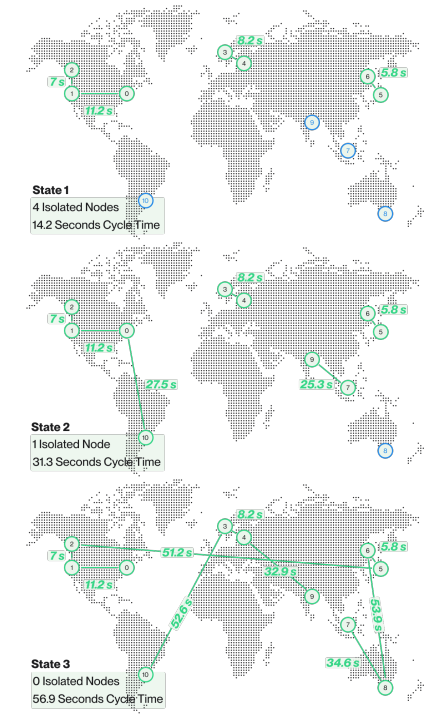
AI-powered routing determines task transmission paths among AIOZ DePIN nodes. Green lines represent connected nodes; blue lines indicate skipped connections due to low confidence.
Workflow: Realizing AI Tasks in Practice
With such rich infrastructure, how does W3AI execute its workflow? From data input to output delivery, W3AI follows a fully decentralized operational model: Data encryption → Task splitting and allocation → Computation and storage execution → Result collection in containers → Decrypted output delivered to user.
We can break down this process into clear steps:
-
First, user-uploaded data undergoes homomorphic encryption before entering the platform, ensuring data security throughout processing—data input and encryption;
-
Encrypted data is split into smaller segments according to task requirements, with each subtask assigned to the most suitable node—task splitting and allocation;
-
Selected nodes perform specific computations—such as AI model training or data analysis—and handle associated data storage—computation and storage execution;
-
Upon completion, results are re-encrypted and stored in designated containers awaiting retrieval—result collection and encryption;
-
Only authorized users can access final outputs, which are decrypted via homomorphic decryption prior to delivery—result decryption and output.

W3AI workflow architecture
Through this workflow, W3AI enhances processing efficiency while maintaining flexibility, scalability, and strong data privacy. It optimizes resource utilization, minimizes manual intervention, and reduces operational costs.
Tokenomics Around the Entire Ecosystem
$AIOZ is a crucial component connecting the entire AIOZ W3AI ecosystem. With the emergence of AI-as-a-Service and shared computing power, the token gains expanded utility and value accrual.
Data Trading and Contribution Incentives
$AIOZ rewards users who contribute computing power and storage resources, ensuring stable network operation. On the platform’s marketplace, users can spend $AIOZ to purchase various AIaaS offerings or trade AI models and datasets. Token holders also participate in network governance, voting on future ecosystem developments.
Sustaining the Ecosystem
A portion of transaction fees paid in $AIOZ funds AIOZ network operations and financial sustainability, ensuring continuous platform maintenance and development. Another portion is permanently burned, helping regulate token supply and mitigate inflation. This carefully designed token circulation loop incentivizes innovation, rewards participation, and drives the ongoing growth of the AIOZ W3AI ecosystem.
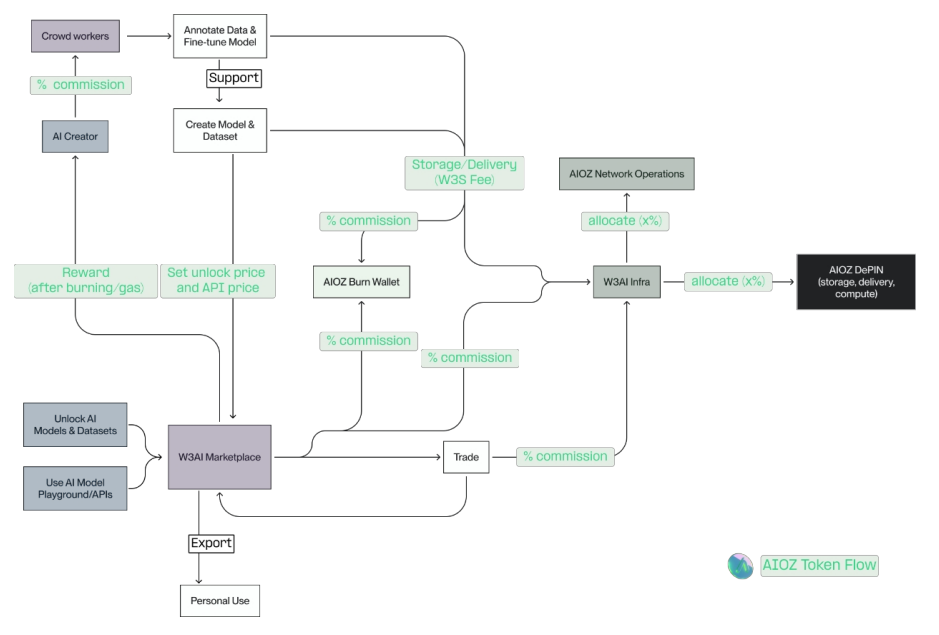
Token flow within the W3AI ecosystem
Conclusion
As a decentralized project transitioning into AI, AIOZ W3AI possesses inherent advantages in technological resources and operational mechanisms. Technically and conceptually, W3AI demonstrates significant potential, offering users more secure, flexible, and efficient computing services along with an engaging ecosystem experience. However, challenges remain—market awareness and trust in decentralized AI solutions are still immature, and the system’s high-performance requirements could lead to elevated operating costs.
Currently, the whitepaper resembles an early-stage blueprint—well-prepared for the future but not yet implemented. How many users will adopt it, and whether unforeseen security or technical issues arise, remain to be tested by the market.
Nevertheless, proactively adapting to emerging narratives represents a sound strategy for Web3 projects when business alignment exists. As both new and established projects enthusiastically embrace the AI trend, only time will tell whether crypto participants will ultimately receive a worthwhile return on their engagement.
Join TechFlow official community to stay tuned
Telegram:https://t.me/TechFlowDaily
X (Twitter):https://x.com/TechFlowPost
X (Twitter) EN:https://x.com/BlockFlow_News
 深潮TechFlow


