









BTC's "squat" not over yet, next "jump" targets $92,000
TechFlow Selected TechFlow Selected
BTC's "squat" not over yet, next "jump" targets $92,000
Once the corrective wave is complete, the fifth wave is expected to rise to approximately $92,000.
 Navigating Web3 tides with focused insights
By BitpushNews Mary Liu
Bitcoin (BTC) reclaimed $64,000 over the weekend but lost that support level in early Monday trading.
The week started with high volatility in the crypto market. According to Bitpush data, BTC surged to an intraday high of $65,545 before sharply reversing after news emerged that the U.S. Securities and Exchange Commission (SEC) had issued a Wells notice to Robinhood’s crypto division, alleging securities violations.
At the time of writing, BTC was trading at $63,115, down 1.5% over 24 hours. Other cryptocurrencies showed mixed performance: Ethereum (ETH), DOGE, SHIB, and MATIC declined 2%-3%, while Solana (SOL) and XRP rose 4%-6%.
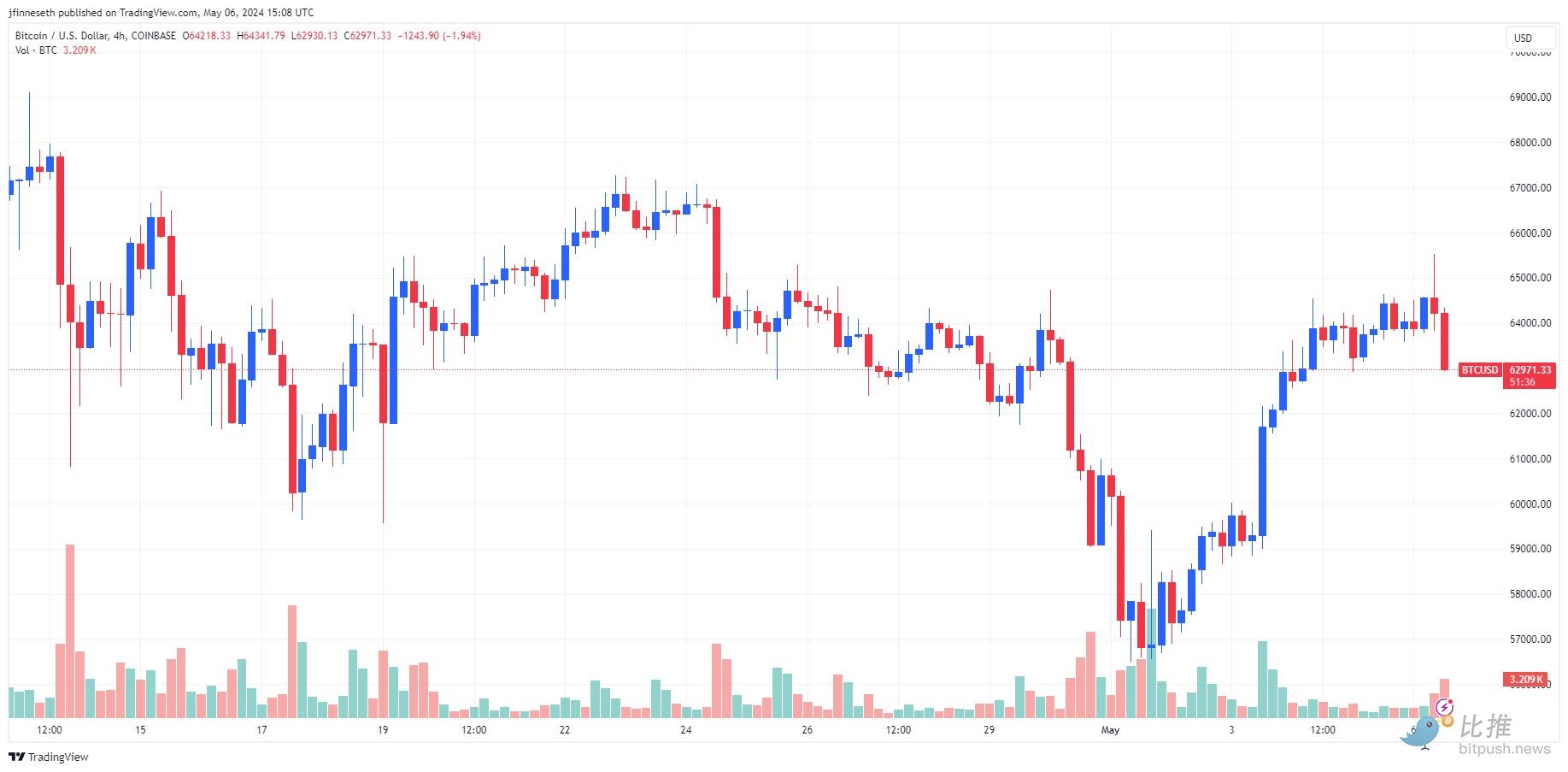
BTC has not completed its correction yet; next upside target is $92,000
John Glover, Chief Investment Officer at cryptocurrency lending firm Ledn, said Bitcoin could still decline further before completing its correction from the March all-time high of $73,000.
Glover’s forecast is based on the Elliott Wave Theory, a technical indicator that assumes asset prices move in repetitive waves. “Although the drop to $56,500 may have already completed the correction, I still expect prices to reach $52,000–$55,000 before the end of wave 4 correction,” Glover stated.

The theory suggests that market movements tend to repeat a specific pattern, consisting of five impulse waves upward followed by three corrective waves downward. Waves 1, 3, and 5 represent the main trend direction, while waves 2 and 4 are pullbacks between these impulsive moves.
“Once the downward/corrective phase completes, I anticipate wave 5 will drive prices up toward approximately $92,000,” Glover concluded.
Other bullish outlooks
Cryptocurrency hedge fund QCP Capital noted renewed demand for Bitcoin call options with strike prices of $75,000 and $100,000 expiring in September, indicating investor optimism about BTC climbing higher in the coming months. Bernstein analysts also told clients in a report on Monday that BTC is “far from finished” with its current bull cycle and reaffirmed their prediction that BTC will reach $150,000 by the end of 2025.
Analysts Gautam Chhugani and Mahika Sapra said: “We feel better about this call as indicators suggest a healthy cycle that is still in its early stages. The risk-reward remains attractive.”
They added that Bitcoin’s pullback to around $56,525 was positive for the market because it “cleared excess leverage in futures contracts on crypto exchanges.”
The analysts also highlighted that spot BTC exchange-traded funds (ETFs) listed in the U.S. saw inflows again on Friday after eight consecutive days of outflows. Notably, Grayscale’s GBTC recorded $63 million in net inflows on Friday—the first inflow in 78 days. Analysts said this figure is significant “considering GBTC has been a major source of sustained selling pressure, which the nine new ETFs have had to absorb.”
Other positive factors cited by Bernstein analysts include strong overall ETF inflows over the past three months, rising corporate interest in buying Bitcoin, stable hash rate post-halving, steady transaction fees after halving, and depressed prices for Bitcoin mining equipment.
Mike Martin, Head of Content at tastycrypto, also viewed last week’s correction as a healthy market development. He expects Bitcoin to “stabilize near the $60,000 level in the short term, influenced by ongoing inflation concerns and monetary policy uncertainty, leading to price stability over the coming months.”
Martin stated in a report: “Looking ahead to year-end, Bitcoin could very well reach $80,000. However, this projection depends on several factors becoming more favorable, including clearer monetary policy signals and potential rate cuts, which could reignite investor interest in risk assets like Bitcoin.”
He added that clarity on rate cuts “will be key to reigniting the Bitcoin bull run. Such a move could improve broader market sentiment and encourage investment into cryptocurrencies as alternatives to traditional investments, which may offer lower returns in a low-interest-rate environment—especially amid dollar depreciation.”
Vijay Marolia, co-founder of The Cash Square, also believes “the bottom may already be in” and “expects the Bitcoin bull market to continue this year.”
He said: “While technically speaking, I wouldn’t be surprised if prices dropped to the $50,000 level in the short term—I believe the bottom may already be here, so I expect this year’s Bitcoin bull market to persist, given that Bitcoin’s price is inversely correlated with confidence in global fiat currencies.”
As for catalysts that could reignite bullish momentum, Marolia pointed to “increased dovish actions by the Federal Reserve (or other major central banks); additional increases in government spending (which will be taxed or inflated away); and any spike in the 10-year Treasury yield and/or a downgrade of the U.S. credit rating.”
Emmanuel Quezada, CEO of U-topia, said: “While accurately predicting market tops or bottoms is challenging, it can be argued that current discounted prices present a significant opportunity for new all-time highs in 2024.”
Quezada added: “Considering current market trends and the impact of institutional order flow on market capitalization, there is a high likelihood that Bitcoin will reach $100,000 in the next quarter. Market corrections often stem from uncertainty. Therefore, regulatory clarity within the market framework is a key driver in channeling liquidity in a favorable direction.”
Join TechFlow official community to stay tuned
Telegram:https://t.me/TechFlowDaily
X (Twitter):https://x.com/TechFlowPost
X (Twitter) EN:https://x.com/BlockFlow_News
 比推 BitpushNews











