








Mode Network: Driving Ethereum Layer 2 Innovation, Efficiently Scaling Every Transaction
TechFlow Selected TechFlow Selected
Mode Network: Driving Ethereum Layer 2 Innovation, Efficiently Scaling Every Transaction
Mode Network is a modular Layer2 network focused on the DeFi sector, built on Optimism's Bedrock upgrade.
 Navigating Web3 tides with focused insights
Author: Tea House Assistant
1. Project Overview
Mode Network is a modular Layer 2 network focused on the DeFi sector, built upon Optimism’s Bedrock upgrade. It supports rapid development and deployment of Ethereum Virtual Machine (EVM)-compatible decentralized applications (DApps), reducing transaction fees by up to 95%.
Mode Network is known for its innovative revenue-sharing model, aiming to empower developers and users to build world-class application ecosystems and directly earn rewards through referrals and contract-guaranteed income. By distributing sequencer revenue to developers and users, it enhances decentralization in DeFi and enables broader participation in network-generated value.
2. Core Mechanisms
2.1 Optimistic Rollup Technology
The Optimistic Rollup technology used by Mode Network is a Layer 2 scaling solution designed to enhance Ethereum's scalability and reduce transaction costs. This technology operates via an independent execution layer on top of Ethereum, significantly improving transaction processing speed without compromising security. Below is a more detailed explanation of how Optimistic Rollups function within Mode Network:
2.1.1 Principles and Workflow
1. Batch Processing:
Optimistic Rollups bundle multiple transactions into batches and submit the batch data to the Ethereum mainnet collectively. This reduces the need for each individual transaction to undergo separate state transitions and validation, thereby lowering transaction costs.
2. Delayed Confirmation:
In Optimistic Rollups, transactions are immediately confirmed on Layer 2 once included in a batch, without waiting for confirmation from the Ethereum mainnet. This provides fast user experience, although final validity still depends on subsequent verification on the main chain.
3. Fraud Proofs:
Optimistic Rollups operate under an "optimistic" assumption that all transactions and batches are honest. If someone suspects fraudulent activity in a batch, they can submit a fraud proof to challenge it. If the challenge succeeds, the fraudulent batch is reverted and associated transactions rolled back.
4. Reversion and Security:
Optimistic Rollups provide an additional security layer because every transaction must eventually be settled on the Ethereum mainnet. Even if errors or malicious actions occur on Layer 2, corrections can be made on the mainnet, ensuring fund safety.
2.1.2 Features and Advantages
-
Scalability: By executing transactions on Layer 2 and only submitting batch data to the mainnet, Optimistic Rollups drastically reduce demand on Ethereum’s resources, enhancing overall network scalability.
-
Cost Efficiency: Reduces the number of transactions requiring direct processing on Ethereum, significantly lowering user fees.
-
User Experience: Offers near-instant transaction confirmations, improving UX—especially for applications like exchanges or games requiring fast settlement.
-
Compatibility: Supports the Ethereum Virtual Machine (EVM), allowing seamless migration of existing Ethereum dApps to Mode Network.
2.2 Sequencer Fee Sharing
The sequencer fee-sharing mechanism is a core component of Mode Network’s economic model, designed to incentivize developers to build and maintain applications on the platform while increasing user engagement.

This mechanism operates through several key features:
2.2.1 Understanding Sequencer Fees
In Layer 2 solutions using Optimistic Rollups, the sequencer plays a crucial role by collecting, ordering, and batching transactions before submitting them to the Ethereum mainnet. This process incurs gas fees on Ethereum; however, due to batch processing, the average cost per transaction is greatly reduced. The sequencer thus generates revenue primarily from user-paid transaction fees.
2.2.2 Fee-Sharing Mechanism
1. Revenue Distribution:
-
Developer Incentives: Mode Network allows developers to register their smart contracts with designated fee-sharing contracts to receive a portion of sequencer revenue. This encourages creation and maintenance of high-transaction-volume apps, which generate more fees.
-
User Rewards: A portion of sequencer revenue is also allocated to reward users, particularly those who refer new users to the network. This referral system promotes organic growth and increases network activity.
2. Contract Registration:
Developers must link their smart contracts to fee-sharing contracts to benefit. This typically involves including specific code snippets during development to ensure proper tracking and reward distribution.
3. Transparency and Automation:
The fee-sharing ratios and allocation rules are transparent and automatically executed via smart contracts, ensuring fairness and trustlessness. This automated approach minimizes disputes and strengthens confidence in the network.
2.2.3 Benefits and Impact
-
Encourages Innovation: Financial incentives attract more developers to innovate, resulting in diverse and robust applications.
-
Boosts Engagement: User reward mechanisms increase participation, encouraging usage and promotion of Mode Network, accelerating adoption.
-
Ecosystem Growth: As high-quality apps emerge and user base expands, the entire ecosystem grows rapidly, increasing overall value and appeal.
2.3 Modular and Collaborative Model
Mode Network’s modular and collaborative model lies at the heart of its blockchain architecture and operational strategy. This design aims to improve flexibility, scalability, and user engagement. Through these strategies, Mode Network seeks to build a versatile and efficient ecosystem that supports diverse app development and fosters cooperation among stakeholders. Below is a detailed overview:
2.3.1 Modular Architecture
1. Definition and Purpose:
Modularity refers to decomposing network functions into independent components or modules, each responsible for specific tasks. This design enables flexible development and maintenance, allowing the network to better adapt to evolving technological and market demands.
2. Implementation:
-
Consensus Layer: May use dedicated modules to handle transaction validation and consensus mechanisms, ensuring security and integrity.
-
Execution Layer: Modularized layer for executing smart contracts and processing transactions, optimizing resource usage and speed.
-
Data Layer: Handles data storage and access independently, improving efficiency and scalability.
-
Interaction Layer: Manages interfaces with users and external systems (e.g., APIs, frontends), ensuring good UX and interoperability.
3. Advantages:
-
Flexibility: Enables quick adjustments or upgrades to individual components without affecting others.
-
Maintainability: Independent modules simplify management, optimization, and reduce potential bugs and security risks.
-
Scalability: Specific modules can be scaled independently as needed, avoiding full network reengineering.
2.3.2 Collaboration Model
1. Collaborative Ecosystem:
Mode Network encourages collaboration among various stakeholders—including developers, users, investors, and partners—to jointly drive network development and value creation.
2. Incentive Mechanisms:
-
Developer and User Incentives: Distributes network revenue (e.g., sequencer fee sharing), offers funding support, and hosts competitions to encourage innovation and participation.
-
Partner Incentives: Establishes partnerships to co-develop solutions and share resources and market opportunities.
3. Governance Model:
-
Decentralized Governance: May adopt a decentralized governance model enabling users and developers to participate in decision-making—such as voting on key upgrades and policy changes via tokens.
-
Transparent Communication: Regularly publishes project updates and financial reports, maintaining transparency and open communication within the ecosystem.
4. Technical Collaboration and Integration:
-
Standardized Interfaces: Provides standardized APIs, enabling third-party apps and services to easily integrate with Mode Network.
-
Cross-chain Interoperability: Develops features supporting interoperability with other blockchains, expanding Mode Network’s reach and market acceptance.
2.4 Mode Network Bridge
The Mode Network Bridge is a critical component of its Layer 2 solution, enabling users to transfer assets efficiently and securely between the Ethereum mainnet and Mode Layer 2. Its primary goal is to simplify cross-chain operations while maintaining high security and low transaction costs.
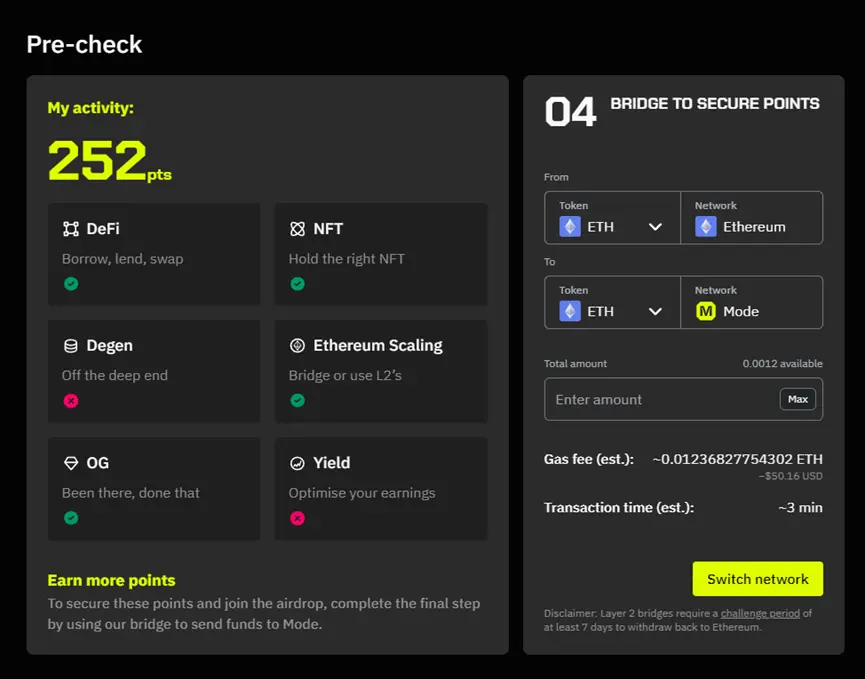
Below is a detailed overview of the Mode Network Bridge:
2.4.1 Functionality and Workflow
1. Asset Transfer:
The bridge allows users to move cryptocurrencies such as ETH and other ERC-20 tokens from Ethereum to Mode Network. This is achieved by locking assets on the mainnet and minting equivalent tokens on Layer 2, preserving asset balance across chains.
2. Two-Phase Operation:
-
Deposit: Users deposit assets from Ethereum into the bridge’s smart contract. Once confirmed, an equal amount of tokens is minted on Mode Layer 2 for use.
-
Withdrawal: When users wish to retrieve assets to Ethereum, the corresponding Layer 2 tokens are burned, and the mainnet contract releases the locked assets.
3. Optimized Transaction Costs:
By batching cross-chain transactions and leveraging Optimistic Rollup technology, the bridge significantly lowers transfer fees by reducing reliance on Ethereum’s mainnet resources.
2.4.2 Security Features
-
Smart Contract Security: Utilizes thoroughly tested and audited smart contracts to lock and release assets, ensuring transaction integrity and fund safety.
-
Distributed Trust: While relying on smart contracts, Mode may implement additional safeguards such as multi-signature schemes or distributed trust models to further strengthen bridge security.
2.4.3 User Experience
-
User-Friendly Interface: Designed with simplicity in mind, making cross-chain operations intuitive—even for non-technical users.
-
Fast Transfers: Leverages Layer 2 efficiency to complete transfers faster than direct Ethereum transactions.
2.4.4 Use Cases
-
DeFi Integration: Users can quickly transfer assets to participate in DeFi applications such as lending, trading, and liquidity mining.
-
Cross-chain Interoperability: The bridge can potentially connect to other compatible blockchains, enhancing ecosystem connectivity.
3. Ecosystem
Mode Network’s ecosystem is built around its Layer 2 solution, aiming to enhance Ethereum’s scalability and efficiency while lowering user costs.

Designed to emphasize innovation, collaboration, and user involvement, the ecosystem includes several key components:
3.1 Economic Model
-
Fee-Sharing Mechanism: Distributes part of transaction fees to developers and users via sequencer fee sharing, encouraging app development and user referrals.
-
Incentive Programs: Includes airdrops, reward campaigns, and referral bonuses to boost network appeal and user activity.
3.2 Developers and Applications
-
Developer Support: Offers comprehensive tools including documentation, SDKs, and devkits to facilitate easy app building and deployment.
-
DApp Ecosystem: Hosts or is developing DApps such as decentralized exchanges (DEXs), lending platforms, games, and financial tools—all leveraging Mode’s low-cost, high-efficiency infrastructure.
3.3 Community and Partnerships
-
Community-Driven: Promotes community-led development through voting and feedback, enabling direct user participation in governance.
-
Strategic Partnerships: Collaborates with other blockchain projects, developer teams, and enterprises to expand functionality and service offerings.
3.4 Governance
-
Decentralized Governance: Empowers token holders to vote on critical network upgrades, fund allocation, and policy changes.
-
Transparency: Maintains openness through regular updates and financial disclosures, fostering trust and engagement.
3.5 Live Ecosystem Projects
Mode Network’s ecosystem is rapidly expanding, particularly excelling in DeFi. Several key projects are already live, showcasing unique functionalities and market positioning:
-
Ether.fi: An Ethereum-based liquid restaking protocol allowing users to restake ETH or other liquid assets to generate lrt tokens and receive eETH. A leader in the restaking space with $2.67 billion in TVL.
-
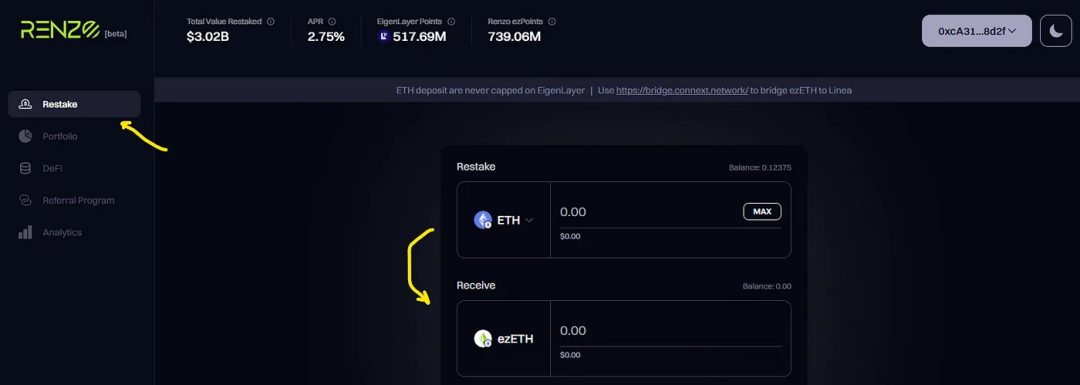
Renzo: Another liquid restaking protocol enabling users to restake assets for lrt tokens and redeem them 1:1 for ezETH. Ranked third in the category with $990 million in TVL.
-
IONIC: A lending protocol aiming to offer optimal interest rates with an economic model balancing borrower and lender incentives. With $61 million in TVL, backed by MetaCartel Ventures, Ohm, and Mode.
4. MODE Token

4.1 Uses and Functions
-
Governance: MODE token holders can participate in network governance, voting on key upgrades and proposals.
-
Incentive Programs: Used to motivate user and developer participation in activities such as hackathons and engagement campaigns.
-
DeFi and Community Sponsorships: Supports integrated DeFi activities and community initiatives, driving project and community growth.
-
Ecosystem Development: Funds expansion and enhancement of the Mode ecosystem, including new projects and partnerships.
4.2 Supply / Distribution Breakdown
-
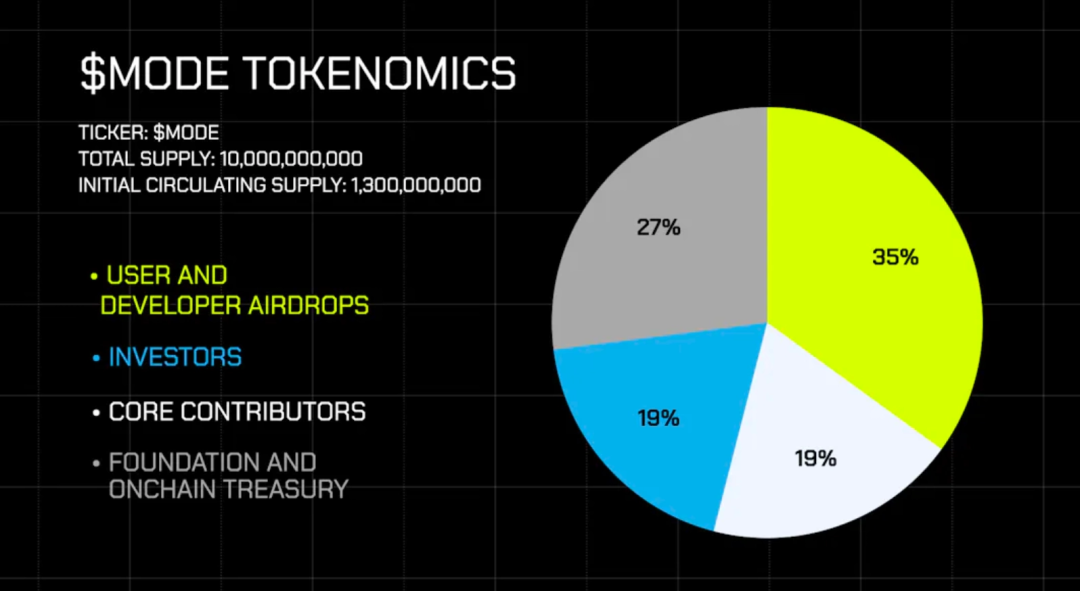
Airdrop: 35% of MODE tokens allocated to airdrops for users and developers to encourage early contribution and engagement.
-
Investors: 19% allocated to early investors to support initial capital and development.
-
Core Team: 19% allocated to core contributors and team members to sustain long-term commitment.
-
On-chain Platform and Treasury: 27% reserved for long-term development, operations, and future funding needs.
-
Total Supply: 10 billion MODE
-
Initial Circulating Supply: 1.3 billion MODE
4.3 Airdrop
4.3.1 Airdrop Overview
-
Token Allocation: A total of 550 million MODE tokens will be distributed via airdrop, with 400 million allocated to points-based airdrop.
-
Purpose: To incentivize early participants and reward contributions from developers and users.
4.3.2 How to Earn Airdrop Points
1. Bridging Assets:
-
Bridge assets such as ETH, USDT, USDC, or WBTC from Ethereum to Mode Network.

-
The longer assets remain bridged on Mode Network, the more points earned.
-
Bridging within the first seven days grants a 12x points multiplier.
2. Invite Friends:
-
Earn 16% of the points accumulated by referred users.
3. Use DApps:
-
Interact with designated DApps such as Eigenlayer, RenzoProtocol, Layerbank, Ionic, and Etherfi to earn double points.
-
These interactions may include swapping, staking, and lending.
Maximizing Airdrop Points Strategy
-
Point Optimization Tips: Maximize points by performing multiple operations across different DApps—staking, borrowing, and swapping.
-
Swap Strategy: For example, swap ETH for EZETH on Kim Exchange, stake and borrow EZETH on Layerbank, then deposit EZETH into Ionic to earn additional points.
5. Team / Funding
Mode Network is led by two key figures—James Ross and Federico Sarquis—both possessing deep industry experience and extensive networks.
-
James Ross: Founder, holds a degree in Economics and Philosophy from the University of Sussex. Former advisor at Hashflow and investor in Eigenlayer and Ethena.
-
Federico Sarquis: Technical Lead, previously organized events for Ethereum Argentina, bringing strong technical and community expertise.
-
The team consists of 15 members operating remotely, enhancing flexibility and global collaboration. This structure enables rapid response to market shifts and technological advancements.
Regarding funding, Mode Network raised $9.75 million in October 2020. Additionally, it received a grant of up to 2 million OP tokens from the Optimism Foundation to support user growth incentives.
In April 2024, it completed a seed round with undisclosed amount, led by KR1.
6. Project Evaluation
6.1 Sector Analysis
Mode Network belongs to the Layer 2 solutions sector, focusing on improving transaction speed and reducing costs via a second-layer network built atop Ethereum, while maintaining security and compatibility with the Ethereum mainnet.
Comparable projects in this space include:
1. Optimism
-
Overview: Optimism is a Layer 2 scaling solution using Optimistic Rollup technology to enhance Ethereum’s scalability and lower fees.
-
Features: Reduces costs by deferring data availability verification and improves transaction throughput.
2. Arbitrum
-
Overview: Another Optimistic Rollup-based Layer 2 solution that executes transactions off-chain and submits results to Ethereum.
-
Features: Emphasizes efficiency and security in handling large-scale applications.
3. Polygon
-
Overview: Polygon (formerly Matic Network) is a multi-chain Layer 2 platform addressing Ethereum’s scalability issues.
-
Features: Offers multiple scaling solutions (sidechains, zk-rollups, optimistic rollups), enabling developers to choose optimal approaches.
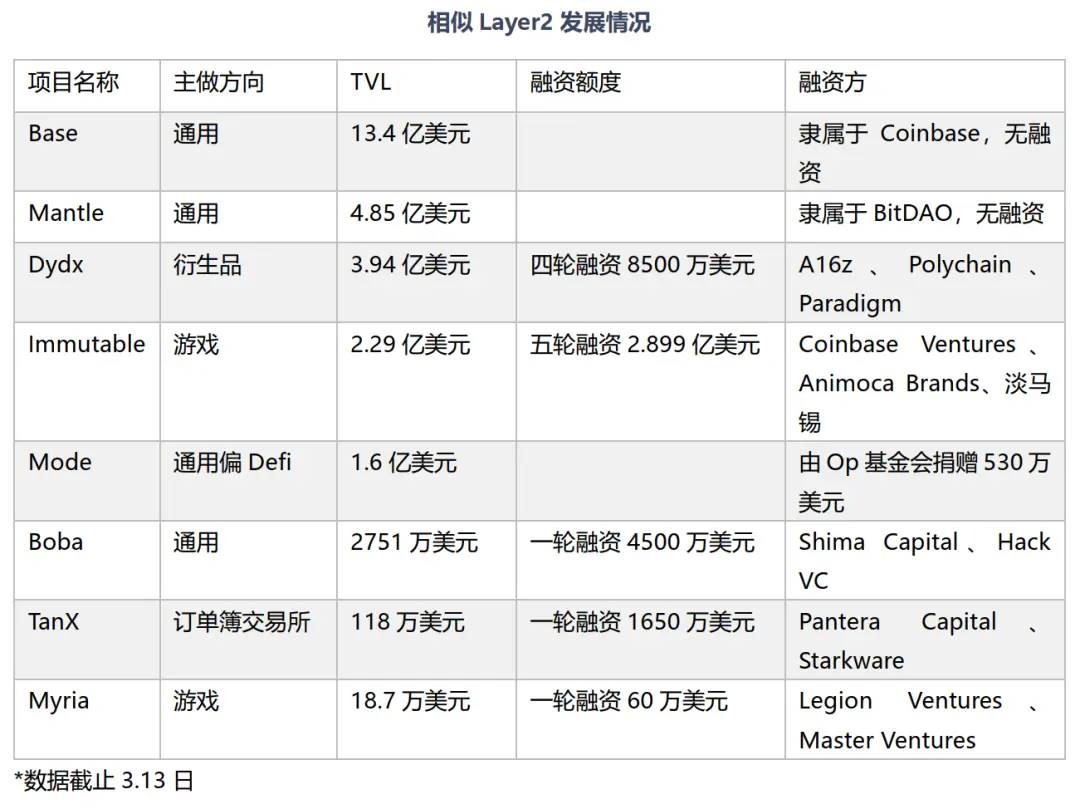
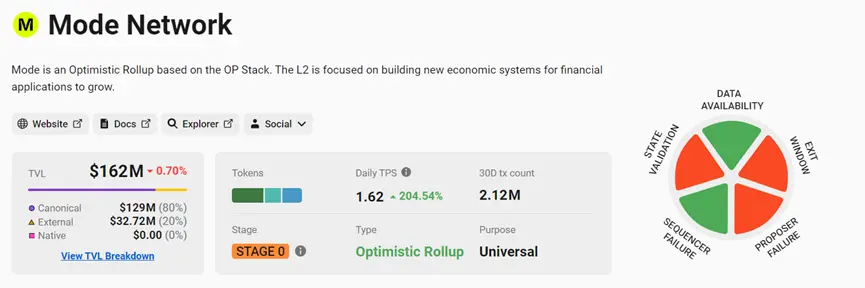
Since mainnet launch, TVL has steadily increased. As of March 19, 2024, Mode ranked 13th among all Layer 2 networks with $162 million in TVL, daily average tps of 1.62, median gas at 0.001 Gwei (costing less than $0.01 per transaction), and a total of 2.12 million transactions over the past 30 days.
6.2 Project Strengths
1. Technical Advantages
-
Optimistic Rollup Application: Mode leverages Optimistic Rollups to boost speed and cut costs. Transactions are processed on Layer 2, with only batch data sent to Ethereum, reducing mainnet load while preserving security.
-
Modular Architecture: Mode’s modularity allows developers to select and integrate features as needed, making it suitable for diverse applications—from simple payments to complex financial products.
2. Ecosystem and Community Incentives
-
Strong Ecosystem Incentives: Through its tokenomics and airdrop programs, Mode actively drives community engagement and ecosystem growth. The airdrop strategy aims to grow and activate the community by rewarding early adopters.
-
Developer Support: Offers robust developer incentives, funding, tools, and resources to lower barriers and accelerate product launches.
3. Performance and Cost Efficiency
-
Lower Transaction Costs: Significantly reduced fees make Mode an attractive, cost-effective platform—especially for high-frequency use cases like DeFi and gaming.
-
Enhanced Throughput: Compared to Ethereum, Mode handles higher transaction volumes with reduced latency, improving user experience.
6.3 Project Weaknesses & Challenges
1. Competitive Pressure
-
Intense Market Competition: Mode faces strong competition from established Layer 2 solutions like Polygon, Arbitrum, Optimism, and zkSync, all of which have larger user bases and broader recognition.
-
Need for Continuous Innovation: To stay competitive, Mode must continuously innovate and improve—critical in the fast-evolving blockchain landscape.
2. User and Market Adoption
-
Adoption Speed: Despite performance advantages, user migration may be slow due to entrenched habits and platform loyalty. Time is needed to evaluate and adapt to a new platform.
-
Market Education: Requires significant education efforts to raise awareness and understanding of Mode Network—particularly among non-technical users.
3. Economic and Funding Risks
-
Funding Dependency: Mode’s growth heavily relies on external financing. Market volatility or declining investor confidence could impact fundraising capabilities.
-
Token Volatility: As a tokenized platform, Mode’s success may be influenced by MODE’s market performance. Price fluctuations could affect stability and attractiveness.
7. Conclusion
In summary, Mode Network stands as an innovative Layer 2 solution aiming to dramatically improve Ethereum’s transaction efficiency and scalability through its Optimistic Rollup technology. By introducing a modular architecture and rich token-based incentives, Mode not only reduces transaction costs but also actively encourages community participation and ecosystem development through airdrops and other incentive programs.
As blockchain technology advances and the crypto market matures, Mode Network envisions itself as a key driver in Ethereum’s ecosystem growth, offering users and developers a faster, more economical, and scalable platform. Leveraging its technological strengths and strategic initiatives, Mode Network is well-positioned to play a significant role in the future of blockchain, contributing to the broader advancement of the industry.
Join TechFlow official community to stay tuned
Telegram:https://t.me/TechFlowDaily
X (Twitter):https://x.com/TechFlowPost
X (Twitter) EN:https://x.com/BlockFlow_News






