









Exclusive Interview with Chu Hok Hong, Head of Digital Asset Management at China Asset Management (Hong Kong): Hong Kong's Digital Asset Industry Holds Tremendous Growth Potential
TechFlow Selected TechFlow Selected
Exclusive Interview with Chu Hok Hong, Head of Digital Asset Management at China Asset Management (Hong Kong): Hong Kong's Digital Asset Industry Holds Tremendous Growth Potential
China Asset Management's Bitcoin ETF and China Asset Management's Ethereum ETF have been approved by the Hong Kong Securities and Futures Commission, and were listed on the Hong Kong Stock Exchange on April 30, 2024.
 Navigating Web3 tides with focused insights
Text by: PANews
Following the approval of spot Bitcoin ETFs in the U.S. on January 10, on April 24, China Asset Management (Hong Kong) announced that its CSOP Bitcoin ETF and CSOP Ether ETF have been approved by the Securities and Futures Commission (SFC) of Hong Kong, to be issued on April 29, 2024, and listed on the Hong Kong Stock Exchange on April 30, 2024. This marks Hong Kong as another global jurisdiction after the U.S. to approve such products, meaning retail investors can now gain exposure to digital assets through these ETFs.
Building upon its existing traditional asset management business, China Asset Management (Hong Kong) has expanded into digital asset management—marking the first time a subsidiary of a leading Chinese fund house has received such approval. Through an exclusive interview with Mr. Chu Ho Hong, Head of Digital Asset Management and Family Wealth Management at China Asset Management (Hong Kong), we explore Hong Kong’s progressive strides in the digital asset space.
PANews: Congratulations on the approval of CSOP’s crypto spot ETFs. Could you share more about your firm’s progress in digital assets?
Chu Ho Hong: Since the Hong Kong government released its Policy Statement on Development of Virtual Assets on October 31, 2022, we’ve witnessed strong top-down momentum positioning Hong Kong as a global Web3.0 hub. In March this year, the Hong Kong Monetary Authority (HKMA) launched three innovation sandbox initiatives—the second phase of its wholesale central bank digital currency (CBDC), stablecoin, and e-HKD pilot programs. Additionally, the upcoming launch of spot Bitcoin and Ether ETFs demonstrates the Hong Kong government’s robust support for a compliant crypto ecosystem. At CSOP Hong Kong, we are embracing this transformation by assembling dedicated teams to deeply research innovations in the crypto industry, including real-world asset (RWA) tokenization (STO) and spot Bitcoin/Ether ETFs, and actively participating in HKMA sandbox experiments. We believe recognition of Web3.0 technologies in financial innovation is growing. As digital assets converge with Web3.0, they are becoming indispensable, and Hong Kong’s digital asset sector holds immense potential.
PANews: What special regulations has the SFC imposed on crypto spot ETFs launched in Hong Kong? Compared to the Bitcoin spot ETFs approved by the U.S. SEC, what advantages and disadvantages do Hong Kong’s ETFs have? What factors contribute to these differences?
Chu Ho Hong: As you noted, Hong Kong’s regulatory approach differs significantly from that of the U.S.—and offers distinct advantages. A key difference is that Hong Kong permits both cash and in-kind subscriptions and redemptions. Under these rules, authorized participants can directly use Bitcoin or Ether to subscribe for or redeem ETF shares, whereas in the U.S., only cash-based creation and redemption are allowed. Although the U.S. spot Bitcoin ETF market is currently larger in scale, Hong Kong may hold a strategic edge, being among the first jurisdictions to approve spot Ethereum ETFs and allow retail investor participation.
These innovations are supported by a rigorous regulatory framework designed to protect retail investors. The SFC has established a comprehensive regulatory regime for crypto asset funds, as outlined in its December 2023 announcement. Fund managers must have solid compliance records and can only invest in cryptocurrencies listed on SFC-licensed virtual asset trading platforms (VATPs) accessible to the Hong Kong public. Moreover, funds are prohibited from employing leverage at the fund level. On custody, the SFC stipulates that fund trustees or custodians may only delegate crypto custody functions to SFC-licensed VATPs or institutions meeting HKMA’s stringent crypto custody standards, all under strict supervision.
PANews: The U.S. SEC did not approve in-kind subscription/redeemable spot ETFs due to concerns over illicit activities. How has Hong Kong designed its system to prevent money laundering and similar risks?
Chu Ho Hong: The current regulatory and licensing framework in Hong Kong emphasizes strict adherence to anti-money laundering (AML), know-your-customer (KYC), and know-your-token (KYT) standards. These frameworks establish robust rules to safeguard investors, including secure asset storage, thorough KYC/KYT procedures, AML oversight, and counter-terrorism financing (CFT) measures. As such, all market participants face stringent obligations to prevent illegal financial activities. In contrast, regulatory oversight over crypto trading platforms and custodians in the U.S. remains incomplete.
PANews: Which investors are currently eligible to purchase Hong Kong’s crypto ETFs?
Chu Ho Hong: Eligible investors in Hong Kong—including qualified investors, institutional investors, retail investors, and qualified international investors—can invest in crypto ETFs. Mainland Chinese investors are currently not permitted to invest in Hong Kong’s crypto ETFs. Specific eligibility should be confirmed with brokers and distribution channels, and investors should monitor for potential future regulatory adjustments or new frameworks.
PANews: Bitcoin has now recorded seven consecutive months of gains. How should investors view digital asset investments today?
Chu Ho Hong: Investment research and decision-making are inherently complex, especially in emerging asset classes like digital assets. I’d like to introduce my own “3D” theory on digital asset investing—Defensive, Diversification, and Decision—for your feedback. These three dimensions address risk defense, portfolio diversification, and investment decision-making.
Take Bitcoin, for example. Born out of the 2008 global financial crisis, Bitcoin represents the first digital, independent, global, rule-based monetary system. Since then, global financial markets have faced multiple crises—the European sovereign debt crisis, extraordinary liquidity measures during the pandemic, and the collapse of major regional banks in the U.S. Investors’ awareness of systemic risk protection has risen sharply. Bitcoin’s decentralized nature theoretically reduces exposure to systemic risks in traditional finance, and its price volatility has decreased over time. Despite its short 15-year history, Bitcoin has performed well during periods of market stress. For instance, during the 2023 U.S. regional banking crisis, Bitcoin surged over 40%, highlighting its role as a hedge against counterparty risk. While Bitcoin has experienced downturns, each has been tied to specific industry events—such as the 2022 FTX exchange collapse due to fraud. Yet, in every cycle, Bitcoin has demonstrated antifragility, repeatedly reaching new highs.
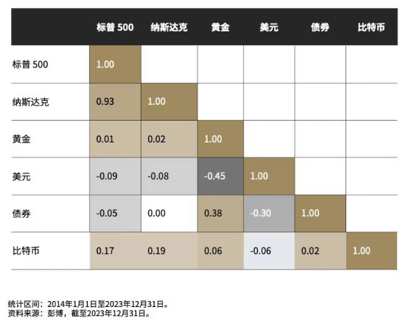
Bitcoin’s unique characteristics—scarcity, liquidity, divisibility, portability, transferability, fungibility, auditability, and transparency—set it apart from traditional assets. Over a five-year horizon (2018–2023), Bitcoin’s correlation with other major asset classes averaged just 0.27. Notably, its correlation with gold and bonds—two traditional safe-haven assets—was only 0.2 and 0.26, respectively, while the correlation between bonds and gold was as high as 0.46. Extending to ten years (2014–2023), Bitcoin’s highest correlation was merely 0.19 with the Nasdaq 100 Index, and even lower—0.06 and 0.02—with gold and bonds. This low correlation makes Bitcoin an excellent tool for portfolio diversification.
As a revolutionary technology and emerging asset class, Bitcoin’s speculative nature and short-term volatility complicate investment decisions. Yet, with a market cap exceeding $1 trillion, Bitcoin has grown in both independence and purchasing power. Investment decisions ultimately revolve around timing and pricing. Both short- and long-term, Bitcoin has outperformed all other major asset classes. According to ARK Investment Management LLC’s analysis based on data and calculations from PortfolioVisualizer.com, as of March 31, 2024, Bitcoin delivered an annualized return of nearly 60% over the past seven years, compared to an average of just 7% for other major assets. Within a classic 60/40 portfolio (60% equities, 40% bonds), portfolios with the largest allocation to Bitcoin performed best over the past five years.
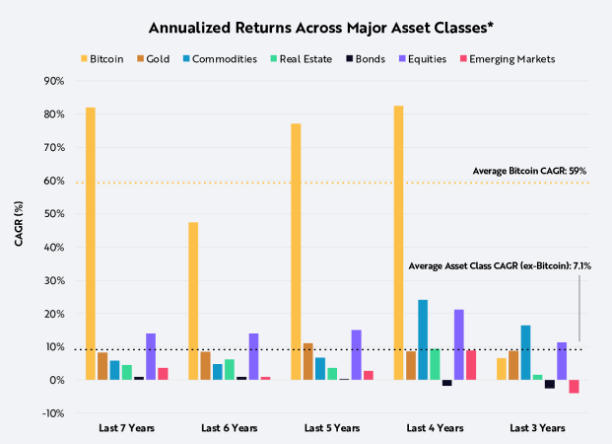
Source: ARK Investment Management LLC, 2024, based on data and calculations from PortfolioVisualizer.com; Bitcoin price data from Glassnode, as of March 31, 2024.
All investments carry risk, and digital assets are no exception. Risks include concentration risk in digital asset ETFs, industry-specific risk, speculation, unforeseen events, extreme price volatility, ownership concentration, regulatory uncertainty, fraud, market manipulation, security vulnerabilities, cybersecurity threats, potential network manipulation, fork risk, illegal usage, and time-zone trading discrepancies. Investors should carefully consider their investment goals, risk tolerance, and market volatility when investing in digital assets or related products like ETFs. The high volatility of crypto markets implies both high risk and high return potential.
PANews: What is CSOP (Hong Kong)’s management capability regarding crypto ETFs, and what initial capital inflows do you expect for Hong Kong’s crypto ETFs?
Chu Ho Hong: CSOP has 26 years of asset management experience, is China’s largest ETF provider, a pioneer in the Chinese fund industry, and launched China’s first ETF. As of March 31, 2024, it manages over RMB 2.15 trillion (approximately USD 300 billion), ranking No.1 in mainland China for 18 consecutive years and holding over 22% of the mainland ETF market [1]. Beyond its dominant position in China, CSOP’s brand influence extends globally. According to ETFGI’s 2023 year-end report, CSOP ranks among the world’s Top 19 ETF issuers—making it the only Chinese issuer in the global top 20.
CSOP (Hong Kong), a wholly-owned subsidiary established 16 years ago, has won over 90 prestigious industry awards. It is a leading Chinese fund house in Hong Kong, renowned for strength and trustworthiness. It manages several of the world’s or Hong Kong’s largest ETFs:
-
World’s largest offshore CSI 300 ETF
-
World’s largest Hang Seng ESG ETF
-
Largest Nasdaq 100 ETF in Hong Kong
-
Largest Japanese equity ETF in Hong Kong
-
Largest European equity ETF in Hong Kong
-
Largest Hong Kong biotech ETF
-
Largest MSCI A50 ETF in Hong Kong
Our team—from portfolio managers and capital markets to operations, trading, sales, and compliance—boasts extensive experience from globally recognized asset management firms, ensuring smooth and efficient operations. Our team is highly cohesive and stable. With 16 years of accumulated expertise in custody, trading, and market-making networks, we possess unmatched resources. Decades of experience have proven CSOP Hong Kong’s excellence in managing core ETF metrics: 1) liquidity, 2) tracking error, 3) premium/discount, and 4) bid-ask spreads. For complex, innovative products like spot Bitcoin and Ether ETFs, these capabilities will be critically tested. We are confident that our strong team, 16 years of operational experience, and established brand presence in Hong Kong will meet market expectations.
We note that the largest U.S. asset manager’s spot Bitcoin ETF started with just $10.45 million on January 10, but by April 25 had surged to $17.2 billion—an approximately 1,700x growth in three months. This stark comparison highlights both the massive potential of traditional investors entering digital assets and Hong Kong’s competitive edge in the global digital asset landscape. As one of China’s largest public asset managers, the country’s largest ETF issuer, and a top-tier Chinese fund house in Hong Kong, we at CSOP (Hong Kong) are highly confident in Hong Kong’s future in digital asset innovation and Web3.0 development.
Unless otherwise stated, data sourced from CSOP (Hong Kong), Bloomberg, Wind, as of April 29, 2024.
Investment involves risk. Fund units may go up or down, past performance does not indicate future returns, and future returns cannot be guaranteed. You may lose the principal amount invested. This information does not constitute an offer to buy or sell any securities or funds, nor any investment advice. This document is for your reference only and should not be relied upon for any investment decision. Certain data herein may be obtained from unaffiliated third parties. We reasonably believe such data to be accurate, complete, and up-to-date as of the indicated date; CSOP (Hong Kong) Limited ensures faithful reproduction of such data but does not guarantee the accuracy or completeness of data provided by unaffiliated third parties. Please read the fund offering documents carefully, including risk factors. Seek independent professional advice if necessary. Issuer: CSOP (Hong Kong) Limited. This material has not been reviewed by the Securities and Futures Commission of Hong Kong.
Join TechFlow official community to stay tuned
Telegram:https://t.me/TechFlowDaily
X (Twitter):https://x.com/TechFlowPost
X (Twitter) EN:https://x.com/BlockFlow_News
 PANews











