








Ethiopia Becomes a Mining Hotspot: Tax Analysis for Mining Companies
TechFlow Selected TechFlow Selected
Ethiopia Becomes a Mining Hotspot: Tax Analysis for Mining Companies
This article analyzes Ethiopia's cryptocurrency tax regime, with a particular focus on taxes and tax rates that may apply to mining enterprises.
 Navigating Web3 tides with focused insights
By TaxDAO
Ethiopia has become the first African country to begin Bitcoin mining. Although Ethiopia still bans cryptocurrency trading, it approved mining-friendly legislation in 2022, allowing for "high-performance computing" and "data mining." According to data from Luxor Technologies, a Bitcoin mining services company, in 2023 Ethiopia ranked fourth as a preferred destination for Bitcoin mining equipment, behind only the United States, Hong Kong, and Asia. It is estimated that Ethiopia has become one of the world's largest recipients of Bitcoin mining hardware. This article analyzes Ethiopia's cryptocurrency tax regime, with a particular focus on taxes and tax rates that may apply to mining enterprises.
1. Tax Issues Related to Mining
1.1 Concept of Mining
Mining is an activity to obtain digital currency by using computer power to solve complex mathematical problems within a network, thereby earning rewards. In the field of cryptocurrencies such as Bitcoin, mining is widely used. Simply put, mining is a computational activity conducted to acquire a certain type of digital currency.
1.2 Mining Income
Mining income refers to rewards earned by using computer equipment to participate in the consensus mechanism of a crypto-asset network, validating transactions or creating new units of crypto-assets. Sources of mining income can be divided into two types: one is the fixed block reward, meaning miners receive a certain amount of crypto-assets each time a new block is added to the blockchain; the other is variable transaction fees, where each transaction pays a certain fee to the miner who validates it. The calculation method for mining income depends on the consensus mechanism used, primarily Proof of Work (PoW) and Proof of Stake (PoS).
1.3 Taxation of Mining
The tax treatment of cryptocurrency mining operations mainly depends on how the jurisdiction defines and classifies crypto-assets, as well as how mining income and expenses are recognized and measured. Depending on the country or region, different tax types may apply to mining income. The main tax categories are analyzed below.
Firstly, direct taxes—mining income may be subject to income tax and capital gains tax. Most countries with mining activities treat mining income as business income for enterprises or individuals and impose corporate income tax or personal income tax accordingly. Tax rates vary based on the miner’s status (individual or enterprise), income level, and place of residence.
Secondly, indirect taxes—some jurisdictions impose value-added tax (VAT) or goods and services tax (GST) on mining income. There is currently no global consensus on whether mining income should be subject to VAT. In the European Union, most countries consider mining activities outside the scope of VAT. Israel, however, treats mining as a service under its 2017 guidelines on taxing virtual currency activities and imposes a 17% VAT. New Zealand similarly treats mining as a service and levies a 15% GST.
Additionally, some countries impose excise taxes on mining companies for reasons related to resource allocation. For example, in March 2023, the U.S. Treasury released a “Budget Supplemental Materials” document proposing a phased excise tax based on electricity consumption in cryptocurrency mining. Under this proposal, companies would be required to report their electricity usage and energy sources.
2. Advantages of Mining in Ethiopia
Due to political and economic headwinds, Bitcoin miners are often attracted to regions with low electricity costs and governments supportive of the cryptocurrency industry. Although Ethiopia still prohibits cryptocurrency trading, it began allowing Bitcoin mining in 2022. For all companies engaged in cryptocurrency mining, Ethiopia has emerged as a rare opportunity. Below is a brief analysis of the advantages of mining in Ethiopia.
2.1 Resistance to Cryptocurrency Mining in Other Countries
Climate change concerns and electricity shortages have led to strong resistance against cryptocurrency mining in many countries. For instance, developing nations like Kazakhstan and Iran initially welcomed Bitcoin mining, but shifted to opposition when domestic discontent arose over energy consumption. In 2021, China banned Bitcoin mining. Most countries prohibit cryptocurrency mining because they fear depleting available electricity, leaving no room for miner expansion. Moreover, miners may suddenly be deemed undesirable by governments and forced to leave.
2.2 Cheap Electricity
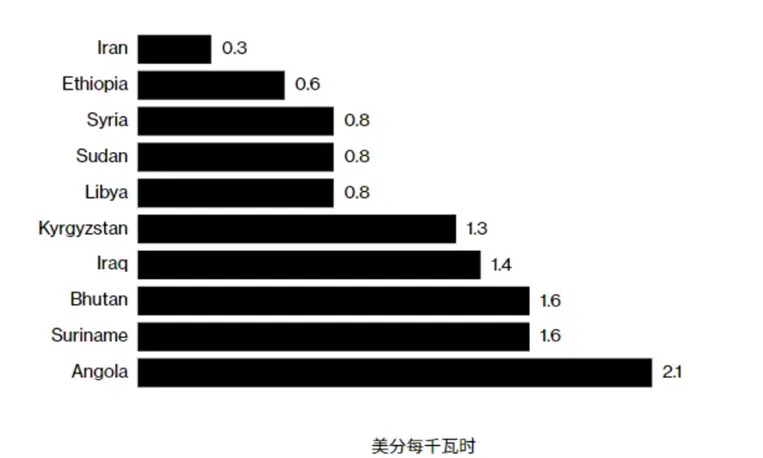
Bitcoin mining rigs consume vast amounts of electricity, with power accounting for up to 80% of a miner’s operating costs. Therefore, access to cheap electricity is a key competitive advantage. In 2023, Bitcoin mining consumed 121 terawatt-hours of electricity. This heavy reliance on power is a major weakness, as it may displace electricity needed by factories and households, leading to political resistance. Ethiopia offers low electricity prices, as shown in the chart (source: Statista Research Department). The Ethiopian Electric Power Corporation reported having signed power supply agreements with 21 Bitcoin miners, 19 of which are from China.
2.3 Ideal Resources and Climate Conditions
In the context of global warming, despite miners’ claims of increasingly using clean energy, Bitcoin mining is increasingly seen as a contributor to climate change. A United Nations study found that two-thirds of the electricity used for Bitcoin mining in 2020 and 2021 came from fossil fuels.
Ethiopia can leverage its abundant surplus green and renewable energy to provide power for Bitcoin mining while also electrifying homes. Ethiopia’s capacity to power Bitcoin mining could rival that of Texas within a few years. Completion of the Grand Ethiopian Renaissance Dam (GERD) project will increase Ethiopia’s generation capacity to 5.3 gigawatts, doubling its current output. Ethiopia’s advantages extend beyond just low-cost renewable energy—the country’s climate is also ideal. The optimal temperature range for mining is 5 to 25 degrees Celsius, closely matching Ethiopia’s average temperatures.
2.4 The Ethiopian Government's Stance
The Ethiopian government permits Bitcoin mining primarily because mining companies pay for electricity in foreign currency. The state utility charges Bitcoin miners a fixed rate of 3.14 cents per kilowatt-hour, creating a lucrative source of foreign exchange. Expanding foreign currency inflows helps alleviate economic challenges, making the mining industry an attractive investment opportunity. According to Project Mano, integrating Bitcoin mining into Ethiopia’s economy could contribute between $2 billion and $4 billion to GDP. Allowing Bitcoin mining may also help close loopholes around foreign exchange controls, create jobs, expand the tax base, and reduce hydroelectric spillage during rainy seasons.
3. Tax Analysis for Mining Enterprises in Ethiopia
3.1 Ethiopia's Tax System
3.1.1 Tax Structure
Ethiopia operates a federal system where taxes are shared between the federal and regional state governments. Regional states remit a portion of collected taxes to the federal government, which then allocates funds back to the regions based on population, economic conditions, and tax contributions.
Federal taxes include customs and other import/export duties; personal income tax on employees of federal and international organizations; profit tax, personal income tax, and VAT from enterprises owned by the federal government; taxes on national lottery and other gambling winnings; taxes on aviation, rail, and maritime operations; taxes on rental income from federal-owned buildings and properties; and taxes on licenses, permits, and services issued or authorized by the federal government.
Shared taxes between federal and local governments include corporate profit tax, personal income tax, VAT, royalties, and land rents from large-scale extraction of oil, gas, and forest resources.
3.1.2 Taxes Potentially Applicable to Mining Companies in Ethiopia
(1) Enterprise Income Tax
Any enterprise earning income in Ethiopia is subject to income tax. Taxpayers are classified into three categories: Category A, B, and C. Corporate income taxpayers fall under Category A. The Income Tax Proclamation divides taxable income into five types: A, B, C, D, and E. Mining enterprises are likely to be taxed under Category B (30%), Category C (30%), Category D (10% or 5%), or potentially Category E (exempt).
(2) Value Added Tax (VAT)
VAT in Ethiopia applies to the supply of goods and services, importation of taxable goods, and specific imported services. VAT registration is mandatory for those exceeding transaction thresholds, though voluntary registration is also possible. VAT is calculated using the credit method; if input tax exceeds output tax, taxpayers may carry forward the excess, request a refund, or offset it against other taxes. There are two VAT rates: the standard rate of 15% and a zero rate. VAT returns are filed monthly. Mining companies may incur VAT on electricity, heat, gas, or water supplies.
(3) Capital Gains Tax
Capital gains refer to profits realized from the transfer of business assets. In Ethiopia, capital gains are classified as Type D income under the Income Tax Proclamation and are subject to income tax (i.e., capital gains tax). The tax rate is 15% for buildings used for commercial, industrial, or office purposes, and 30% for shares in companies.
(4) Royalty Tax
In Ethiopia, royalty payments refer to compensation for the use or right to use literary, artistic, or scientific works—including copyrights for films, tapes for radio or TV broadcasts—as well as patents, trademarks, designs, models, drawings, secret formulas, or processes, or industrial, commercial, or scientific equipment. It also includes payments for technical information related to industrial, commercial, or scientific experience. Royalties are taxed at a flat rate of 5%.
3.2 Tax Implications for Mining Companies in Ethiopia
Cryptocurrency companies operating in Ethiopia must register with the Information Network Security Agency (INSA), the country’s cybersecurity authority. Non-compliant firms may face legal consequences. INSA also has regulatory powers over crypto products and related transactions and will be responsible for developing operational procedures and building crypto infrastructure.
Ethiopia applies a combination of territorial and residence-based taxation principles. Any enterprise earning income in Ethiopia must pay income tax. Resident enterprises are taxed on their worldwide income. Mining companies operating in Ethiopia are likely to have their local income classified as either Category C or D income, both taxed at 30%. Whether income is treated as ordinary business income or capital gain depends on classification, though official guidance remains unclear. Supply of electricity, heat, and similar utilities is subject to VAT in Ethiopia. Given mining companies’ high electricity dependence, they effectively bear the VAT burden on power—ultimately affecting their overall tax cost. Furthermore, if mining activities are classified as providing services or labor, direct VAT obligations could arise.
Regarding the timing of income recognition, many argue that cryptocurrency mining represents internally developed intangible assets. Miners invest in computers, electricity, and personnel to build and operate mining systems—essentially creating internal intangible assets. Thus, income or gains should be recognized only upon subsequent sale of the mined cryptocurrency. Currently, there are no clear regulations indicating specific tax incentives for mining companies in Ethiopia, although existing general incentives—such as employment-related tax breaks—may apply. Additionally, mining companies importing mining rigs or related equipment will be subject to customs duties, though exact rules and rates require further clarification.
Join TechFlow official community to stay tuned
Telegram:https://t.me/TechFlowDaily
X (Twitter):https://x.com/TechFlowPost
X (Twitter) EN:https://x.com/BlockFlow_News
 TaxDAO











