









Bitcoin fees surge after halving: Understanding the game mechanics behind runes
TechFlow Selected TechFlow Selected
Bitcoin fees surge after halving: Understanding the game mechanics behind runes
Based on current fee consumption, the issuance of Rune assets may not be sustainable.
 Navigating Web3 tides with focused insights
Author: Jimmy Song
Translation: Luffy, Foresight News
Bitcoin halving is a scheduled event, one of the periodic holidays on Bitcoin. Like soft fork activations and the launch of various financial instruments, it's an unpredictable day that occurs only every few years, making it especially noteworthy for both Bitcoin enthusiasts and mainstream media.
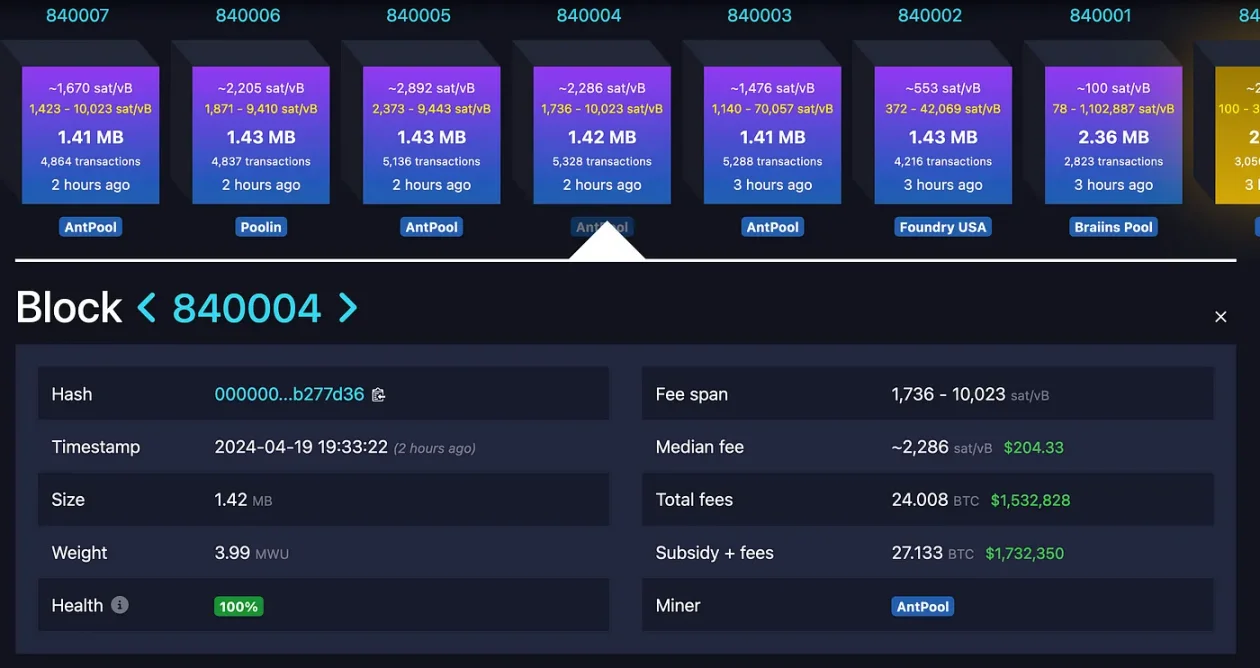
This year’s halving was equally anticipated, but we encountered a minor twist requiring further explanation. Bitcoin's fourth halving reduced the block subsidy from 6.25 BTC to 3.125 BTC at block 840,000 as expected. Unexpectedly, however, this was followed by a transaction fee of 37.626 BTC—the highest ratio of transaction fees to block subsidy in Bitcoin’s history. One single transaction paid nearly 8 BTC in fees.
Even Higher Fees
Not only was the fee high in block 840,000, but the next five blocks also saw unusually high fees: 4.486, 6.99, 16.068, 24.008, and 29.821 BTC respectively—setting a historical record. Nothing like this has ever happened before on the Bitcoin network.
Throughout Bitcoin’s history, it has been extremely rare for transaction fees to exceed the block subsidy. During the 50 and 25 BTC reward eras, there were a few instances, but these were due to user errors (typically forgetting to include a change address), with nearly all excessive fees coming from single erroneous transactions. In the 12.5 BTC era, several transactions near the end of 2017 had cumulative fees exceeding the block subsidy. And during the recently concluded 6.25 BTC era, many blocks during the Ordinals craze saw fees surpassing the subsidy.
Still, such occurrences remained relatively rare. Even in the period leading up to Bitcoin’s fourth halving, most blocks had fees below 1.5 BTC. Yet in this new era of 3.125 BTC subsidies, as of this writing (block 840018), every block’s fees have exceeded the subsidy, with some surpassing it by multiples. So what happened? Why are block fees so high after the halving?
Runes
The reason lies with a new protocol called Runes, designed in September 2023 by Casey Rodarmor as another Bitcoin-based colored coin protocol. Its core idea is to enable token issuance directly on Bitcoin’s native UTXO set.
Looking back, colored coins have existed for a long time. The main concept is that certain Bitcoin transaction outputs can be “colored,” giving them meaning beyond just the BTC amount—such as representing another "asset" or issued token. The first implementation dates back 11 years to 2013, followed by multiple attempts including Mastercoin (later renamed Omni), Counterparty, and more recently RGB, Taro Assets, and BRC-20.
As Rodarmor stated on his blog, his motivation for creating this new protocol was to bring some assets from other chains onto Bitcoin. To make the protocol’s launch more dramatic, Rodarmor chose block 840,000 as the starting point, resulting in the chaos we’ve witnessed.
Simplification and Game Theory
Casey Rodarmor, also the creator of Ordinals, adopted a similar concept for Runes—using uppercase Latin letters to name assets. This seems reasonable, but what happens when conflicts arise? How do we distinguish between two assets with the same name?
To simplify things, the protocol simply checks whether an asset already exists; if the name conflicts with an existing one, no new asset is issued. This indeed simplifies client logic and ensures each asset has a globally unique name. Unfortunately, it also introduces serious incentive problems.
Sniping Asset Issuance
The first incentive issue is that if an asset issuance transaction is sent to the Bitcoin mempool, other observers could steal the name by broadcasting their own earlier transaction once it becomes visible across network nodes.
In Bitcoin, “earlier” is a strict concept. Blocks are ordered, and transactions within blocks are ordered—first come, first served. But if you want to grab a desirable symbol name, you can monitor the mempool for transactions attempting to create new assets and issue your own with a higher fee. This is the essence of sniping.
What makes this particularly alarming is that both transactions might end up in the same block, but only the first succeeds in issuing the asset. The second fails to issue anything yet still pays its full fee.
Miners typically sort transactions by fee rate, so higher fees increase the chance of successful issuance. I say “increase” because there’s a second incentive problem I’ll discuss shortly. From a game theory perspective, both parties are incentivized to keep raising their fees to outbid each other. This dynamic resembles a bidding war, where rational decisions lead to irrational outcomes (e.g., paying $1.50 for a $1 bill). Every loser pays heavily and gains nothing.
Second-Order Games
Given this mechanism, it’s unsurprising that many issuers initially set intentionally high fees to deter anyone from trying to snatch their symbol. After all, if your sniping attempt fails, you lose the fee you paid. For this reason, RBF (Replace-by-Fee) usage has also surged—allowing issuers to act preemptively, while snipers can do the same against issuers.
Note that RBF doesn’t eliminate fee payments here, since replacement transactions must pay higher fees than the originals. Either way, miners ultimately benefit.
Now consider the miner’s role. Miners could, if they wished, prioritize lower-fee transactions and include them in blocks. In fact, there’s an incentive for miners to accept off-chain payments to somehow influence transaction ordering without revealing how much was paid. This gives miners significant leverage within the protocol.
Conclusion
Runes have caused extremely high fees on the Bitcoin network. It's hard to tell whether this design was intentional or not, but we do know that Runes have been hyped over recent months and widely anticipated. As one of the first assets launched under this protocol, it certainly carries marketing value.
Sadly, aside from the usual fully centralized altcoin scams, the cost of congesting block space has now become even higher. Currently, even 1000 sats/vbyte may not be enough to get into certain blocks. Rune issuance is now dominating nearly all other use cases.
That said, the current pace of Rune issuance is completely unsustainable. In just the first 18 blocks, over $20 million in fees were spent, mostly on Rune creation. At this rate, Rune issuers would spend $150 million per day—or $1 billion per week. Frankly, I don’t think this can last long. Meanwhile, miners producing these blocks must be thrilled.
Join TechFlow official community to stay tuned
Telegram:https://t.me/TechFlowDaily
X (Twitter):https://x.com/TechFlowPost
X (Twitter) EN:https://x.com/BlockFlow_News
 @jimmysong











