Where did the $3.6 billion in Ethereum outflows go during the first quarter?
TechFlow Selected TechFlow Selected
Where did the $3.6 billion in Ethereum outflows go during the first quarter?
Arbitrum claims $2.3 billion, emerging as the biggest winner.
 Navigating Web3 tides with focused insights
Author: Michael Nadeau
Translation: Luffy, Foresight News
They say you should follow the smart money when investing, and one of the great advantages of public blockchains is that we can easily do so using on-chain data.
As blockchain-connecting infrastructure improves, network effects and economic moats within any single network may become increasingly difficult to sustain. For this reason, we've been analyzing net capital flows across the top 15 L1s and L2s to precisely identify where value is moving within public blockchain ecosystems—and now it’s time to share our findings.
Which Blockchains Have the Highest Net Inflows?
Winners:
-
Arbitrum stands out as the biggest winner. Over the past three months, Arbitrum received over $2.3 billion in net inflows from other blockchains.
-
Optimism ranks second with nearly $800 million in net inflows during the same period.
-
StarkWare comes third with over $700 million in net inflows.
-
Base ranks fourth, with nearly $600 million in net inflows over the past three months.
-
Finally, Sui makes the top five with $423 million in inflows and is the only non-EVM chain to see significant capital inflow over the past 90 days.
Losers:
-
Ethereum experienced over $3.6 billion in net outflows over the past 90 days. However, more than $4.4 billion flowed into the Ethereum ecosystem via L2s during the same period. Since L2s pay settlement fees to ETH L1, these funds effectively never leave Ethereum.
-
zkSync saw outflows exceeding $1 billion over the past three months.
-
Over $500 million exited the Avalanche ecosystem.
Where Did Arbitrum’s Inflows Come From?
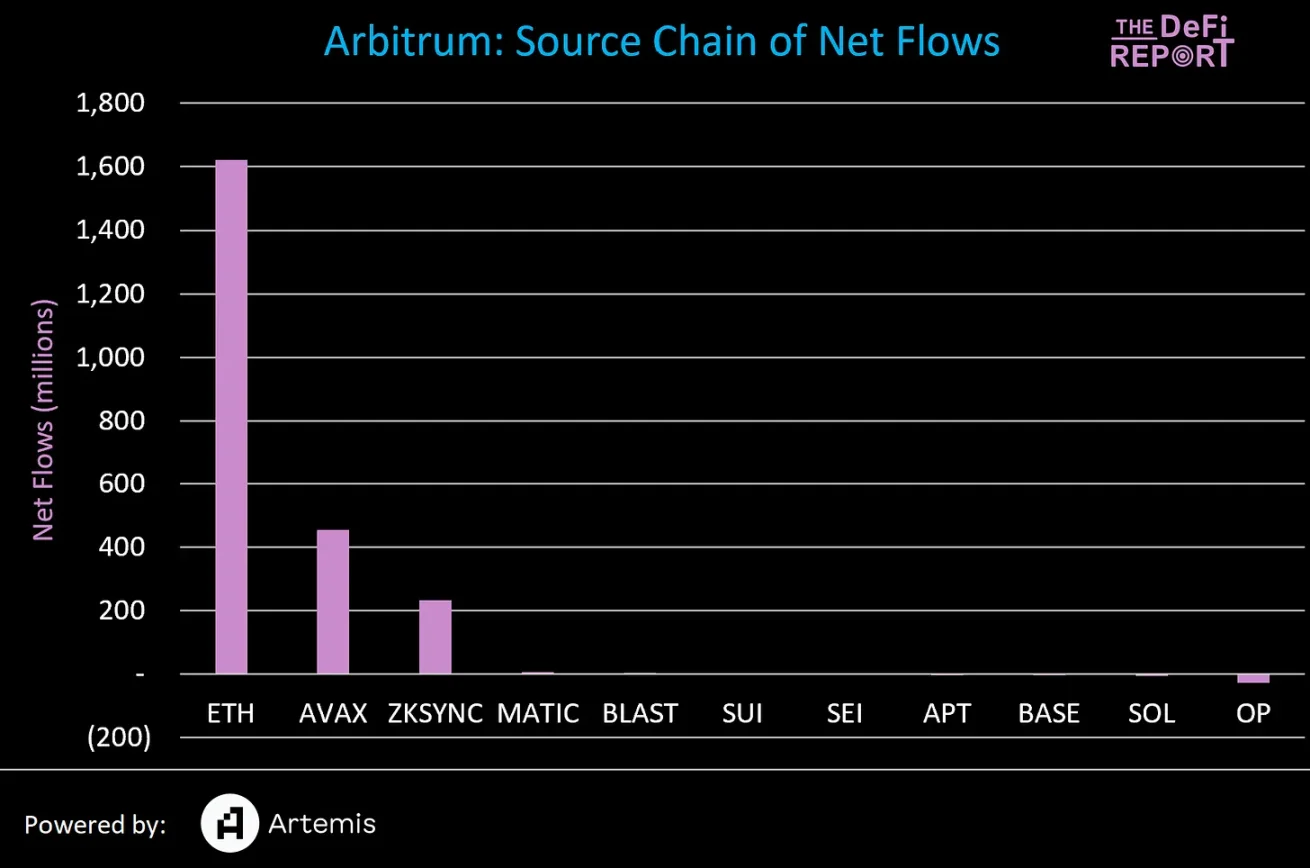
We can see that the vast majority (70%) of Arbitrum’s inflows originated from Ethereum L1. About 25% of these inflows were stablecoins, while the remaining 75% consisted of other tokens. We expect capital to continue migrating from Ethereum L1 to its most popular L2s.
Surprisingly, nearly $500 million moved from the Avalanche ecosystem to Arbitrum. Revisiting the first chart, Avalanche was one of the largest losers in the cohort, with $543 million exiting its ecosystem last quarter—84% of which went directly to Arbitrum.
Which Projects on Arbitrum Are Capturing These Inflows?
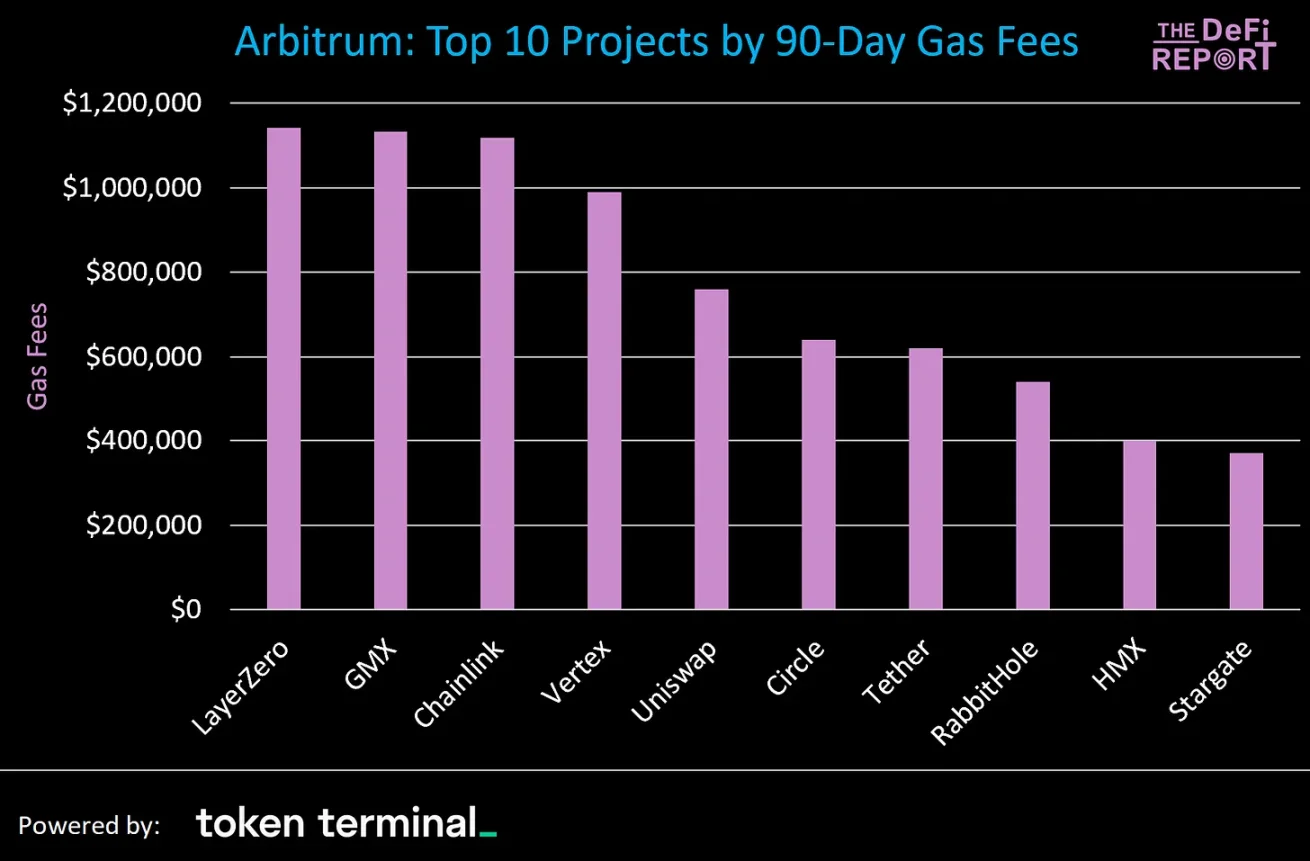
We can't definitively say which projects on Arbitrum are capturing these inflows, but the above projects consumed the most gas on Arbitrum over the past quarter.
When examining 90-day trends, RabbitHole (a gaming platform) stands out, with gas consumption increasing by 1,147% over the last quarter.
Another interesting observation about Arbitrum is that after Pyth Network—the leading oracle on Solana—launched support for Arbitrum, its gas consumption surged by 600% over the past quarter.
Blockchains With the Largest Outflows
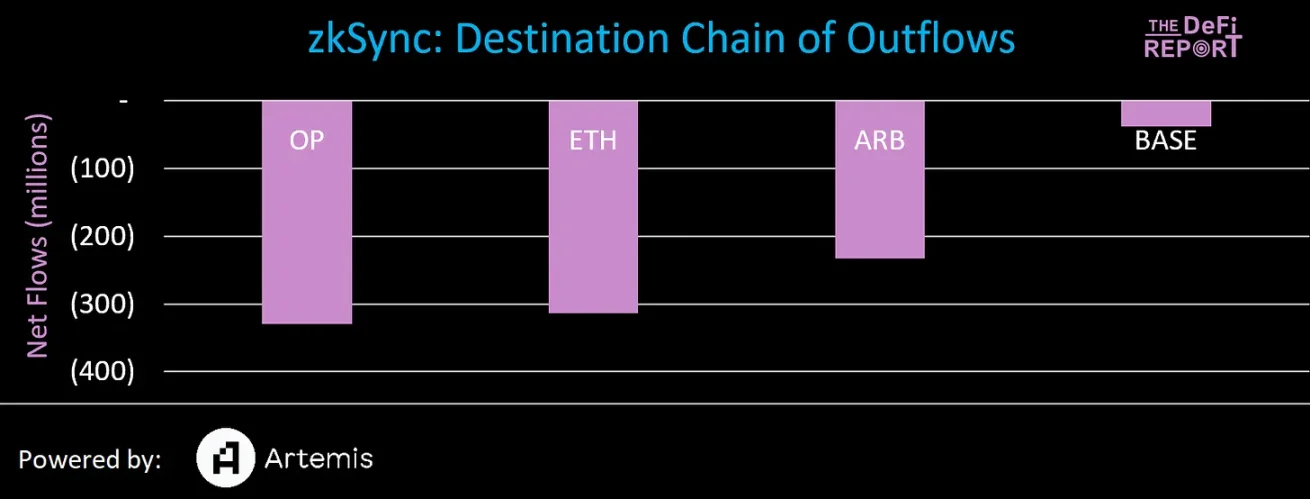
We’ve discussed Avalanche. Additionally, zkSync (an Ethereum L2) lost over $1 billion in funds over the past 90 days. Where did this money go?
-
$328 million flowed into Optimism
-
$313 million went to Ethereum
-
$232 million moved to Arbitrum
-
$37 million went to Base
Key takeaway: All funds exiting zkSync remained within the Ethereum ecosystem.
What about Ethereum? We know Arbitrum pulled $1.6 billion from Ethereum—but where did the rest go?
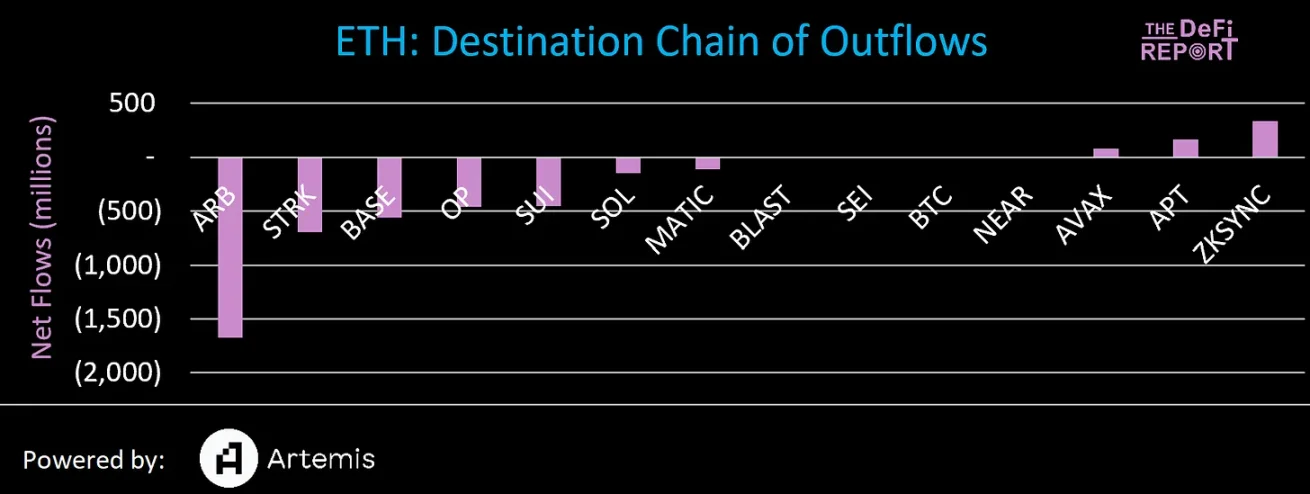
The vast majority of Ethereum’s outflows also stayed within the Ethereum ecosystem, flowing into Starknet, Base, and Optimism.
Sui was the largest non-EVM beneficiary of Ethereum outflows, receiving $452 million. Additionally, Solana received $152 million in inflows from Ethereum.
Key Takeaways
As public blockchain networks mature, we expect the volume of capital across tech stacks to rise.
We also anticipate the emergence of 3–5 dominant L1s (alongside a number of less significant L1s).
However, as cross-chain infrastructure and account abstraction mature, we expect value to flow freely across various networks and ecosystems, making durable network effects and economic moats harder to achieve.
That said, our analysis of capital flows across major L1s and L2s has yielded several key insights.
Ethereum
The largest L1 has seen substantial outflows, but it's regaining traction at the L2 level. In my view, this is positive for Ethereum. If we observed capital leaving L1 not for L2s but entirely outside the Ethereum ecosystem, that would be a red flag. To be clear, we’re not seeing that today.
Moreover, despite over $3 billion in outflows, Ethereum’s TVL still rose by 60% over the past three months. This highlights the flaws of TVL as a KPI—highly sensitive to volatile underlying asset prices and prone to manipulation.
Solana
Over the past three months, Solana recorded only $169 million in net inflows among the top 15 L1s and L2s. Yet, during the same period, Solana’s TVL grew from $1.4 billion to $4.5 billion—an increase of 221%.
How did this happen?
-
Over the past three months, SOL’s price rose from $100 to $171—a 77% increase.
-
An increasing amount of SOL has been deposited into liquid staking solutions (Marinade, Jito, BlazeStake).
-
Several projects within the Solana ecosystem launched tokens, including Jito, Pyth, Jupiter, and Tensor. These projects minted billions in new wealth, some of which remained within Solana DeFi.
-
Memecoins on Solana have been in a frenzy for months, with rising trading volumes and "value locked."
Solana’s growth in TVL is largely organic, driven internally within the ecosystem.
Sui
Sui is the biggest winner among the new generation of “high-throughput” blockchains. It attracted $423 million in net inflows, the majority coming from Ethereum. This appears to be the primary catalyst behind Sui’s TVL surge from $220 million to $660 million today.
Cross-Chain Bridges
As mentioned above, as cross-chain infrastructure matures, value movement across networks may accelerate—potentially pulling capital away from any single L1 and possibly benefiting bridges themselves. To be clear, we aren’t observing this yet, but we’re monitoring it closely.
Wormhole is one of today’s largest cross-chain bridges, enabling interoperability between Solana, Ethereum, Arbitrum, BNB, Avalanche, Optimism, Near, and Polygon. The team recently launched its token, reaching an FDV of over $10 billion at one point. This figure rivals that of Ethereum L2s, signaling strong market recognition for robust cross-chain infrastructure.
Join TechFlow official community to stay tuned
Telegram:https://t.me/TechFlowDaily
X (Twitter):https://x.com/TechFlowPost
X (Twitter) EN:https://x.com/BlockFlow_News