









What real-world use cases can EigenLayer's first batch of AVS provide?
TechFlow Selected TechFlow Selected
What real-world use cases can EigenLayer's first batch of AVS provide?
AVS is the ultimate demonstration of whether the EigenLayer protocol can truly be practical and secure.
 Navigating Web3 tides with focused insights
Author: ZHIXIONG PAN
The restaking ecosystem has finally reached two major milestones: the mainnet launch of EigenLayer (and EigenDA), and the first batch of AVSs going live on mainnet—AltLayer, Brevis, eoracle, Lagrange, Witness Chain, Xterio.
AVSs are ultimately what determine whether the EigenLayer protocol can achieve real utility and security. Previous restaking protocols (such as Renzo/Puffer) or liquid restaking tokens were merely initial steps to bootstrap liquidity within this ecosystem. Until now, growth was primarily driven by incentives attracting more ETH into the restaking ecosystem and engaging more operators. Only with AVSs can demand be unlocked, creating tangible value for crypto and decentralized networks.
The first wave of AVSs spans multiple sectors including rollup-as-a-service, oracles, ZK computation processing, DePIN, and gaming. Notably, ZK coprocessors represent a relatively new concept without mature products yet, but EigenLayer has already launched support for both Brevis and Lagrange in its initial cohort.
Additionally, EigenLayer’s mainnet launch does not mean the protocol is fully mature. Several components remain unclear, such as the future slashing mechanism for operators, economic designs ensuring AVS security, and tokenomics, all of which await further disclosures from the team.
What Is an AVS?
AVS stands for Actively Validated Services—a concept defined within the EigenLayer protocol. Simply put, AVSs can be seen as “middleware,” providing services like data and validation capabilities to end-user applications. For example, oracles aren’t end-user products themselves, but they supply critical data to DeFi, gaming, and wallets—making them a classic example of an AVS.
Downstream of an AVS is typically an end-user product, while upstream are restaking operators who contribute their staked ETH via protocols like Puffer or Renzo to support specific AVSs.
Compared to most protocols, EigenLayer’s business model is relatively straightforward: end-users pay directly or indirectly for the applications they use. Since these apps rely on AVS-provided services, revenue flows back to AVSs, node operators, the EigenLayer protocol, and users who supplied restaked ETH. Distribution models vary, and early-stage projects may leverage crypto-native advantages—such as tokenomics—to distribute native tokens as user rewards.
Therefore, for the ecosystem to become self-sustaining, more diverse AVS types must emerge, and end-user applications must come to trust the reliability of AVS services.
AltLayer: Rollup-as-a-Service
AltLayer is a Rollup-as-a-Service (RaaS) provider that enables customized deployment of Layer 2 rollup networks. Data availability (DA) is crucial for any rollup, so AltLayer supports not only Ethereum but also EigenDA, developed by EigenLayer.
Furthermore, AltLayer has partnered with EigenLayer to launch a Restaked Rollup framework, offering three modular AVSs:
-
VITAL (AVS for decentralized verification of rollup's state): An AVS enabling decentralized validation of rollup states
-
MACH (AVS for fast finality): An AVS delivering fast finality
-
SQUAD (AVS for decentralized sequencing): An AVS providing decentralized sequencing
These aim to solve three key challenges in blockchain: slow finality, centralized sequencers, and reliance on centralized settlement layers—all essential components for robust rollups. The MACH module has gone live, currently serving Xterio and Optimism.
Further reading:
https://blog.altlayer.io/altlayer-run-eigenda-operator-is-live-on-mainnet-5e1b15a0d307
Brevis: ZK Coprocessor
The concept of "ZK coprocessing" has existed for over a year, but due to limited practical applications and technical complexity, it remains poorly understood. In short, it uses zero-knowledge proof technology to enable Ethereum smart contracts to access more verifiable external data, expanding application possibilities.
Brevis offers a solution leveraging AVS to deliver ZK coprocessor functionality. Part of its team comes from Celer Network, a cross-chain bridging protocol, with Mo Dong as co-founder of both projects. He recently delivered a talk titled “A Smart ZK Coprocessor” at the Hong Kong Web3 Scholars Conference.
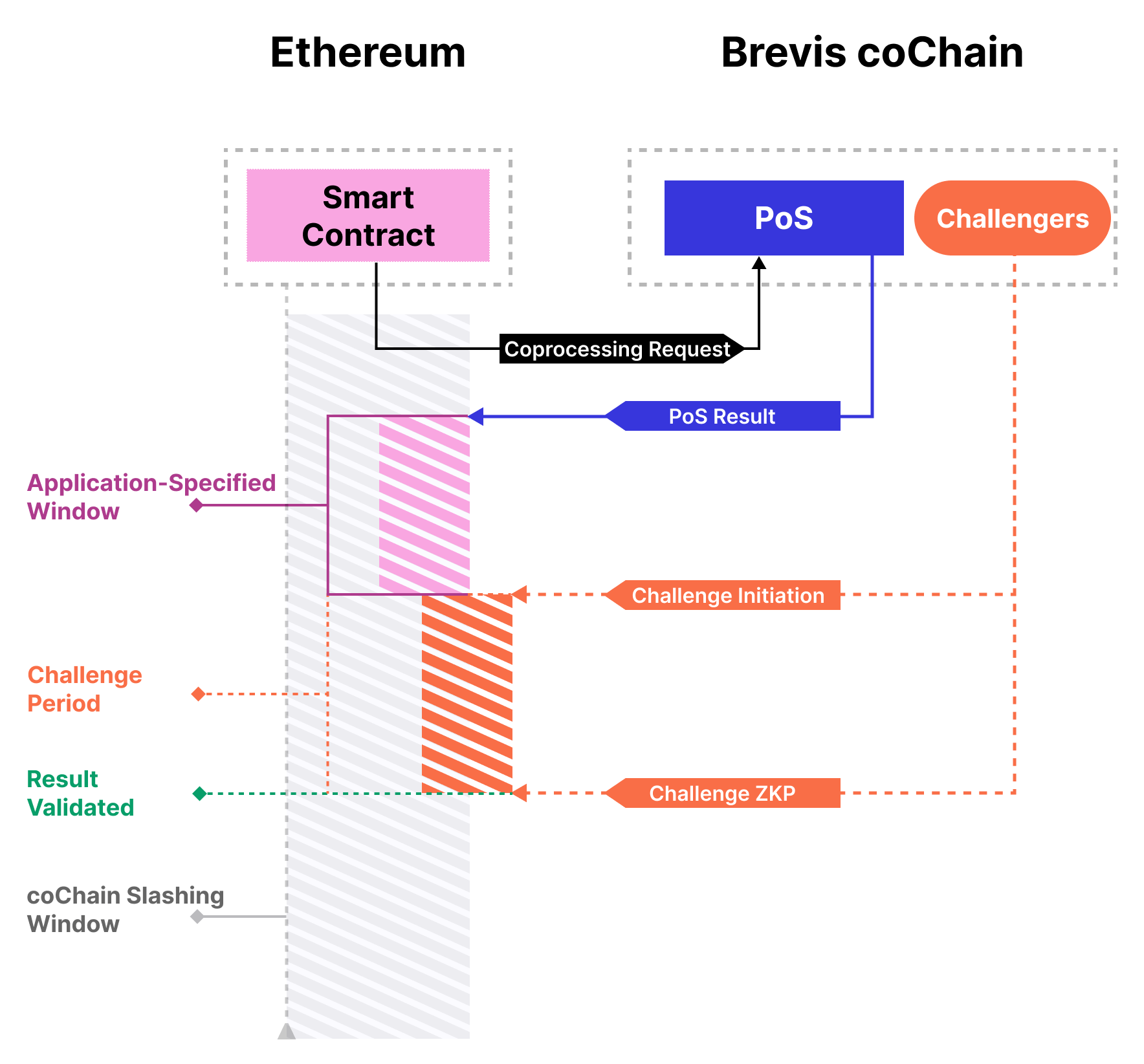
Brevis introduced the coChain solution, aiming to reduce the cost of building a full “ZK coprocessor” purely using smart contracts and ZK proofs. This provides a more cost-effective approach while unlocking previously unattainable capabilities—important given the inherent limitations of EVM.
Brevis coChain is a PoS blockchain secured by ETH staking through EigenLayer. Its design blends optimistic and ZK mechanisms—essentially combining fraud proofs and validity proofs. If malicious behavior is detected, challengers can generate ZK proofs to dispute it and penalize offenders. This involves careful game-theoretic and tokenomic considerations.
eoracle: Modular and Programmable Oracle Network
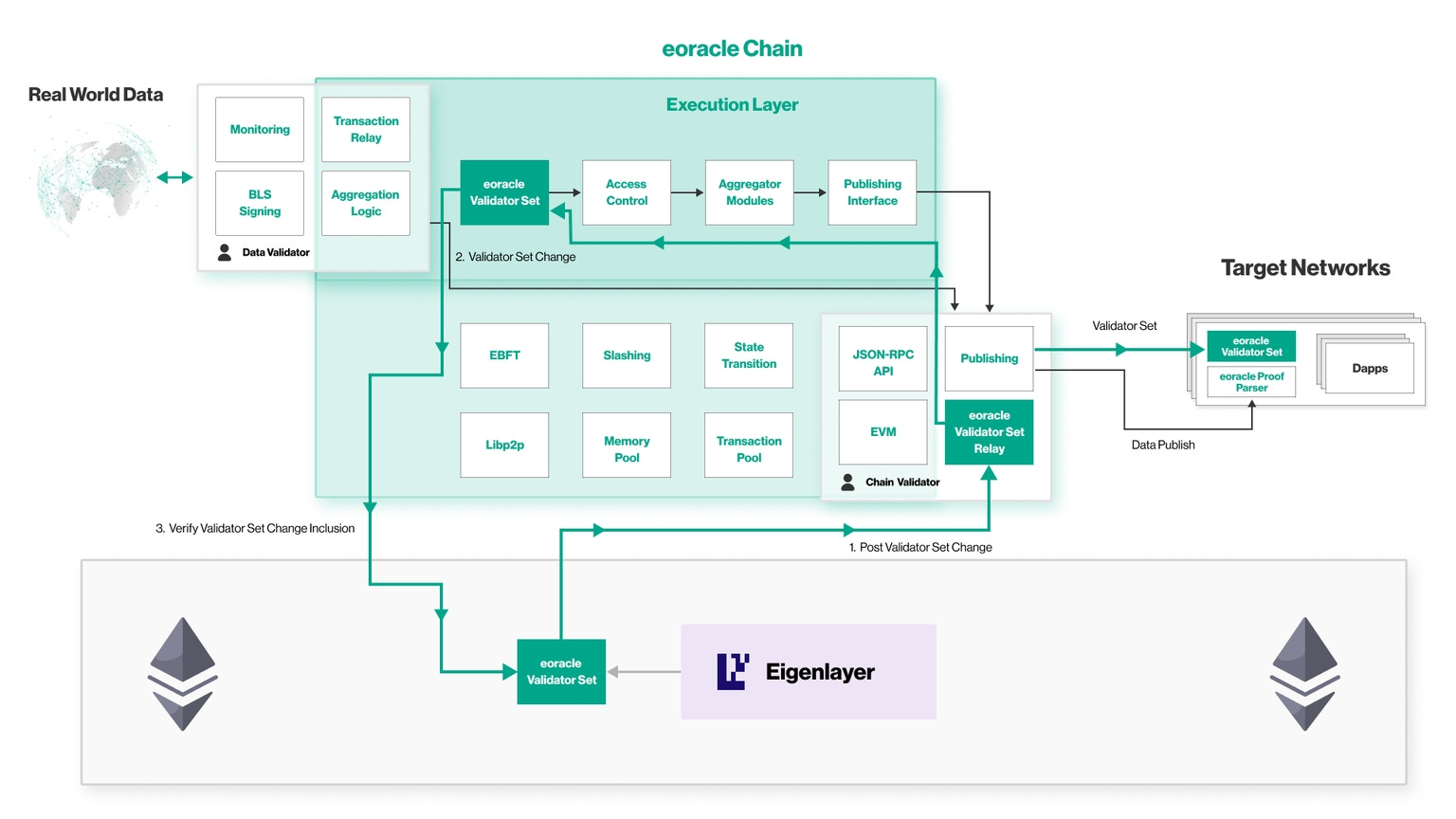
The name eoracle combines "(e)thereum" and "oracle." It calls itself the first “native” oracle on Ethereum, likely because its security relies on staked ETH, unlike Chainlink, whose security depends on its own node network and LINK token—resulting in different security assumptions.
The demand and business model for oracles are clearer than for other AVSs. Many DeFi and RWA applications require off-chain data, which oracle networks deliver through a distributed set of validating nodes.
eoracle explicitly adopts a dual-token model, a structure potentially shared by other AVSs: network security is backed by restaked ETH, while a native AVS token incentivizes node participation. Details about the native token’s functions remain undisclosed, but the team believes it will boost network engagement (via user incentives?), ensure fair value distribution (e.g., revenue sharing based on token holdings?), and promote decentralization of the eoracle protocol (possibly via governance weight or voting rights).
Further reading: https://eoracle.gitbook.io/eoracle
Lagrange: Parallel ZK Coprocessor
Lagrange is another ZK coprocessor, but emphasizes “parallel” processing. Otherwise, its service offerings are somewhat similar to Brevis.
The Lagrange team claims their ZK coprocessor natively supports parallelization and horizontal scaling, capable of efficiently generating proofs for large-scale distributed computations involving on-chain storage or transaction data. Workloads can be distributed across thousands of worker nodes simultaneously, with security guaranteed by ETH staked on EigenLayer.
Last month, Renzo, Swell, and Puffer jointly announced partnerships with Lagrange, each delegating $500 million worth of restaked ETH to support the network. In return, Lagrange has designed special features for these platforms—for instance, leveraging its ability to retrieve on-chain historical data to calculate user scores.
The name Lagrange honors the mathematician, mechanician, and astronomer Joseph-Louis Lagrange.
Further reading:
https://medium.com/@lagrangelabs/lagrange-labs-secures-1-5-f654f716277a
Witness Chain: A DePIN Network
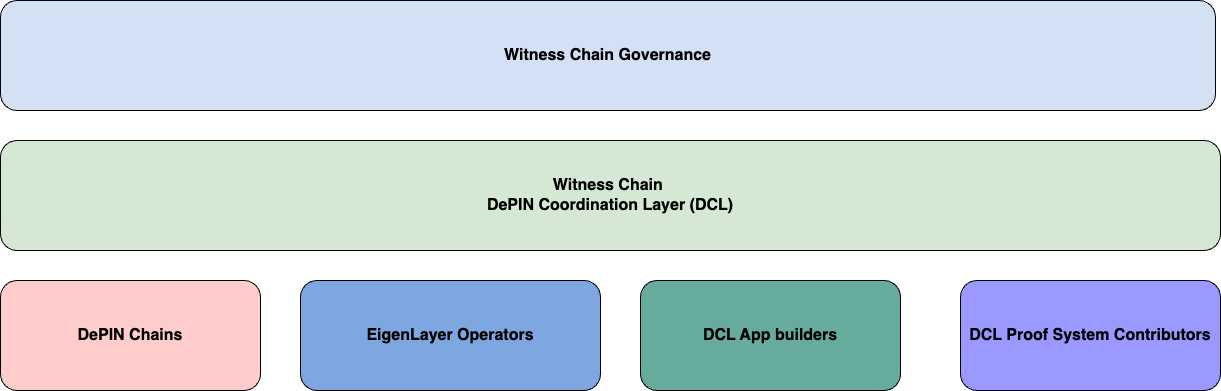
Witness Chain is a network specifically designed for decentralized IoT devices, comprising various components such as the DePIN Coordination Layer (DCL). DCL provides fundamental services required by DePIN ecosystems—including chain security, node bandwidth, and physical location verification. These basic services are referred to as Watchtowers, responsible for measuring the above metrics and generating valid proofs usable at the DCL layer. This aligns closely with the literal meaning of “witness”—to observe and attest.
Further reading: https://docs.witnesschain.com
Xterio: Gaming-Focused L2
Xterio differs slightly from the other AVSs listed above. It is actually a Layer 2 blockchain built using AltLayer’s RaaS platform, leveraging EigenDA and the OP Stack. Xterio Chain will focus on AI and Web3 gaming applications. According to AltLayer, Xterio L2 utilizes the previously mentioned MACH (AVS for fast finality). AltLayer also provides MACH services to Optimism’s mainnet.
Further reading: https://twitter.com/XterioGames/status/1775873500684636577
Outlook and Challenges
More types of AVSs will undoubtedly emerge in the EigenLayer ecosystem. However, many are concerned about the systemic risks EigenLayer introduces to the Ethereum ecosystem. By bypassing traditional smart contracts and directly leveraging Ethereum’s validator base, EigenLayer represents a fundamentally different paradigm compared to prior Ethereum-based protocols. Yet this is also the appeal of permissionless innovation—even if EigenLayer didn’t exist, others would likely pursue similar paths.
Moreover, Lido—the largest liquid staking protocol in Ethereum—controls the most staked ETH and operates numerous validators. The direct competition between EigenLayer and Lido may force Lido to reevaluate its business model and long-term sustainability. Meanwhile, EigenLayer itself still needs time to fill in missing pieces and mature its infrastructure.
Join TechFlow official community to stay tuned
Telegram:https://t.me/TechFlowDaily
X (Twitter):https://x.com/TechFlowPost
X (Twitter) EN:https://x.com/BlockFlow_News
 @ChainFeedsxyz






