








Vitalik: Degen Communism, the one true political ideology
TechFlow Selected TechFlow Selected
Vitalik: Degen Communism, the one true political ideology
The core theme of Degen communism is embracing the chaos of the market, while adjusting the rules to support public goods, limit harms, and provide exits for those who cannot bear it.
 Navigating Web3 tides with focused insights
Written by: Vitalik Buterin
Translated by: Lynn, Mars Finance
In 2024, there is a widespread belief across the Western world that all our political ideologies have become outdated and increasingly disappointing. The old ideas dominating elite political thought—whether capitalism, liberalism, progressive social democracy, or others—are rapidly falling out of favor. Capitalists are supporting tariffs. Liberals are pushing to ban lab-grown meat and actively attacking the few remaining members of their ranks who still remember that liberalism should be about freedom. Meanwhile, the world's "new authoritarians" have offered almost no attractive alternative.
Some attempt to respond to this crisis by reminding us of the virtues of civilized decorum from bygone eras, hoping we can turn back the clock. My friend Dennis Porteux exemplifies this mindset: https://twitter.com/pourteaux/status/1774592680418541747
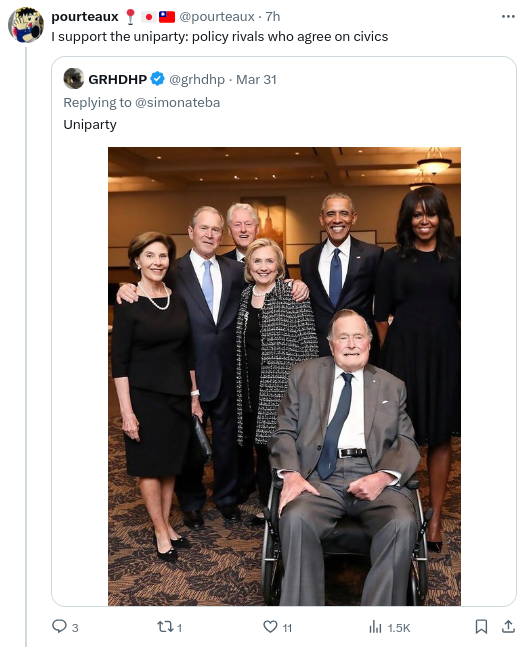
The problem is that this is fundamentally a reactionary mindset, and it fails for the same reasons that all other reactionary mindsets fail. If we were previously in political equilibrium A, and today we are in political equilibrium B, that itself strongly suggests that A was unstable—and even if you somehow force a transition back to A, the likely outcome is that we will drift back to B again.
No matter how much defenders of the old order might wish otherwise, the notions of decency and etiquette held by pre-internet conservative elites are simply incompatible with the world of the 2020s. Therefore, instead of looking backward, we should look forward. So what is the forward-looking ideology that addresses these issues? Degen communism.
What Is "Degen Communism"?

What does the internet of the 2020s— not Substack’s “decent” internet, nor a hypothetical version of Twitter where only bad actors get censored and only they get censored—but the real internet as it exists today, fundamentally want? The answer is chaos. It doesn’t want polite debates among professionals who disagree on policy but agree on civility. It wants decisive action and risk. It doesn’t want a genteel world that respects principles, where even losers accept defeat calmly because they know they might win tomorrow; it wants a world of great warriors willing to stake their entire life savings and reputations on one move reflecting their deepest convictions about what needs to be done. We want a world where brave people can freely take such risks.
At the same time, human well-being demands greater attention to the common good. We’ve seen too many epic collapses orchestrated by failed elite schemes, where ordinary people end up devastated while elites walk away unscathed—or even benefit. The 2008 financial crisis is a prime example. Rapid technological advancement and swift openness in immigration and trade have improved conditions for most, but often left those unable to adapt jobless. Fast-growing tech companies “disrupt” old extractive elites, only to quickly become extractive elites themselves. Yet most advocates of the common good tie it to extreme notions of “social stability,” which often serve as excuses for old extractive elites to stay in power—ideologies that are clumsy and misaligned with 21st-century dynamics. Just as occasional forest fires positively impact the antifragility of natural ecosystems, chaos is the mother of renewal and revitalization.
This brings me to the core idea of Degen communism: a political ideology that openly embraces chaos, but adjusts key rules and incentives to create background pressure ensuring that the consequences of chaos align with the common good.
Degen communist ideas can be adopted by any entity with network effects: crypto projects, social media sites, virtual gaming environments, and governments. Many core ideas are transferable across all these categories.
Cryptocurrency: The Degen Vanguard—Can It Become "Degen Communism"?
The cryptocurrency world is one of the most dengen-influenced social spheres. Its booms and busts are more dramatic than almost any other market. Yet, the actual impact of downturns is often less severe than it appears—this is why the space hasn't completely collapsed. A 90% price drop wipes out billions in value, but the average dollar loss is mostly paper wealth: people hold during rises and continue holding during falls. A coin that lost $100 million in an average hack was worth one-tenth as much two years prior. Sometimes, unpredictable chaos even brings benefits: many memecoins have donated large sums to charity.
But when projects suddenly fail, too many people get hurt. Can we create a world where chaos remains, but the human damage from collapse is ten times smaller? Here, I reiterate an idea I supported during the 2022 Terra/Luna crash: https://twitter.com/VitalikButerin/status/1525561624974700545
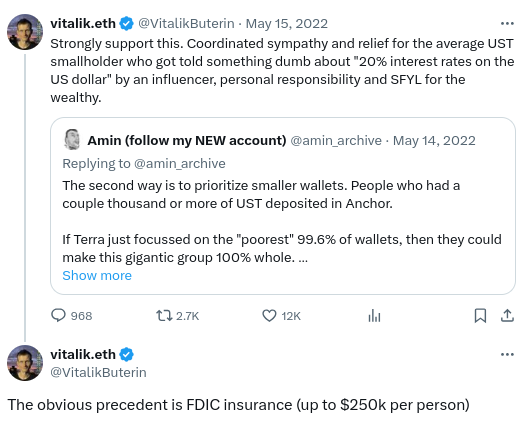
When a project collapses or gets hacked and can only return partial funds, don’t refund proportionally. Instead, fully reimburse smaller users first, up to a certain threshold (e.g., $50,000). When I proposed this idea two years ago, many dismissed it, misunderstanding it as demanding government bailouts. Today, fewer people care about principle, so even government-backed versions of this idea may now be easier to adopt. But here, I’m not proposing anything involving government; rather, I suggest project teams include in their terms of service that in case of bankruptcy, partial refunds will prioritize small users this way. The only ask of government is to pass appropriate regulations recognizing such arrangements as legally valid in bankruptcy courts.
This reduces the negative impact of chaos on the most vulnerable. How then do we better capture the benefits of chaos? On this front, I support multiple measures:
-
Memecoins and games can donate a portion of their token supply to charity.
-
Projects can use airdrops to allocate the most resources to individual users and public-benefit contributors like open-source developers and solo creators. The Starknet airdrop is a great example, as are other egalitarian airdrops like the ENS airdrop.
-
Projects can have public goods funding programs (either proactive or retroactive). The first three rounds of Optimism’s retroactive funding are a great example; more projects should follow this model.
-
If governance tokens are too centralized and the concentrated holders make bad decisions, communities should be more willing to fork the project and zero out the tokens of the centralized actors who made the wrong decision. This worked best in the Steem/Hive fork.
Many of these ideas, especially those relying on some notion of “one person, one share,” were hard to implement reliably in 2019. However, in 2024, we have increasingly powerful proof-of-personhood protocols, proof-of-participation systems (like POAP), and reusable lists (like Starkware’s list of unique stakers used for airdrops). Thus, a “Degen communist” future for crypto is entirely possible.
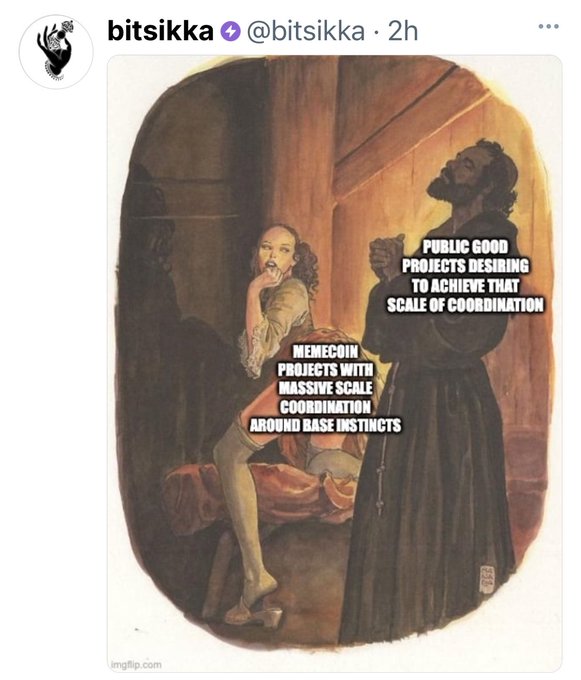
The solution is to combine both. Preserve the base instincts, especially the fundamental love of watching things blow up, but tilt them toward the common good. In exchange, those driven by base instincts gain greater legitimacy.
By the way, maybe that’s why L2s are called “bases.”
What Might "Degen Communism" Look Like in Government Policy?
In the broader world, the two main forms of chaos are social media and markets. We shouldn’t try to eliminate either form of chaos; instead, we should embrace both (especially markets) and work to align them more closely with the public interest. Politics is inherently a slower-moving domain, so these suggestions will appear ten times milder. Still, the expanded scope compensates for this.
Land Value Tax and YIMBY
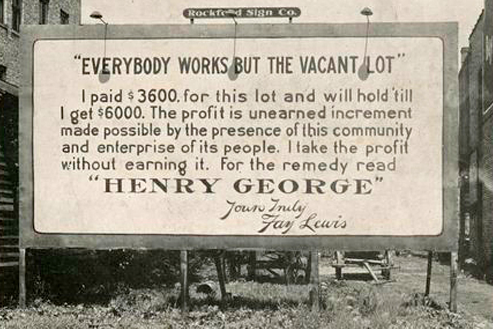
Today, real estate markets in many developed regions are in crisis. In the most expensive areas, wealthy landowners earn millions simply by holding onto properties bought decades ago at low prices. Provisions like California’s Proposition 13 mean they pay property taxes as if their lots were still valued at those much lower prices. Meanwhile, many of these individuals also push to maintain restrictive regulations that prevent denser housing construction. This is a society rigged in favor of the rich. The traditional left’s favorite countermeasure—rent control—only benefits people who have lived in one place for years, leaving newcomers struggling to find homes. At the same time, governments’ ability to raise revenue for public services is constrained: if income and sales taxes are pushed too high, people move elsewhere.
This status quo is the opposite of Degen, and the opposite of communism. Thus, Degen communists would seek to overturn every part of it. Since income and business can flee overtaxed states or countries, we should shift the tax burden away from taxing income and business and place it primarily on land, which cannot flee. A land value tax is an annual property tax levied proportionally on the value of land (but not buildings on it), widely supported by economists for over a century. We could add per-capita exemptions to limit the tax’s impact on the most vulnerable: if half the revenue from land value taxes is directly distributed as per-capita dividends, anyone owning less than half the average amount of land—i.e., nearly all poor people—would receive a net gain!
This can be seen as a market-based tax-and-dividend system, or as a rationing scheme: if you own less land than your quota, you can rent out your excess quota to those with more land and get paid for it.
Degen communists would also abolish restrictive regulations that severely limit construction on land, allowing far more building. Some places already use approaches close to this: much of East Asia, and surprisingly, Austin, Texas.
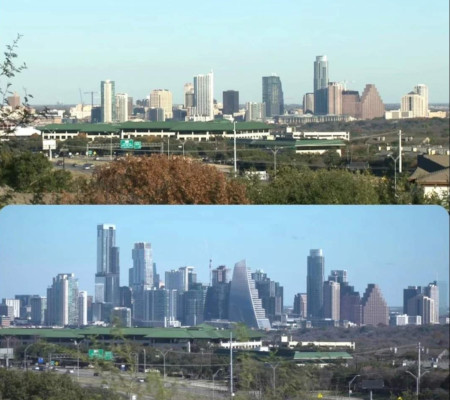
Austin has seen rapid housing supply growth and declining rents. Texas lacks a land value tax, but has high property taxes: 1.77% annually versus around 0.7% in most of California. Texas taxes the rich, but taxes land—not income. It taxes the static, not the dynamic, making it more affordable for the poor.
Today, many suffer from high prices—so let’s reduce prices where we can through simple policy adjustments (most obviously, rent).
Harberger Tax on Intellectual Property
“Intellectual property” (i.e., copyright and patents) is one of the forms of “property” most controlled by elites and one of the most vitality-killing forms of government regulation. On the other hand, many worry that fully eliminating intellectual property would excessively harm incentives for innovation and artistic creation. To strike a balance, I propose a happy middle ground: we keep copyrights and patents, but impose a Harberger tax on them.
Here’s how it works. For a copyright or patent to be valid, its owner must publicly register a value—the “exclusive price” of the copyright or patent. They must then pay an annual tax of 2% of this exclusive price (they can change the price anytime). Anyone can pay the owner the exclusive price and gain unlimited rights to use (and, if desired, sublicense globally) the copyright or patent. In all cases, the original owner retains usage rights; others can gain usage rights either through the owner’s permission or by paying the exclusive price.
This serves two purposes. First, it sets a default: if someone isn’t actively profiting by keeping an invention or work exclusive, it defaults to being publicly accessible. Second, by pricing exclusivity, it marginally leads to more permissionless access and less exclusivity. Revenue from this tax could fund citizen dividends or a secondary pool supporting nonprofit science and art.
Immigration
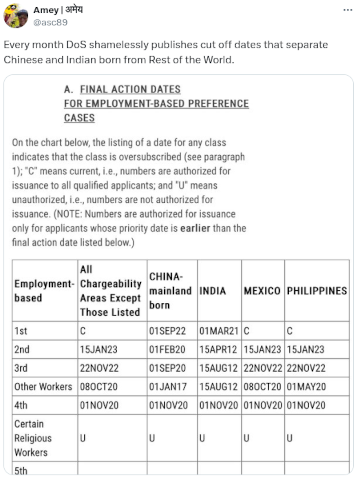

Above: Standard U.S. immigration system—backlogged and unfair. Below: Alternative U.S. immigration system—honest and fair
One of early communism’s most beautiful and profound ideas was internationalism: concern for “workers of the world unite” and songs like “The Internationale.” Unfortunately, in 2024 we live in an era of rising nationalism, where each country cares only about its own citizens and indifference to those born abroad is considered normal. Faced with these restrictions, some are taking matters into their own hands, entering wealthy countries the old-fashioned way—just as nearly everyone did before globalist control mechanisms like passports emerged about a century ago.
Degen communists will embrace dynamism and change, especially when such energy disproportionately benefits the global poor. Degen communists will greatly expand safe, legal pathways for people to travel and live where they want, trusting that liberalized housing construction and governments enriched by associated tax revenues will build the needed infrastructure. Restrictions would focus on excluding particularly high-risk individuals or bad actors, not nearly everyone. “Proof-of-stake” schemes could be used, where someone stakes money (or future invitation rights) to vouch that the person won’t violate rules, automatically granting entry. This enhances security while increasing full freedom of movement.
Decision-Making in "Degen Communism"
Decision-making in Degen communist institutions will be democratic and follow three equally important principles: dynamism, cross-tribal communication, and quality. Decisions can be made quickly via algorithms that identify common ideas across typically disagreeing groups, improving decision quality without consolidating fixed elites.
This involves a two-layer stack:
-
Public discussion and consensus-seeking platforms enabling broad participation, including mechanisms to identify points of agreement. This includes tools like pol.is and Community Notes, focusing on cross-tribal communication. It also includes prediction markets (like Polymarket), which help communities discover accurate forecasts and give intellectuals a venue to express their strongest, most passionate beliefs—and let others bet against them.
-
Final governance mechanisms (such as voting). These could use quadratic voting, but “cross-tribal bridging” features could be enhanced via matrix factorization algorithms from Community Notes or pairwise, limited quadratic voting.
Together, these tools enable fast, large-scale decision-making in a dynamic way that favors quality, allowing experts to rise quickly depending on the issue or decision at hand.
Across all these possible implementations, the core theme of Degen communism remains the same. Don’t try to enforce stagnation. Instead, embrace the chaos of markets and other fast-paced human activities. But simultaneously, adjust the rules so their benefits support public goods (including the quality of governance itself), while their downsides are contained—or even eliminated—for those who cannot bear them. This may be the way forward for everyone in the 21st century.
Join TechFlow official community to stay tuned
Telegram:https://t.me/TechFlowDaily
X (Twitter):https://x.com/TechFlowPost
X (Twitter) EN:https://x.com/BlockFlow_News
 @VitalikButerin









