SpaceX hasn’t even announced its IPO yet—have “smart money” investors already started rushing into the “space sector”?
TechFlow Selected TechFlow Selected
SpaceX hasn’t even announced its IPO yet—have “smart money” investors already started rushing into the “space sector”?
The “Five Little Dragons,” which have generally posted double-digit gains, may be a key entry point for understanding this round of commercial aerospace revaluation.
 Navigating Web3 tides with focused insights
By Frank, MSX
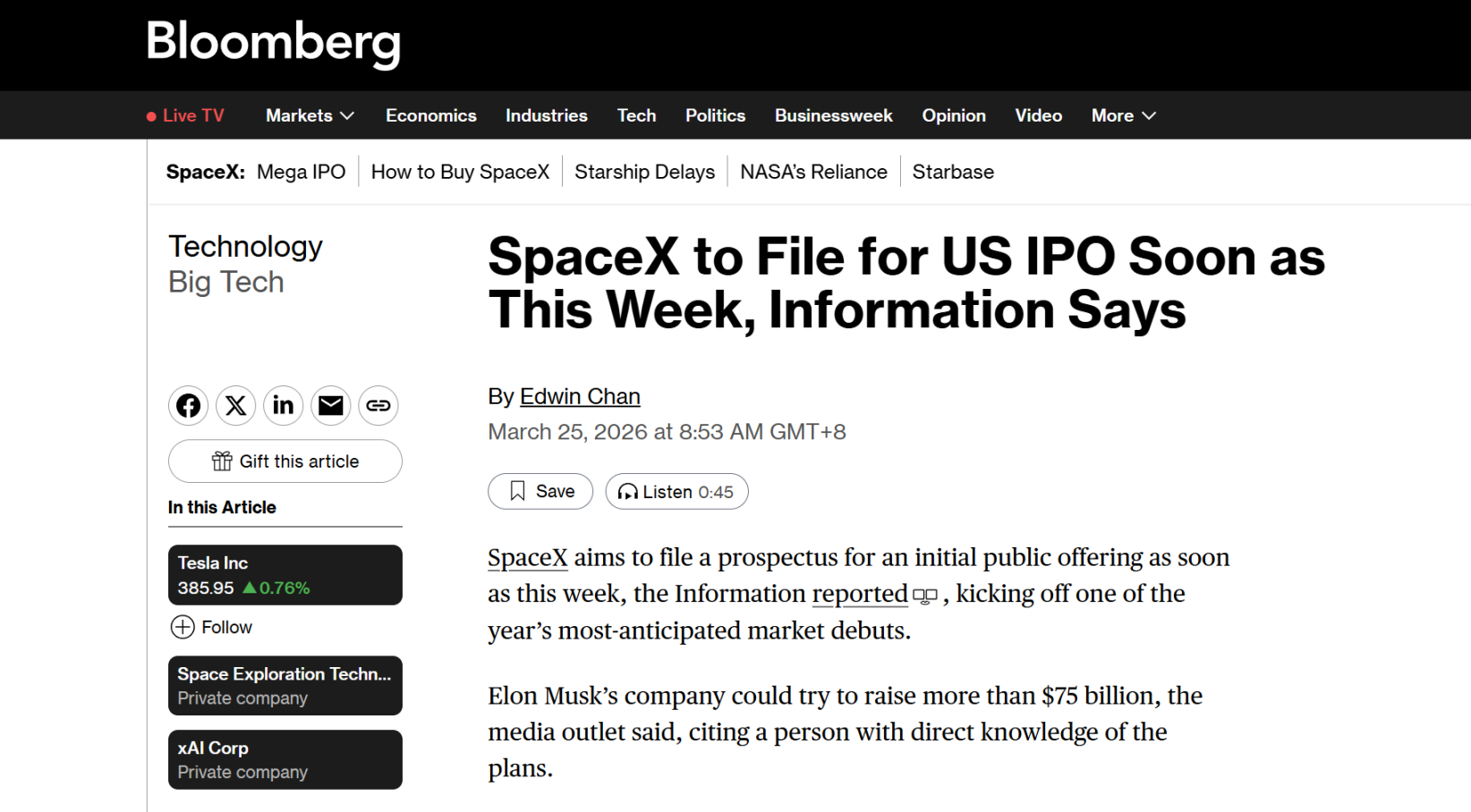
This year’s most anticipated U.S. IPO among unicorns appears to be just one step away from launch.
According to sources, SpaceX plans to confidentially file its IPO prospectus as early as this week or next, aiming for a June listing. The commercial spaceflight and space-themed sector responded immediately—indeed, just before this rally began, MSX added five commercial space-related U.S. equity tokens—MNTS.M, SIDU.M, PL.M, BKSY.M, and YSS.M—on March 23, all posting double-digit gains; several surged nearly 30% intraday, offering investors a relatively ample window for entry.
Notably, SpaceX’s fundraising target may exceed $75 billion. If realized, this would not only significantly surpass the previously rumored $50 billion goal but also dwarf Saudi Aramco’s $29.4 billion IPO in 2019—the largest IPO in history, by far.
This raises the core question this article seeks to explore: Beyond the emotional catalyst of SpaceX’s IPO rumors, what deeper structural logic underpins this rally in the commercial space sector—and does this revaluation possess the foundation to broaden further?
I. Is SpaceX’s IPO the Starting Gun for the Commercial Space Sector?
Although SpaceX remains unlisted, its influence on secondary markets has never been absent.
Understanding this requires first grasping SpaceX’s role within the broader commercial space ecosystem. It is no longer merely a rocket company—it is the foundational infrastructure provider sustaining the entire commercial space industry and serves as the strongest global “valuation anchor.” From launch capacity and Starlink communications to orbital transportation and crewed missions, each of SpaceX’s technological breakthroughs lowers costs and improves efficiency for downstream small- and medium-sized space companies.
Precisely because of this, the current rally in space stocks naturally stems first from the IPO speculation surrounding SpaceX. A $75 billion fundraising target and a potential valuation of $1.75 trillion—these two figures alone act as a powerful stimulant for the entire commercial space sector.
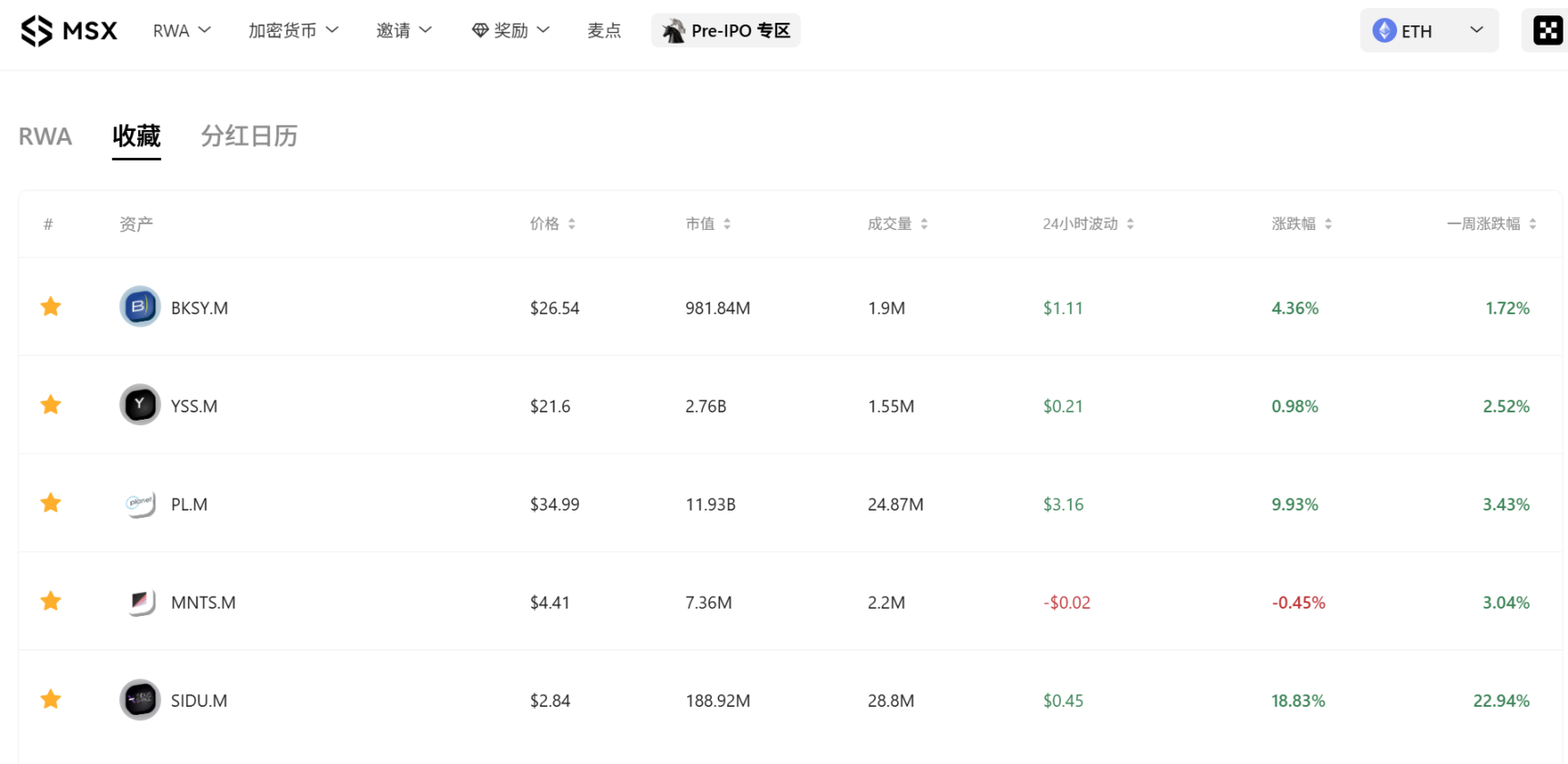
Hence, rather than a single stock rising, the entire space-themed sector warmed up in unison, exhibiting pronounced sector-wide resonance.
The clearest manifestation is MSX’s recent addition of the commercial space “Five Little Dragons”: MNTS.M, SIDU.M, PL.M, BKSY.M, and YSS.M—all backed by solid fundamentals and collectively covering several core directions across the commercial space value chain:
MNTS.M (Momentus) specializes in “last-mile” orbital transfer services for low Earth orbit (LEO). Its Vigoride vehicle is scheduled to fly aboard SpaceX’s Falcon 9 on its next mission—not just another routine launch, but rather a commercial validation. This signals that, as global satellite constellation deployment accelerates, orbital transfer demand is shifting from an “optional add-on” to a “must-have.”
SIDU.M (Sidus Space) serves as a “gateway” into the U.S. defense procurement system, having secured qualification for multiple programs under the Missile Defense Agency (MDA). For early-stage space companies, government contract eligibility is the most direct trigger for valuation re-rating—and the most stable revenue anchor outside of commercial orders.
PL.M (Planet Labs) stands out as the most fundamentally robust remote-sensing leader in this rally—and the highest-market-cap name among MSX’s five newly added U.S. equity tokens. It operates a globally covering satellite constellation, offers daily revisit capability, and runs a commercially proven data subscription model.
As such, it is one of the few space companies whose value can be discussed meaningfully using ARR and gross margin metrics. Backlog grew 79% year-on-year to nearly $900 million—and the company reported its first-ever profit. The significance of this inflection point extends far beyond a single quarterly result.
BKSY.M (BlackSky) is transitioning from a “satellite company” to an “intelligence services provider,” with its core competitive advantage rooted in a closed-loop capability combining high-frequency revisit and AI-powered analysis. For example, its third-generation (Gen-3) satellite constellation delivers commercially available imagery at 35 cm (0.35 m) resolution. Coupled with geoeconomic tensions driving intelligence demand, BlackSky is moving from selling raw data to delivering decision-support services—a positioning that commands substantially higher valuation premiums than pure remote-sensing data providers.
YSS.M (York Space Systems) is a key supplier for the U.S. Army’s Proliferated Warfighter Space Architecture (PWSA) program—backed directly by the military. Such contracts provide predictable cash flow. As a recently listed IPO candidate, institutional accumulation remains ongoing, resulting in a relatively clean shareholding structure and high upside elasticity.
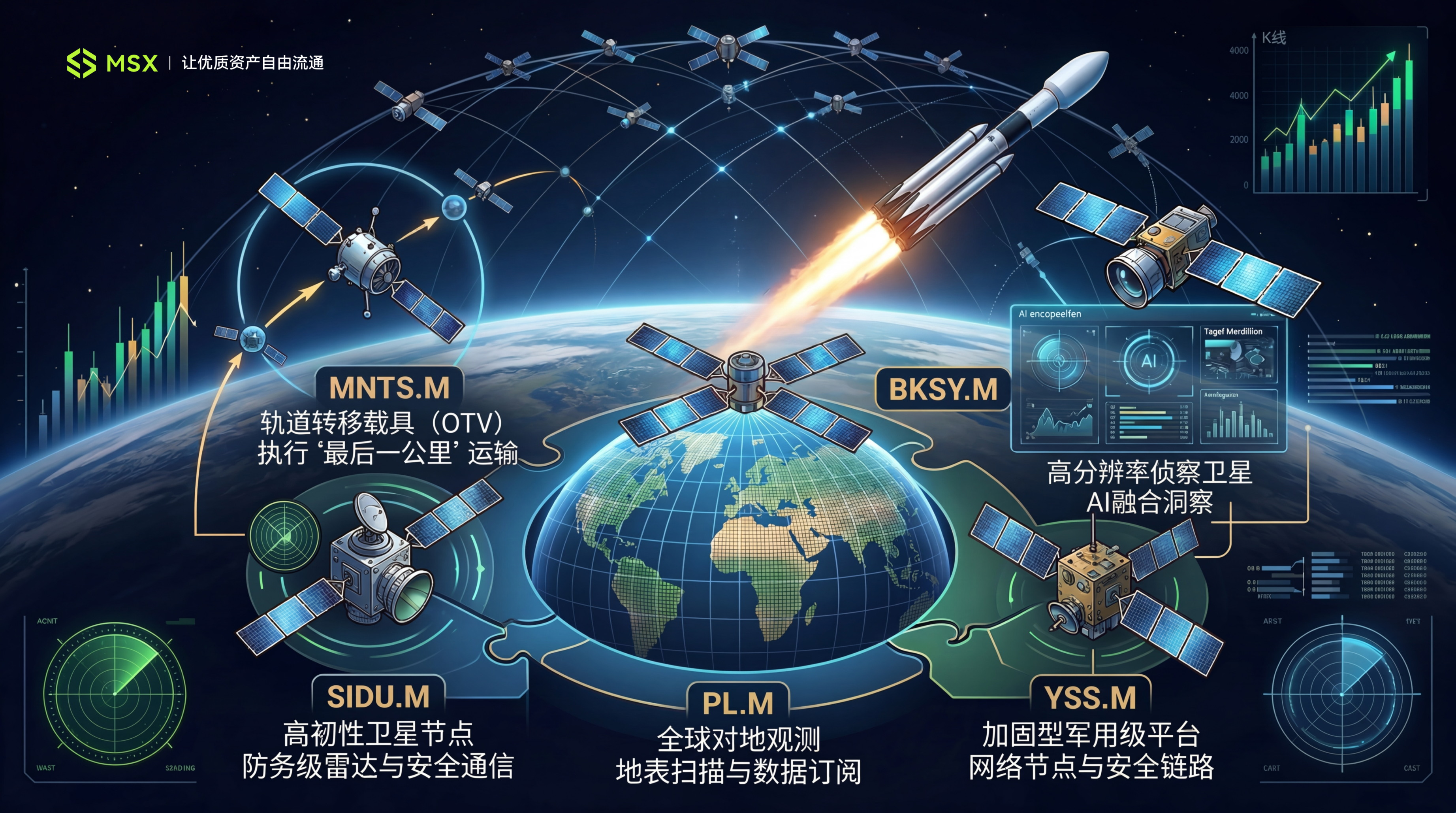
Ultimately, MSX’s timely addition of these five names was designed to cover core segments of the commercial space value chain: in-orbit transportation and mission execution; satellites and defense contracts; Earth observation and remote-sensing data; and newly listed, high-elasticity satellite platform companies.
This basket’s strategic value lies not in betting on any single event, but in proactively allocating across different beneficiaries of the broader “commercial space re-rating”—a key reason why MSX successfully captured the broad-based rally.
II. Re-rating: From “Science Fiction” to “Hard Currency”
Of course, reducing this rally solely to “news-driven sentiment” would underestimate its broader historical context.
Reviewing the rationale behind MSX’s successful pre-rally stock selection reveals that the firm did not blindly gamble on sentiment—but instead identified two pivotal signals:
- First, at last week’s NVIDIA GTC Conference, Jensen Huang announced NVIDIA’s strategic push into the space industry—including dedicated space-grade compute chips and cosmic digital twins tailored for orbital environments. This signals that AI is no longer just a terrestrial productivity tool—it is becoming the foundational architecture for autonomous satellite navigation and real-time low-orbit data processing;
- Second, on March 23, SpaceX, Tesla, and xAI jointly announced the “TERAFAB” initiative—an ambitious project leveraging AI and highly automated manufacturing to produce one terawatt of AI compute chips annually, primarily for space deployment. This effectively drew an enormous scalability multiplier for the public markets;
Based on deep analysis of these two signals, MSX’s research team decisively completed coverage of the commercial space “Five Little Dragons” on March 23 itself.
It is widely known that, for much of its history, the commercial space sector has been viewed as “unappetizing” in secondary markets—primarily because it is a capital-intensive “burn rate” game: rockets, satellites, lunar landings, deep-space exploration, Starlink—each term sounds thrilling, yet in capital markets, many firms face persistently high R&D spending, long project timelines, delayed profitability, and severe cash-flow pressure.
But this time, something is different.
Beginning in 2025, commercial space is no longer just about “launching rockets.” Instead, it is increasingly being deconstructed into a clearer, more investor-friendly real-world industrial chain. Beyond launch services, a growing number of genuinely viable, repeat-order business models are emerging:
Satellite manufacturing, in-orbit servicing, Earth observation, defense-oriented remote sensing, low-orbit communication networks, and AI-enhanced image analytics and intelligence distribution. This means the value of commercial space is no longer derived solely from distant future visions—but increasingly from verifiable orders, service capabilities, and demonstrable customer demand.
Looking deeper, three underlying logics are simultaneously driving this re-rating:
First, a dramatic reduction in launch costs is reshaping the industry’s economic foundation. The maturation of reusable rocket technology continues to drive down per-unit orbital access costs; and lower launch costs, in turn, reduce barriers to satellite constellation deployment, in-orbit servicing, and data commercialization.
For many small- and medium-sized commercial space firms, this means businesses previously confined to experimental validation phases are now approaching scalable deployment and breakeven viability. SpaceX itself is the foremost driver of this cost curve—and precisely for this reason, its IPO expectations exert such strong spillover effects across the entire sector.
Second, commercial space is converging with larger macro themes. Today’s strongest market narratives—AI, defense, communications, and new energy—all intersect with space infrastructure. AI demands ever-increasing volumes of high-quality data and stronger edge-sensing capabilities; defense systems increasingly rely on real-time reconnaissance, space-based communications, and distributed satellite networks; and global geopolitical competition further elevates the strategic importance of space capabilities.
When a sector begins embedding itself across multiple dominant investment narratives, it ceases to be an isolated niche concept—and instead evolves into a thematic hub attracting repeated capital allocation.
Third, the market is beginning to accept differentiated pricing within the commercial space sector. In the past, “space stocks” were uniformly treated as sentiment-driven theme assets—moving in lockstep. Now, as the industry matures, investors recognize that companies’ values reside on fundamentally different planes: some sell satellite platforms; others sell imagery data; still others sell defense contract eligibility, in-orbit service capabilities, or even the liquidity and elasticity of newly listed shares.
This reflects a transition from thematic correlation to “value-chain tiered pricing”—and once a sector reaches this stage, it often signals that it has evolved beyond short-term speculation into a domain worthy of long-term research and sustained trading.
III. What Does This Space Stock Rally Mean for Investors?
Superficially, this rally was indeed ignited by heightened expectations around SpaceX. But more profoundly, what is truly driving renewed investor commitment is commercial space’s transformation—from a long-term narrative sector into a “priceable” one with clear industrial segmentation.
This represents the fundamental shift in logic enabling capital markets to begin pricing it seriously.
Yet after the initial surge, how far the rally extends ultimately hinges on fundamentals. MSX Research believes that, following the short-term sentiment catalyst, the depth and sustainability of this rally will depend on the following key variables:
- Substantive progress in SpaceX’s IPO process: Confidentially filing the prospectus is merely step one; each subsequent milestone—roadshow, pricing, and listing—will continue fueling topic热度 and capital inflows;
- The timing of U.S. defense and space budget implementation: While incremental funding for the new fiscal year has been confirmed, the actual allocation of contracts across specific companies will unfold over the next two quarters—this will be the primary source of stock-level divergence. Companies backed by concrete contract awards will inevitably diverge in performance from those driven purely by sentiment;
- Each company’s cash reserves and financing capacity: Most early-stage space firms remain unprofitable. Market rallies often coincide with optimal windows for fundraising—so a critical signal to watch is whether management chooses to raise additional capital at elevated valuations, rather than cashing out. This is the most direct—and hardest-to-fake—indicator of insider confidence;
Of course, regardless of short-term developments, one direction is increasingly clear: SpaceX’s IPO will not mark the conclusion of this industry story—but rather, the starting point for the entire commercial space value chain entering mainstream capital markets’ field of vision.
Over the past decade, this sector’s narrative largely resided at the PowerPoint and conceptual level—capital mostly priced “imagination.” In the years ahead, however, markets will increasingly assess these companies using real revenue, executed contracts, and verifiable profitability milestones.
For investors, this represents both opportunity—and expectation.
Sector-wide resonance windows are rare—but only a select few companies will truly endure the test of time.
Join TechFlow official community to stay tuned
Telegram:https://t.me/TechFlowDaily
X (Twitter):https://x.com/TechFlowPost
X (Twitter) EN:https://x.com/BlockFlow_News